The Institutional Lens series unpacks the protocol mechanics, infrastructure decisions, and governance considerations that matter most for institutional participants in proof-of-stake networks. Each article is written for professionals operating at the intersection of traditional finance and blockchain infrastructure, including digital asset custodians, crypto-native funds, ETF issuers, treasury teams, and staking product managers.
Solana has crossed a threshold that changes how institutional participants need to think about it. Total Payment Volume on Solana surged 755% year-over-year, driven by institutional adoption and approximately $950 million in ETF inflows (Source: Ainvest). The March 2026 SEC and CFTC joint interpretation explicitly classified SOL as a digital commodity and confirmed that solo, self-custodial, custodial, and liquid staking models do not constitute securities transactions. The regulatory overhang that kept many compliance teams on the sidelines is gone.
What remains is a decision that carries more institutional weight than most teams have yet appreciated. The question is not whether to stake SOL, but how. For digital asset custodians, crypto-native funds, ETF issuers, treasury teams, and staking product managers, Solana staking for institutions is not a single product. Native staking and liquid staking are structurally different risk profiles, custody architectures, and capital management frameworks. Getting this decision right is as important as the allocation decision itself.
Learnings for Busy Readers
What this article covers:
How native and liquid staking differ structurally, not just mechanically
The risk, custody, and liquidity implications of each for institutional participants
How the current market shift across ETF approvals, LST fragmentation, and Alpenglow changes the calculus
A decision framework and due diligence checklist for institutional teams
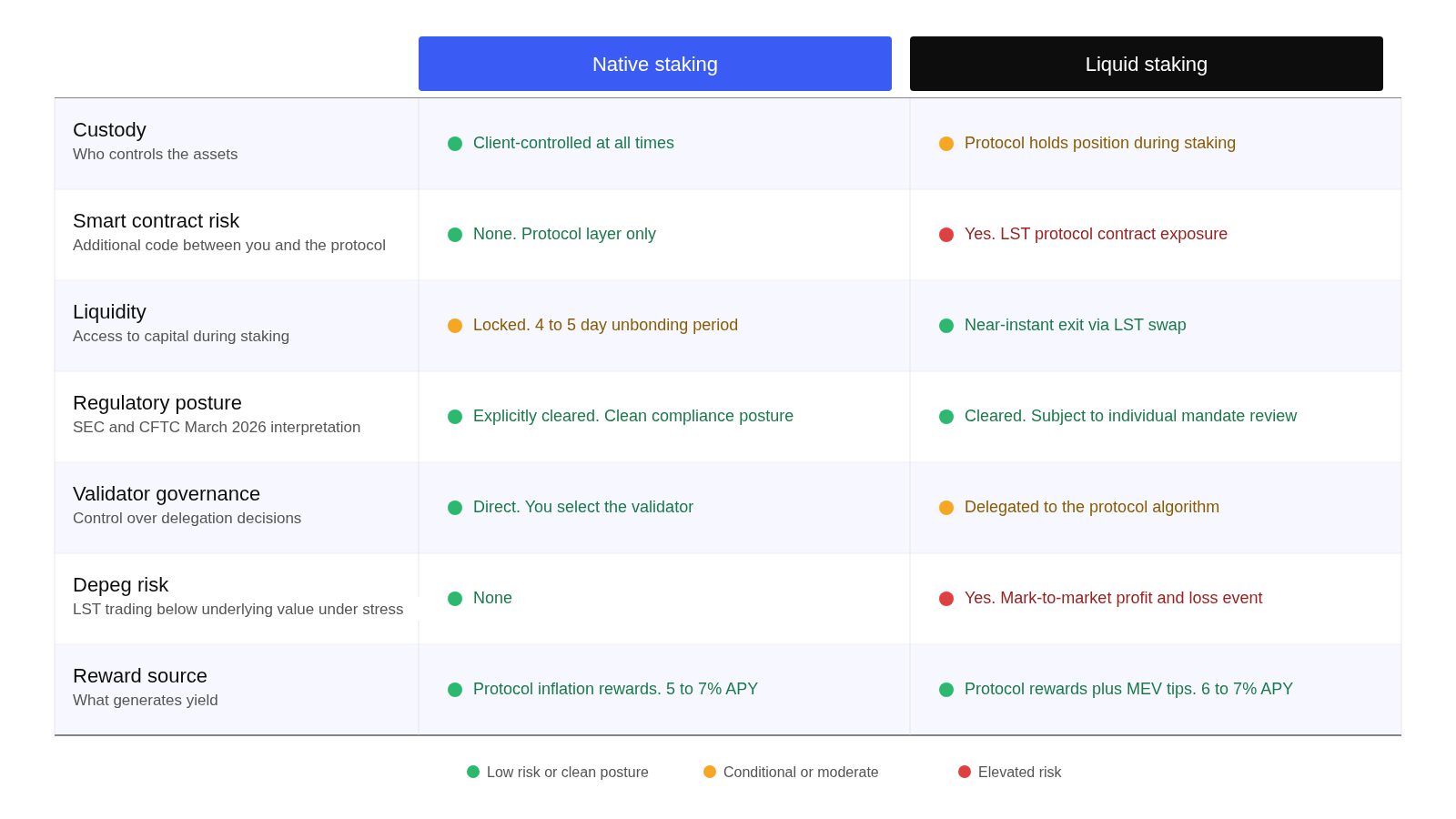
The core argument: Native staking offers full custody control, no smart contract exposure, and a clean compliance posture. Liquid staking offers capital efficiency and DeFi composability at the cost of additional risk layers. For most institutional mandates, the right answer is not one or the other. It is understanding exactly which tradeoffs your organisation is equipped to underwrite.
The Decision Is Not What Most Teams Think It Is
The most common framing of the native vs. liquid staking question in Solana staking for institutions is a yield question. Native staking currently generates 5 to 7% APY depending on validator performance and commission rates, while liquid staking tokens such as JitoSOL and JupSOL generate between 5.89% and 6.16% APY as of early 2026, with some protocols reaching higher during periods of elevated network activity (Source: Sanctum).
For retail participants, the yield differential is the dominant consideration. For institutional participants, it is rarely the right place to start. The correct framing is a risk architecture question: what risk layers is your organisation prepared to accept, and does your mandate permit them?
Native staking and liquid staking expose participants to materially different risk categories. Understanding those categories, not the APY differential, is the foundation of a defensible institutional staking framework on Solana.
Native Staking: The Institutional Baseline
In native staking, SOL is delegated directly from a client-controlled wallet to a validator. The delegator retains full custody of the private keys. The staked SOL never leaves the delegator's control. It is locked for voting weight purposes, not transferred to a third party.
What native staking provides for institutions:
Full non-custodial architecture. The validator never holds client assets. Delegation is an instruction, not a transfer. This is structurally aligned with the non-custodial infrastructure model that institutional compliance frameworks typically require.
No smart contract risk. Native staking operates at the protocol layer. There is no additional smart contract between the delegator and the network. The only code risk is Solana's base layer itself.
Clean regulatory posture. The March 2026 SEC and CFTC interpretation explicitly confirmed that self-custodial staking with a third-party validator, where the custodian acts as agent and does not determine staking amounts or fix reward rates, is not a securities transaction. Native staking maps directly to this definition.
Predictable reward mechanics. Protocol-generated rewards accrue each epoch, approximately every two days, are denominated in SOL, and compound automatically into the staked balance. Reward rates are determined entirely by network conditions.
The institutional tradeoff:
The primary constraint of native staking for institutions is liquidity. Native staking locks SOL for approximately two epochs, around four to five days, when unstaking is initiated (Source: HittinCorners). For treasury teams managing redemption obligations or funds with liquidity covenants, this is a material consideration. It is not a disqualifying one, but it needs to be accounted for in position sizing and liquidity management frameworks before capital is deployed.
The secondary consideration is validator selection. In native staking, the delegator chooses a specific validator. That choice has direct implications for reward performance, slashing risk exposure, and governance representation. It is an active decision that requires due diligence, not a passive one.
Liquid Staking: Capital Efficiency with Additional Risk Layers
In liquid staking, SOL is deposited into a staking protocol such as Jito, Marinade, or Sanctum, which delegates to a set of validators and issues a liquid staking token (LST) representing the staked position plus accrued rewards. The LST can be traded, used as collateral in DeFi protocols, or swapped back to SOL through liquidity pools.
Over $3.3 billion in SOL is liquid-staked across Jito, DoubleZero, Marinade, and Sanctum as of early 2026, representing approximately 10 to 15% of all staked SOL. The segment is growing rapidly and is increasingly the focus of institutional product development.
What liquid staking adds for institutions:
Liquidity. LSTs can be swapped back to SOL near-instantly through liquidity pools, removing the epoch lock-up constraint of native staking.
DeFi composability. LSTs can be used as collateral on lending protocols, provided as liquidity in AMM pools, or deployed in structured yield strategies. This unlocks additional reward layers on top of the base staking rate, a meaningful consideration for institutions seeking to maximise capital efficiency.
MEV distribution. Protocols like Jito pass a portion of MEV block tips to LST holders, which is why JitoSOL consistently generates a modest premium above the base native staking rate.
The institutional risk calculus:
Liquid staking for institutions introduces risk categories that native staking does not. Every institutional team evaluating LSTs needs to assess these explicitly.
Smart contract risk. The LST protocol itself is a smart contract. Vulnerabilities in that contract represent a risk to staked capital that does not exist in native staking. The relevant question is not whether a protocol has been audited, as most have been, but whether your mandate permits smart contract exposure at all, and whether the protocol's audit history and incident record are acceptable to your risk committee.
LST depeg risk. Under market stress, LSTs can trade below their underlying SOL value. During periods of stress, LSTs can trade below their underlying asset value. Institutions should maintain sufficient liquidity buffers and avoid over-leveraging LST positions (Cobo). For funds with mark-to-market accounting obligations, a temporary depeg is a profit and loss event regardless of whether the underlying position eventually recovers.
Validator concentration risk. LST protocols delegate to validator sets according to their own algorithms. The delegator has no direct control over validator selection. This matters for institutions with specific governance obligations, as they are effectively delegating governance representation to the protocol's delegation strategy rather than making that decision directly.
Custody and compliance complexity. LSTs are tokens, not staking positions. Their treatment for accounting, tax reporting, and regulatory classification may differ from native staked SOL depending on jurisdiction. This is an active area of legal development and warrants specific advice for each institution.
What Is Changing Right Now and Why It Matters
Three developments in early 2026 have materially shifted the landscape for Solana staking for institutions.
The SEC and CFTC commodity ruling. The March 17 joint interpretation formally cleared all four staking models, including liquid staking, as non-securities activities. For compliance teams that had blocked LST exposure pending regulatory clarity, that barrier is now removed. The question shifts from whether an institution can participate to whether it should, and under what framework.
LST market fragmentation. JitoSOL's dominance is fracturing. Nasdaq filed a proposal in February 2026 to list the VanEck JitoSOL Solana Liquid Staking ETF, the first attempt to offer a regulated product tied directly to an LST. Galaxy Digital launched institutional SOL staking in March 2026. Hex Trust integrated JitoSOL for custodial staking, signalling that traditional custodians are beginning to treat LSTs as standard yield products. The LST landscape is maturing rapidly, but it is also becoming more complex. Institutions entering now face more protocol choices, more counterparty relationships, and more due diligence surface area than existed twelve months ago.
Alpenglow's impact on native staking economics. The Alpenglow upgrade, approved by 98% of validators and deploying in 2026, will eliminate validator voting fees entirely. The elimination of voting fees means validators keep a larger portion of their earnings, effectively making staking more profitable for both validators and delegators, particularly for smaller operators who were previously losing a higher percentage of rewards to mandatory voting costs (Source: Phemex). For institutions in native staking programs, this represents an improvement in net reward rates without any change to risk posture, a meaningful compression of the native vs. liquid yield differential.
The Institutional Decision Framework
This is not a binary choice. Many institutional programs will run both: native staking for their core, compliance-sensitive position, and a controlled LST allocation where the mandate permits and the risk framework supports it. The relevant questions for each component are the following.
For native Solana staking for institutions:
Is your custody architecture non-custodial and client-controlled? Have you conducted due diligence on your validator's infrastructure, incident history, and governance posture? Is your liquidity management framework designed around the epoch lock-up timeline? Does your reward reporting infrastructure support validator-level attribution for accounting and audit purposes?
For liquid staking as an institutional layer:
Does your mandate permit smart contract exposure, and has legal confirmed the applicable standard? Has your risk committee reviewed the specific protocol's audit history, slashing incident record, and depeg history? Does your accounting framework have a defined treatment for LST mark-to-market movements? Are you clear on the tax treatment of LST rewards in each operating jurisdiction? Is the validator governance delegation of the LST protocol acceptable, given that the protocol determines it rather than you?
P2P.org's Solana staking infrastructure is built for institutional native staking with non-custodial architecture, validator-level reporting, geographically distributed infrastructure, and operational safeguards aligned with the risk posture institutional partners require. Our technical documentation provides detailed guidance on integration, reward reporting, and operational architecture for teams building or evaluating a Solana staking program.
Ready to build your Solana staking program on institutional-grade infrastructure?P2P.org provides non-custodial, validator-level Solana staking for institutions with full reward attribution and reporting built in. Explore P2P.org Solana Staking
Due Diligence Checklist
For staking product managers, risk committees, and compliance teams evaluating a Solana staking structure.
Native staking:
[ ] Custody architecture is non-custodial with client keys and client control
[ ] Validator selected based on infrastructure quality, incident history, and geographic distribution
[ ] Epoch lock-up timeline integrated into liquidity management framework
[ ] Validator-level reward reporting available in accounting-compatible format
[ ] SLA framed around operational practices, not performance guarantees
Liquid staking (additional layer):
[ ] Smart contract audit history reviewed and accepted by the risk committee
[ ] Slashing incident and depeg history reviewed for selected protocol
[ ] LST accounting treatment confirmed with legal and finance teams
[ ] Tax treatment of LST rewards confirmed per operating jurisdiction
[ ] The validator delegation strategy of the protocol is reviewed and acceptable
[ ] DeFi deployment strategy, if any, has independent risk approval
Key Takeaway
For institutional participants in Solana's proof-of-stake network, the native vs. liquid staking decision is not primarily about yield optimisation. It is about risk architecture, custody posture, and mandate alignment. Native staking provides the cleanest institutional baseline with full custody control, no smart contract exposure, and a regulatory posture that maps directly to the March 2026 SEC and CFTC interpretation. Liquid staking offers capital efficiency and composability at the cost of additional risk layers that each institution must explicitly evaluate and accept.
With Alpenglow improving native staking economics, the SEC commodity ruling removing regulatory ambiguity, and the LST market becoming more complex rather than simpler, the case for starting with a rigorous native staking foundation has never been stronger. Build the baseline correctly, then evaluate whether your mandate and risk framework support expanding from there.
Protocol-generated rewards are determined by network conditions and are variable. P2P.org does not control or set reward rates. Slashing risks are protocol-defined and client-borne. Operational safeguards are implemented to reduce slashing exposure, but do not eliminate protocol-level risk.
FAQ
What is the difference between native staking and liquid staking for Solana institutional programs?
In native staking, SOL is delegated directly from a client-controlled wallet to a validator. The delegator retains full custody at all times, and the staked SOL never leaves their control. In liquid staking, SOL is deposited into a protocol which issues a liquid staking token representing the staked position. The LST can be traded or used in DeFi, but introduces additional risk layers, including smart contract exposure and potential depeg risk that native staking does not carry.
Is liquid staking on Solana permitted under institutional mandates following the March 2026 ruling?
As of March 17, 2026, the SEC and CFTC jointly confirmed that liquid staking activities do not constitute securities transactions, provided the provider does not fix or guarantee reward amounts. This ruling removed the primary regulatory barrier that had previously caused many institutional compliance teams to restrict LST exposure. Whether a specific mandate permits LST exposure remains a question for each institution's legal and risk teams.
How does the Alpenglow upgrade affect Solana staking for institutions?
Alpenglow eliminates validator voting fees, which had previously represented a meaningful operating cost, reducing net rewards for both validators and delegators. When deployed in 2026, it improves the net reward rate of native staking programs without changing their risk posture. This compresses the yield differential between native and liquid staking, making native staking more competitive for institutions where the additional risk layers of LSTs are not warranted by the mandate.
What is the unstaking timeline for institutional native SOL staking?
Native SOL staking has an unstaking period of approximately two epochs, or around four to five days under normal network conditions. This lock-up period is a material liquidity consideration for institutional programs and should be integrated into position sizing and liquidity management frameworks before capital is deployed.
How should institutions account for liquid staking tokens?
LSTs are tokens representing staked positions and accrued rewards. Their accounting treatment, particularly for mark-to-market movements, reward recognition, and tax treatment, may differ from native staked SOL depending on jurisdiction and applicable accounting standards. Institutions should obtain specific legal and accounting guidance for their operating jurisdiction before deploying into LST positions.
What due diligence should institutions conduct on a liquid staking protocol?
Key areas include the protocol's smart contract audit history and any prior incidents, its slashing and depeg history, its validator delegation strategy and whether it aligns with governance obligations, the accounting and tax treatment of LST rewards in the relevant jurisdiction, and whether the protocol has had independent security reviews by recognised firms.
Disclaimer
This article is provided for informational purposes only and does not constitute legal, regulatory, compliance, or investment advice. Regulatory obligations may vary depending on jurisdiction and specific business activities. Readers should consult their own legal and compliance advisors regarding applicable requirements.
Subscribe to P2P-economy
Get the latest posts delivered right to your inbox
<p><strong>Series: DeFi Infrastructure for Institutions</strong><br><br><a href="http://p2p.org/?ref=p2p.org">P2P.org</a>'s content series for regulated institutions evaluating on-chain capital allocation. Each article addresses a specific infrastructure, governance, or compliance dimension that determines whether a DeFi allocation can clear institutional approval and operate within mandate.</p><p>This is the second article in the regulatory trilogy examining the external pressure making institutional-grade vault governance a requirement rather than an option. <a href="https://p2p.org/economy/mica-defi-vaults-institutional-allocators/">The first article</a> examined what MiCA means for DeFi vault operators and institutional allocators. The third article will examine how conflict-of-interest regulatory frameworks are catching up to the curator model.</p><p><em>Previously in this series: </em><a href="https://p2p.org/economy/mica-defi-vaults-institutional-allocators/"><em>What MiCA Means for DeFi Vault Operators and Institutional Allocators</em></a></p><h2 id="introduction">Introduction</h2><p>Decentralised finance was built to remove intermediaries. The Travel Rule was built to hold intermediaries to account. That tension now sits at the centre of global AML supervision for anyone operating at the intersection of regulated institutions and DeFi vault infrastructure.</p><p>The Travel Rule is not a new concept. FATF Recommendation 16 has required originator and beneficiary information to accompany qualifying financial transfers since the 1990s, first for wire transfers, then extended to virtual assets in 2019. What is new is the enforcement environment. As of December 30, 2024, the EU's Transfer of Funds Regulation enforces the Travel Rule across all crypto-asset transfers involving a CASP with no minimum threshold. The UK has been enforcing its version since September 2023. As of early 2026, 73% of countries have enacted Travel Rule legislation. FATF updated Recommendation 16 again in June 2025 to further standardise cross-border payment information requirements. The era of aspirational Travel Rule compliance is over.</p><p>For DeFi vault operators and institutional allocators, the enforcement shift creates a specific and largely unresolved compliance problem. The Travel Rule requires a named originator and a named beneficiary to accompany every qualifying transfer. DeFi vault rebalances are executed by smart contracts. Smart contracts do not have names, addresses, or date-of-birth records. The data the Travel Rule requires does not exist in the architecture that executes the transaction.</p><p>This article explains what the Travel Rule requires mechanically, why DeFi vault architecture creates a structural compliance gap, how that gap affects both operators and institutional allocators in practice, and what the infrastructure requirement looks like for closing it.</p><figure class="kg-card kg-image-card kg-card-hascaption"><img src="https://p2p.org/economy/content/images/2026/05/travel-rule-defi-vault-compliance-gap.jpg" class="kg-image" alt="A three-section diagram showing the Travel Rule compliance gap in DeFi vault rebalances. The top row shows the problem: institutional client identity held by custodian, smart contract executing a rebalance with no originator or beneficiary data generated, and on-chain settlement with the Travel Rule obligation unmet. The middle row shows the required solution: an identity mapping layer, compliant data generated at execution, and transmission to the counterparty VASP before settlement. The bottom row shows jurisdiction thresholds for the EU Transfer of Funds Regulation with no minimum threshold, the US Bank Secrecy Act at three thousand dollars, and the FATF baseline at one thousand dollars." loading="lazy" width="2000" height="1304" srcset="https://p2p.org/economy/content/images/size/w600/2026/05/travel-rule-defi-vault-compliance-gap.jpg 600w, https://p2p.org/economy/content/images/size/w1000/2026/05/travel-rule-defi-vault-compliance-gap.jpg 1000w, https://p2p.org/economy/content/images/size/w1600/2026/05/travel-rule-defi-vault-compliance-gap.jpg 1600w, https://p2p.org/economy/content/images/2026/05/travel-rule-defi-vault-compliance-gap.jpg 2240w" sizes="(min-width: 720px) 720px"><figcaption><i><em class="italic" style="white-space: pre-wrap;">The Travel Rule compliance gap in DeFi vault rebalances and the data layer required to close it.</em></i></figcaption></figure><h2 id="learnings-for-busy-readers">Learnings for Busy Readers</h2><p>Short on time? Here are the key takeaways. For the full analysis and supporting data, continue reading below.</p><p>The Travel Rule requires originator and beneficiary information, full name, account identifier, wallet address, and in higher-value transactions, physical address or date of birth, to accompany every qualifying crypto-asset transfer. In the EU, under the Transfer of Funds Regulation, this applies to every CASP-to-CASP transfer with no minimum threshold. In the US, the Bank Secrecy Act, it applies to transfers of $3,000 or more.</p><p>The compliance gap in DeFi vault architecture is architectural, not procedural. When a curator initiates a vault rebalance, the transaction is executed by a smart contract. The smart contract is not a VASP. It does not hold customer identity data. It cannot transmit originator and beneficiary information because that information does not exist in the execution layer. The entity that is a VASP, the custodian or service provider interacting with the vault on behalf of an institutional client, must generate that data from outside the protocol and attach it to the transaction before it settles.</p><p>Most vault products were not designed with this infrastructure in mind. The gap is not a minor operational adjustment. It requires a data architecture that sits above the smart contract execution layer, holds verified identity information for every institutional participant, maps that information to every vault transaction at the point of execution, and transmits it to counterparty VASPs in a format that satisfies jurisdiction-specific Travel Rule requirements.</p><p>For institutional allocators, the Travel Rule gap adds a due diligence requirement that sits entirely outside the protocol evaluation. Before initiating vault interactions through a custodian or service provider, institutions need to verify that their intermediary's Travel Rule infrastructure can generate compliant data for every vault transaction type, including rebalances initiated by smart contracts, not just for direct custody transfers.</p><h2 id="what-the-travel-rule-requires">What the Travel Rule Requires</h2><p>The Travel Rule's core requirement is straightforward: when a VASP or CASP transmits virtual assets on behalf of a customer, it must collect and transmit specific identifying information about the originator and the beneficiary to the receiving institution. That information must travel with the transfer, not reside in a separate onboarding system.</p><p>The specific data requirements vary by jurisdiction. Under the EU Transfer of Funds Regulation, which applies from December 30, 2024, with no minimum threshold, every CASP-to-CASP transfer requires the originator's full name, account or wallet identifier, and either a physical address, official personal document number, customer identification number, or date of birth, plus the beneficiary's name and account identifier. Under the US Bank Secrecy Act, the threshold is $3,000, with requirements for the originator's full name, account or wallet number, physical address, and the amount and execution date of the transfer.</p><p>FATF's updated guidance, revised at the June 2025 Plenary, reinforces that the obligation applies wherever a financial service is being provided, regardless of whether the service is characterised as decentralised. The guidance is explicit that DeFi arrangements are not outside the scope if there are natural or legal persons who control or operate a service. As of the June 2025 FATF targeted update, 99 jurisdictions are advancing Travel Rule implementation. Only 21% of 138 assessed jurisdictions are fully compliant with FATF Recommendation 15, indicating that enforcement is still developing, but the direction is unambiguous. (Source: FATF Targeted Update, June 2025; Zyphe, VASP KYC Compliance, March 2026.)</p><p>The data must travel with the transfer in real time, not in a post-settlement report. This is the operationally demanding part. It requires infrastructure that can generate, verify, and transmit identity data at the point of transaction execution, not after the fact.</p><h2 id="the-structural-compliance-gap-in-defi-vaults">The Structural Compliance Gap in DeFi Vaults</h2><p>The Travel Rule compliance gap in DeFi vault architecture is not a documentation problem. It is an architectural problem rooted in how vault transactions are initiated and executed.</p><p>In a standard vault rebalance, the curator identifies an allocation opportunity, proposes a strategy adjustment, and the vault smart contract executes the resulting transactions across one or more DeFi lending protocols. The smart contract is the execution agent. It is not a VASP. It does not hold customer identity data. It does not have a compliance function. It simply executes the instructions encoded in its logic and settles the resulting transactions on-chain.</p><p>This creates a specific Travel Rule problem with three dimensions.</p><h3 id="the-originator-identification-problem"><strong>The originator identification problem</strong></h3><p>The Travel Rule requires a named originator: the entity instructing the transfer, with verified identity data. In a vault rebalance, the instruction comes from the smart contract executing the curator's strategy. There is no named human originator in the execution layer. The custodian or service provider who originally deposited assets into the vault on behalf of the institutional client is the economic originator, but that relationship is not encoded in the transaction that the smart contract executes. Mapping the institutional client's identity data to the smart contract execution requires infrastructure that sits above the protocol layer and maintains that mapping at every transaction point.</p><h3 id="the-beneficiary-identification-problem"><strong>The beneficiary identification problem</strong></h3><p>In a vault rebalance, assets move between protocol positions, not between named individuals or institutions. When a vault reallocates from one lending market to another, the beneficiary of the transaction is a smart contract address, not a person. Under the EU TFR, CASPs must assess whether a customer owns or controls a self-hosted wallet before making assets available for transfers over €1,000. A smart contract address is not a self-hosted wallet in the traditional sense. It is a protocol address. Generating compliant beneficiary data for smart contract destinations requires a classification and verification system that most vault products were not designed to include.</p><h3 id="the-interoperability-problem"><strong>The interoperability problem</strong></h3><p>Even where a custodian has Travel Rule infrastructure for standard crypto transfers, that infrastructure may not be designed to handle the transaction types that DeFi vault rebalances generate. DeFi vault transactions can involve multiple protocols, multiple chains, wrapped assets, and liquidity pool interactions. Each of these transaction types raises specific questions about how the Travel Rule applies and how originator and beneficiary data should be structured. As of 2026, there is no universal standard for Travel Rule data transmission, though protocols like TRISA, OpenVASP, and TRUST are operating in parallel. A custodian whose Travel Rule infrastructure uses one protocol may be unable to exchange data with a counterparty using a different one.</p><blockquote><strong>The institutional digital asset space moves fast.</strong> Our subscribers get structured analysis across staking, DeFi vaults, and regulation through <em>DeFi Dispatch</em>, <em>Institutional Lens</em>, <em>DeFi Infrastructure for Institutions</em>, and<em>Legal Layer</em>. No noise. Just the signals that matter. <strong>Subscribe to the newsletter at the bottom of this page.</strong></blockquote><h2 id="how-the-gap-affects-vault-operators">How the Gap Affects Vault Operators</h2><p>For vault operators that fall within MiCA's CASP framework, or that serve clients in jurisdictions with equivalent Travel Rule obligations, the compliance gap is an operational infrastructure requirement that cannot be deferred.</p><p>The Travel Rule obligation attaches at the point where a CASP is involved in a transfer. A vault operator managing institutional assets is providing a service that places it within the CASP scope. Every vault transaction involving an institutional client's assets is a transaction that the vault operator's Travel Rule infrastructure must be able to process. That includes rebalances, protocol interactions, and position adjustments initiated by the vault's smart contract logic.</p><p>The practical requirement is a data layer that sits above the smart contract execution environment and performs three functions. First, it maintains a verified identity record for every institutional participant and maps that record to the vault addresses associated with their allocations. Second, it intercepts every transaction at the point of initiation, generates the required originator and beneficiary data from the identity record, and attaches that data to the transaction before it executes. Third, it transmits the data to counterparty VASPs in a format compatible with the applicable Travel Rule protocol and retains a timestamped record for regulatory audit purposes.</p><p>Under the EU TFR, originator and beneficiary data must be retained for five years after the end of the business relationship or transaction. That retention requirement is a data management obligation that extends well beyond the transaction itself. The vault operator's Travel Rule infrastructure must include a compliant data retention and retrieval system that can produce records on regulatory request.</p><h2 id="how-the-gap-affects-institutional-allocators">How the Gap Affects Institutional Allocators</h2><p>For institutional allocators, the Travel Rule gap creates a due diligence requirement that operates at the counterparty level rather than the protocol level.</p><p>The allocator's obligation is typically discharged through the custodian or service provider they use to interact with DeFi vault protocols. The custodian is the VASP. The custodian bears the Travel Rule obligation for transfers initiated on the allocator's behalf. But the allocator needs to verify, before initiating any vault interaction, that their custodian's Travel Rule infrastructure can handle the specific transaction types that vault interactions generate.</p><p>This verification requirement has three specific dimensions. First, the allocator needs to confirm that the custodian can generate compliant originator data for vault rebalances initiated by smart contracts, not just for direct custody transfers. The mapping of institutional identity to smart contract execution is the non-trivial part. Second, the allocator needs to confirm that the custodian can handle the vault's specific transaction types, including multi-protocol rebalances, wrapped asset interactions, and any cross-chain transactions the vault strategy involves. Third, the allocator needs to confirm that the custodian's Travel Rule protocol is interoperable with the counterparty VASPs involved in the vault's transaction flow.</p><p>For institutional allocators operating across multiple jurisdictions, the interoperability question is particularly complex. The EU applies the Travel Rule with no minimum threshold. The US applies it at $3,000. The UK applies a risk-based approach. Singapore, Hong Kong, and South Korea have their own implementations. A vault strategy that involves transactions across multiple jurisdictions requires Travel Rule infrastructure that can apply the correct data requirements for each transaction based on the jurisdictions of the parties involved.</p><p>The due diligence checklist for Travel Rule compliance is therefore not a protocol-level question. It is a custodian infrastructure question that needs to be resolved before vault interactions begin.</p><h2 id="key-takeaway">Key Takeaway</h2><p>The Travel Rule's compliance gap in DeFi vault architecture is architectural. Smart contracts do not generate originator and beneficiary data. The vault products built on top of them were not designed to produce it. And the enforcement environment, with the EU TFR applying to every CASP transfer since December 30, 2024, and 73% of countries having enacted Travel Rule legislation as of early 2026, means the gap can no longer be treated as a future compliance consideration.</p><p>For vault operators, closing the gap requires a data layer above the smart contract execution environment that maps institutional identity to vault transactions, generates compliant Travel Rule data at the point of execution, and retains records in a format that satisfies the retention and retrieval requirements of the applicable jurisdictions.</p><p>For institutional allocators, it requires a custodian due diligence process that verifies Travel Rule infrastructure at the transaction-type level, not just at the general compliance framework level. The question is not whether the custodian is Travel Rule compliant. The question is whether the custodian's Travel Rule infrastructure can handle the specific transaction types that vault interactions generate.</p><p>The infrastructure that closes both gaps is the same infrastructure that the first trilogy of this series identified as the missing governance layer: an independent data and compliance layer sitting above the execution environment, operating at the transaction level, independently of the smart contracts executing the strategy.</p><p><em>Next in this series: How Conflict-of-Interest Regulatory Frameworks Are Catching Up to the Curator Model</em></p><h2 id="frequently-asked-questions">Frequently Asked Questions</h2><h3 id="what-is-the-travel-rule-and-why-does-it-apply-to-defi-vault-operators"><strong>What is the Travel Rule, and why does it apply to DeFi vault operators?</strong></h3><p>The Travel Rule, based on FATF Recommendation 16, requires VASPs and CASPs to collect and transmit originator and beneficiary information alongside qualifying virtual asset transfers. It applies to vault operators because any entity providing crypto-asset portfolio management services to clients is providing a service that falls within the VASP or CASP scope under the applicable jurisdiction's definition. The obligation attaches at the service provider level, not the protocol level. The DeFi protocols the vault operator uses to execute transactions may not be regulated, but the vault operator managing institutional assets through those protocols is.</p><h3 id="what-data-does-the-travel-rule-require-to-accompany-a-crypto-asset-transfer"><strong>What data does the Travel Rule require to accompany a crypto-asset transfer?</strong></h3><p>Under the EU Transfer of Funds Regulation, which applies to all CASP-to-CASP transfers with no minimum threshold since December 30, 2024, the required data includes the originator's full name, account or wallet identifier, and either a physical address, official personal document number, customer identification number, or date of birth, plus the beneficiary's name and account identifier. Under the US Bank Secrecy Act, the threshold is $3,000, with requirements for the originator's full name, account or wallet number, and physical address. FATF's June 2025 update further standardised cross-border requirements, with national implementation timelines varying by jurisdiction.</p><h3 id="why-is-generating-travel-rule-data-for-defi-vault-rebalances-technically-difficult"><strong>Why is generating Travel Rule data for DeFi vault rebalances technically difficult?</strong></h3><p>Vault rebalances are executed by smart contracts, not by named human originators. The smart contract is not a VASP and does not hold customer identity data. Generating compliant Travel Rule data requires a separate data layer that maintains verified identity records for every institutional participant, maps those records to the vault addresses associated with their allocations, and intercepts every transaction at the point of initiation to attach the required originator and beneficiary data before the transaction executes. The beneficiary identification problem is equally challenging, as the beneficiary of a rebalance transaction is typically a protocol address rather than a named individual or institution.</p><h3 id="what-does-travel-rule-interoperability-mean-and-why-does-it-matter-for-vault-operators"><strong>What does Travel Rule interoperability mean, and why does it matter for vault operators?</strong></h3><p>Travel Rule interoperability refers to the ability of different VASPs' Travel Rule systems to exchange originator and beneficiary data with each other. Multiple competing protocols currently handle this data exchange, including TRISA, OpenVASP, and TRUST, and they are not universally compatible. A vault operator whose infrastructure uses one protocol may be unable to exchange data with a counterparty using a different one. For vault operators handling multi-protocol, multi-chain transactions, interoperability gaps can create compliance failures at specific transaction points even where the underlying data infrastructure is otherwise compliant.</p><h3 id="what-should-institutional-allocators-verify-about-their-custodians-travel-rule-infrastructure-before-initiating-vault-interactions"><strong>What should institutional allocators verify about their custodian's Travel Rule infrastructure before initiating vault interactions?</strong></h3><p>Allocators should verify three things. First, the custodian can generate compliant originator data for vault rebalances initiated by smart contracts, not just for direct custody transfers. Second, the custodian's infrastructure can handle the specific transaction types involved in the vault strategy, including multi-protocol rebalances, wrapped asset interactions, and any cross-chain transactions. Third, the custodian's Travel Rule protocol is interoperable with the counterparty VASPs involved in the vault's transaction flow. These are infrastructure questions that need to be resolved before vault interactions begin, not after the first transaction fails a compliance check.</p><hr><p><a href="http://p2p.org/?ref=p2p.org"><em>P2P.org</em></a><em> builds the protection layer that sits between regulated institutions and DeFi execution environments, independently of the curators who manage allocation strategies. If you are evaluating the infrastructure requirements for a DeFi allocation program, </em><a href="https://p2p.org/?ref=p2p.org#form"><em>talk to our team</em></a><em>.</em></p><p><strong><em>Disclaimer</em></strong></p><p>This article is provided for informational purposes only and does not constitute legal, regulatory, compliance, or investment advice. Regulatory obligations may vary depending on jurisdiction and specific business activities. Readers should consult their own legal and compliance advisors regarding applicable requirements.</p>
<h2 id="series-hub-institutional-staking"><strong>Series: Hub | Institutional Staking</strong></h2><p>The Institutional Staking Hub is <a href="http://p2p.org/?ref=p2p.org">P2P.org</a>'s definitive reference for institutions building proof-of-stake programs. From foundational concepts to infrastructure selection and risk architecture, each article addresses a specific operational or technical dimension that determines how a staking program performs in practice.</p><p>This is article 2 in the series. Read the foundation first: <a href="https://p2p.org/economy/what-is-institutional-staking/">What Is Institutional Staking? A Complete Guide for Funds, Custodians, and Treasury Teams</a></p><h2 id="learnings-for-busy-readers">Learnings for Busy Readers</h2><p>What this article covers:</p><ul><li>What validator infrastructure is and what it actually does at the network level</li><li>The difference between self-operated and delegated validator models</li><li>The technical components that determine whether infrastructure is institutional-grade</li><li>How key management architecture affects custody, risk, and compliance</li><li>What client diversity means and why it matters for operational resilience</li><li>How DVT changes the risk architecture of validator operations</li><li>The metrics and certifications that define institutional-grade validator providers</li><li>A due diligence checklist for evaluating validator infrastructure</li></ul><p>The core argument: Validator infrastructure is not a commodity. The operational decisions made at the infrastructure layer determine uptime, slashing exposure, reward outcomes, and compliance posture. Institutions that treat validator selection as a risk management decision consistently achieve better outcomes than those that treat it as a cost optimisation exercise.</p><h2 id="introduction">Introduction</h2><p>Most institutional conversations about staking start with reward rates. They should start with infrastructure.</p><p>Validator infrastructure is the operational layer that sits between an institution's capital and the proof-of-stake protocol it is participating in. It determines whether consensus participation is reliable or fragile, whether slashing exposure is managed or assumed, and whether the reporting an institution needs for accounting, audit, and compliance can actually be produced.</p><p>Major progress in validator infrastructure, institutional custody, multi-chain staking frameworks, and enterprise-grade reporting has made staking operationally viable at scale. For large asset managers, including pension funds, endowments, and conservative allocators, the legal uncertainty and operational risk that kept them on the sidelines are now falling away (Source: <a href="https://coinshares.com/us/insights/knowledge/institutional-staking-on-the-rise/?ref=p2p.org">CoinShares</a>).</p><p>But operational viability is not the same as operational quality. As institutions move from evaluation to deployment, the question changes from whether staking is viable to whether the infrastructure underpinning a specific staking program meets institutional standards. This article answers that question from the ground up.</p><h2 id="what-validator-infrastructure-is">What Validator Infrastructure Is</h2><p>In a proof-of-stake network, validators are the entities responsible for proposing and attesting to new blocks. They do not just hold staked capital. They run software, maintain network connections, sign messages, and participate in consensus rounds continuously. When a validator goes offline, misses attestations, or double-signs a message, the protocol responds with penalties. When a validator performs correctly, the protocol distributes rewards.</p><p>Validator infrastructure is everything that makes that participation happen reliably: the hardware or cloud architecture the validator software runs on, the key management system that controls signing credentials, the monitoring stack that detects and responds to anomalies, the client software that communicates with the network, and the reporting layer that captures everything for downstream use.</p><p>Ethereum supports over 1.1 million active validators in 2026, with average validator uptime near 99.2% across the network (Source: <a href="https://coinlaw.io/cryptocurrency-staking-statistics/?ref=p2p.org">CoinLaw</a>). That network average conceals significant variance between operators. In enterprise IT, Service Level Agreements (SLAs) define the expected uptime and reliability of a service provider. The blockchain space is increasingly moving in the same direction, especially as institutions explore staking as part of their portfolio strategy.</p><h2 id="self-operated-vs-delegated-validator-models">Self-Operated vs. Delegated Validator Models</h2><p>Institutions entering proof-of-stake networks have two structural choices for how they participate at the infrastructure layer.</p><h3 id="self-operated-validators"><strong>Self-operated validators</strong></h3><p>An institution builds and operates its own validator nodes. It controls the infrastructure, manages the keys, handles software updates, and monitors performance directly. This model gives maximum control and governance participation, but it carries the full operational burden. The institution must maintain the specialised engineering capability, 24/7 monitoring, incident response processes, and protocol expertise required to operate validators safely at scale.</p><p>Rather than hiring experts, provisioning hardware or cloud infrastructure, and securing forensic-grade security, institutions using a managed service can get their staking strategy up and running in weeks or less. The inverse is equally true: institutions that choose self-operation must be prepared to build all of that capability in-house.</p><h3 id="delegated-validator-infrastructure-staking-as-a-service"><strong>Delegated validator infrastructure (staking-as-a-service)</strong></h3><p>An institution delegates its capital to a professional validator operator. The institution retains custody of its assets at all times. The provider operates the infrastructure, manages keys, monitors performance, handles upgrades, and delivers reporting. This is the dominant model for institutional participation, as it removes the operational burden while preserving custody control.</p><p>The critical requirement in any delegated arrangement is non-custody. In a correctly structured staking-as-a-service model, the validator provider never holds the institution's assets. Assets are not transferred. Delegation happens at the protocol level, and the institution retains withdrawal authority.</p><h2 id="the-technical-components-of-institutional-grade-infrastructure">The Technical Components of Institutional-Grade Infrastructure</h2><p>Not all validator infrastructure is equivalent. The gap between consumer-grade and institutional-grade validator operations shows up across five technical dimensions.</p><figure class="kg-card kg-image-card kg-card-hascaption"><img src="https://p2p.org/economy/content/images/2026/05/_p2p-validator-infrastructure-stack-institutional.jpg" class="kg-image" alt="A four-layer vertical diagram showing the institutional validator infrastructure stack: Protocol Layer at the base, followed by Infrastructure Layer, Key Management Layer, and Reporting Layer at the top, each labelled with its primary function." loading="lazy" width="2000" height="1304" srcset="https://p2p.org/economy/content/images/size/w600/2026/05/_p2p-validator-infrastructure-stack-institutional.jpg 600w, https://p2p.org/economy/content/images/size/w1000/2026/05/_p2p-validator-infrastructure-stack-institutional.jpg 1000w, https://p2p.org/economy/content/images/size/w1600/2026/05/_p2p-validator-infrastructure-stack-institutional.jpg 1600w, https://p2p.org/economy/content/images/2026/05/_p2p-validator-infrastructure-stack-institutional.jpg 2240w" sizes="(min-width: 720px) 720px"><figcaption><i><em class="italic" style="white-space: pre-wrap;">The institutional validator infrastructure stack. Four layers from protocol to reporting, showing how each layer contributes to uptime, security, and compliance.</em></i></figcaption></figure><h3 id="hardware-and-network-architecture"><strong>Hardware and network architecture</strong></h3><p>Institutional validators operate on dedicated hardware rather than shared cloud infrastructure, with redundant power, connectivity, and compute. Professional validators target near-perfect uptime backed by strict SLAs. They utilise low-latency bare-metal hardware, high-throughput connectivity, and optimised client diversity to prevent network-wide bugs from causing local outages. Geographic distribution across multiple data centres reduces single-point-of-failure risk. Active/passive failover mechanisms ensure consensus participation continues through hardware or connectivity incidents.</p><h3 id="key-management-architecture"><strong>Key management architecture</strong></h3><p>Validator keys are the most sensitive operational asset in a staking program. There are two key types relevant to institutional operations: the signing key, used to participate in consensus, and the withdrawal key, used to access staked capital and rewards.</p><p>In an institutional non-custodial arrangement, the institution retains the withdrawal key at all times. The validator operator manages the signing key through a key management system designed to prevent the signing key from being exposed, duplicated, or used in ways that would trigger double-signing penalties. Hardware security modules, remote signing services, and key sharding approaches are all architectural choices at this layer.</p><h3 id="client-diversity"><strong>Client diversity</strong></h3><p>Every proof-of-stake network runs on consensus client software. On Ethereum, multiple independent client implementations exist, including Prysm, Lighthouse, Teku, Nimbus, and Lodestar on the consensus layer. The risk of running a single client in concentration is significant. The Prysm outage in December 2025, where validator participation dropped to approximately 75% and 248 blocks were missed, vividly demonstrated the risk posed by stakers herding toward a single consensus client.</p><p>Institutional-grade providers operate diversified client environments. If one client has a bug or outage, validators running alternative clients continue participating normally. This is a meaningful differentiator that does not appear in uptime statistics measured under normal conditions.</p><h3 id="monitoring-and-incident-response"><strong>Monitoring and incident response</strong></h3><p>Validator infrastructure requires continuous monitoring: block proposal success rates, attestation participation, peer connectivity, signing latency, and software version currency. Institutional-grade operations maintain 24/7 monitoring with defined escalation paths and incident response procedures. To avoid slashing, validators must operate secure, redundant, and highly available infrastructure. This includes implementing slashing protection mechanisms such as remote signing, key sharding, or sentry node architectures, and continuously monitoring node health, block production, and consensus participation metrics.</p><h3 id="reporting-and-audit-infrastructure"><strong>Reporting and audit infrastructure</strong></h3><p>Institutions need validator-level reward attribution for accounting, tax reporting, and audit purposes. This requires a reporting layer that captures rewards at the epoch level, attributes them to specific delegations, and delivers data in formats compatible with institutional back-office systems. Performance data, slashing history, and governance participation records all require structured capture. This layer is frequently underspecified in evaluations focused on uptime and fee rates.</p><h2 id="what-dvt-changes-about-validator-risk-architecture">What DVT Changes About Validator Risk Architecture</h2><p>Distributed Validator Technology (DVT) is a protocol-level mechanism that distributes the validator signing function across multiple independent nodes. Rather than a single node holding and using the signing key, DVT allows a threshold of nodes to collectively produce validator signatures. No single node has access to the complete key.</p><p>For institutional operations, DVT addresses two risk categories simultaneously. First, it eliminates single-point-of-failure at the signing layer. A hardware failure, network outage, or compromise of a single node does not disable the validator or expose the signing key. Second, it structurally prevents double-signing, since generating a duplicate signature requires a threshold of nodes to act simultaneously, which does not occur under normal failure conditions.</p><p>DVT is not yet universally deployed across all proof-of-stake networks, but its adoption is accelerating on Ethereum and represents a meaningful infrastructure maturity signal when evaluating providers.</p><h2 id="reward-mechanics-at-the-infrastructure-layer">Reward Mechanics at the Infrastructure Layer</h2><p>Protocol rewards are generated by the network, not by the validator provider. What the infrastructure layer controls is how efficiently those rewards are captured.</p><p>On Ethereum, rewards come from two sources: consensus layer rewards (base staking rewards for correct block proposals and attestations) and execution layer rewards (priority fees and MEV). Base ETH staking rewards generally range from 3% to 4%, while restaking incentives can temporarily lift combined yields above 8% to 15% (Source: <a href="https://coinlaw.io/cryptocurrency-staking-statistics/?ref=p2p.org">CoinLaw</a>).</p><p>Infrastructure quality affects reward capture in measurable ways. A validator with sustained 99.9% uptime captures consensus rewards on nearly every eligible slot. A validator with 98% uptime misses roughly 1 in 50 attestation opportunities. At scale, that difference compounds into material reward outcomes across a staking program.</p><p>MEV capture is a separate infrastructure consideration. Validators connected to MEV relays receive a share of transaction ordering value from block builders. Institutional operators must evaluate the MEV relay landscape for compliance implications, since certain relay types may route transactions in ways that conflict with regulatory obligations around transaction ordering.</p><p>Network conditions determine protocol-generated rewards and are variable. <a href="http://p2p.org/?ref=p2p.org">P2P.org</a> does not control or set reward rates.</p><h2 id="the-institutional-standard-certifications-audits-and-compliance-requirements">The Institutional Standard: Certifications, Audits, and Compliance Requirements</h2><p>For institutions operating under regulatory obligations, independent validation of validator infrastructure controls matters.</p><p>SOC 2 Type II is the most relevant independent security attestation for validator infrastructure providers. Enterprise clients typically want Type II reports because they demonstrate how controls perform in real operations, not just at a point in time. A SOC 2 Type II report covering availability and security criteria provides meaningful independent assurance that the controls governing validator uptime and key management are operating as documented. It is a floor, not a ceiling, but it is a meaningful one. <a href="http://p2p.org/?ref=p2p.org">P2P.org</a> achieved SOC 2 Type II certification in December 2025, independently validating our operational controls across security and availability criteria (Source: <a href="https://p2p.org/economy/validator-due-diligence-framework-what-institutions-really-need-to-evaluate/">P2P.org</a>).</p><p>ISO 27001 certification for information security management systems is a second relevant attestation, particularly for institutions operating under MiCA in Europe or with data governance obligations. Penetration testing records, incident disclosure history, and governance participation policies round out the compliance picture.</p><p>Institutional adoption of crypto risk frameworks has climbed to 78%, with custodial spend reaching $16 billion in 2025. Risk compliance ranks as the top priority for 84% of institutions. <a href="https://coinlaw.io/bitcoin-staking-statistics/?ref=p2p.org">CoinLaw</a> Validator infrastructure sits at the centre of that risk framework for any institution running a staking program.</p><h2 id="how-to-evaluate-validator-infrastructure-a-due-diligence-framework">How to Evaluate Validator Infrastructure: A Due Diligence Framework</h2><p>For a complete evaluation process, including the specific questions to ask and the mechanisms to assess, see our Validator Playbook article: <a href="https://p2p.org/economy/validator-due-diligence-framework-what-institutions-really-need-to-evaluate/">Validator Due Diligence: An Institutional Framework</a>.</p><p>The criteria below are the foundational dimensions any institutional evaluation must cover.</p><h3 id="infrastructure-architecture"><strong>Infrastructure architecture</strong></h3><ul><li>[ ] Does the provider operate dedicated hardware or shared cloud infrastructure?</li><li>[ ] Are data centres geographically distributed with documented failover?</li><li>[ ] What is the provider's SLA for validator uptime, and what is the documented track record?</li></ul><h3 id="key-management"><strong>Key management</strong></h3><ul><li>[ ] How are signing keys managed? Remote signing, HSM, or key sharding?</li><li>[ ] Does the institution retain withdrawal key control at all times?</li><li>[ ] What is the key recovery process in the event of a provider incident?</li></ul><h3 id="client-diversity-1"><strong>Client diversity</strong></h3><ul><li>[ ] Does the provider run multiple consensus clients across its validator fleet?</li><li>[ ] What is the distribution across client types, and how is this documented?</li><li>[ ] How does the provider respond to client-specific bugs or vulnerabilities?</li></ul><h3 id="slashing-risk-controls"><strong>Slashing risk controls</strong></h3><ul><li>[ ] What slashing protection mechanisms are in place?</li><li>[ ] What is the provider's slashing history across all networks they operate on?</li><li>[ ] Is there a documented incident response process specific to slashing conditions?</li></ul><h3 id="reporting-and-compliance"><strong>Reporting and compliance</strong></h3><ul><li>[ ] Can the provider deliver validator-level reward attribution at the epoch level?</li><li>[ ] Are reports available in formats compatible with institutional accounting systems?</li><li>[ ] Does the provider hold SOC 2 Type II or equivalent independent certification?</li></ul><h3 id="network-coverage-and-governance"><strong>Network coverage and governance</strong></h3><ul><li>[ ] Which proof-of-stake networks does the provider support?</li><li>[ ] How does the provider handle protocol governance participation on behalf of delegators?</li><li>[ ] What is the process for network upgrades and client version management?</li></ul><h2 id="where-p2porg-sits-in-this-architecture">Where <a href="http://p2p.org/?ref=p2p.org">P2P.org</a> Sits in This Architecture</h2><p><a href="http://p2p.org/?ref=p2p.org">P2P.org</a> operates non-custodial validator infrastructure across more than 40 proof-of-stake networks, supporting custodians, funds, ETF issuers, and treasury teams with institutional-grade staking programs. Our infrastructure operates on dedicated hardware with geographic distribution, client diversity across consensus implementations, and SOC 2 Type II certification achieved in December 2025.</p><p>Institutions retain full custody of their assets throughout. Validator-level reward reporting is available for accounting and audit requirements. Governance participation policies are configurable per delegation.</p><p>Explore our infrastructure and supported networks at <a href="https://p2p.org/?ref=p2p.org">p2p.org</a>.</p><p>Building an institutional staking program? <a href="http://p2p.org/?ref=p2p.org">P2P.org</a> provides non-custodial validator infrastructure across 40+ proof-of-stake networks, with validator-level reporting and operational safeguards designed for institutional requirements. <a href="https://p2p.org/?ref=p2p.org">Explore P2P.org Staking Infrastructure</a></p><h2 id="key-takeaway">Key Takeaway</h2><p>Validator infrastructure is the operational foundation of every institutional staking program. It determines uptime, slashing exposure, reward capture, reporting capability, and compliance posture. The decision of which infrastructure to operate or delegate to is a risk management decision, not a cost decision.</p><p>The institutions that will operate effective staking programs at scale are those that evaluate validator infrastructure with the same rigour they apply to any other mission-critical operational dependency. The checklist above is a starting point. The standard is set by the protocol and by the expectations of the risk committees, custodians, and regulators that govern institutional capital.</p><p>Network conditions determine protocol-generated rewards and are variable. <a href="http://p2p.org/?ref=p2p.org">P2P.org</a> does not control or set reward rates. Slashing risks are protocol-defined and client-borne. Operational safeguards are implemented to reduce slashing exposure but do not eliminate protocol-level risk.</p><h2 id="frequently-asked-questions">Frequently Asked Questions</h2><h3 id="what-is-validator-infrastructure-in-proof-of-stake-networks"><strong>What is validator infrastructure in proof-of-stake networks?</strong></h3><p>Validator infrastructure is the technical stack that enables participation in proof-of-stake consensus. It includes the hardware or cloud architecture the validator software runs on, the key management system that controls signing credentials, the monitoring and incident response stack, the consensus client software, and the reporting layer that captures performance and reward data. Validator infrastructure determines uptime, slashing exposure, reward capture, and compliance posture for any staking program.</p><h3 id="what-is-the-difference-between-self-operated-and-delegated-validator-infrastructure"><strong>What is the difference between self-operated and delegated validator infrastructure?</strong></h3><p>In a self-operated model, the institution builds and runs its own validator nodes, retaining full control but carrying the full operational burden, including specialised engineering, 24/7 monitoring, and protocol expertise. In a delegated model (staking-as-a-service), a professional validator provider operates the infrastructure while the institution retains custody of its assets at all times. The delegation happens at the protocol level, and the institution retains withdrawal authority. Most institutional participants use the delegated model.</p><h3 id="what-makes-validator-infrastructure-institutional-grade"><strong>What makes validator infrastructure institutional-grade?</strong></h3><p>Institutional-grade validator infrastructure operates on dedicated hardware with geographic redundancy, runs diversified consensus clients to avoid single-client failure risk, manages signing keys through hardware security modules or remote signing services, maintains 24/7 monitoring with documented incident response procedures, holds independent certifications such as SOC 2 Type II, and delivers validator-level reward reporting compatible with institutional accounting and audit requirements.</p><h3 id="what-is-distributed-validator-technology-and-why-does-it-matter-for-institutions"><strong>What is Distributed Validator Technology, and why does it matter for institutions?</strong></h3><p>DVT distributes the validator signing function across multiple independent nodes. No single node holds the complete signing key. A threshold of nodes must act together to produce a valid signature. This eliminates single-point-of-failure at the signing layer and structurally prevents double-signing, since triggering that condition requires a threshold of nodes to act simultaneously under failure conditions. For institutions, DVT is a meaningful risk reduction mechanism at the key management layer.</p><h3 id="how-do-validator-infrastructure-decisions-affect-reward-outcomes"><strong>How do validator infrastructure decisions affect reward outcomes?</strong></h3><p>Protocol rewards are determined by the network, not by the provider. However, infrastructure quality determines how efficiently rewards are captured. A validator with sustained 99.9% uptime captures consensus rewards on nearly every eligible slot. A validator with 98% uptime misses approximately 1 in 50 attestation opportunities. At the institutional scale, that gap compounds into material reward differences over time. MEV relay selection is a separate infrastructure consideration with both performance and compliance implications.</p><h3 id="what-certifications-should-institutions-look-for-in-a-validator-provider"><strong>What certifications should institutions look for in a validator provider?</strong></h3><p>SOC 2 Type II is the most relevant independent certification for validator infrastructure, as it validates how operational controls perform over time rather than at a single point in time. ISO 27001 is relevant for information security management, particularly under MiCA in Europe. Institutions should also request penetration testing records, incident disclosure history, and documentation of governance participation policies as part of their due diligence process.</p><h3 id="what-is-non-custodial-staking-and-why-is-it-required-for-institutional-programs"><strong>What is non-custodial staking, and why is it required for institutional programs?</strong></h3><p>In non-custodial staking, the institution's assets remain under the institution's control throughout the staking process. The validator provider operates infrastructure but never holds the assets. Withdrawal keys remain with the institution. In custodial staking, assets are transferred to the provider or a third-party custodian, which triggers additional regulatory obligations in most institutional compliance frameworks. Non-custodial architecture is the standard requirement for institutional staking programs because it preserves custody integrity and avoids the regulatory implications of asset transfer.</p><hr><p><strong><em>Disclaimer</em></strong></p><p>This article is provided for informational purposes only and does not constitute legal, regulatory, compliance, or investment advice. Regulatory obligations may vary depending on jurisdiction and specific business activities. Readers should consult their own legal and compliance advisors regarding applicable requirements.</p>
 ALL
Agoric
Aptos
Auth
Avail
Avalanche
Axelar
Babylon
Bitcoin
bouldertech
BTC
capital flow
Cardano
Celestia
certifications
Chainlink
compliance
Cosmos
Crescent
curator
Cyberway
DAOBet
Data stream
DeFi
defi dispatch
defi infrastrcuture
defi infrastructure
defi news
defi vault
due diligence
DVT
Dymension
Economy
Education
EigenLayer
Elrond
employee
employee advocacy
employee interviews
ETF
Ethereum
Evmos
exit queue
Explain Like I'm Five
Governance
Guide
hedge fund
how to
HR
HUB series
Hyperliquid
infrastructure
institutional lens
institutional staking
ISO 27001
ISO/IEC 27001:2022
Issuer
Kava
Kusama
landing
latin america
legal layer
legislation
Lido
liquid staking
LSP
Manta
Mantle
Marlin
Matic
MEV
MiCA
Moonbeam
MultiversX
Near
Networks
News
NuCypher
Oasis
Obol
Origin
P2P Verified
Partnership
pectra
Persistence
playbook
Pocket
Polkadot
Polygon
product
products
Quicksilver
Regen
regulation
ALL
Agoric
Aptos
Auth
Avail
Avalanche
Axelar
Babylon
Bitcoin
bouldertech
BTC
capital flow
Cardano
Celestia
certifications
Chainlink
compliance
Cosmos
Crescent
curator
Cyberway
DAOBet
Data stream
DeFi
defi dispatch
defi infrastrcuture
defi infrastructure
defi news
defi vault
due diligence
DVT
Dymension
Economy
Education
EigenLayer
Elrond
employee
employee advocacy
employee interviews
ETF
Ethereum
Evmos
exit queue
Explain Like I'm Five
Governance
Guide
hedge fund
how to
HR
HUB series
Hyperliquid
infrastructure
institutional lens
institutional staking
ISO 27001
ISO/IEC 27001:2022
Issuer
Kava
Kusama
landing
latin america
legal layer
legislation
Lido
liquid staking
LSP
Manta
Mantle
Marlin
Matic
MEV
MiCA
Moonbeam
MultiversX
Near
Networks
News
NuCypher
Oasis
Obol
Origin
P2P Verified
Partnership
pectra
Persistence
playbook
Pocket
Polkadot
Polygon
product
products
Quicksilver
Regen
regulation