How Hedge Funds Are Approaching On-chain Yield Strategies in 2026
Series: DeFi Infrastructure for Institutions
P2P.org's content series for regulated institutions evaluating on-chain capital allocation. Each article addresses a specific infrastructure, governance, or compliance dimension that determines whether a DeFi allocation can clear institutional approval and operate within mandate.
This is the second article in the third trilogy of the series, examining the operational reality for specific institutional profiles. The first article examined the infrastructure requirements and risk considerations for custodians. The third article will address institutional treasury teams. The previous trilogy examined how conflict-of-interest frameworks across MiFID II, AIFMD II, and IOSCO's DeFi recommendations are converging on the curator model: How Conflict-of-Interest Regulatory Frameworks Are Catching Up to the Curator Model
Short on time? Here are the key takeaways. For the full analysis and supporting data, continue reading below.
Over 55% of traditional hedge funds now hold digital assets as of 2025, up from 47% the year before. DeFi-focused funds expanded 22% in 2025 and averaged 28% returns driven by staking, restaking, and decentralised lending. The shift from experimentation to structured allocation is documented and accelerating.
Crypto-native and traditional hedge funds face different starting points. Crypto-native funds have the technical access and on-chain familiarity but may lack the governance infrastructure to satisfy institutional LP due diligence. Traditional hedge funds have strong governance frameworks but face a technical access and operational integration gap when interacting with DeFi vault protocols directly.
The four primary on-chain yield strategies hedge funds are pursuing in 2026 are stablecoin lending in curated vaults, delta-neutral yield strategies, ETH liquid staking combined with DeFi vault allocation, and real-world asset vault strategies. Each carries a distinct risk profile and governance requirement.
Risk management is now the primary differentiator, not yield. The Sortino ratio, which focuses on downside risk rather than total volatility, is emerging as the preferred performance metric for DeFi strategies because it better reflects the asymmetric risk profile of on-chain yield positions.
The governance infrastructure requirements for hedge funds interacting with DeFi vaults are similar to those for custodians: pre-execution mandate validation, exportable compliance logs, and contractual role separation between the curator and the infrastructure layer. Funds without this infrastructure cannot demonstrate mandate alignment to LPs or regulators.
Introduction
Hedge fund participation in digital assets crossed a structural threshold in 2025. Over 55% of traditional hedge funds now invest directly in digital assets, up from 47% the year before, with institutional investors representing 56% of capital in crypto hedge funds.
DeFi-focused funds within that universe expanded 22% in 2025 and averaged 28% returns driven by staking, restaking, and decentralised lending, underperformed only by quantitative strategies using AI-driven algorithmic trading at 48%.
The shift is structural, not cyclical. HedgeCo reported in January 2026 that the largest crypto investment firms, including hedge funds, venture platforms, and hybrid asset managers, are increasingly evaluated as permanent participants in global capital markets rather than speculative players. On-chain asset management is projected to reach $64 billion AUM by the end of 2026 under base case assumptions, with bull case forecasts pushing materially higher.
But the move from observing on-chain yield to structuring it within a fund mandate is not straightforward. Crypto-native hedge funds have the technical access and protocol familiarity, but may not have the governance infrastructure that institutional LP due diligence now requires. Traditional hedge funds have strong governance frameworks but face an operational integration gap when interacting with DeFi vault protocols. Both profiles are now solving for the same underlying problem: how to access on-chain yield in a way that is structurally governed, mandate-aligned, and defensible to investors and regulators.
This article examines how each profile is approaching that problem, what on-chain yield strategies are attracting the most institutional capital, and what the governance infrastructure requirement looks like for a hedge fund operating at an institutional scale.
The Two Hedge Fund Starting Points
The infrastructure and governance gap between a fund that has historically operated in traditional markets and one that has been building onchain since 2020 is significant. Understanding where each profile starts from clarifies what each needs to build.
Crypto-native hedge funds
They have accumulated years of on-chain operational experience. They understand protocol risk, have established relationships with curators, and have the technical infrastructure to interact with DeFi vaults directly. Their challenge in 2026 is institutional credibility: the LP base they are now targeting, pension funds, endowments, family offices, and fund of funds, requires governance documentation that most crypto-native funds have not built. Pre-execution mandate validation, exportable compliance logs, conflict of interest policies, and audit-compatible reporting are not standard infrastructure in crypto-native operations. The gap for these funds is governance depth rather than technical access.
Traditional hedge funds
Those entering the on-chain space bring the governance infrastructure that crypto-native funds are building toward. They have established frameworks for mandate documentation, LP reporting, compliance monitoring, and risk governance. Their challenge is operational integration: interacting with DeFi vault protocols requires technical infrastructure, custody arrangements for vault tokens, and operational familiarity with smart contract-based execution that most traditional fund operations do not have. The gap for these funds is technical access capability rather than governance depth.
Both profiles are converging on the same destination: a fund structure that can access on-chain yield strategies with the governance infrastructure that institutional LP due diligence requires and the technical execution that DeFi vault protocols demand. The sequencing differs. The destination is the same.
The Four Primary Onchain Yield Strategies in 2026
Hedge fund participation in DeFi vaults is not monolithic. Four distinct strategy types are attracting the majority of institutional capital in 2026, each with a distinct risk profile and governance requirement.
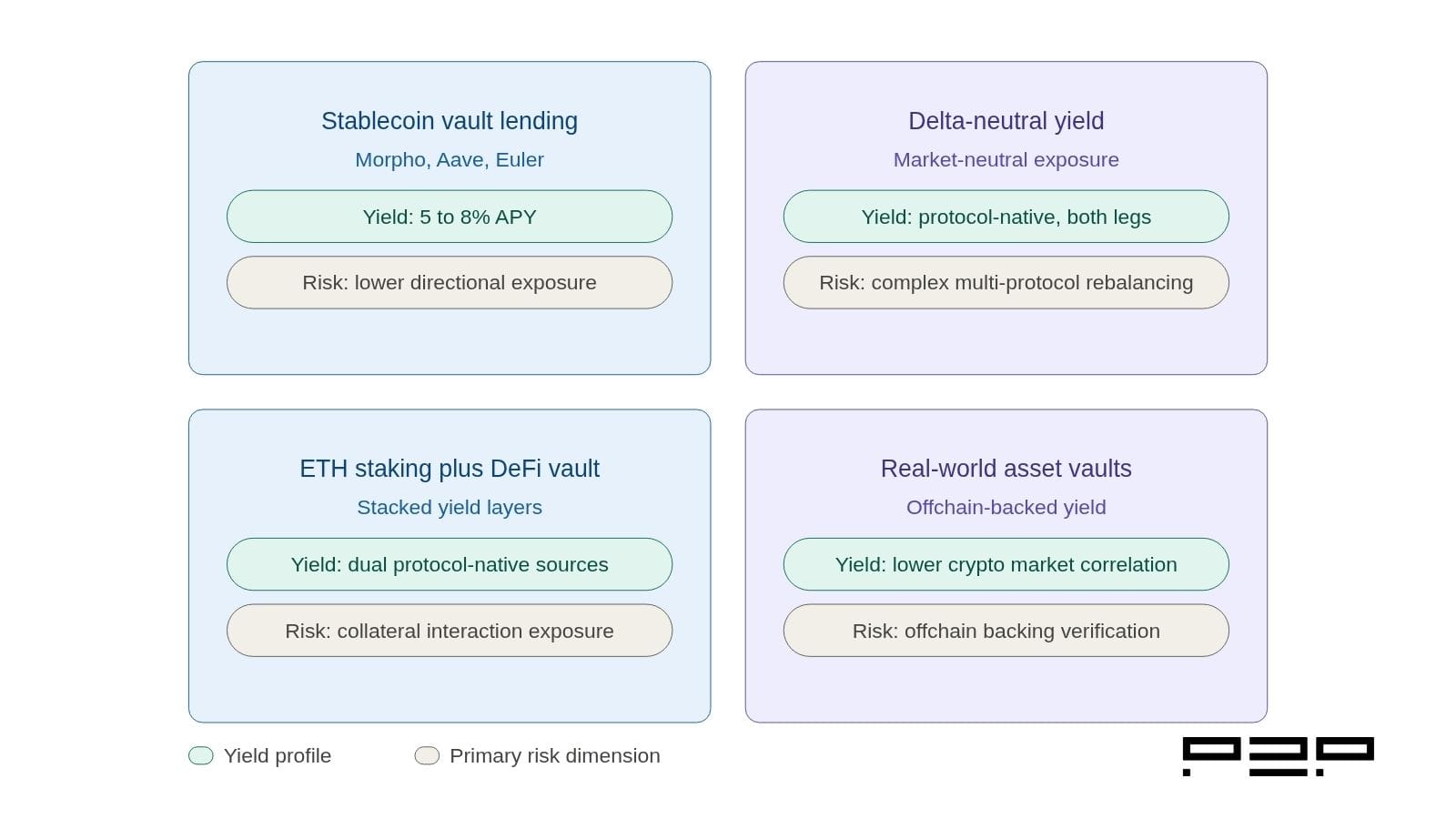
The four primary on-chain yield strategies hedge funds are pursuing in 2026, with yield profile and primary risk dimension for each.
Stablecoin lending in curated vaults
Stablecoin lending across Morpho, Aave, and Euler remains the most established entry point for hedge funds accessing on-chain yield. DeFi protocols deliver 5 to 8% APY on stablecoin deposits, compared to 4 to 5% for traditional money market funds.
The yield spread is meaningful without requiring significant directional exposure. For funds with stablecoin mandates or treasury allocation flexibility, curated stablecoin vaults offer protocol-native yield with a risk profile closer to traditional fixed income than to directional crypto. The governance requirement is standard vault infrastructure: pre-execution controls, compliance log production, and role separation.
Delta-neutral yield strategies
A growing segment of hedge fund DeFi participation involves strategies designed to generate yield while neutralising directional price exposure. A common structure involves lending a stable asset while borrowing a volatile one to deploy into separate protocols, insulating the overall position from market movements while generating protocol-native yield from both legs. These strategies are particularly attractive during periods of high volatility when directional bets become risky. The governance requirement is more demanding than simple vault allocation: delta-neutral strategies involve multiple protocol interactions and continuous rebalancing, which requires pre-execution validation across a more complex transaction graph and a compliance log that captures every leg of the strategy, not just single vault interactions.
ETH liquid staking combined with DeFi vault allocation
Funds already holding ETH staking exposure are increasingly combining liquid staking token positions with DeFi vault allocation to stack protocol-native yields. An ETH position generating liquid staking token rewards can be simultaneously deployed as collateral in a lending vault, generating an additional yield layer from the same underlying asset. This strategy requires understanding the interaction between the liquid staking token's risk profile and the vault's collateral parameters, and the governance requirement includes validating that the combined exposure stays within the fund's concentration limits and collateral allowlists at every rebalancing point.
Real-world asset vault strategies
RWA-backed vaults derive returns from offchain economic activity including government debt, private credit, insurance premiums, and payment financing. Their yield profiles are less correlated with crypto market cycles and more closely aligned with traditional fixed income products, making them attractive to traditional hedge funds seeking onchain access without full crypto market correlation. JPMorgan Asset Management's launch of a $100 million tokenised money market fund on Ethereum in 2025 signalled the institutional legitimacy of this strategy category. The governance requirement for RWA vault strategies includes verification that the offchain asset backing is accurately represented onchain, which adds a due diligence layer beyond the standard vault governance framework.
One of the most significant developments in institutional DeFi participation in 2025 and 2026 is the shift in what differentiates serious institutional participants from the broader market. Yield is no longer the primary differentiator. Risk management is.
Today's leading DeFi vaults are not passive vehicles that run indefinitely once deployed. They are actively managed structures shaped by explicit constraints and ongoing oversight. The funds accessing them at institutional scale are applying risk management frameworks that go materially beyond the standard retail DeFi due diligence of evaluating curator track records and protocol audit histories.
The Sortino ratio is emerging as the preferred performance metric for DeFi strategies over the traditional Sharpe ratio. The Sharpe ratio measures returns relative to total volatility, which is less suited to DeFi's high-volatility environment. The Sortino ratio focuses on downside risk specifically, providing a more accurate view of risk-adjusted performance in markets where upside volatility is not a risk dimension that institutional LPs penalise. DeFi protocols, including Aave, are building risk modules specifically to improve Sortino ratios, through mechanisms like over-collateralised vaults and real-time rebalancing analytics, making them increasingly attractive to risk-averse institutional funds.
For hedge funds, the risk management framework for on-chain yield strategies needs to address four specific dimensions that do not exist in traditional asset management.
Smart contract risk assessment
Every protocol layer in the vault's execution stack carries smart contract risk: the vault itself, the underlying lending protocols, any oracle infrastructure providing price feeds, and any bridge infrastructure involved in cross-chain positions. Unlike counterparty risk in traditional finance, smart contract risk is non-recoverable if exploited. Funds must evaluate the audit history, formal verification status, and bug bounty programs of every layer before allocating, and must have a framework for reassessing that risk as protocol upgrades occur.
Curator incentive alignment evaluation
As the second trilogy of this series established, the curator model creates a structural conflict of interest between TVL optimisation and mandate alignment. Funds need to evaluate not just whether a curator has a strong track record, but whether the infrastructure governing the relationship between the curator and the fund's capital validates mandate alignment at the execution level, independently of the curator's own incentives.
Liquidity stress modelling
DeFi vault positions are not always instantly redeemable. Vault liquidity depends on the available liquidity in the underlying lending markets, which can tighten during market stress events. Funds whose LP agreements or redemption policies specify withdrawal timelines must model vault liquidity conditions as a variable in redemption planning, not treat vault positions as equivalent in liquidity to cash or short-term fixed income.
Systemic collateral concentration risk
The KelpDAO episode of April 2026, in which a single cross-chain collateral token's depegging drove $14 billion out of DeFi in 48 hours, illustrated the systemic risk dimension of collateral concentration across DeFi protocols. Funds holding positions in multiple vaults that share common collateral tokens carry correlated exposure that is difficult to model through standard counterparty risk frameworks. Position-level monitoring of shared collateral dependencies is an emerging requirement for institutional DeFi risk management.
The institutional digital asset space moves fast. Our subscribers get structured analysis across staking, DeFi vaults, and regulation through DeFi Dispatch, Institutional Lens, DeFi Infrastructure for Institutions, and Legal Layer. No noise. Just the signals that matter. Subscribe to the newsletter at the bottom of this page.
Governance Infrastructure Requirements for Hedge Funds
The governance infrastructure requirements for hedge funds accessing DeFi vaults are structurally similar to those for custodians, with one additional dimension: LP reporting.
Pre-execution mandate validation
A hedge fund operating within a documented investment mandate needs to demonstrate to its LPs and, increasingly, to regulators that every allocation decision is within mandate parameters at the point of execution. In a DeFi vault context, this means the same independent pre-execution validation layer identified in the custodian article: a function that checks every vault interaction against the fund's mandate before it executes, independently of the curator's decisions, and produces a log of every check, every block, and every approved transaction.
Exportable compliance logs
Hedge fund LPs conducting operational due diligence and regulators reviewing fund compliance need to be able to verify that capital was managed within mandate parameters at every historical execution point. A vault dashboard is not sufficient. The compliance log must be sequential, timestamped, and exportable in a format that an external auditor can verify independently. This is the same requirement that applies across all regulated delegated capital management arrangements. DeFi vault allocation does not exempt funds from it.
Conflict of interest documentation
As the regulatory trilogy of this series established, MiFID II, AIFMD II, and IOSCO's DeFi recommendations all require the identification, documentation, and management of conflicts of interest in investment management arrangements. For hedge funds interacting with DeFi vault curators, this means documenting the curator's incentive structure, the potential conflicts it creates, and the governance controls that manage those conflicts. The independent validation layer is the primary control. Its existence and operation need to be documented in the fund's conflicts of interest policy.
LP reporting integration
Beyond regulatory compliance, hedge funds face LP reporting requirements that custodians do not. LPs expect portfolio-level NAV reporting that accurately represents vault token positions at their underlying asset value, attribution reporting that separates protocol-native yield from curator strategy performance, and risk reporting that reflects the smart contract, curator concentration, and liquidity risk dimensions specific to DeFi vault positions. Funds that cannot produce this reporting in a format consistent with LP expectations will face LP due diligence failures regardless of their investment performance.
Spark's February 2026 launch of Spark Prime and Spark Institutional Lending, which extended more than $9 billion in on-chain stablecoin liquidity to hedge funds and trading firms while keeping collateral overcollateralized and custody controls off-chain, illustrates the direction the market is moving: institutional-grade DeFi yield access with the risk controls and reporting infrastructure that hedge fund LPs require.
What This Means for Hedge Funds Evaluating Onchain Yield
The hedge funds that are building durable on-chain yield programs in 2026 are not the ones chasing the highest available APY across curator-managed vaults. They are the ones that have identified the governance infrastructure requirement, built or sourced the independent validation layer, and structured their on-chain positions within a framework that their LPs can audit and their risk committees can defend.
The market signal is clear. On-chain asset management is on track to reach $64 billion AUM by the end of 2026 under base case assumptions, with institutional investors already representing 56% of capital in crypto hedge funds. The yield opportunity is documented and growing. The differentiation between funds that capture it durably and funds that encounter governance failures will be determined by infrastructure, not strategy.
For hedge funds evaluating on-chain yield strategies, the questions that matter are not primarily about which protocols or curators to access. They are about whether the infrastructure governing that access can produce the pre-execution validation, compliance log, and LP reporting that institutional-grade operation requires. The funds that answer those questions first will build the track records that attract the next wave of institutional LP capital.
Talk to our team if you are evaluating how P2P.org's protection layer supports hedge fund on-chain yield programs.
Key Takeaway
Hedge fund participation in on-chain yield strategies is past the experimentation phase. DeFi-focused funds expanded 22% in 2025 and averaged 28% returns. The structural shift is documented and accelerating.
The differentiation in 2026 is not yield access. Most funds that want to access on-chain yield can find a path to do so. The differentiation is governance infrastructure: pre-execution mandate validation, exportable compliance logs, conflict of interest documentation, and LP reporting integration that demonstrates mandate alignment at every execution point.
Crypto-native funds that build this governance layer will be positioned to attract institutional LP capital at the scale their on-chain expertise warrants. Traditional funds that build the technical access layer within their existing governance frameworks will be positioned to deploy the capital they already manage into on-chain yield strategies. Both paths lead to the same place: an institutional-grade on-chain yield program that a risk committee can approve, an LP can audit, and a regulator can examine.
Next in this series: Stablecoin Onchain Strategies for Institutional Treasury Mandates
Frequently Asked Questions (FAQs)
What on-chain yield strategies are hedge funds pursuing in 2026?
The four primary strategies attracting institutional hedge fund capital in 2026 are stablecoin lending in curated vaults across protocols including Morpho, Aave, and Euler; delta-neutral yield strategies that neutralise directional price exposure while generating protocol-native yield from multiple positions; ETH liquid staking combined with DeFi vault allocation to stack yield layers from the same underlying asset; and real-world asset vault strategies that derive returns from offchain economic activity including government debt and private credit, offering lower correlation with crypto market cycles.
Why is the Sortino ratio preferred over the Sharpe ratio for DeFi strategies?
The Sharpe ratio measures returns relative to total volatility. In DeFi's high-volatility environment, upside volatility can distort the Sharpe ratio in ways that do not reflect actual risk. The Sortino ratio focuses specifically on downside risk, providing a more accurate view of risk-adjusted performance for strategies where upside volatility is not a concern institutional LPs penalise. DeFi protocols including Aave are building mechanisms specifically designed to impro
How does the governance infrastructure requirement for hedge funds differ from that for custodians?
The core infrastructure requirements are similar: pre-execution mandate validation, exportable compliance logs, and contractual role separation between the curator and the infrastructure layer. The primary additional requirement for hedge funds is LP reporting integration: portfolio-level NAV reporting that accurately represents vault token positions at their underlying asset value, attribution reporting that separates protocol-native yield from curator strategy performance, and risk reporting that reflects the smart contract, curator concentration, and liquidity risk dimensions specific to DeFi vault positions.
What is systemic collateral concentration risk, and why does it matter for hedge funds?
Systemic collateral concentration risk arises when multiple DeFi vaults share common collateral tokens. If that collateral token depegs or experiences a liquidity crisis, the impact propagates simultaneously across all vaults using it as collateral. The KelpDAO episode of April 2026 illustrated this: a single cross-chain collateral token's depegging drove $14 billion out of DeFi in 48 hours, affecting vaults across multiple protocols simultaneously. Hedge funds holding positions in multiple vaults that share common collateral tokens carry correlated exposure that standard counterparty risk frameworks do not capture. Position-level monitoring of shared collateral dependencies is an emerging requirement for institutional DeFi risk management.
How should hedge funds evaluate DeFi vault curators?
The primary question is not whether a curator has a strong track record but whether the infrastructure governing the relationship between the curator and the fund's capital validates mandate alignment at the execution level, independently of the curator's own incentives. Curators are incentivised by TVL growth and performance fees, not by mandate alignment with any individual fund. Without an independent pre-execution validation layer sitting above the curator's execution decisions, the fund cannot demonstrate mandate alignment to its LPs or regulators, regardless of the curator's historical performance.
About P2P.org
P2P.org builds the protection layer that sits between regulated institutions and DeFi execution environments, independently of the curators who manage allocation strategies. If you are evaluating the infrastructure requirements for a DeFi allocation program, reach out to our team of experts.
Disclaimer
This article is provided for informational purposes only and does not constitute legal, regulatory, compliance, or investment advice. Regulatory obligations may vary depending on jurisdiction and specific business activities. Readers should consult their own legal and compliance advisors regarding applicable requirements.
Subscribe to P2P-economy
Get the latest posts delivered right to your inbox
<p>Today, <a href="http://p2p.org/?ref=p2p.org">P2P.org</a> launches Syncro Data Stream: a real-time blockchain data stream for Sui and Hyperliquid, built directly on P2P.org's active validator infrastructure.</p><p>Syncro Data Stream is designed for latency-sensitive teams where on-chain data latency directly affects trading performance. Trading teams, market makers, quant funds, and arbitrage desks operating on Sui or Hyperliquid now have access to validator-speed data delivery through a dedicated WebSocket endpoint, at flat monthly pricing with a one-week free trial.</p><p>For trading teams that have been making do with shared public endpoints and checkpoint-based feeds, this changes what is available at a documented, accessible price point.</p><figure class="kg-card kg-image-card kg-card-hascaption"><img src="https://p2p.org/economy/content/images/2026/05/syncro-data-stream-data-path-diagram.jpg" class="kg-image" alt="Diagram showing two data delivery paths from a validator node: the Syncro Data Stream path via private Sentry and dedicated WebSocket, and the public path via network gossip and shared RPC endpoint" loading="lazy" width="1600" height="900" srcset="https://p2p.org/economy/content/images/size/w600/2026/05/syncro-data-stream-data-path-diagram.jpg 600w, https://p2p.org/economy/content/images/size/w1000/2026/05/syncro-data-stream-data-path-diagram.jpg 1000w, https://p2p.org/economy/content/images/2026/05/syncro-data-stream-data-path-diagram.jpg 1600w" sizes="(min-width: 720px) 720px"><figcaption><i><em class="italic" style="white-space: pre-wrap;">Syncro Data Stream sources data at the validator and delivers it to clients before it reaches public infrastructure. The public path adds network propagation and shared endpoint delays on top.</em></i></figcaption></figure><h2 id="what-is-syncro-data-stream">What is Syncro Data Stream?</h2><p>Syncro Data Stream is a real-time blockchain data stream sourced directly from P2P.org's active validators. Unlike shared public endpoints and standard RPC providers, Syncro Data Stream delivers on-chain data before it propagates to public infrastructure, at the earliest point of network availability.</p><p>The product launches on two networks simultaneously, Sui Network and Hyperliquid Network.</p><figure class="kg-card kg-video-card kg-width-regular kg-card-hascaption" data-kg-thumbnail="https://p2p.org/economy/content/media/2026/05/p2p-org-syncro-data-stream-Sui-Hyperliquid-promotional-video_thumb.jpg" data-kg-custom-thumbnail="">
<div class="kg-video-container">
<video src="https://p2p.org/economy/content/media/2026/05/p2p-org-syncro-data-stream-Sui-Hyperliquid-promotional-video.mp4" poster="https://img.spacergif.org/v1/1920x1080/0a/spacer.png" width="1920" height="1080" playsinline="" preload="metadata" style="background: transparent url('https://p2p.org/economy/content/media/2026/05/p2p-org-syncro-data-stream-Sui-Hyperliquid-promotional-video_thumb.jpg') 50% 50% / cover no-repeat;"></video>
<div class="kg-video-overlay">
<button class="kg-video-large-play-icon" aria-label="Play video">
<svg xmlns="http://www.w3.org/2000/svg" viewBox="0 0 24 24">
<path d="M23.14 10.608 2.253.164A1.559 1.559 0 0 0 0 1.557v20.887a1.558 1.558 0 0 0 2.253 1.392L23.14 13.393a1.557 1.557 0 0 0 0-2.785Z"></path>
</svg>
</button>
</div>
<div class="kg-video-player-container">
<div class="kg-video-player">
<button class="kg-video-play-icon" aria-label="Play video">
<svg xmlns="http://www.w3.org/2000/svg" viewBox="0 0 24 24">
<path d="M23.14 10.608 2.253.164A1.559 1.559 0 0 0 0 1.557v20.887a1.558 1.558 0 0 0 2.253 1.392L23.14 13.393a1.557 1.557 0 0 0 0-2.785Z"></path>
</svg>
</button>
<button class="kg-video-pause-icon kg-video-hide" aria-label="Pause video">
<svg xmlns="http://www.w3.org/2000/svg" viewBox="0 0 24 24">
<rect x="3" y="1" width="7" height="22" rx="1.5" ry="1.5"></rect>
<rect x="14" y="1" width="7" height="22" rx="1.5" ry="1.5"></rect>
</svg>
</button>
<span class="kg-video-current-time">0:00</span>
<div class="kg-video-time">
/<span class="kg-video-duration">0:58</span>
</div>
<input type="range" class="kg-video-seek-slider" max="100" value="0">
<button class="kg-video-playback-rate" aria-label="Adjust playback speed">1×</button>
<button class="kg-video-unmute-icon" aria-label="Unmute">
<svg xmlns="http://www.w3.org/2000/svg" viewBox="0 0 24 24">
<path d="M15.189 2.021a9.728 9.728 0 0 0-7.924 4.85.249.249 0 0 1-.221.133H5.25a3 3 0 0 0-3 3v2a3 3 0 0 0 3 3h1.794a.249.249 0 0 1 .221.133 9.73 9.73 0 0 0 7.924 4.85h.06a1 1 0 0 0 1-1V3.02a1 1 0 0 0-1.06-.998Z"></path>
</svg>
</button>
<button class="kg-video-mute-icon kg-video-hide" aria-label="Mute">
<svg xmlns="http://www.w3.org/2000/svg" viewBox="0 0 24 24">
<path d="M16.177 4.3a.248.248 0 0 0 .073-.176v-1.1a1 1 0 0 0-1.061-1 9.728 9.728 0 0 0-7.924 4.85.249.249 0 0 1-.221.133H5.25a3 3 0 0 0-3 3v2a3 3 0 0 0 3 3h.114a.251.251 0 0 0 .177-.073ZM23.707 1.706A1 1 0 0 0 22.293.292l-22 22a1 1 0 0 0 0 1.414l.009.009a1 1 0 0 0 1.405-.009l6.63-6.631A.251.251 0 0 1 8.515 17a.245.245 0 0 1 .177.075 10.081 10.081 0 0 0 6.5 2.92 1 1 0 0 0 1.061-1V9.266a.247.247 0 0 1 .073-.176Z"></path>
</svg>
</button>
<input type="range" class="kg-video-volume-slider" max="100" value="100">
</div>
</div>
</div>
<figcaption><p dir="ltr"><span style="white-space: pre-wrap;">Syncro Data Stream delivers real-time blockchain data for Sui and Hyperliquid, sourced directly from P2P.org's active validator nodes before it reaches any public endpoint.</span></p></figcaption>
</figure><h3 id="syncro-data-stream-for-sui-network">Syncro Data Stream for Sui Network</h3><p>The stream delivers Sui transaction events at certificate processing, before transactions reach public checkpoints and RPC feeds. This is the stage at which the validator has processed the transaction, but before it has been confirmed and published to the broader network. Each client receives a WebSocket endpoint with isolated credentials and IP-based access controls, providing real-time data streaming optimised for execution speed.</p><h3 id="syncro-data-stream-for-hyperliquid-network">Syncro Data Stream for Hyperliquid Network</h3><p>The stream delivers full Hyperliquid order flow from P2P.org's active validator and private sentry nodes, within milliseconds of block creation. Every order across every asset: open, modify, cancel, and fill, with side, price, quantity, status, order ID, and user attribution. Block events, system metrics, and heartbeat data arrive on a dedicated channel, keeping operational signals out of the market data path. Per-asset subscriptions or full firehose, with WebSocket JSON or ESP binary delivery.</p><p>Both products are available at $2,000 per month each, with a one-week free trial for new clients.</p><h2 id="why-on-chain-data-latency-matters">Why on-chain data latency matters</h2><p>For most applications, receiving transaction data a few hundred milliseconds after it hits public infrastructure is acceptable. For latency-sensitive teams, it is not.</p><p>On-chain data latency is the gap between when something happens on the network and when your systems see it. For trading teams, that gap determines whether an opportunity is still open or already taken. For market makers, it determines whether a quote reflects the current state or stale state. For arbitrage desks, it determines whether a price discrepancy still exists by the time an order reaches the book.</p><p>Public APIs and shared RPC endpoints introduce on-chain data latency in two ways. First, data has to propagate from the validator through the network before it reaches a public endpoint. Second, shared infrastructure adds queuing and rate limiting that compound the delay under load. The result is that by the time your systems see the data, multiple other teams have already acted on it.</p><p>This is not a marginal problem. On chains with sub-second finality like Sui and Hyperliquid, where block times are measured in hundreds of milliseconds, even a 5 ms latency gap relative to the fastest available feed can be meaningful. In these environments, opportunities can open and close within milliseconds</p><p>Syncro Data Stream reduces that gap to a single validator-to-client hop, delivering data before it touches any public infrastructure.</p><h2 id="built-on-active-validator-infrastructure">Built on active validator infrastructure</h2><p>The differentiator for Syncro Data Stream is not just speed. It is where the data originates.</p><p>P2P.org operates active validators on both Sui and Hyperliquid, giving us direct access to network data at the infrastructure level. For Sui, our data stream is integrated with our validator operations, allowing us to surface transaction events earlier than standard public data sources.</p><p>For Hyperliquid, we use a dedicated low-latency data delivery setup within our private infrastructure, designed to reduce unnecessary overhead and provide clients with timely access to block and transaction data.</p><p>P2P.org is not a trading firm. Syncro Data Stream is a read-only data stream. P2P.org has no visibility into client strategies, positions, execution logic, or customer data. For teams evaluating infrastructure providers that also trade, this distinction matters.</p><h2 id="who-syncro-data-stream-is-for">Who Syncro Data Stream is for</h2><p>Syncro Data Stream is built for teams that have outgrown shared public infrastructure and need dedicated, validator-speed data delivery.</p><h3 id="high-frequency-and-systematic-traders">High-frequency and systematic traders</h3><p>For directional and arbitrage teams, execution quality depends on latency. Public endpoint latency puts teams at a structural disadvantage relative to teams with faster access. Syncro Data Stream is designed to help close that gap, providing a low-latency baseline that supports tighter entry and exit timing across Sui and Hyperliquid.</p><h3 id="market-making-and-liquidity-provision">Market making and liquidity provision</h3><p>Relying on delayed data leads to adverse selection. Syncro Data Stream delivers validator-speed order flow with granular user attribution, allowing market makers to maintain tighter spreads, manage inventory risk more effectively, and meaningfully shift the information baseline for teams that need to quote accurately under fast-moving conditions.</p><h3 id="quantitative-research-and-alpha-generation">Quantitative research and alpha generation</h3><p>Aggregated feeds mask market microstructure. Syncro Data Stream for Hyperliquid provides the complete, non-summarised order flow across every asset with persistent user IDs. This high-fidelity stream can enable modelling approaches that are difficult to achieve on snapshot-based feeds, supporting predictive signal research and counterparty analysis.</p><p>For Hyperliquid specifically, Syncro Data Stream is positioned as an open, documented, validator-speed offering with transparent pricing at $2,000 per month and a one-week free trial, designed for teams that need accessible, production-ready sentry-level data.</p><h2 id="part-of-the-syncro-infrastructure-product-line">Part of the Syncro infrastructure product line</h2><p>Syncro Data Stream joins Syncro Sender, P2P.org's Solana transaction landing service, as part of the Syncro infrastructure line.</p><p>Syncro Sender routes Solana transactions through P2P.org's staked validator connections and multi-path delivery to reach the block leader before traffic coming through public RPCs. It is already in production with leading trading teams.</p><p>Syncro Data Stream and Syncro Sender address two sides of the same problem: getting your systems closer to the chain than shared public infrastructure allows. Sender handles the execution side on Solana. Syncro Data Stream handles the data side on Sui and Hyperliquid. For teams operating across multiple networks, both products run on the same <a href="http://p2p.org/?ref=p2p.org">P2P.org</a> validator infrastructure and follow the same dedicated endpoint model.</p><h2 id="getting-started">Getting started</h2><p>Both Syncro Data Stream products are available now. Provisioning is straightforward: share your IP for allowlisting, receive your dedicated WebSocket endpoint and credentials, and connect your systems. Most teams are live within days of signing.</p><p>New clients receive a one-week free trial to validate integration, latency, and data quality against their existing setup. No credit card required.</p><p>Full technical documentation is available at <a href="https://docs.p2p.org/?ref=p2p.org">docs.p2p.org</a>.</p><p>To get started with Syncro Data Stream for Sui, visit the <a href="https://www.p2p.org/products/syncro-sui-transaction-data-stream?ref=p2p.org" rel="noreferrer">Syncro Data Stream Sui page</a>.</p><p>To get started with Syncro Data Stream for Hyperliquid, visit the <a href="https://www.p2p.org/products/syncro-hyperliquid-data-stream?ref=p2p.org" rel="noreferrer">Syncro Data Stream Hyperliquid page</a>.</p><hr><h2 id="about-p2porg">About P2P.org</h2><p>P2P.org has operated blockchain infrastructure since 2018 across dozens of proof-of-stake networks, serving a broad base of institutional partners. Syncro is P2P.org's crypto trading infrastructure product line, built on the same validator infrastructure that powers our staking business.</p><hr><h2 id="disclaimer"><em>Disclaimer</em></h2><p>This material is provided for informational purposes only and does not constitute investment, financial, legal, or tax advice. <a href="http://p2p.org/?ref=p2p.org">P2P.org</a> accepts no liability for any actions taken based on it. Latency and performance figures referenced are estimates based on internal benchmarks and may vary depending on network conditions, geography, and client infrastructure. Past performance is not indicative of future results.</p>
<hr><h2 id="series-legal-layer">Series: Legal Layer</h2><p>Legal Layer is <a href="http://p2p.org/?ref=p2p.org">P2P.org</a>'s monthly regulatory intelligence series for custodians, ETF issuers, treasury teams, staking product managers, and validator risk committees operating at the intersection of institutional finance and proof-of-stake infrastructure. Each edition covers the regulatory developments, legislative updates, and policy signals that matter most for institutions building or evaluating staking and DeFi strategies. Previously in the series: <a href="https://p2p.org/economy/legal-layer-institutional-staking-defi-regulatory-update-april-2026/">Legal Layer: Institutional Staking & DeFi Regulatory Update, April 2026</a></p><h2 id="what-does-may-2026s-regulation-news-mean-for-institutions-building-staking-and-defi-programs">What does May 2026's regulation news mean for institutions building staking and DeFi programs?</h2><p>The CLARITY Act cleared the Senate Banking Committee with bipartisan support. A new Federal Reserve chair was confirmed under the most divisive vote in Fed history. The European Commission launched a MiCA public consultation with a July 1 authorization deadline bearing down on EU-operating institutions. The full CLARITY Act text gave institutional legal teams their first formal look at how staking and DeFi vault arrangements will be classified. And the OCC's conditional approvals for crypto-focused national trust banks codified the third-party risk management standards that validator operators serving bank-affiliated custodians will now be held to.</p><h2 id="1-clarity-act-clears-senate-banking-committee-with-bipartisan-15-9-vote-advances-to-senate-floor">1. CLARITY Act Clears Senate Banking Committee With Bipartisan 15-9 Vote, Advances to Senate Floor</h2><p>The Senate Banking Committee advanced the Digital Asset Market Clarity Act to the Senate floor with a bipartisan 15-9 vote on May 14, the most consequential Senate action on crypto legislation in history. Two Democrats, Ruben Gallego and Angela Alsobrooks, crossed over to vote with all 13 Republicans. The bill now requires 60 votes to overcome a filibuster on the Senate floor, meaning seven additional Democratic votes are needed beyond the two who supported it in committee. Source: <a href="https://www.mexc.com/news/723709?ref=p2p.org">MEXC</a></p><p>The White House has set a July 4 signing target, and the most plausible path to hitting it runs through an ethics provision compromise that unlocks the remaining Democratic votes needed for floor passage. Even in the best case, enforceable rules will not exist until 2027. The SEC, CFTC, and Treasury still need to draft proposed rules, run notice-and-comment periods of 30 to 90 days each, revise based on industry feedback, and publish final rules. That process takes at least a year and is required by federal administrative law. Source: <a href="https://coinmarketcap.com/academy/article/apollo-global-to-take-9percent-stake-in-morpho-protocol?ref=p2p.org">CoinMarketCap</a></p><p>The 309-page bill formally divides oversight of digital assets between the SEC and the CFTC, with a decentralization threshold test determining whether a token falls under SEC jurisdiction as a security or CFTC jurisdiction as a commodity. The bill passed the House in July 2025 with a bipartisan 294-134 vote. A separate market structure bill cleared the Senate Agriculture Committee in January 2026, meaning the two versions will need to be reconciled before final passage. Source: <a href="https://cryptonews.net/news/defi/32437875/?ref=p2p.org">Crypto News</a></p><h3 id="why-is-it-relevant-for-validators-and-the-staking-ecosystem">Why is it relevant for validators and the staking ecosystem?</h3><ul><li>Committee passage moves the legal classification of staking as a non-securities activity, established in the March 17 SEC-CFTC joint interpretation, closer to a permanent statute that cannot be reversed by a future administration.</li><li>The decentralization threshold test in the bill is the operative mechanism that institutional compliance departments will use to classify multi-chain staking programs, DeFi vault deployments, and liquid staking token arrangements.</li><li>The DeFi exclusion provisions, confirmed as finalised during markup, directly protect non-custodial validator infrastructure and distributed validator technology operators from intermediary registration requirements under the CFTC framework.</li><li>Even with a July 4 signing, enforceable rules will not exist until 2027 at the earliest. Institutions building staking programs now should treat the March 17 guidance as the operative compliance framework while monitoring rulemaking timelines.</li></ul><h2 id="2-kevin-warsh-confirmed-as-federal-reserve-chair-in-most-divisive-vote-in-fed-history">2. Kevin Warsh Confirmed as Federal Reserve Chair in Most Divisive Vote in Fed History</h2><p>Kevin Warsh was confirmed as the next Federal Reserve chair on May 13 in a 54-45 vote, the closest confirmation in the modern era. Warsh, 56, takes over from Jerome Powell, whose term as chair expired on May 15. Powell has chosen to remain on the Fed Board as a governor, with at least two years remaining in his term as governor. The vote was almost entirely along party lines, with only Pennsylvania Democrat Senator John Fetterman crossing over to support Warsh.</p><p>At his April 21 confirmation hearing, Warsh said the U.S. economy is still dealing with ripples from a pandemic-driven spike in inflation and that the Fed needs a different framework for assessing it. Warsh has argued there is room to lower rates but promised to use his own judgment in setting monetary policy and not to take orders from the White House. His first meeting as Fed chair is set for June 16 to 17, and his shared views over the coming weeks are expected to give investors a preview of how he plans to lead the central bank. Source: <a href="https://www.grip.globalrelay.com/the-secs-fifth-crypto-roundtable-defining-the-future-of-defi/?ref=p2p.org">Globalrelay</a></p><h3 id="why-is-it-relevant-for-validators-and-the-staking-ecosystem-1">Why is it relevant for validators and the staking ecosystem?</h3><ul><li>A new Fed chair who has argued for rate reductions reshapes the opportunity cost calculation for institutional capital deployed into proof-of-stake networks. Lower rates reduce fixed income's yield advantage, strengthening the relative attractiveness of staking yield as an institutional return source.</li><li>Warsh's stated preference for a reduced Fed balance sheet and tighter monetary discipline signals a structural shift in the macro environment in which institutional staking economics are evaluated by treasury committees and risk managers.</li><li>The perception challenge Warsh faces around Fed independence, given the White House's vocal advocacy for lower rates, introduces a macro risk factor that institutional compliance departments managing staking programs under fiduciary obligations will need to model explicitly.</li><li>His first FOMC meeting on June 16 to 17 will be the first concrete signal of how he intends to balance rate policy independence against the administration's expectations, a development that directly affects the yield environment in which staking programs compete for institutional allocation.</li></ul><h2 id="3-european-commission-launches-mica-public-consultation-targeting-defi-and-staking-rules">3. European Commission Launches MiCA Public Consultation Targeting DeFi and Staking Rules</h2><p>The European Commission launched a public consultation on the Markets in Crypto-Assets Regulation on May 20, inviting feedback from industry participants, financial institutions, academics, consumer groups, and the wider public on whether the framework remains suitable for the evolving crypto economy. The consultation will remain open through August 31 and could be the first step toward what some industry observers are already calling MiCA 2. By July 2026, crypto asset service providers must either secure full MiCA authorization or cease operating within the EU. MiCA review seeks opinions on risks associated with DeFi, and the Commission is also studying public trust in digital assets and evaluating whether consumers understand crypto products under MiCA. Source: <a href="https://www.conference-board.org/research/ced-policy-backgrounders/the-outlook-for-digital-assets-in-2026?ref=p2p.org">Conference Board</a></p><p>ESMA has warned that last-minute MiCA authorization applications will face heightened scrutiny. EU institutions engaging with staking services may need to assess licensing status, asset segregation models, AML and KYC requirements, DORA compliance, and data protection obligations before selecting a provider. The grandfathering period for pre-existing providers expires on July 1, 2026, after which any crypto asset service provider that has not obtained authorization must cease providing regulated services in the EU. Source: <a href="https://www.sec.gov/newsroom/speeches-statements/atkins-remarks-crypto-roundtable-tokenization-051225-keynote-address-crypto-task-force-roundtable-tokenization?ref=p2p.org">SEC.gov</a></p><h3 id="why-is-it-relevant-for-validators-and-the-staking-ecosystem-2">Why is it relevant for validators and the staking ecosystem?</h3><ul><li>The July 1, 2026, MiCA authorization deadline creates an immediate compliance obligation for custodians, staking platforms, and crypto asset service providers operating in the EU. Any institution that has not secured authorization must cease EU operations within weeks.</li><li>The Commission's explicit inclusion of DeFi risks and staking business models in the MiCA review consultation signals that the next iteration of EU crypto regulation will directly address the governance and operational standards for on-chain yield infrastructure.</li><li>A potential MiCA 2 covering DeFi protocols and staking arrangements would have direct implications for validator operators whose infrastructure serves EU-regulated institutions, as supervisory expectations for third-party validator relationships are likely to be codified.</li><li>For institutions building European staking programs, the consultation period through August 31 represents the primary window to shape how staking services are defined and regulated under the next framework.</li></ul><h2 id="4-clarity-act-full-text-released-defi-and-staking-provisions-examined">4. CLARITY Act Full Text Released: DeFi and Staking Provisions Examined</h2><p>The Senate Banking Committee released the full 309-page text of the CLARITY Act on May 12, ahead of its May 14 committee vote, providing the first public view of the complete legislative architecture that will govern digital asset markets. The ethics conflict-of-interest provision, which would limit government officials from profiting from the crypto industry, was not resolved during committee markup and must be added as an amendment before the floor vote. Democrats have indicated they will not vote for the bill without it, while White House advisers have stated they will reject any language that singles out a specific officeholder. Source: <a href="https://unchainedcrypto.com/apollo-global-management-strikes-morpho-token-deal-in-major-defi-lending-push/?ref=p2p.org">Unchained</a></p><p>The bill creates a regulatory framework for crypto assets analogous to what the GENIUS Act did for stablecoins, establishing a statutory foundation for the SEC-CFTC jurisdictional split. The American Bankers Association has urged senators to use the CLARITY Act to close a loophole that allows digital asset service providers to offer interest or yield on payment stablecoins in ways that could circumvent the GENIUS Act's prohibition, a lobbying position that has direct implications for how yield-bearing staking products are treated under the final legislation. Source: <a href="https://www.allcryptowhitepapers.com/crypto-news-this-week-285m-hack-ethereum-upgrade-ai-tokens-pump-defi-update/?ref=p2p.org">All Crypto Whitepapers</a></p><h3 id="why-is-it-relevant-for-validators-and-the-staking-ecosystem-3">Why is it relevant for validators and the staking ecosystem?</h3><ul><li>The public release of the full bill text allows institutional legal and compliance teams to begin formal analysis of how staking arrangements, DeFi vault deployments, and liquid staking token structures are classified under the proposed SEC-CFTC framework for the first time.</li><li>The ABA's lobbying position on stablecoin yield directly threatens to impose restrictions that could affect yield-bearing staking products if the final bill conflates staking yield with stablecoin interest. This is a risk that institutional compliance teams managing staking programs should monitor through the floor amendment process.</li><li>The ethics provision impasse is the single legislative variable most likely to delay or derail floor passage. Institutions building compliance timelines around the July 4 signing target should maintain a parallel planning track for a September to December 2026 scenario.</li><li>The bill's treatment of DeFi protocols as either regulated intermediaries or excluded software, depending on the decentralization threshold test, will determine whether curator-managed vault infrastructure requires CFTC registration.</li></ul><h2 id="5-occ-conditional-approvals-for-crypto-focused-national-trust-banks-signal-banking-system-integration">5. OCC Conditional Approvals for Crypto-Focused National Trust Banks Signal Banking System Integration</h2><p>The OCC granted conditional approvals for several national trust bank charters focused on digital assets in the early months of 2026, covering entities planning to provide custody, staking, and related services. A key rule change took effect on April 1, 2026, removing old ambiguities and confirming that national trust banks can engage in non-fiduciary activities alongside their core trust operations, supporting broader custody work without unnecessary limits. Source: <a href="https://www.sec.gov/featured-topics/crypto-task-force/crypto-task-force-roundtables?ref=p2p.org">SEC</a></p><p>The proposed activities of the approved institutions include digital asset custody, settlement, clearing, transfer, escrow, staking, trade execution, and brokerage services, as well as fiduciary, exchange, and payment agent services, stablecoin issuance, and reserve asset custody for affiliated stablecoin issuers. The OCC has confirmed that national banks may outsource permissible digital asset activities, including custody and execution services, to third parties, subject to appropriate third-party risk management practices. Source: <a href="https://www.gate.com/blog/101687/clarity-act-2026-stablecoin-yield-legislation-breakthrough-us-crypto-regulation-turning-point?ref=p2p.org">Gate.com</a></p><h3 id="why-is-it-relevant-for-validators-and-the-staking-ecosystem-4">Why is it relevant for validators and the staking ecosystem?</h3><ul><li>OCC conditional approvals for national trust banks offering staking services as a permissible banking activity establish the first federally chartered institutional staking providers in U.S. history, creating a new category of regulated competitor and partner for existing validator infrastructure operators.</li><li>The OCC's explicit requirement for third-party risk management practices when outsourcing digital asset activities, including staking, codifies the due diligence standard that bank-affiliated custodians will apply to validator selection — SOC 2 Type II certification, uptime SLAs, and slashing risk documentation become formal banking compliance requirements.</li><li>National trust banks that obtain OCC charters for staking services will require underlying validator infrastructure to operate at the reliability and governance standards expected of federally regulated institutions, raising the operational floor for validator operators serving this segment.</li><li>The stablecoin reserve asset custody permissions granted to OCC-chartered institutions create a direct connection between bank-regulated stablecoin issuance and proof-of-stake validator infrastructure, as the networks holding those reserves require institutional-grade validator participation to function.</li></ul><p><em>The Legal Layer is published monthly. It covers regulatory developments relevant to institutional participants in proof-of-stake networks, DeFi infrastructure, and digital asset markets.</em></p><p><em>P2P.org does not provide legal advice. This content is for informational purposes only.</em></p><p>👉 <strong>Subscribe to our newsletter</strong> at the bottom of this page to receive a monthly summary of the latest staking and DeFi regulatory developments, curated for institutional participants.</p><hr><p><strong>Disclaimer</strong></p><p>This article is provided for informational purposes only and does not constitute legal, regulatory, compliance, or investment advice. Regulatory obligations may vary depending on jurisdiction and specific business activities. Readers should consult their own legal and compliance advisors regarding applicable requirements.</p>
 ALL
Agoric
Aptos
Auth
Avail
Avalanche
Axelar
Babylon
Bitcoin
bouldertech
BTC
capital flow
Cardano
Celestia
certifications
Chainlink
compliance
Cosmos
Crescent
curator
Cyberway
DAOBet
Data stream
DeFi
defi dispatch
defi infrastrcuture
defi infrastructure
defi news
defi vault
due diligence
DVT
Dymension
Economy
Education
EigenLayer
Elrond
employee
employee advocacy
employee interviews
ETF
Ethereum
Evmos
exit queue
Explain Like I'm Five
Governance
Guide
hedge fund
how to
HR
HUB series
Hyperliquid
infrastructure
institutional lens
institutional staking
ISO 27001
ISO/IEC 27001:2022
Issuer
Kava
Kusama
landing
latin america
legal layer
legislation
Lido
liquid staking
LSP
Manta
Mantle
Marlin
Matic
MEV
MiCA
Moonbeam
MultiversX
Near
Networks
News
NuCypher
Oasis
Obol
Origin
P2P Verified
Partnership
pectra
Persistence
playbook
Pocket
Polkadot
Polygon
product
products
Quicksilver
Regen
regulation
ALL
Agoric
Aptos
Auth
Avail
Avalanche
Axelar
Babylon
Bitcoin
bouldertech
BTC
capital flow
Cardano
Celestia
certifications
Chainlink
compliance
Cosmos
Crescent
curator
Cyberway
DAOBet
Data stream
DeFi
defi dispatch
defi infrastrcuture
defi infrastructure
defi news
defi vault
due diligence
DVT
Dymension
Economy
Education
EigenLayer
Elrond
employee
employee advocacy
employee interviews
ETF
Ethereum
Evmos
exit queue
Explain Like I'm Five
Governance
Guide
hedge fund
how to
HR
HUB series
Hyperliquid
infrastructure
institutional lens
institutional staking
ISO 27001
ISO/IEC 27001:2022
Issuer
Kava
Kusama
landing
latin america
legal layer
legislation
Lido
liquid staking
LSP
Manta
Mantle
Marlin
Matic
MEV
MiCA
Moonbeam
MultiversX
Near
Networks
News
NuCypher
Oasis
Obol
Origin
P2P Verified
Partnership
pectra
Persistence
playbook
Pocket
Polkadot
Polygon
product
products
Quicksilver
Regen
regulation