Ethereum Validator Exit Queue: What Institutional Operators Must Know
Series: Validator Playbook
Validator Playbook is P2P.org's operational series for infrastructure engineers, staking product managers, and validator risk committees building or evaluating institutional-grade staking programs. Each article addresses a specific operational, technical, or governance dimension of running or selecting validator infrastructure at an institutional scale.
Ethereum's exit queue is a deliberate protocol mechanism, not a flaw. It rate-limits validator exits to protect consensus stability, preventing rapid destabilisation of the active validator set (Source: EIP-7922, Ethereum Improvement Proposals).
The protocol's churn limit, currently set at 256 ETH per epoch via EIP-7514, caps how much ETH can exit the validator set per roughly 6.4-minute epoch. When exit demand exceeds this rate, validators queue and wait times extend from hours to weeks (Source: Ethereum Staking Knowledge Base, beaconcha.in).
In September 2025, the Ethereum validator exit queue reached its historical peak of 2.67 million ETH, with wait times exceeding 46 days. The trigger was a single large infrastructure provider exiting approximately 1.6 million ETH of validators simultaneously as a security precaution following unrelated security incidents (Source: CoinDesk, September 2025).
By January 2026, the exit queue had cleared to zero while the entry queue surged to 2.6 million ETH, confirming that September's event was a structural stress test resolved by the protocol as designed (Source: ValidatorQueue.com).
Validators continue earning protocol rewards throughout the exit queue wait. The cost of an unplanned exit is opportunity cost and delayed liquidity, not principal loss.
For institutional operators, the exit queue is a liquidity planning variable that belongs in treasury models and risk frameworks. The operational question is not whether to exit, but when, in what sequence, and with what lead time given the current queue depth.
How the Ethereum Validator Exit Queue Works
Ethereum's proof-of-stake consensus mechanism includes a built-in rate limiter on both validator activation and exit. This mechanism, the churn limit, controls how much ETH can enter or leave the active validator set per epoch. An epoch is a period of 32 slots, approximately 6.4 minutes.
The security rationale is precise. As documented in EIP-7922, the exit queue exists because a malicious validator that could immediately exit the set may attempt a double-spend attack: publishing a block, then releasing a conflicting block after their stake has exited and the slashing mechanism can no longer hold them accountable. The queue ensures stake remains at risk for long enough to enforce accountability (Source: EIP-7922, Ethereum Improvement Proposals).
The current churn limit was introduced by EIP-7514 and extended to exits by EIP-7251, capping exits at 256 ETH per epoch. This translates to a maximum of approximately 57,600 ETH that can be processed for exit per day under normal conditions. The limit is designed so that no more than roughly 10 percent of the total stake can exit within one month, preserving the economic security guarantees of finalised transactions (Source: EIP-7922, Ethereum Improvement Proposals).
When exit demand exceeds the daily processing capacity, validators are placed in a queue. Wait times are a direct function of queue depth divided by daily churn capacity. At the September 2025 peak of 2.67 million ETH awaiting exit, validators faced over 46 days before reaching the cooldown step, the longest wait time in Ethereum's staking history (Source: CoinDesk).
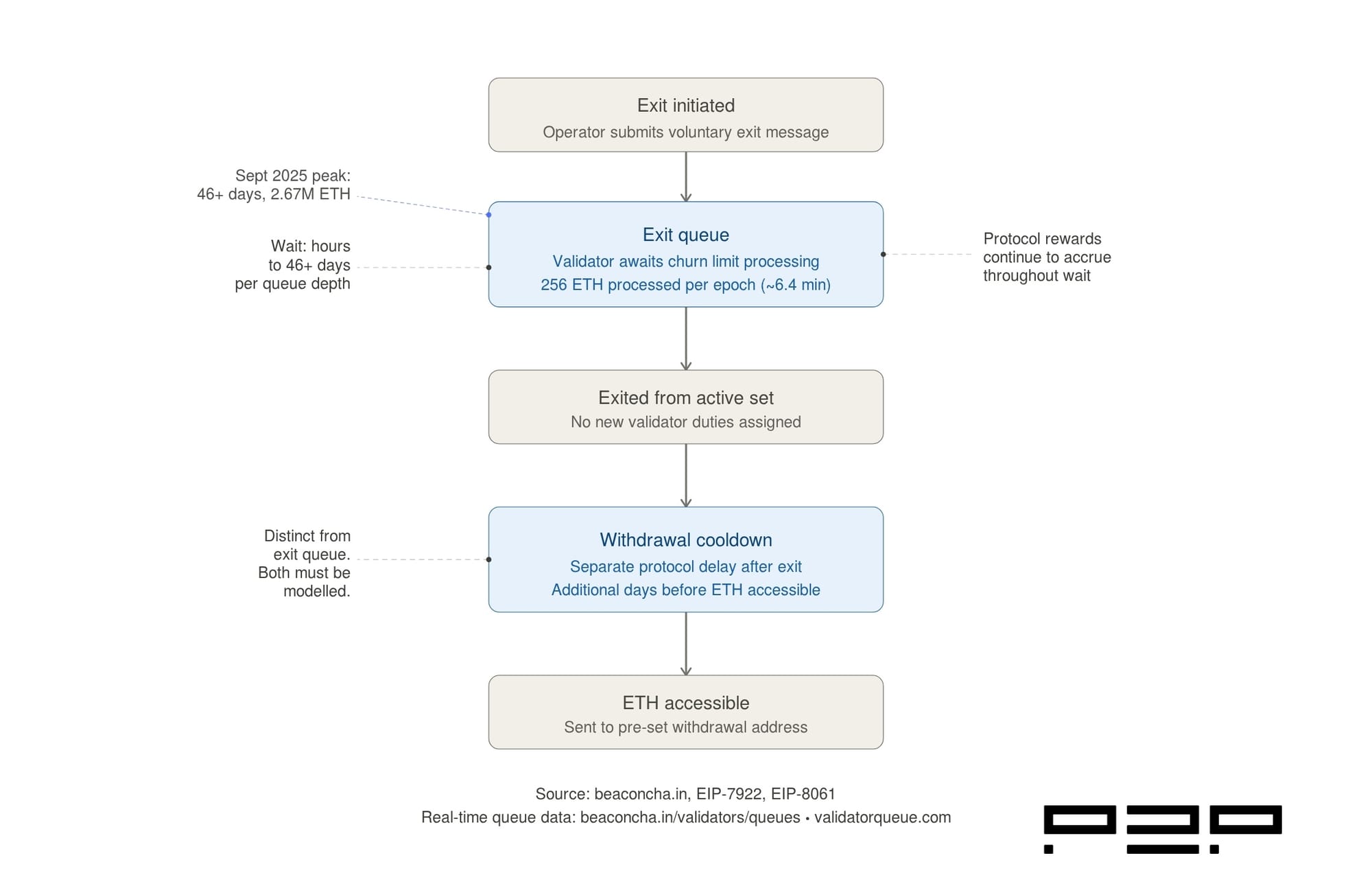
Importantly, exit is a two-step process. The first step is the exit queue itself, during which the validator is removed from the active validator set. The second is the withdrawal cooldown period, a separate protocol delay before the unstaked ETH becomes accessible at the withdrawal address. Both periods must be factored into any exit timeline estimate. Real-time queue depth and estimated wait times for both steps are publicly available via beaconcha.in and validatorqueue.com.
The five stages of the Ethereum validator exit queue process, from exit initiation to ETH withdrawal. Source: beaconcha.in, EIP-7922, EIP-8061.
Institutional Risk Framing
The exit queue introduces two categories of operational risk for institutional validators: liquidity risk and sequencing risk.
Liquidity risk
It arises when an institution needs to redeploy or withdraw staked ETH within a timeframe shorter than the current exit queue wait. An operator planning to shift custody arrangements, rotate infrastructure providers, adjust portfolio exposure, or respond to a client redemption request must account for queue depth at the time of exit initiation, not at the time of planning.
During normal conditions, when the exit queue is short or empty, this risk is negligible. Exit can be initiated and completed within hours. During elevated queue conditions, as in September 2025, the same operation required 46 days or more. The gap between expected and actual liquidity timelines is where institutional risk concentrates.
Sequencing risk
Itarises when an operator needs to coordinate exits across multiple validators simultaneously, particularly when those validators are tied to client segregated positions. The protocol processes exits in queue order without operator-level priority. A large simultaneous exit request does not receive preferential treatment: it joins the queue in the order it is submitted, and if other operators are exiting concurrently, the wait extends proportionally for everyone.
The September 2025 event illustrated this with unusual clarity. When a single infrastructure provider submitted exit requests for validators holding approximately 1.6 million ETH simultaneously, queue depth increased by over 60 percent within a single day, extending wait times for all other operators in the queue regardless of their own exit reasons. As Ethereum researcher analysis noted at the time, even a large staking operator with 3 percent of the validator set that attempts to exit all at once faces the same per-epoch churn constraint as any other participant (Source: EIP-7922, Ethereum Improvement Proposals).
What the September 2025 Peak Revealed
The September 2025 exit queue peak is the most instructive data point available for institutional operators evaluating how Ethereum's exit mechanics behave under stress.
The immediate trigger was a security precaution taken by a large infrastructure provider following two unrelated security incidents: the NPM supply-chain attack and the SwissBorg breach. The provider took the decision to exit all validators as a precautionary measure, submitting exit requests for approximately 1.6 million ETH of validators within a short window. The exit queue, already elevated to 18 days in August due to profit-taking following a sustained ETH price rally, surged to over 2.5 million ETH within days, with wait times reaching 46 days (Source: CoinDesk).
Three aspects of this event are operationally significant for institutional operators.
First, the network performed exactly as designed. Transaction processing, DeFi protocol operations, and cross-chain activity were unaffected throughout the event. Ethereum's core functionality is independent of validator exit queue conditions. The exit queue is a consensus layer phenomenon, not a network stability failure.
Second, validators continued earning protocol rewards throughout the exit process. Operators in the queue did not lose rewards while waiting. The cost was delayed access to unstaked ETH, not lost rewards.
Third, the event was resolved within months. By January 2026, the exit queue had cleared entirely, and the entry queue had simultaneously surged to 2.6 million ETH, with entry wait times of approximately 45 days, confirming that the majority of September's exits were repositioning rather than permanent departures from the Ethereum staking ecosystem (Source: ValidatorQueue.com).
The protocol response to the September peak also accelerated work on EIP-8061, a draft proposal to increase exit churn capacity, and EIP-7922, which proposes a dynamic exit queue rate limit that would allow the churn limit to adapt to historical exit patterns rather than remaining fixed. Both are responses to the operational friction the September event exposed (Source: EIP-8061, EIP-7922).
The institutional digital asset space moves fast. Our subscribers get structured analysis across staking, DeFi vaults, and regulation through DeFi Dispatch, Institutional Lens, DeFi Infrastructure for Institutions, and Legal Layer. No noise. Just the signals that matter. Subscribe to the newsletter at the bottom of this page.
Operational Depth: Managing Exit Timing as an Institutional Operator
For institutions managing validator positions at scale, the practical question is how to structure exit operations to minimise exposure to queue timing uncertainty.
Monitor queue depth proactively
Real-time queue data is publicly available via beaconcha.in and validatorqueue.com. Building queue depth into regular operational monitoring allows treasury and infrastructure teams to anticipate elevated wait times before they become relevant to a planned exit. The September 2025 spike was observable for weeks before it peaked. Operators with monitoring in place had the option to initiate exits before the queue depth reached its maximum.
Stage large exits
An operator holding validators across a large ETH position can submit exit requests in tranches rather than simultaneously. Staged exits spread queue exposure over time, reduce the operator's contribution to queue depth, and benefit both the operator and the broader ecosystem. For institutional clients with segregated validator infrastructure, the staging schedule can be coordinated with custody and reporting timelines.
Account for the full exit timeline in liquidity planning
The exit process involves two sequential steps: the validator exit queue and the withdrawal cooldown period. Both must be included in liquidity timeline estimates. Institutional liquidity models that treat staked ETH as immediately accessible without accounting for current queue conditions will systematically underestimate exit timelines during periods of elevated demand.
Understand the re-staking implications
Exit queue events are frequently followed by activation queue surges. Operators planning to rotate infrastructure providers or rebalance validator positions should model both the exit timeline and the subsequent activation queue wait for re-staking, as the two can compound. During the September 2025 event, analysis suggested that if 75 percent of the exiting ETH was re-deposited, the combined activation queue would have created a total round-trip delay approaching 129 days (Source: CoinDesk).
Governance and Capital Implications
The exit queue has implications beyond operational planning. It is increasingly relevant to how institutional decision-makers structure mandates and risk frameworks around staking positions.
For asset managers and fund operators, staked ETH is a balance sheet position with a protocol-imposed liquidity constraint that is variable: near-zero under normal conditions, exceeding 45 days during queue peaks. Risk frameworks that treat staked ETH as equivalent in liquidity to unstaked ETH do not accurately reflect the asset's characteristics. The exit queue is the mechanism through which that liquidity constraint is expressed, and it should be modelled explicitly in fund terms, redemption policies, and treasury guidelines.
For custodians managing staked ETH on behalf of clients, the exit queue creates an obligation to communicate expected exit timelines accurately when clients request withdrawals or position changes. Understating exit timelines during elevated queue conditions creates client relationship risk and potential compliance exposure where withdrawal timelines are contractually specified.
For exchanges offering staking products to institutional clients, exit queue management capability is a meaningful product differentiator. Operators with monitoring infrastructure, staging capability, and operational transparency around exit timing provide a measurably better experience than those treating exit as a binary on-demand operation.
The protocol trajectory also matters for governance. Both EIP-7922 and EIP-8061 are active draft proposals aimed at improving exit liquidity, with EIP-8061 explicitly noting that the September 2025 exit queue event, which stretched beyond 40 days, was a direct motivator for the proposed churn limit increase (Source: EIP-8061, Ethereum Improvement Proposals). Institutions with active validator operations should track the progress of both EIPs as they move through the Ethereum governance process.
When evaluating a validator infrastructure partner's exit queue management capabilities, institutional operators should assess the following.
Queue monitoring infrastructure
Does the partner monitor exit queue depth in real time and proactively communicate elevated conditions to clients? Reactive communication after a queue spike is operationally insufficient.
Staged exit capability
Can the partner execute staged exits across large validator positions, and can those stages be customised to align with client liquidity timelines and reporting periods?
Full timeline transparency
Does the partner communicate both the exit queue wait and the withdrawal cooldown period in exit timeline estimates, or only the queue portion?
Historical exit management
Has the partner managed large-scale exits for institutional clients during elevated queue conditions? The September 2025 event is now a reference point. Partners with documented experience managing client exits during that period can demonstrate operational capability under stress.
that
During the exit process, withdrawal addresses are fixed at the point of validator creation and cannot be changed using validator keys. This is a structural safeguard documented in Ethereum's protocol design: stake and consensus layer rewards are sent only to the pre-specified withdrawal address, and validator keys cannot redirect them (Source: Ethereum Staking Knowledge Base, beaconcha.in). Clients should verify that this architecture is in place with any partner before initiating exits.
P2P.org operates non-custodial validator infrastructure across 40+ proof-of-stake networks. Our exit management process includes real-time queue monitoring, staged exit execution for institutional positions, and full timeline communication covering both the exit queue and withdrawal cooldown periods. Explore P2P.org Staking Infrastructure.
Key Takeaway
For exchanges, custodians, and asset managers managing Ethereum validator positions, the exit queue is a liquidity planning variable that belongs in treasury models, risk frameworks, and client communication protocols. It is not a protocol risk: it is a protocol feature. Ethereum's September 2025 stress test confirmed that the mechanism works as designed, the network remained stable, rewards continued to accrue, and the queue cleared within months.
The operational gap that creates institutional risk is not the exit queue itself but the absence of proactive queue monitoring, staged exit capability, and accurate timeline communication. Operators who treat exit as an on-demand operation without accounting for queue depth will encounter planning failures. Operators who build queue dynamics into standard infrastructure and treasury workflows will not.
Frequently Asked Questions (FAQs)
How long does it take to exit an Ethereum validator?
Exit timelines depend on current queue depth and the protocol's daily churn capacity. In normal conditions with a short or empty exit queue, the process completes within hours. During elevated queue conditions, such as the September 2025 peak, wait times exceeded 46 days. The exit process also includes a separate withdrawal cooldown period after queue processing before ETH is fully accessible. Current queue depth and estimated wait times for both stages are available in real time via beaconcha.in and validatorqueue.com.
Do validators earn rewards while waiting in the exit queue?
Yes. Validators continue earning protocol rewards during the exit queue wait. Rewards stop only once the validator is fully exited from the active validator set. The queue delays access to the unstaked ETH but does not interrupt reward accrual during the wait period (Source: Ethereum Staking Knowledge Base, beaconcha.in).
Why does the Ethereum exit queue exist?
The exit queue is a deliberate security mechanism. Without it, a malicious validator could exit the set immediately after executing a double-spend attack, before the slashing mechanism could hold them accountable. By enforcing a churn limit, the protocol ensures that stake remains at risk long enough to enforce economic accountability for validator behaviour. The security design and rationale are documented in EIP-7922 (Source: EIP-7922, Ethereum Improvement Proposals).
Can an institutional operator prioritise their exit position in the queue?
No. The Ethereum protocol processes exit requests in queue order without operator-level priority. Large simultaneous exit requests are subject to the same churn limit as all other exits. Staging exit requests over time is the primary tool available to operators managing large positions who want to minimise their contribution to queue depth and reduce wait time variability.
What protocol changes are being considered to address exit queue congestion?
Two draft EIPs are currently under consideration. EIP-7922 proposes a dynamic exit queue rate limit that would allow the churn limit to adapt based on historical exit patterns, reducing unnecessarily long delays during quiet periods and scaling capacity in line with demonstrated need. EIP-8061 proposes increasing exit and consolidation churn limits directly, motivated in part by the September 2025 exit queue event that stretched wait times beyond 40 days. Both remain drafts and have not yet been scheduled for a hard fork (Source: EIP-7922, EIP-8061).
What is the difference between the exit queue and the withdrawal cooldown?
The exit queue is the wait period before a validator is removed from the active validator set. The withdrawal cooldown is a separate protocol delay after exit processing before the unstaked ETH is accessible at the withdrawal address. Both must be accounted for in exit timeline planning. The total period from exit initiation to accessible ETH is the sum of both stages (Source: Ethereum Staking Knowledge Base, beaconcha.in).
Disclaimer
This article is provided for informational purposes only and does not constitute legal, regulatory, compliance, or investment advice. Regulatory obligations may vary depending on jurisdiction and specific business activities. Readers should consult their own legal and compliance advisors regarding applicable requirements.
Subscribe to P2P-economy
Get the latest posts delivered right to your inbox
<h2 id="p2p-verified-people-of-p2porg"><br><strong>P2P Verified | People of P2P.org</strong> </h2><p>P2P Verified is P2P.org's people series — featuring the professionals behind our infrastructure, their career paths, and what working in blockchain and digital assets actually looks like from the inside. <br><br>Read our previous P2P Verified story: <a href="https://p2p.org/economy/leadership-trust-p2p-org-ali-boukhalfa-emerging-markets/">Leadership Without Borders: How Ali Boukhalfa Builds Trust Across MENA and LATAM</a>.</p><h2 id="introduction">Introduction</h2><p>Betsabe Botaitis has spent more than 15 years working at the intersection of finance, technology, and organizational growth. From traditional finance through fintech and into blockchain infrastructure, her career reflects a consistent conviction: that finance is not a reporting function. It is a strategic lever.</p><p>As CFO of P2P.org, Betsabe oversees global financial operations while collaborating with a distributed team across time zones and markets. Based in Las Vegas, she brings a perspective shaped by highly regulated industries and fast-moving technology environments — and a leadership philosophy grounded in curiosity, shared accountability, and building systems that outlast any individual contributor.</p><p>This conversation explores what drew her to P2P.org, how she thinks about finance in the context of a high-growth blockchain company, and what professionals from traditional finance backgrounds can expect when they make the move into digital assets.</p><h2 id="what-you-will-take-away-from-this-read">What You Will Take Away From This Read</h2><p>For finance professionals considering a move into Web3 or blockchain infrastructure, Betsabe's experience offers something rare: a CFO-level perspective on what the transition actually looks like, what stays the same, and what genuinely changes.</p><p>For candidates from any background evaluating P2P.org as an employer, her answers to questions about culture, ownership, and daily experience are among the most direct available from inside the organization.</p><h2 id="an-entrepreneurial-spirit-across-the-entire-organization">An Entrepreneurial Spirit Across the Entire Organization</h2><p>Betsabe has worked with talented teams before. What stood out at <a href="http://p2p.org/?ref=p2p.org">P2P.org</a> was not expertise alone. What stood out was the energy behind it.</p><div class="kg-card kg-callout-card kg-callout-card-grey"><div class="kg-callout-text">"What stood out to me immediately was the entrepreneurial spirit. There's a strong curiosity across the company and a genuine hunger to keep learning and improving."</div></div><p>That combination of curiosity and commitment creates an environment where ideas move fast, and improvement is the default assumption. For finance professionals accustomed to organizations where the finance function is treated as a cost centre or a gate rather than a growth partner, this distinction matters.</p><div class="kg-card kg-callout-card kg-callout-card-grey"><div class="kg-callout-text">"People are deeply committed to their work, and that passion creates an environment where ideas move quickly and teams are encouraged to think about how things can be done better."</div></div><p>The implication for candidates is meaningful: if you are the kind of professional who asks why things are done a certain way and wants the space to improve them, the culture here rewards that orientation.</p><h2 id="finance-as-strategy-not-just-reporting">Finance as Strategy, Not Just Reporting</h2><p>One of the clearest threads running through Betsabe's experience at P2P.org is a redefinition of what finance is for.</p><div class="kg-card kg-callout-card kg-callout-card-grey"><div class="kg-callout-text">"Finance today can play a much broader role than traditional reporting. It can help drive strategy, enable better decision-making, and support innovation across the organization."</div></div><p>This view is becoming more common in high-growth technology companies, but it is still far from universal. Many finance functions remain structured around control and compliance. At <a href="http://p2p.org/?ref=p2p.org">P2P.org</a>, the expectation is different: finance is a partner to the business, contributing to decisions rather than simply tracking their outcomes.</p><p>For professionals transitioning from TradFi or enterprise environments, this framing may represent either an adjustment or a relief, depending on where they are coming from. Either way, it is worth understanding before joining.</p><h2 id="growth-that-starts-with-context">Growth That Starts With Context</h2><p>When Betsabe talks about developing her team, she starts not with skills or targets but with visibility.</p><div class="kg-card kg-callout-card kg-callout-card-grey"><div class="kg-callout-text">"Growth starts with understanding how each activity contributes to the bigger picture. Finance teams can sometimes feel removed from the front lines of revenue, so I focus on helping the team see how their work directly supports the company's progress."</div></div><p>This approach reflects something broader about how <a href="http://p2p.org/?ref=p2p.org">P2P.org</a> appears to operate: the assumption that people perform better when they understand why their work matters, not just what they are supposed to do.</p><p>She also emphasizes continuous learning as a structural priority, not an afterthought. Attending conferences, exploring new technologies, staying close to how the industry is evolving — these are treated as part of the job, not extras.</p><div class="kg-card kg-callout-card kg-callout-card-grey"><div class="kg-callout-text">"Growth doesn't happen in isolation. It comes from constantly expanding your perspective."</div></div><h2 id="collaboration-without-silos-experimentation-without-chaos">Collaboration Without Silos, Experimentation Without Chaos</h2><p>Two principles define how Betsabe's team operates. The first is the deliberate removal of silos. The second is the creation of space for experimentation, within a framework of strong fundamentals.</p><div class="kg-card kg-callout-card kg-callout-card-grey"><div class="kg-callout-text">"I also believe in creating a safe space for experimentation. In fast-moving industries, teams need the ability to test ideas, learn quickly, and adapt. As long as the fundamentals remain strong, that flexibility allows us to innovate while maintaining the discipline finance requires."</div></div><p>That balance, between innovation and discipline, between flexibility and rigour, is the defining challenge of running finance inside a blockchain company. Betsabe's answer is not to choose one over the other but to hold both simultaneously, using strong systems as the foundation that makes experimentation safe.</p><h2 id="trust-built-through-consistency">Trust Built Through Consistency</h2><p>On delegation and trust, Betsabe's view is straightforward: trust is not granted, it is earned through consistent delivery and mutual accountability.</p><div class="kg-card kg-callout-card kg-callout-card-grey"><div class="kg-callout-text">"Trust is built through consistency and shared accountability. Over time, as teams deliver results and support one another, that trust naturally grows."</div></div><p>Leadership by example plays a central role in this. When managers are visibly engaged, curious, and willing to learn alongside their teams, it creates permission for others to take ownership. That top-down modelling effect is something Betsabe has observed consistently at P2P.org across all levels of the organization.</p><div class="kg-card kg-callout-card kg-callout-card-grey"><div class="kg-callout-text">"Sustainable organizations don't rely on individual heroics. They rely on strong systems and strong teams."</div></div><h2 id="a-blue-ocean-with-real-structure">A Blue Ocean With Real Structure</h2><p>One phrase Betsabe returns to when describing P2P.org is "blue ocean" — the sense that the space still has enormous room for genuine innovation, not just iteration.</p><div class="kg-card kg-callout-card kg-callout-card-grey"><div class="kg-callout-text">"What excites me most about P2P.org is the opportunity to build. The industry still feels like a blue ocean, where there is space to innovate, improve processes, and create real impact."</div></div><p>For professionals who have spent careers optimizing within well-defined systems, this is a significant signal. P2P.org is not a company asking people to maintain what exists. It is asking people to help build what comes next.</p><p>That said, the culture is not one of unstructured ambition. The diversity of perspectives within the team, combined with a balance between strong governance and genuine innovation, creates an environment where building happens with discipline rather than despite it.</p><h2 id="staying-resilient-in-volatile-markets">Staying Resilient in Volatile Markets</h2><p>Fifteen years in emerging technologies has given Betsabe a calibrated view of pressure. She does not minimize it. She manages it.</p><div class="kg-card kg-callout-card kg-callout-card-grey"><div class="kg-callout-text">"I've worked in emerging technologies for more than 15 years, so I've learned that pressure is part of the environment. Instead of fighting it, I focus on managing it through healthy habits like exercise and good nutrition, and also through a strong support network."</div></div><p>At work, her approach is solution-oriented. When something is not working, the focus moves immediately to analysis and forward motion rather than dwelling on the problem.</p><div class="kg-card kg-callout-card kg-callout-card-grey"><div class="kg-callout-text">"Maintaining an external perspective on the industry also helps keep daily challenges in context."</div></div><p>This is a useful frame for anyone entering a high-growth, high-volatility environment for the first time: the professionals who sustain performance over years tend to be those who have built stable personal foundations, not those who simply work harder under pressure.</p><h2 id="key-takeaways">Key Takeaways</h2><p>For professionals evaluating P2P.org or a move into blockchain infrastructure from a finance, fintech, or enterprise background, Betsabe's experience highlights several things that are easy to miss in standard hiring conversations:</p><p>Finance has a strategic mandate, not just a reporting one. The expectation at P2P.org is that finance contributes to decisions, not just documents them. Professionals who want that kind of scope will find it here.</p><p>Curiosity is a cultural value, not a personality bonus. Across the organization, the orientation toward learning and improvement is structural. People who ask better questions tend to fit and grow faster.</p><p>Strong systems enable innovation. The balance between governance and experimentation is deliberate. Discipline and flexibility are not in tension here — one creates the conditions for the other.</p><p>Trust is built through delivery and example. There are no shortcuts to it, and no one is exempt from modelling it, including senior leadership.</p><p>The opportunity to build is real. <a href="http://p2p.org/?ref=p2p.org">P2P.org</a> is at a stage where the decisions being made now will shape the organization for years. For professionals who want to contribute to that, the timing matters.</p><h2 id="frequently-asked-questions-faqs">Frequently Asked Questions (FAQs)<br></h2><h3 id="what-kind-of-background-do-finance-professionals-need-to-join-p2porg">What kind of background do finance professionals need to join P2P.org? </h3><p>Betsabe's own career spans traditional finance, fintech, and blockchain, which reflects the range of experience the company draws from. Deep financial fundamentals, comfort with complexity, and intellectual curiosity about emerging technologies appear to matter more than crypto-native experience alone.</p><h3 id="is-p2porg-a-good-environment-for-senior-professionals-transitioning-from-tradfi-into-web3">Is P2P.org a good environment for senior professionals transitioning from TradFi into Web3?</h3><p>Based on Betsabe's perspective, yes. The company values strong governance alongside innovation, which means experienced professionals from regulated industries bring directly applicable skills. What tends to differentiate successful transitions is a willingness to apply those skills in a faster-moving, less-defined environment.</p><h3 id="how-does-p2porg-approach-leadership-development-at-a-senior-level">How does P2P.org approach leadership development at a senior level?</h3><p>Betsabe describes a culture where growth is tied to understanding how individual work connects to company outcomes, continuous learning is actively encouraged, and leadership is modeled through example at every level. Senior professionals are given genuine scope and real accountability rather than narrowly defined mandates.</p><h3 id="what-does-collaboration-look-like-inside-the-finance-function-at-p2porg">What does collaboration look like inside the finance function at P2P.org?</h3><p>The emphasis is on removing silos and building cross-functional visibility. Finance works as a partner to the broader business rather than operating in isolation. That means more exposure to strategy, product, and operations than a traditional finance role typically involves.</p><h3 id="how-can-i-connect-with-betsabe-botaitis">How can I connect with Betsabe Botaitis?</h3><p>You can connect with Betsabe directly on LinkedIn at <a href="https://www.linkedin.com/in/betsabebotaitis/?ref=p2p.org">linkedin.com/in/betsabebotaitis</a>.</p><h3 id="where-can-i-find-open-roles-at-p2porg">Where can I find open roles at <a href="http://p2p.org/?ref=p2p.org">P2P.org</a>? </h3><p>You can explore current opportunities at <a href="https://p2p.org/career?ref=p2p.org">p2p.org/career</a>.</p>
<hr><h2 id="series-legal-layer">Series: Legal Layer</h2><p>Legal Layer is <a href="http://p2p.org/?ref=p2p.org">P2P.org</a>'s monthly regulatory intelligence series for custodians, ETF issuers, treasury teams, staking product managers, and validator risk committees operating at the intersection of institutional finance and proof-of-stake infrastructure. Each edition covers the regulatory developments, legislative updates, and policy signals that matter most for institutions building or evaluating staking and DeFi strategies.</p><p>Previously in the series: <a href="https://p2p.org/economy/legal-layer-institutional-staking-defi-regulatory-update-march-2026/">Legal Layer: Institutional Staking & DeFi Regulatory Update, March 2026</a></p><h2 id="1-clarity-act-enters-its-final-legislative-window-as-senate-returns-from-recess">1. CLARITY Act Enters Its Final Legislative Window as Senate Returns From Recess</h2><p>The Senate returned from Easter recess on April 13, opening what may be the most consequential legislative window for crypto market structure legislation this year. April appears to be a lost cause for a markup vote, but a Senate Banking Committee hearing in May could keep the legislation on track for full Senate passage by July, though any further delays could effectively kill its chances for 2026 (Source: <a href="https://www.coindesk.com/news-analysis/2026/04/21/crypto-s-great-hope-in-senate-s-clarity-act-still-has-a-path-to-survive-tight-calendar?ref=p2p.org">CoinDesk</a>).</p><p>At a Washington event on April 22, Senator Bernie Moreno delivered a firm ultimatum, declaring that the CLARITY Act must clear Congress by the end of May and that missing that deadline could shelve the bill indefinitely. Senator Lummis confirmed that DeFi provisions are finalised and that markup is still targeted for late April. Polymarket odds of the bill passing in 2026 moved from 38% to 46% following Moreno's statement (Source: <a href="https://www.disruptionbanking.com/2026/04/23/clarity-act-deadline-senator-morenos-end-of-may-ultimatum-is-congresss-last-real-chance/?ref=p2p.org">Disruption Banking</a>).</p><p>The content dispute that defined the first quarter of 2026 is largely resolved. The Tillis-Alsobrooks yield compromise, a White House Council of Economic Advisers report, Coinbase CEO Brian Armstrong's endorsement reversal, and coordinated administration support have closed the substantive gap. The obstacle is now procedural: Senator Tillis must release the revised yield text before Chairman Scott can set a markup date (Source: <a href="https://www.fintechweekly.com/news/clarity-act-armstrong-endorsement-scott-three-hurdles-markup-april-2026?ref=p2p.org">FinTech News</a>).</p><p><strong>Source</strong>: CoinDesk, FinTech Weekly, Disruption Banking</p><h3 id="why-relevant-for-validators-and-the-staking-ecosystem">Why relevant for validators and the staking ecosystem?</h3><ul><li>CLARITY Act passage would convert the March 17 SEC-CFTC joint interpretation — which explicitly classified protocol staking as a non-securities activity — from persuasive guidance into binding statute</li><li>The bill's DeFi exclusion provisions, now confirmed as finalised, directly protect non-custodial validator infrastructure and distributed validator technology operators from intermediary registration requirements</li><li>The narrow May window means the next 30 days are the most consequential for long-term regulatory certainty across institutional staking, DeFi vault infrastructure, and multi-chain validator programs</li><li>Failure to pass in 2026 would leave institutional compliance departments operating against administrative guidance that a future administration could reverse</li></ul><h2 id="2-sec-holds-clarity-act-roundtable-as-regulators-signal-alignment-with-congress">2. SEC Holds CLARITY Act Roundtable as Regulators Signal Alignment With Congress</h2><p>The SEC convened a public forum on digital asset market structure on April 16, placing the bill's trajectory on full display for the first time since the Senate returned from Easter recess. The session is not a vote or formal markup, but the commissioners running it are the same ones who will implement the CLARITY Act once Congress passes it. The stablecoin yield compromise appears to be holding firm, with the White House describing it as a must-have for unlocking the remaining sticking points (Source: <a href="https://bitcoinethereumnews.com/tech/sec-clarity-act-roundtable-kicks-off-today/?ref=p2p.org">BitcoinEthereumNews.com</a>).</p><p>The bill must still clear the Senate Banking Committee, pass a full Senate floor vote requiring 60 votes, reconcile with the Agriculture Committee version and the House-passed text, and receive a presidential signature. The roundtable does not shorten that path, but it signals regulators are aligned and waiting for lawmakers to act (Source: <a href="https://bitcoinethereumnews.com/tech/sec-clarity-act-roundtable-kicks-off-today/?ref=p2p.org">BitcoinEthereumNews.com</a>).</p><p>Source: Bitcoin Ethereum News, FinTech Weekly, Latham & Watkins</p><h3 id="why-relevant-for-validators-and-the-staking-ecosystem-1">Why relevant for validators and the staking ecosystem?</h3><ul><li>Commissioner Peirce, who leads the SEC Crypto Task Force, has consistently framed validator participation and staking-as-a-service as activities that must be protected through rulemaking with the force of law, not only staff guidance</li><li>The roundtable reinforces that the SEC's implementation posture is ready — the remaining bottleneck is legislative, not regulatory</li><li>For custodians and staking platforms building institutional product roadmaps, the alignment between SEC, CFTC, and the White House reduces the risk that regulatory posture shifts before the bill is signed</li></ul><h2 id="3-fdic-publishes-genius-act-proposed-rule-completing-interagency-stablecoin-framework">3. FDIC Publishes GENIUS Act Proposed Rule, Completing Interagency Stablecoin Frame<strong>work</strong></h2><p>The FDIC formally proposed its approach to stablecoin issuers on April 7, 2026, as one of the federal financial regulators required to write rules under last year's GENIUS Act. The proposal, which aligns closely with the OCC's February framework, covers capital, liquidity, and custody standards for FDIC-supervised depository institutions issuing stablecoins through subsidiaries, and is open for a 60-day public comment period closing June 9 (Source: <a href="https://www.coindesk.com/policy/2026/04/07/stablecoin-issuers-get-closer-to-u-s-federal-rules-with-fdic-s-new-proposal?ref=p2p.org">CoinDesk</a>).</p><p>The OCC's comprehensive February rulemaking, published in the Federal Register on March 2, established the first full federal framework for payment stablecoin issuers, covering reserves, redemption, capital, custody, and licensing. The OCC comment period closes May 1. Together, the OCC and FDIC proposals operationalize the GENIUS Act's statutory requirements into supervisory infrastructure across the federal banking system (Source: <a href="https://www.mondaq.com/unitedstates/fiscal-monetary-policy/1776066/occ-proposes-comprehensive-federal-framework-for-stablecoin-issuers-under-the-genius-act?ref=p2p.org">Mondaq</a>).</p><p>Source: CoinDesk, OCC, Federal Register, Gibson Dunn</p><h3 id="why-relevant-for-validators-and-the-staking-ecosystem-2">Why relevant for validators and the staking ecosystem?</h3><ul><li>The GENIUS Act framework defines payment stablecoins as non-interest-bearing instruments — the reserve and custody standards being codified will shape how stablecoin liquidity flows through DeFi protocols and lending markets that interact with staking infrastructure</li><li>OCC custody standards require segregation and exclusive control over private keys and reserve assets, establishing a baseline that will influence how institutional custodians structure staking arrangements</li><li>The prohibition on yield for simply holding stablecoins reinforces the importance of yield-bearing alternatives — including staking — as the primary mechanism through which institutional capital earns protocol-native returns on-chain</li><li>Banks seeking to operate as stablecoin custodians under these frameworks will require third-party validator relationships, as the technical requirements for maintaining distributed ledger participation cannot be handled in-house by most banking institutions</li></ul><h2 id="4-banking-industry-requests-genius-act-comment-period-extension-signalling-implementation-friction">4. Banking Industry Requests GENIUS Act Comment Period Extension, Signalling Implementation Friction</h2><p>A coalition of U.S. bank trade associations, including the American Bankers Association and the Bank Policy Institute, sent a letter to the Treasury Department and the FDIC requesting extended comment periods on three GENIUS Act rule proposals, arguing that all three are directly contingent on the OCC's final framework and cannot be properly evaluated until the OCC rule is finalised (Source: <a href="https://www.coindesk.com/policy/2026/04/22/banks-seek-to-slow-down-implementation-of-crypto-s-genius-act-on-stablecoin-oversight?ref=p2p.org">CoinDesk</a>).</p><p>The same banking organizations are also embroiled in the stablecoin yield dispute that has delayed the CLARITY Act for months. The dual front, requesting rulemaking delays while lobbying against stablecoin yield provisions in the CLARITY Act, signals that the banking industry's engagement with digital asset regulation has shifted from opposition to active shaping of implementation details (Source: <a href="https://www.coindesk.com/policy/2026/04/22/banks-seek-to-slow-down-implementation-of-crypto-s-genius-act-on-stablecoin-oversight?ref=p2p.org">CoinDesk</a>).</p><p>Source: CoinDesk</p><h3 id="why-relevant-for-validators-and-the-staking-ecosystem-3">Why relevant for validators and the staking ecosystem?</h3><ul><li>Implementation delays at the OCC and FDIC level push back the timeline for banks to formally enter the stablecoin custody and issuance market, extending the window in which crypto-native custodians and staking infrastructure providers operate without direct bank competition</li><li>The banking industry's focus on stablecoin yield provisions has a direct read-through to staking: if stablecoins cannot pay yield, staking becomes an even more structurally important mechanism for generating on-chain returns within compliant institutional frameworks</li><li>Third-party risk management requirements being codified across the OCC, FDIC, and Treasury frameworks will require banks to conduct formal due diligence on validator operators they rely on, establishing a new institutional standard for validator selection and performance documentation</li></ul><h2 id="5-white-house-council-of-economic-advisers-publishes-analysis-of-stablecoin-yield-ban-impact">5. White House Council of Economic Advisers Publishes Analysis of Stablecoin Yield Ban Impact</h2><p>On April 8, the White House Council of Economic Advisers published a 21-page analysis finding that a full ban on stablecoin yield would increase U.S. bank lending by $2.1 billion, a 0.02% improvement, while imposing an $800 million welfare cost on households. The analysis was published the day before Treasury Secretary Bessent's Wall Street Journal op-ed calling on the Senate Banking Committee to advance the CLARITY Act (Source: <a href="https://www.fintechweekly.com/news/clarity-act-armstrong-endorsement-scott-three-hurdles-markup-april-2026?ref=p2p.org">FinTech News</a>).</p><p>Standard Chartered estimated that an uncapped stablecoin yield provision could redirect up to $500 billion in deposits out of the banking system, explaining the banking lobby's resistance. The White House has taken the crypto industry's position, with a top crypto adviser describing further bank lobbying on the issue as motivated by greed or ignorance (Source: <a href="https://www.coindesk.com/news-analysis/2026/04/21/crypto-s-great-hope-in-senate-s-clarity-act-still-has-a-path-to-survive-tight-calendar?ref=p2p.org">CoinDesk</a>).</p><p>Source: FinTech Weekly, CoinDesk, Standard Chartered Research</p><h3 id="why-relevant-for-validators-and-the-staking-ecosystem-4">Why relevant for validators and the staking ecosystem?</h3><ul><li>The CEA analysis provides the economic baseline that will govern how stablecoin yield provisions are ultimately written into statute. The finding that a yield ban imposes significant household welfare costs strengthens the case for activity-linked rewards that preserve DeFi composability</li><li>The administration's alignment with the crypto industry position on stablecoin yield is directly relevant to staking economics: if stablecoin yield is constrained, institutional capital seeking on-chain returns has fewer alternatives, increasing the relative attractiveness of staking yield from validator infrastructure</li><li>The coordinated release of the CEA analysis and the Bessent op-ed signals that the executive branch is actively managing the legislative calendar. This development reduces the risk of the bill dying from inaction rather than substantive disagreement</li></ul><h2 id="6-kevin-warsh-advances-toward-fed-chair-confirmation-as-powells-term-expires-in-may">6. Kevin Warsh Advances Toward Fed Chair Confirmation as Powell's Term Expires in May</h2><p>Senator Thom Tillis confirmed on April 27 that he is prepared to support Kevin Warsh's nomination for Federal Reserve chair after the Department of Justice dropped its criminal investigation into outgoing Chair Jerome Powell. With Tillis's support secured, the Senate Banking Committee is set to vote on Warsh's confirmation, giving him a clear path to replacing Powell when Powell's term expires in mid-May (Source: <a href="https://defirate.com/clarity-act-fact-sheet/?ref=p2p.org">DeFi Rate</a>).</p><p>In remarks to the Senate Banking Committee during his April 21 confirmation hearing, Warsh stated that the Fed must stay in its lane, framing political independence as most at risk when the central bank strays into fiscal and social policies beyond its mandate. He issued a pointed criticism of the Fed's accumulated long-term balance sheet position, arguing that the institution's footprint in Treasury and mortgage markets had distorted price signals and suppressed yields (Source: <a href="https://www.sec.gov/featured-topics/crypto-task-force/crypto-task-force-roundtables?ref=p2p.org">SEC</a>).</p><p>Source: CNBC, The Hill</p><h3 id="why-relevant-for-validators-and-the-staking-ecosystem-5">Why relevant for validators and the staking ecosystem?</h3><ul><li>Warsh is widely expected to move quickly toward rate cuts once confirmed, a shift that would reduce the relative yield advantage of traditional fixed income and increase the attractiveness of staking yield as an institutional return source</li><li>His stated focus on shrinking the Fed's balance sheet and restoring monetary discipline signals a tightening of the conditions that made stablecoins and on-chain cash equivalents attractive as Fed-adjacent instruments — a dynamic that redirects institutional attention toward productive on-chain capital deployment, including staking and DeFi infrastructure</li><li>The transition at the Fed is absorbing significant Senate Banking Committee bandwidth during the same window that the CLARITY Act markup is being scheduled — directly affecting the legislative calendar that determines when U.S. crypto market structure legislation reaches the floor</li><li>A new Fed chair with a different posture on rate policy reshapes the macro backdrop in which institutional staking economics are evaluated, affecting how treasury committees model the opportunity cost of deploying capital into proof-of-stake networks versus traditional instruments</li></ul><hr><p><em>The Legal Layer is published monthly. It covers regulatory developments relevant to institutional participants in proof-of-stake networks, DeFi infrastructure, and digital asset markets.</em></p><p>👉 Subscribe to our newsletter to receive a monthly summary of the latest staking and DeFi regulatory developments, curated for institutional participants.</p><hr><p><strong><em>Disclaimer</em></strong></p><p>This article is provided for informational purposes only and does not constitute legal, regulatory, compliance, or investment advice. Regulatory obligations may vary depending on jurisdiction and specific business activities. Readers should consult their own legal and compliance advisors regarding applicable requirements.</p>
 ALL
Agoric
Aptos
Auth
Avail
Avalanche
Axelar
Babylon
Bitcoin
bouldertech
BTC
capital flow
Cardano
Celestia
certifications
Chainlink
compliance
Cosmos
Crescent
curator
Cyberway
DAOBet
Data stream
DeFi
defi dispatch
defi infrastrcuture
defi infrastructure
defi news
defi vault
due diligence
DVT
Dymension
Economy
Education
EigenLayer
Elrond
employee
employee advocacy
employee interviews
ETF
Ethereum
Evmos
exit queue
Explain Like I'm Five
Governance
Guide
hedge fund
how to
HR
HUB series
Hyperliquid
infrastructure
institutional lens
institutional staking
ISO 27001
ISO/IEC 27001:2022
Issuer
Kava
Kusama
landing
latin america
legal layer
legislation
Lido
liquid staking
LSP
Manta
Mantle
Marlin
Matic
MEV
MiCA
Moonbeam
MultiversX
Near
Networks
News
NuCypher
Oasis
Obol
Origin
P2P Verified
Partnership
pectra
Persistence
playbook
Pocket
Polkadot
Polygon
product
products
Quicksilver
Regen
regulation
ALL
Agoric
Aptos
Auth
Avail
Avalanche
Axelar
Babylon
Bitcoin
bouldertech
BTC
capital flow
Cardano
Celestia
certifications
Chainlink
compliance
Cosmos
Crescent
curator
Cyberway
DAOBet
Data stream
DeFi
defi dispatch
defi infrastrcuture
defi infrastructure
defi news
defi vault
due diligence
DVT
Dymension
Economy
Education
EigenLayer
Elrond
employee
employee advocacy
employee interviews
ETF
Ethereum
Evmos
exit queue
Explain Like I'm Five
Governance
Guide
hedge fund
how to
HR
HUB series
Hyperliquid
infrastructure
institutional lens
institutional staking
ISO 27001
ISO/IEC 27001:2022
Issuer
Kava
Kusama
landing
latin america
legal layer
legislation
Lido
liquid staking
LSP
Manta
Mantle
Marlin
Matic
MEV
MiCA
Moonbeam
MultiversX
Near
Networks
News
NuCypher
Oasis
Obol
Origin
P2P Verified
Partnership
pectra
Persistence
playbook
Pocket
Polkadot
Polygon
product
products
Quicksilver
Regen
regulation