Why Most DeFi Vaults Weren't Built for Institutional Risk Tolerance
Series: DeFi Infrastructure for Institutions
P2P.org's DeFi infra series is especially meant for regulated institutions evaluating on-chain capital allocation. Each article addresses a specific infrastructure, governance, or compliance dimension that determines whether a DeFi allocation can clear institutional approval and operate within mandate.
This article opens a three-part sequence on the structural gap between DeFi vault architecture and institutional requirements. Part one covers why most vaults were not built for institutional risk tolerance. Part two examines the conflict of interest at the heart of vault design. Part three explains what mandate validation at execution actually means for regulated allocators.
The numbers signal a market that should be moving. A January 2025 survey of 352 institutional investors by EY-Parthenon and Coinbase found that 83% plan to increase crypto allocations, with 59% intending to commit more than 5% of their AUM. Yet only 24% currently engage with DeFi. The gap between intention and deployment is not primarily a protocol problem. The protocols work. DeFi total value locked surpassed $89 billion in 2025. The lending infrastructure is mature, audited, and increasingly well understood.
The gap is architectural. Most DeFi vault products were designed for retail capital, and the governance assumptions built into that design create structural problems that regulated institutions cannot work around. Those problems do not show up in yield figures or protocol audits. They show up the moment a compliance team, a risk committee, or a legal function begins asking the questions they are required to ask before capital moves.
This article explains what those problems are, why they are architectural rather than superficial, and what the institutional requirement actually looks like in practice.
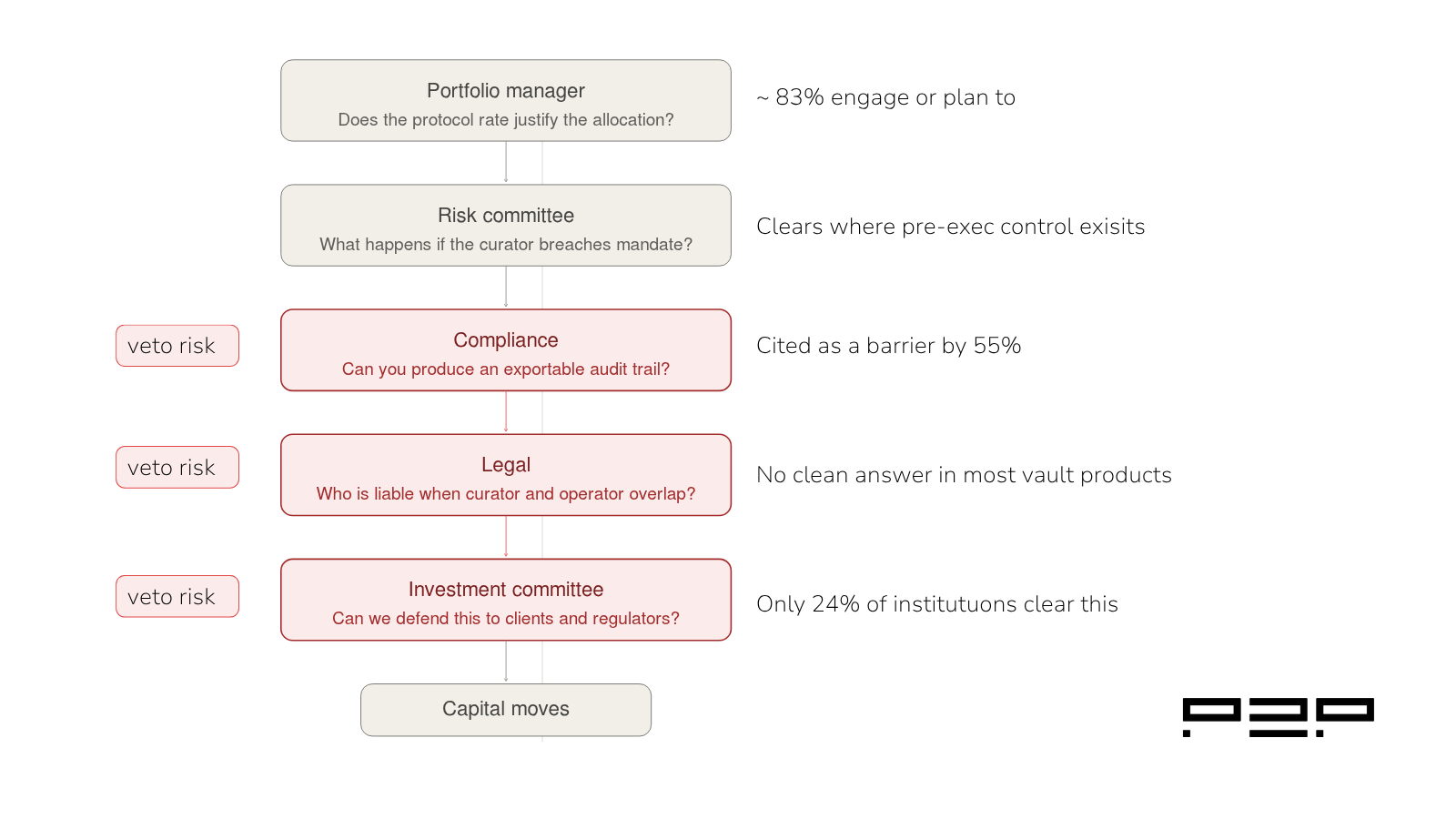
Where most institutional DeFi allocations stop before capital moves.
Learnings for Busy Readers
Short on time? Here are the key takeaways. For the full analysis and supporting data, continue reading below.
Most DeFi vaults were designed for retail capital, which creates three structural gaps that regulated institutions cannot work around: no pre-execution mandate validation, no exportable compliance log, and no contractual role separation between curator and operator.
Permissioned access does not close those gaps. KYC-gated pools and whitelisted depositor sets answer whether an institution can enter a protocol. They do not answer whether the institution can demonstrate, after the fact, that capital was managed within mandate parameters at every point.
The Aave Arc case is instructive: a permissioned product built specifically for regulated institutions holds $50,000 in total value locked. The architecture was right. The governance layer was missing.
The infrastructure that closes the institutional DeFi gap is not an upgraded version of what retail vaults provide. It is a separate layer entirely, sitting above the curator and the execution environment, validating every transaction before it settles and producing a compliance log that survives external audit.
DeFi Vaults Were Designed for a Different Risk Framework
To understand the gap, it helps to understand what DeFi vaults were originally designed to do.
The vault model emerged as a solution to a genuine problem: retail capital wanted access to DeFi protocol yields without the operational complexity of managing positions manually across multiple protocols. A vault abstracts that complexity. A depositor commits capital, a curator manages the allocation strategy, and the vault smart contract executes the rebalances automatically.
That design is highly effective for its intended use case. Morpho's curated vault system holds roughly $5.8 billion in total value locked. Kamino manages $2.36 billion on Solana. The market has validated the product architecture at scale.
But the risk framework built into that architecture reflects retail assumptions. In a retail context, the depositor evaluates the curator's track record and the protocol's audit history, accepts the smart contract risk, and monitors the position through a dashboard. The governance question is essentially: do I trust this curator? The compliance question does not exist. The audit trail requirement does not exist. The mandate validation requirement does not exist.
Regulated institutions do not operate in that framework. They operate in one where capital allocation decisions are governed by documented mandates, reviewed by multiple internal functions, and subject to post-hoc audit by external parties. The gap between those two frameworks is not a gap in risk tolerance alone. It is a gap in what the infrastructure is required to produce.
The Three Governance Gaps
Gap 1: No Pre-Execution Mandate Validation
In most vault architectures, the curator decides the allocation strategy and the smart contract executes it. There is no independent layer between the curator's decision and on-chain settlement that validates whether the execution is within the client's mandate parameters before it occurs.
For a retail depositor, this is acceptable. The depositor has opted into the curator's strategy and accepts the execution as designed.
For a regulated institution, it is a structural problem. The same EY-Parthenon and Coinbase survey found that compliance risk was cited by 55% of institutional investors as a barrier to DeFi engagement, and lack of internal expertise by 51%. These are not concerns about whether DeFi is legal. They are concerns about whether institutions can operationalize DeFi exposure within their existing risk frameworks. A position that breaches a concentration limit settles on-chain before the risk committee knows it happened. The institution discovers the breach through portfolio monitoring after the fact. That sequence does not clear a risk committee.
Pre-execution mandate validation means every curator transaction is checked against the client's parameters before it settles: concentration limits, protocol allowlists, slippage thresholds, and oracle integrity checks. The breach does not settle. It is blocked. That is a fundamentally different infrastructure function from monitoring, and most vault products do not have it.
Gap 2: No Exportable Compliance Log
A vault dashboard shows current positions, historical performance, and rebalancing history. That is monitoring infrastructure. It is useful for portfolio management. It is not an audit trail.
An audit trail is a sequential log of every execution decision, the parameters checked at the time of each execution, every transaction blocked and the mandate limit that triggered the block, in a format that can be exported and verified independently by an external auditor. The difference matters because auditors and regulators are not checking whether the positions look correct now. They are checking whether the institution can demonstrate that every decision was within mandate parameters at the time it was made.
Most vault products cannot produce that demonstration because the infrastructure to generate it was never built. The design assumption was that on-chain transparency, the ability to verify every transaction on a block explorer, was equivalent to an audit trail. For regulatory purposes, it is not.
Gap 3: No Contractual Role Separation
Academic analysis of on-chain lending from October 2024 to November 2025 across six major lending systems found that a small set of curators intermediates a disproportionate share of system total value locked, and that the main locus of risk in DeFi lending has migrated from base protocols to the curator layer, where competing vault managers decide which assets and loans are originated. The researchers argue this shift requires a corresponding upgrade in transparency standards(Source: Institutionalizing Risk Curation in Decentralized Credit, arXiv, December 2025.).
In most vault architectures, the curator who designs the strategy and the operator who manages the infrastructure are either the same entity or operate without contractually separated liability boundaries. For retail capital, this simplifies the relationship. There is one counterparty.
For regulated institutions, it creates an unresolvable legal problem. When something goes wrong, who is liable? The curator who made the allocation decision? The operator who managed the smart contract? If those functions are not contractually separated with explicit liability maps, legal cannot answer the question. And legal, not being able to answer the question, means the allocation does not proceed.
The framework that regulated institutions apply to every other delegated capital management arrangement requires defined counterparty roles with non-overlapping responsibilities. A structure where curator and operator are the same entity, or where their liability boundaries are undefined, does not fit that framework.
Why Permissioned Access Does Not Solve the Problem
The common industry response to the institutional adoption gap has been to add permissioned access layers: KYC-gated pools, whitelisted depositor sets, and compliance-oriented interfaces.
The data on this approach is instructive. As Sygnum Bank noted in its institutional DeFi assessment, at least one permissioned lending product built specifically for regulated institutions held a negligible $50,000 in total value locked despite being architecturally designed to meet institutional compliance requirements. KYC-gated vaults and permissioned lending pools more broadly have not attracted meaningful institutional flows. Sygnum, one of the few regulated digital asset banks, concluded that nearly all inflows continue to come from asset managers, hedge funds, or crypto-native firms with higher risk tolerance, not from the major institutional decision-makers the products were designed to serve.
The reason is that permissioned access addresses the wrong problem. The question institutional due diligence asks is not "can we access this protocol compliantly?" It is "can we demonstrate, after the fact, that our capital was managed within mandate parameters at every point, by a counterparty whose liability is contractually defined?" Access controls do not answer that question. Pre-execution validation, audit trail infrastructure, and role separation do.
Even where regulatory conditions are improving, the resolution institutional decision-makers require is not primarily regulatory. It is architectural.
What Institutional-Grade Vault Infrastructure Actually Requires
The institutions that have successfully deployed capital into DeFi protocols have done so by identifying infrastructure that addresses each of the three gaps directly.
Société Générale, through its digital assets division SG FORGE, became the first major global bank to deploy capital into permissionless DeFi, using Morpho protocol vaults on Ethereum mainnet following months of due diligence and a purpose-built institutional risk framework. The methodology developed for that deployment required answering the same three governance questions that stop most institutions: pre-execution controls, audit-compatible reporting, and defined role boundaries.
The infrastructure requirement is not a higher version of what retail vaults provide. It is a different category of function entirely: a protection layer that sits between the institution and the execution environment, independent of the curator, validating every transaction before it settles and producing a compliance log that can survive an external audit.
Institutional crypto asset management is projected to grow at a 25.5% compound annual growth rate, reaching $5.53 billion by 2030, with that growth contingent on regulatory clarity and advances in custody standards. The custody and reporting standards that growth depends on are not being built at the protocol layer. They are being built at the protection layer above it.
Key Takeaway
The institutional DeFi adoption gap is not primarily a yield problem, a regulatory problem, or a protocol maturity problem. It is a governance architecture problem.
DeFi vaults were built for retail capital, and the assumptions built into that architecture do not accommodate the pre-execution controls, audit trail infrastructure, or role separation that regulated institutions require as standard. Permissioned access addresses the access question. It does not address the governance question. And the governance question is the one that determines whether an allocation clears internal approval.
The infrastructure that closes the gap is not an extension of what current vault products provide. It is a new layer entirely.
What is the difference between a DeFi vault and institutional-grade vault infrastructure?
A DeFi vault allocates capital according to a curator's strategy and executes rebalances automatically through a smart contract. Institutional-grade vault infrastructure adds a protection layer above that execution environment: pre-execution mandate validation that checks every transaction against the client's parameters before settlement, an exportable compliance log that produces an audit-compatible record of every execution decision, and contractually defined role separation between the curator, the operator, and the infrastructure provider. These are not enhancements to the vault product. They are a separate infrastructure function.
Why do institutional allocators require pre-execution mandate validation?
Because post-execution monitoring does not satisfy institutional risk governance requirements. If a vault rebalance breaches a concentration limit, post-execution monitoring surfaces the breach after the transaction has settled on-chain. For a regulated institution, that sequence means the breach is already in the portfolio by the time the risk committee is notified. Pre-execution validation blocks the transaction before it settles. That is the governance standard applied to every other delegated capital management arrangement in regulated finance.
What does an institutional-grade compliance log contain?
A compliance log for institutional DeFi purposes should contain a sequential record of every execution decision, the specific mandate parameters checked at the time of each decision, every transaction blocked and the mandate limit that triggered the block, and every protocol interaction, all in a format that can be exported and verified independently by an external auditor. A block explorer provides transaction verification. A compliance log provides mandate verification. The distinction matters for regulatory audit purposes.
Why has permissioned DeFi access not attracted significant institutional capital?
Permissioned access addresses whether institutional participants can enter a DeFi protocol in a compliant manner. It does not address whether the governance architecture of the vault itself satisfies institutional due diligence requirements. The three barriers that stop most institutional allocations are the absence of pre-execution mandate controls, the absence of an exportable audit trail, and the absence of contractual role separation. KYC gating and whitelisted pools do not address any of those three requirements.
Which institutions have successfully deployed capital into DeFi vaults?
Société Générale, through SG FORGE, deployed into Morpho protocol vaults following a purpose-built institutional risk framework. Bitwise launched a non-custodial vault on Morpho in January 2026. Anchorage Digital provides institutional clients with access to Morpho Vaults with custody of the resulting vault tokens. Each of these deployments required developing or identifying governance infrastructure that addressed the pre-execution, audit, and role separation requirements that standard vault products do not provide.
Get Advise
P2P.org builds the protection layer that sits between regulated institutions and DeFi execution environments. If you are evaluating the infrastructure requirements, for a DeFi allocation program, talk to our team.
Disclaimer
This article is provided for informational purposes only and does not constitute legal, regulatory, compliance, or investment advice. Regulatory obligations may vary depending on jurisdiction and specific business activities. Readers should consult their own legal and compliance advisors regarding applicable requirements.
Subscribe to P2P-economy
Get the latest posts delivered right to your inbox
<p><strong>Series:</strong> Validator Playbook | Institutional Infrastructure</p><p>The Validator Playbook is <a href="http://p2p.org/?ref=p2p.org">P2P.org</a>'s operational series for infrastructure engineers, staking product managers, and validator risk committees building or evaluating institutional-grade staking programs. Each article addresses a specific operational, technical, or governance dimension of running or selecting validator infrastructure at an institutional scale.</p><p><strong>Previously in the series:</strong> <a href="https://p2p.org/economy/ethereum-slashing-explained-what-custodians-funds-exchanges-must-know/">Ethereum Slashing Explained: What Custodians, Funds and Exchanges Must Know</a></p><h2 id="learnings-for-busy-readers">Learnings for Busy Readers</h2><p><strong>What this article covers:</strong></p><ul><li>Why standard metrics like fees and uptime are insufficient for institutional due diligence</li><li>The seven dimensions that institutional validator due diligence must cover</li><li>The questions to ask at each stage and what good answers actually look like</li><li>A complete due diligence checklist for procurement and risk committee use</li></ul><p><strong>The core argument:</strong> Validator due diligence is not a yield evaluation. It is an engineering reliability assessment. The institutions that make delegation decisions on the basis of mechanisms, not marketing, consistently achieve better outcomes across uptime, slashing avoidance, and incident response.</p><h2 id="introduction">Introduction</h2><p>Most validator due diligence processes start in the wrong place. Fee schedules get compared. Uptime dashboards get reviewed. Marketing materials get forwarded to risk committees. And then a delegation decision gets made on the basis of information that does not actually describe how a validator performs when something goes wrong.</p><p>In 2026, staking is no longer a peripheral activity for institutions. The institutional staking services market reached USD 5.8 billion in 2024 and is projected to grow to USD 33.31 billion by 2033 (Source: <a href="https://coinshares.com/us/insights/knowledge/institutional-staking-on-the-rise/?ref=p2p.org">CoinShares</a>). As allocations grow and staking becomes embedded in custody platforms, treasury programs, and regulated ETF products, the validator selection decision carries consequences that extend well beyond the immediate yield impact. A validator failure is an operational incident. A slashing event is a financial loss and potentially a regulatory disclosure obligation. Getting the selection process right is not optional.</p><p>This article sets out a practical due diligence framework for institutional teams evaluating validator infrastructure. It is written for staking product managers, validator risk committees, infrastructure engineers, and procurement teams who need to go beyond the surface metrics and understand what a validator operation actually looks like under stress.</p><h2 id="why-standard-metrics-are-not-enough">Why Standard Metrics Are Not Enough</h2><p>The most commonly referenced validator metrics are commission rate, advertised APY, and uptime percentage. None of these tells you what you actually need to know.</p><p>The commission rate tells you the price. It does not tell you what the price buys, whether the fee model is sustainable, or whether the operator has the resources to invest in the infrastructure quality that protects your stake. An aggressively low fee may be attractive in the short term, but it can also signal an under-resourced operation or a commercial strategy focused on volume rather than long-term relationships. </p><p>Advertised APY is a function of network conditions, not operator quality. Two validators on the same network with identical commission rates will produce similar yields under normal conditions. The difference between them shows up during chain upgrades, periods of network congestion, and incident response.</p><p>In 2026, the highest-impact staking outcomes are determined by operational reliability, key-management decisions, and incident behaviour, not the headline APR. The most expensive failures show up during chain upgrades, congestion, correlated cloud incidents, or governance-driven parameter changes (Source: <a href="https://cryptoadventure.com/staked-review-2026-non-custodial-institutional-staking-reporting-and-tradeoffs/?ref=p2p.org">Crypto Adventure</a>).</p><p>Uptime percentage is the most misleading metric of all. A validator can show 99.9% average uptime across a reporting period while having failed catastrophically during the one critical window that mattered. A client upgrade weekend. A network fork. A period of unusual congestion. Average uptime hides the variance that institutional risk frameworks are designed to assess.</p><p>The right frame for validator due diligence is not a yield evaluation. It is an engineering reliability assessment conducted the same way a risk committee would assess any critical infrastructure vendor.</p><figure class="kg-card kg-image-card kg-card-hascaption"><img src="https://p2p.org/economy/content/images/2026/04/validator_due_diligence_seven_dimensions.jpg" class="kg-image" alt="A seven-dimensional framework for institutional validator due diligence showing infrastructure architecture, key management, slashing risk controls, change management, reporting and auditability, commercial terms and exit, and protocol coverage, with a signal of maturity for each dimension." loading="lazy" width="1600" height="900" srcset="https://p2p.org/economy/content/images/size/w600/2026/04/validator_due_diligence_seven_dimensions.jpg 600w, https://p2p.org/economy/content/images/size/w1000/2026/04/validator_due_diligence_seven_dimensions.jpg 1000w, https://p2p.org/economy/content/images/2026/04/validator_due_diligence_seven_dimensions.jpg 1600w" sizes="(min-width: 720px) 720px"><figcaption><i><em class="italic" style="white-space: pre-wrap;">The seven dimensions of institutional validator due diligence. Each row covers what the dimension includes and what a strong answer from a provider looks like.</em></i></figcaption></figure><h2 id="the-seven-dimensions-of-institutional-validator-due-diligence">The Seven Dimensions of Institutional Validator Due Diligence</h2><h3 id="1-infrastructure-architecture-and-failure-mode-analysis">1. Infrastructure Architecture and Failure Mode Analysis</h3><p>The first question is not where the infrastructure is located. It is how it's designed to fail.</p><p>Every validator infrastructure has failure modes. The relevant question is whether those failure modes are independent or correlated. A validator operation that runs all nodes in the same cloud region with the same automation pipeline and the same deployment tooling has correlated failure risk. A single incident, a regional outage, or a software bug in an automated update can take down the entire operation simultaneously.</p><p>Validator operations should be evaluated like reliability engineering. A buyer should focus on correlated failure and safe redundancy. Downtime can trigger penalties when validators fail to meet protocol participation requirements. More severe penalties can be triggered by unsafe redundancy that leads to double-signing (Source: <a href="https://cryptoadventure.com/staked-review-2026-non-custodial-institutional-staking-reporting-and-tradeoffs/?ref=p2p.org">Crypto Adventure</a>).</p><p>The architecture questions that matter:</p><ul><li>Are nodes distributed across independent infrastructure providers and geographic regions?</li><li>Are multiple consensus client implementations supported to reduce client diversity risk?</li><li>Is there active-active or active-passive failover, and how does the failover logic prevent double-signing?</li><li>What is the rollback procedure if a software update causes instability?</li><li>Does the provider operate bare metal infrastructure, cloud, or a hybrid, and how is each maintained?</li></ul><p>A mature operator can answer each of these questions with specifics. An operator competing primarily on price typically cannot.</p><h3 id="2-key-management-and-access-controls">2. Key Management and Access Controls</h3><p>Validator key management is the most consequential security dimension in any staking program. A key compromise does not always result in direct theft of assets, but it can result in slashable behaviour, validator downtime, loss of governance participation, and reputational exposure that exceeds the financial loss.</p><p>In institutional staking, not all risk lies in infrastructure. It is also critical to understand who controls what: funds, signing keys, withdrawal credentials, reward parameters, exit processes, and operational authorisations. It is therefore not enough to speak abstractly about custodial or non-custodial staking. Due diligence must break down the operational and contractual flow: what the operator does, what the client retains, what the custodian controls, and which points require joint authorisation.</p><p>The key management questions that matter:</p><ul><li>Are signing keys and withdrawal keys held in separate environments with separate access controls?</li><li>Are Hardware Security Modules (HSMs) used for signing key operations?</li><li>How is access to signing infrastructure controlled, logged, and audited?</li><li>What is the procedure for key rotation, and how is it tested?</li><li>How is double-signing prevented specifically during failover events?</li></ul><p>Institutions should request a written description of the key management architecture, not a verbal summary. The document should specify who holds what access, under what conditions access is granted, and how key operations are logged.</p><h3 id="3-slashing-risk-controls-and-incident-history">3. Slashing Risk Controls and Incident History</h3><p>Slashing is the protocol-level penalty for validator misbehaviour. The two primary causes are double-signing and prolonged inactivity. Both are largely preventable through good operational design. For a detailed breakdown of how Ethereum's slashing mechanics work at the protocol level, refer to the previous article in this series: <a href="https://p2p.org/economy/ethereum-slashing-explained-what-custodians-funds-exchanges-must-know/">Ethereum Slashing Explained: What Custodians, Funds and Exchanges Must Know</a>.</p><p>For institutional due diligence, the relevant questions are not whether slashing has occurred, but what the operator's controls are, whether those controls have been tested, and what happened in any historical incidents.</p><p>The slashing risk questions that matter:</p><ul><li>What technical controls prevent double-signing during failover events specifically?</li><li>Has the operator experienced any slashing events? What was the root cause, and what architectural changes followed?</li><li>How are slashing conditions monitored in real time?</li><li>What is the incident response procedure if a slashing risk is detected before it triggers?</li><li>What contractual coverage applies to slashing losses, and what are the specific exclusions?</li></ul><p>Be precise about slashing guarantee language. Whether slashing guarantees exist and what exclusions apply is a critical evaluation question. The due diligence question is not whether these words exist on a page, but how they map to reality: how keys are protected, how changes are approved, what happens in incident response, and what financial or contractual backstops exist (Source: <a href="https://cryptoadventure.com/stakin-review-2026-iso-27001-non-custodial-staking-the-tie-acquisition-pros-and-cons/?ref=p2p.org">Crypto Adventure</a>).</p><h3 id="4-change-management-and-protocol-upgrade-handling">4. Change Management and Protocol Upgrade Handling</h3><p>Protocol upgrades are one of the highest-risk moments in any validator operation. Client software must be updated within specific windows. Timing matters. Rollback procedures must be available. Governance decisions must be understood and acted on promptly.</p><p>Institutions that delegate to validators are, in effect, delegating the decision of how protocol upgrades are handled. That is a governance decision with direct financial consequences, and it requires explicit evaluation.</p><p>The upgrade management questions that matter:</p><ul><li>How does the operator track protocol upgrade schedules across the networks it validates?</li><li>What is the process for testing upgrades before deploying to production validators?</li><li>How are staged rollouts managed, and what triggers a rollback?</li><li>Does the operator participate in validator governance processes, and is there a documented policy?</li><li>How are clients notified of upcoming upgrades and their potential operational impact?</li></ul><h3 id="5-reporting-and-auditability">5. Reporting and Auditability</h3><p>Institutional staking programs require reward attribution at the validator level, in formats compatible with internal risk management systems and external audit requirements. A dashboard is a monitoring infrastructure. An audit trail is something different.</p><p>A buyer should request sample reporting packs that mirror internal requirements, including reward timing granularity and event classification, clear separation of principal, rewards, and fees, and chain event treatment such as redelegations or downtime penalties.</p><p>The reporting questions that matter:</p><ul><li>Can the provider deliver reward attribution at the validator level, disaggregated by epoch and by asset?</li><li>Is the reporting format compatible with internal accounting and risk management systems?</li><li>Is there an exportable, independently verifiable audit log of all validator operations, not just a dashboard?</li><li>How are chain events such as downtime penalties, redelegations, and slashing incidents logged and reported?</li><li>Can reporting be delivered in formats required for tax reporting in the institution's operating jurisdiction?</li></ul><p>On certifications: SOC 2 Type II is the most relevant independent security attestation for validator infrastructure providers. Enterprise clients typically want Type II reports because they demonstrate how controls perform in real operations, not just at a point in time (Source: <a href="https://wolfia.com/blog/soc-2-compliance-requirements-complete-guide?ref=p2p.org">Wolfia</a>). A SOC 2 Type II report covering availability and security criteria provides meaningful independent assurance that the controls governing validator uptime and key management are operating as documented. It is a floor, not a ceiling, but it is a meaningful one. <a href="http://p2p.org/?ref=p2p.org">P2P.org</a> achieved SOC 2 Type II certification in December 2025, independently validating our operational controls across security and availability criteria.</p><h3 id="6-commercial-terms-slas-and-exit-procedures">6. Commercial Terms, SLAs, and Exit Procedures</h3><p>The commercial structure of a staking relationship defines the accountability framework. Fees, SLAs, and exit procedures are not administrative details. They are the contractual expression of how risk is allocated between the institution and the provider.</p><p>SLAs should specify response times, escalation paths, penalties if uptime falls below the guarantee, and custom agreements. The question is what support is included: 24/7 monitoring, dedicated account teams, reporting, incident management, custodian integrations, contractual coverage, and contingency response capability.</p><p>The commercial terms questions that matter:</p><ul><li>What is the fee structure, and what is explicitly included vs. billed as an add-on?</li><li>Are there different tiers for standard delegation versus dedicated validator operations?</li><li>What does the SLA actually commit to, and what are the remedies if commitments are not met?</li><li>What is the procedure for migrating stake to a different provider if the relationship ends?</li><li>What would happen operationally if the provider ceased operations, and is there a documented continuity plan?</li></ul><p>It is also important to review exit processes: migration, validator changes, and orderly off-boarding. Another useful question is what would happen if the provider ceased operations tomorrow. The quality of the answer often reveals its maturity.</p><h3 id="7-protocol-coverage-and-multi-chain-operational-consistency">7. Protocol Coverage and Multi-Chain Operational Consistency</h3><p>Institutional staking programs increasingly span multiple proof-of-stake networks. Ethereum, Solana, Polkadot, Cosmos, and others each have distinct consensus mechanisms, upgrade cycles, slashing conditions, and governance processes. A provider that operates well on Ethereum may not have the same operational maturity on Solana.</p><p>The protocol coverage questions that matter:</p><ul><li>On which networks does the provider have the deepest operational track record?</li><li>Are the infrastructure, architecture, and key management controls consistent across all supported networks?</li><li>How does the provider handle networks with different upgrade cadences and governance participation requirements?</li><li>Is there chain-specific reporting available for each network in the institution's portfolio?</li><li>How many networks does the provider support, and is that breadth matched by operational depth?</li></ul><p><a href="http://p2p.org/?ref=p2p.org">P2P.org</a> operates non-custodial validator infrastructure across more than 40 proof-of-stake networks, with consistent operational standards applied across each. Our <a href="https://p2p.org/networks/solana?ref=p2p.org">Solana staking infrastructure</a> and <a href="https://p2p.org/networks/ethereum?ref=p2p.org">Ethereum staking infrastructure</a> pages describe the specific architecture and reporting capabilities for each network, and our <a href="https://docs.p2p.org/?ref=p2p.org">technical documentation</a> provides integration details for procurement and engineering teams.</p><blockquote><strong>Evaluating validator infrastructure for your institution?</strong> <a href="http://p2p.org/?ref=p2p.org">P2P.org</a> provides non-custodial staking across 40+ proof-of-stake networks with SOC 2 Type II certified operational controls, validator-level reporting, and dedicated institutional support. <a href="https://p2p.org/networks/ethereum?ref=p2p.org">Explore P2P.org Staking Infrastructure</a></blockquote><h2 id="due-diligence-checklist">Due Diligence Checklist</h2><p>For staking product managers, validator risk committees, and procurement teams conducting institutional validator due diligence. Organised by the seven dimensions covered above.</p><p><strong>Infrastructure architecture:</strong> [ ] Nodes distributed across independent infrastructure providers and geographic regions [ ] Multiple consensus client implementations supported to reduce client diversity risk [ ] Failover logic documented and specifically designed to prevent double-signing [ ] Rollback procedures exist and have been tested for software update failures [ ] Infrastructure type (bare metal, cloud, hybrid) documented with maintenance procedures</p><p><strong>Key management:</strong> [ ] Signing keys and withdrawal keys held in separate environments with separate access controls [ ] HSM or equivalent used for signing key operations [ ] Access to signing infrastructure is logged, audited, and role-based [ ] Key rotation procedures are documented and tested [ ] Double-signing prevention mechanism specifically covers failover scenarios</p><p><strong>Slashing risk controls:</strong> [ ] Technical controls against double-signing during failover are documented [ ] Slashing incident history reviewed, including root cause and architectural changes [ ] Real-time slashing condition monitoring is in place with defined alerting [ ] Incident response procedure for pre-slashing detection is documented [ ] Slashing guarantee or coverage language reviewed with specific exclusions confirmed</p><p><strong>Change management:</strong> [ ] Protocol upgrade tracking process documented for all supported networks [ ] Staged rollout and rollback procedures for software updates are in place [ ] Governance participation policy is documented [ ] Client notification process for upgrades is defined with timelines</p><p><strong>Reporting and auditability:</strong> [ ] Validator-level reward attribution available disaggregated by epoch and asset [ ] Reporting format compatible with internal accounting and risk management systems [ ] Exportable audit log of all validator operations available (not dashboard only) [ ] Chain event treatment (downtime, redelegations, slashing) is logged and reportable [ ] SOC 2 Type II report available covering security and availability criteria</p><p><strong>Commercial terms:</strong> [ ] Fee structure reviewed with explicit list of included vs. additional services [ ] SLA reviewed with specific uptime commitments and remedies confirmed [ ] Exit and migration procedure documented [ ] Operational continuity plan reviewed for provider cessation scenario</p><p><strong>Protocol coverage:</strong> [ ] Operational track record reviewed on each specific network in the institution's portfolio [ ] Infrastructure and key management controls confirmed as consistent across networks [ ] Chain-specific reporting confirmed as available for each required network [ ] Governance participation policy confirmed for each relevant network</p><h2 id="key-takeaway">Key Takeaway</h2><p>Validator due diligence is a reliability engineering assessment. The institutions that treat it as a yield comparison consistently underperform relative to those that evaluate mechanisms: how the infrastructure is designed to fail safely, how keys are managed and protected, how slashing is prevented rather than just insured against, and how the provider behaves when something goes wrong.</p><p>The seven dimensions covered in this framework are not equally weighted. Infrastructure architecture and key management are foundational. Slashing history and controls are the clearest signals of operational maturity. Reporting and audit trail capability determine whether the program can survive internal compliance scrutiny. Commercial terms and exit procedures define accountability. Protocol coverage determines whether the relationship can grow with the institution's staking program.</p><p>Evaluate each dimension with evidence, not assertions. Request documentation, ask for incident histories, and treat the quality of answers as a signal in itself.</p><h2 id="faq">FAQ</h2><p><strong>What is validator due diligence?</strong></p><p>Validator due diligence is the process of evaluating a proof-of-stake validator infrastructure provider before delegating institutional capital. It covers infrastructure architecture, key management, slashing risk controls, change management, reporting capabilities, commercial terms, and protocol coverage. It is distinct from a yield evaluation and should be conducted as a reliability engineering assessment.</p><p><strong>Why are uptime percentages insufficient for institutional due diligence?</strong></p><p>Average uptime percentages hide variance. A validator can achieve 99.9% average uptime while failing critically during the specific high-risk windows that matter most, such as client upgrades, network forks, or congestion events. Institutional risk frameworks require understanding incident behaviour and failure mode design, not average performance under normal conditions.</p><p><strong>What is the most important dimension of validator due diligence?</strong></p><p>Infrastructure architecture and key management are the foundational dimensions. Slashing history and controls are the clearest signals of operational maturity. No single dimension is sufficient on its own. A provider with excellent infrastructure but opaque key management or no documented incident response is not a complete institutional partner.</p><p><strong>What certifications should an institutional staking provider have?</strong></p><p>SOC 2 Type II is the most relevant independent security attestation for validator infrastructure providers. It independently verifies that operational controls governing uptime and security are operating as documented over a sustained period, not just at a point in time. ISO 27001 is an additional signal of information security management maturity. Certifications are a floor, not a ceiling, and should be reviewed alongside the specific controls they cover.</p><p><strong>How should institutions evaluate slashing guarantees offered by providers?</strong></p><p>Slashing guarantee language requires careful examination. The relevant questions are not whether the guarantee exists but what the specific exclusions are, what the maximum coverage is, and how the guarantee maps to the provider's actual controls. A guarantee that excludes the most likely slashing causes, such as misconfigurations during upgrades, provides limited protection. The strongest protection comes from robust anti-slashing controls, not contractual language.</p><p><strong>What should the exit and migration procedures include?</strong></p><p>Exit and migration procedures should document how stake is transferred to a new provider without exposing the institution to unnecessary downtime or slashing risk during the transition, who is responsible for each step, what the expected timeline is for each network, and what happens to accumulated rewards during the migration. Institutions should test the provider's fluency with this question during initial evaluation. A provider who cannot answer clearly has not thought through the scenario.</p><p><strong>How does validator due diligence differ across proof-of-stake networks?</strong></p><p>Each proof-of-stake network has distinct consensus mechanisms, upgrade cadences, slashing conditions, and governance processes. Validator due diligence must be conducted on a network-by-network basis, not generalised across a provider's entire portfolio. A provider with deep operational experience on Ethereum may have more limited maturity on Solana or Polkadot. Request chain-specific incident history and performance evidence for each network in the institution's staking program.</p><hr><p><strong>Get Advise</strong></p><p><em>Protocol-generated rewards are determined by network conditions and are variable. </em><a href="http://p2p.org/?ref=p2p.org"><em>P2P.org</em></a><em> does not control or set reward rates. Slashing risks are protocol-defined and client-borne. Operational safeguards are implemented to reduce slashing exposure, but do not eliminate protocol-level risk.</em></p><hr><p><strong><em>Disclaimer</em></strong></p><p>This article is provided for informational purposes only and does not constitute legal, regulatory, compliance, or investment advice. Regulatory obligations may vary depending on jurisdiction and specific business activities. Readers should consult their own legal and compliance advisors regarding applicable requirements.</p>
<p>The start of April 2026 has brought several significant developments across Ethereum staking infrastructure, tokenized asset markets, ETF product evolution, and the convergence of traditional and on-chain finance.</p><p>From the Ethereum Foundation completing a landmark treasury shift to Apollo Global Management deepening its on-chain lending infrastructure commitment, this edition highlights five developments shaping how institutional capital interacts with decentralized networks.</p><p>👉 Subscribe to our newsletter at the bottom of this page to receive a monthly summary of the latest DeFi and staking developments, curated for institutional participants.</p><h2 id="quick-learning-for-busy-readers"><strong>Quick Learning for Busy Readers</strong></h2><ul><li>The Ethereum Foundation has completed its 70,000 ETH staking commitment, shifting from ETH sales to a protocol-native yield model</li><li>Grayscale's Ethereum Staking ETF has operationalized new liquidity mechanics for managing staked asset redemptions</li><li>Tokenized U.S. Treasuries have crossed $12.88 billion in distributed asset value, with represented asset value up 31% in thirty days</li><li>Major financial institutions are actively transitioning parts of the repo market onto blockchain settlement infrastructure</li><li>Apollo Global Management has entered a structured cooperation agreement with Morpho, committing to acquire up to 9% of the protocol's governance token supply over four years</li></ul><p>Missed the previous DeFi Dispatch? Catch up on the latest DeFi news and signals from the previous edition:</p><p>👉 <a href="https://p2p.org/economy/defi-dispatch-defi-news-and-signals-march-2026-issue-2/">https://p2p.org/economy/defi-dispatch-defi-news-and-signals-march-2026-issue-2/</a></p><h2 id="whats-driving-defi-markets-at-the-start-of-april-2026"><strong>What's driving DeFi markets at the start of April 2026?</strong></h2><p>The developments at the opening of April 2026 reflect a market in structural transition. Institutional participants are moving from observing blockchain infrastructure to actively embedding capital within it, whether through staking treasury strategies, ETF product development, on-chain settlement systems, or direct protocol governance positions.</p><p>Below, we break down five key developments and why they matter for asset managers, custodians, hedge funds, ETF issuers, exchanges, and staking teams.</p><h3 id="1-the-ethereum-foundation-completes-its-70000-eth-staking-commitment"><strong>1. The Ethereum Foundation Completes Its 70,000 ETH Staking Commitment</strong></h3><p>The Ethereum Foundation has staked roughly $143 million worth of ether, effectively completing its previously announced 70,000 ETH staking target. The move shifts the foundation from regularly selling ETH to fund its approximately $100 million in annual expenses toward earning a staking yield of an estimated $3.9 million to $5.4 million a year instead.</p><p>The goal is to generate staking rewards to fund protocol research, grants, and operations, replacing the previous practice of selling ETH, which often created sell pressure in the market. The program uses open-source tools for distributed signing and validator management with diverse client pairings for security and decentralization, with no reliance on centralized providers.</p><p>Sources: <a href="https://www.coindesk.com/markets/2026/04/03/ethereum-foundation-stakes-another-usd93-million-ether-reaching-its-70-000-eth-target?ref=p2p.org" rel="noreferrer">CoinDesk</a>, <a href="https://www.tekedia.com/ethereum-foundation-stakes-22517-eth-via-the-treasurys-multisignature-wallet/?ref=p2p.org" rel="noreferrer">Tekedia</a></p><h4 id="why-is-this-important"><strong>Why is this important?</strong></h4><p>This development matters for several interconnected reasons:</p><ul><li>It signals that even the network's own foundation views staking as a preferred capital management mechanism over market liquidations.</li><li>It reduces structural ETH sell pressure from one of the ecosystem's largest treasury holders.</li><li>It demonstrates how large institutional entities can use proof-of-stake mechanics to generate protocol-native yield without relying on centralized staking providers.</li><li>It reinforces the importance of validator infrastructure as the operational layer enabling these treasury strategies at scale.</li></ul><p>For validator operators and staking teams, the Ethereum Foundation's shift models a treasury playbook that asset managers and treasury committees are increasingly considering.</p><h3 id="2-grayscale-ethereum-staking-etf-operationalizes-new-redemption-mechanics"><strong>2. Grayscale Ethereum Staking ETF Operationalizes New Redemption Mechanics</strong></h3><p>Beginning on April 6, 2026, Grayscale's Ethereum Staking ETF introduced new liquidity tools for handling share redemptions when Ethereum liquidity is constrained, including the ability to use delayed delivery orders where digital assets owed to a liquidity provider are delivered once specific staked assets become transferable.</p><p>The formalization of a liquidity provider agreement represents a significant operational milestone, designed to ensure the ETF functions smoothly on NYSE Arca with proper mechanisms for share creation, redemption, and trading. </p><p>Sources: <a href="https://www.stocktitan.net/sec-filings/ETHE/8-k-grayscale-ethereum-staking-etf-reports-material-event-f99833794056.html?ref=p2p.org" rel="noreferrer">Stocktitan</a>, <a href="https://www.minichart.com.sg/2026/04/07/grayscale-ethereum-staking-etf-files-8-k-with-sec-key-details-and-registration-information/?ref=p2p.org">Minichart</a>.</p><h4 id="why-is-this-important-1"><strong>Why is this important?</strong></h4><p>Staking within an ETF structure introduces liquidity management challenges that do not exist in standard spot products. The unbonding period on Ethereum means staked assets cannot be instantly liquidated to meet redemptions. The operationalization of delayed delivery mechanisms is a direct response to this constraint, and its formal codification signals:</p><ul><li>ETF issuers are actively solving the redemption mechanics that staking introduces into regulated product structures.</li><li>Infrastructure decisions at the custody and validator layer directly affect how ETF products perform under redemption pressure.</li><li>As more issuers develop staking-enabled products, these operational frameworks become reference architecture for the broader market.</li></ul><p>For custodians, exchanges, and institutional staking teams, this is the mechanics layer that determines whether staking ETFs scale.</p><h3 id="3-tokenized-us-treasuries-cross-1288-billion-in-distributed-asset-value"><strong>3. Tokenized U.S. Treasuries Cross $12.88 Billion in Distributed Asset Value</strong></h3><p>As of early April 2026, tokenized U.S. Treasuries hold approximately $12.88 billion in total value across distributed and represented assets, having grown from roughly $5 billion in late 2024, reflecting sustained institutional demand. </p><p>Represented asset value across the broader tokenization ecosystem stood at $441.38 billion as of April 6, up 31.61% over the prior thirty days. A joint statement from the Federal Reserve, OCC, and FDIC in Q1 2026 clarified that the capital rule is technology-neutral, meaning an eligible tokenized security receives the same capital treatment as the non-tokenized form of the same security. </p><p>Sources: <a href="https://metamask.io/news/types-of-tokenized-real-world-assets-rwa-categories?ref=p2p.org">MetaMask</a>, <a href="https://www.fintechweekly.com/news/real-world-asset-tokenization-explainer-institutional-2026?ref=p2p.org">FinTech News</a>.</p><h4 id="why-is-this-important-2"><strong>Why is this important?</strong></h4><p>Tokenized government securities are becoming the benchmark low-risk asset for compliant institutional capital on-chain. The growth from $5 billion to nearly $13 billion in roughly 18 months reflects:</p><ul><li>A shift from experimentation to production-scale deployment among asset managers and funds.</li><li>Regulatory guidance providing the framework for banks and asset managers to treat tokenized instruments the same as their non-tokenized equivalents.</li><li>The emergence of programmable treasury management as a genuine institutional tool, not a pilot category.</li></ul><p>As tokenized assets scale, the reliability and security of the blockchain networks settling these instruments becomes increasingly central to institutional risk assessment.</p><h3 id="4-major-financial-institutions-move-repo-market-infrastructure-on-chain"><strong>4. Major Financial Institutions Move Repo Market Infrastructure On-Chain</strong></h3><p>As of April 6, 2026, major financial institutions are actively transitioning parts of the $12.5 trillion repo market onto Ethereum, representing one of the most significant signals of traditional finance embedding blockchain infrastructure into core settlement operations. </p><p>Institutional crypto in 2026 is increasingly centred on controlled access, with large financial firms using on-chain systems for repo, treasury activity, and cash management inside environments built around compliance and permissions, while simultaneously seeking access to the liquidity available on public chains. </p><p>Sources: <a href="https://coinmarketcap.com/cmc-ai/ethereum/latest-updates/?ref=p2p.org">CoinMarketCap</a>, <a href="https://beincrypto.com/on-chain-economy-splitting-in-two/?ref=p2p.org">BeInCrypto</a>.</p><h4 id="why-is-this-important-3"><strong>Why is this important?</strong></h4><p>The repo market is one of the most foundational mechanisms in global finance, functioning as the overnight collateral and liquidity backbone for banks, funds, and financial market participants. Its migration toward blockchain settlement infrastructure signals:</p><ul><li>Blockchain is no longer being evaluated as an alternative to traditional finance, but as the settlement layer for it.</li><li>On-chain settlement for repo creates direct demand for stable, high-performance validator infrastructure to process and finalize transactions reliably.</li><li>As permissioned and public chain environments begin connecting, validator operators supporting public networks become part of the institutional settlement stack.</li></ul><p>For hedge funds, custodians, and treasury teams, this is the convergence point many have been anticipating.</p><h3 id="5-apollo-global-management-enters-structured-cooperation-agreement-with-morpho"><strong>5. Apollo Global Management Enters Structured Cooperation Agreement With Morpho</strong></h3><p>Apollo Global Management struck a cooperation agreement to support lending markets built on Morpho's on-chain protocol. The deal allows Apollo to acquire up to 90 million MORPHO tokens over 48 months, which would represent approximately 9% of the protocol's governance token supply. The move follows BlackRock's push into decentralized finance, listing its tokenized fund and acquiring tokens of decentralized exchange Uniswap. </p><p>The Apollo deal follows several high-profile institutional partnerships that have helped Morpho strengthen its position in decentralized lending. In late January 2026, Bitwise Asset Management introduced its first on-chain vault on Morpho, offering USDC deposits with yields of up to 6%. Morpho currently holds approximately $5.8 billion in total value locked. </p><p>Sources: <a href="https://www.coindesk.com/business/2026/02/15/wall-street-giant-apollo-deepens-crypto-push-with-morpho-token-deal?ref=p2p.org">CoinDesk</a>, <a href="https://crypto.news/apollo-morpho-token-acquisition-defi-lending-2026/?ref=p2p.org">Crypto News</a>.</p><h4 id="why-is-this-important-4"><strong>Why is this important?</strong></h4><p>Apollo managing approximately $940 billion in assets, acquiring a governance stake in a DeFi lending protocol is not a portfolio allocation. It is a structural commitment to on-chain credit infrastructure:</p><ul><li>It signals that alternative asset managers are evaluating DeFi lending protocols as operational infrastructure, not speculative positions.</li><li>The cooperation agreement component, focused on supporting lending markets built on Morpho, means Apollo is embedding its credit expertise directly into on-chain vault design.</li><li>Morpho's curated vault architecture, where professional risk teams allocate capital across isolated lending markets, is increasingly the model that institutions recognize as compatible with their risk management requirements.</li></ul><p>For staking product managers, DeFi infrastructure teams, and risk committees, the Apollo deal is the clearest signal yet that institutional capital is moving beyond observation and into direct protocol-level engagement.</p><h2 id="key-takeaways-for-asset-managers-custodians-hedge-funds-etf-issuers-exchanges-and-staking-teams"><strong>Key Takeaways for Asset Managers, Custodians, Hedge Funds, ETF Issuers, Exchanges, and Staking Teams</strong></h2><p>The start of April 2026 highlights several converging trends:</p><ul><li>Staking is becoming a treasury management tool for major ecosystem participants, not only a validator activity.</li><li>ETF products are operationalizing the liquidity mechanics that staking introduces into regulated structures.</li><li>Tokenized real-world assets are moving from pilot to production at an institutional scale.</li><li>Traditional financial infrastructure, including repo markets, is beginning to settle on blockchain networks.</li><li>Alternative asset managers are acquiring direct governance positions in DeFi lending protocols.</li></ul><p>These developments reinforce how blockchain infrastructure is transitioning from an alternative financial layer to the settlement and operational backbone of institutional capital markets.</p><h2 id="frequently-asked-questions-faqs"><strong>Frequently Asked Questions (FAQs)</strong><br></h2><h3 id="why-is-defi-news-relevant-for-staking-participants"><strong>Why is DeFi news relevant for staking participants?</strong></h3><p>DeFi news reflects how capital flows through blockchain ecosystems. These flows influence staking participation rates, validator demand, and the economic conditions in which staking infrastructure operates.</p><h3 id="what-is-the-repo-market-and-why-does-its-move-on-chain-matter"><strong>What is the repo market,</strong> <strong> and why does its move on-chain matter?</strong></h3><p>The repo market is the mechanism by which financial institutions lend and borrow against collateral on a short-term basis. It underpins global liquidity. When it moves on-chain, it creates direct demand for the blockchain infrastructure that processes and finalizes those transactions.</p><h3 id="are-staking-yields-within-etf-structures-the-same-as-staking-directly"><strong>Are staking yields within ETF structures the same as staking directly?</strong></h3><p>No. ETF staking yields are affected by the proportion of assets staked, unbonding periods, custodian service fees, and the need to maintain liquidity reserves for redemptions. These factors mean ETF staking yields are typically lower than direct on-chain staking yields.</p><h3 id="what-does-tokenized-treasury-growth-mean-for-defi-infrastructure"><strong>What does tokenized Treasury growth mean for DeFi infrastructure?</strong></h3><p>As tokenized Treasuries scale, they require the blockchain networks settling them to maintain high uptime, security, and reliability. Validator infrastructure supporting those networks becomes part of the financial infrastructure stack.</p><h3 id="what-is-a-curated-defi-vault-and-why-are-institutions-interested"><strong>What is a curated DeFi vault, and why are institutions interested?</strong></h3><p>A curated vault is a smart contract managed by professional risk teams that allocates depositor capital across isolated lending markets with defined risk parameters. Institutions are attracted to the combination of on-chain transparency, non-custodial asset control, and structured risk management that curated vaults provide.</p><hr><p>👉 <strong>Subscribe to our newsletter </strong>to receive a monthly summary of the latest DeFi and staking developments, curated for institutional participants. </p><p>👉 <strong>Or follow us on </strong><a href="https://ky.linkedin.com/company/p2p-org?ref=p2p.org" rel="noreferrer"><strong>LinkedIn</strong></a><strong> or </strong><a href="https://x.com/P2Pvalidator?ref=p2p.org" rel="noreferrer"><strong>X</strong></a> to stay updated when new DeFi Dispatch editions are published.</p>
 ALL
Agoric
Aptos
Auth
Avail
Avalanche
Axelar
Babylon
Bitcoin
bouldertech
BTC
capital flow
Cardano
Celestia
certifications
Chainlink
compliance
Cosmos
Crescent
curator
Cyberway
DAOBet
Data stream
DeFi
defi dispatch
defi infrastrcuture
defi infrastructure
defi news
defi vault
due diligence
DVT
Dymension
Economy
Education
EigenLayer
Elrond
employee
employee advocacy
employee interviews
ETF
Ethereum
Evmos
exit queue
Explain Like I'm Five
Governance
Guide
hedge fund
how to
HR
HUB series
Hyperliquid
infrastructure
institutional lens
institutional staking
ISO 27001
ISO/IEC 27001:2022
Issuer
Kava
Kusama
landing
latin america
legal layer
legislation
Lido
liquid staking
LSP
Manta
Mantle
Marlin
Matic
MEV
MiCA
Moonbeam
MultiversX
Near
Networks
News
NuCypher
Oasis
Obol
Origin
P2P Verified
Partnership
pectra
Persistence
playbook
Pocket
Polkadot
Polygon
product
products
Quicksilver
Regen
regulation
ALL
Agoric
Aptos
Auth
Avail
Avalanche
Axelar
Babylon
Bitcoin
bouldertech
BTC
capital flow
Cardano
Celestia
certifications
Chainlink
compliance
Cosmos
Crescent
curator
Cyberway
DAOBet
Data stream
DeFi
defi dispatch
defi infrastrcuture
defi infrastructure
defi news
defi vault
due diligence
DVT
Dymension
Economy
Education
EigenLayer
Elrond
employee
employee advocacy
employee interviews
ETF
Ethereum
Evmos
exit queue
Explain Like I'm Five
Governance
Guide
hedge fund
how to
HR
HUB series
Hyperliquid
infrastructure
institutional lens
institutional staking
ISO 27001
ISO/IEC 27001:2022
Issuer
Kava
Kusama
landing
latin america
legal layer
legislation
Lido
liquid staking
LSP
Manta
Mantle
Marlin
Matic
MEV
MiCA
Moonbeam
MultiversX
Near
Networks
News
NuCypher
Oasis
Obol
Origin
P2P Verified
Partnership
pectra
Persistence
playbook
Pocket
Polkadot
Polygon
product
products
Quicksilver
Regen
regulation