DeFi Vault Allocation for Custodians: Infrastructure Requirements and Risk Considerations
Series: DeFi Infrastructure for Institutions
P2P.org's content series for regulated institutions evaluating on-chain capital allocation. Each article addresses a specific infrastructure, governance, or compliance dimension that determines whether a DeFi allocation can clear institutional approval and operate within mandate.
This article opens the third trilogy of the series, shifting from the structural and regulatory dimensions examined in the first two trilogies to the operational reality for specific institutional profiles. The first article in this trilogy addresses custodians. The second will address hedge funds. The third will address institutional treasury teams.
Short on time? Here are the key takeaways. For the full analysis and supporting data, continue reading below.
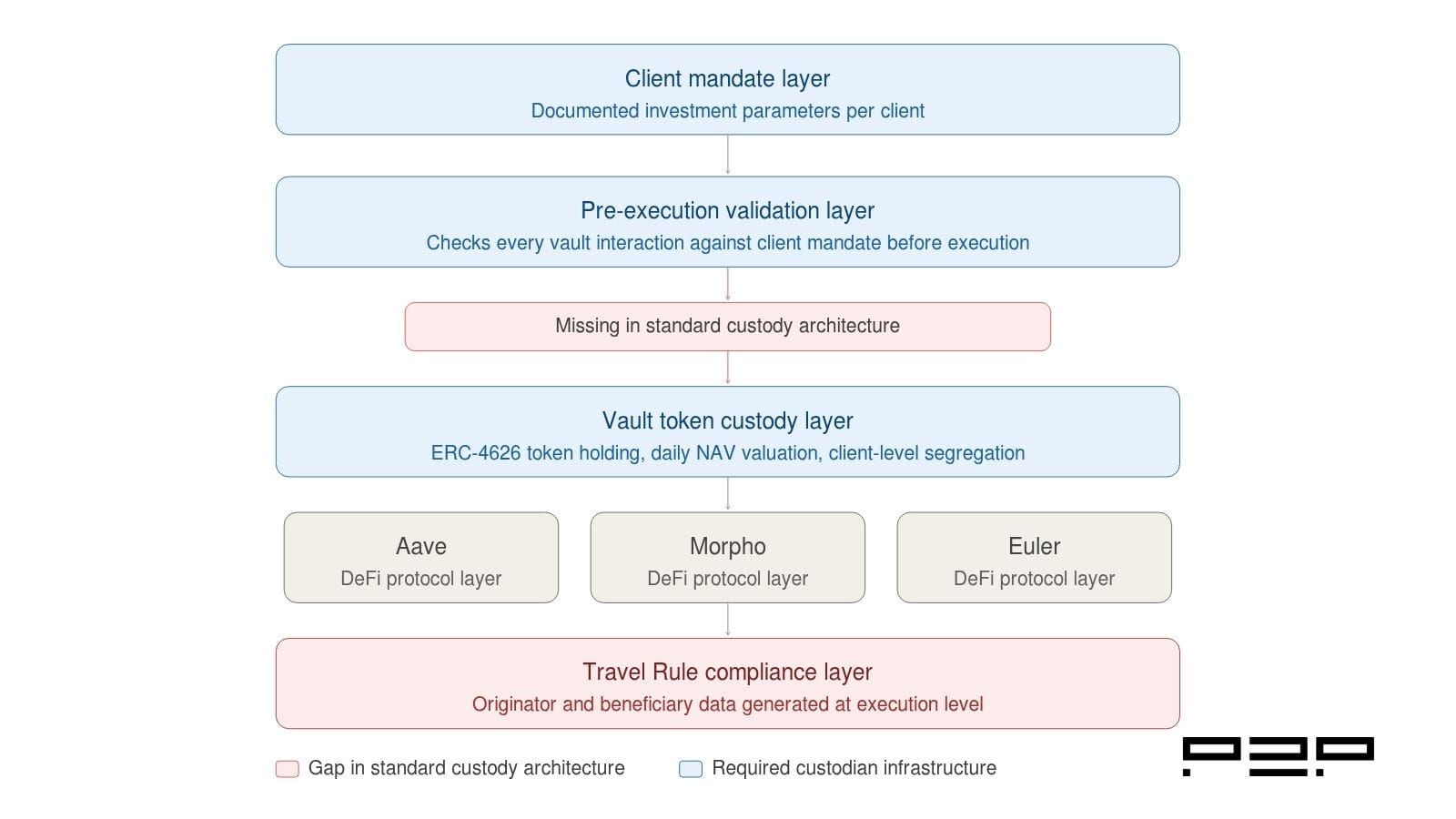
Vault token custody is architecturally different from direct asset custody. When client assets enter a DeFi vault, the custodian holds vault tokens, not the underlying assets. Those tokens require dedicated valuation infrastructure, daily NAV reconciliation against the vault's on-chain portfolio, and client-level segregation built on top of the vault's pooled architecture.
Pre-execution mandate validation cannot be delegated to the vault. Curators have no visibility into individual client mandates. The custodian must maintain an independent validation layer that checks every vault interaction against each client's documented investment parameters before execution.
The Travel Rule obligation attaches at the custodian level. Smart contract-initiated vault rebalances do not generate originator or beneficiary data automatically. Custodians need vault-specific Travel Rule infrastructure that maps client identity to vault addresses and generates compliant data at the point of execution.
Client asset segregation requirements extend to vault token positions. MiCA and OCC qualified custodian standards require insolvency-remote, segregated structures. That requirement applies to vault token holdings, not just static asset custody.
Digital asset native custodians and traditional custodians face different gaps. Digital asset native custodians typically need to deepen governance and compliance infrastructure. Traditional custodians typically need to build technical access capability. Both need to close their respective gaps before offering institutional-grade DeFi vault access.
Introduction
The digital asset custody market is projected to grow from approximately $1 trillion in assets under custody in 2026 to over $7 trillion by 2035, driven by institutional uptake and the expansion of tokenised real-world assets (Source: Finance Magnates, How Digital Asset Platform and Custody Technology Secure Institutional Funds, February 2026). That growth is not coming from passive storage. It is coming from clients who want their custodians to do more: access DeFi protocols, generate yield on idle assets, and interact with on-chain capital markets on their behalf.
The regulatory environment has moved to support that expansion. The repeal of SAB 121 in January 2025 removed the accounting barriers that had prevented US banks from offering crypto custody at scale. The OCC's 2025 guidance reinforced that national banks can act as qualified custodians for digital assets. MiCA established comprehensive custody standards across all 27 EU member states from December 2024. The Responsible Financial Innovation Act, introduced in late 2025, is advancing a legislative framework for digital asset custody in the US.
But regulatory clarity on custody does not automatically produce operational clarity on DeFi vault access. The infrastructure requirements for holding digital assets and the infrastructure requirements for interacting with DeFi vaults on behalf of institutional clients are related but not equivalent. A custodian that has solved for asset segregation, key management, and regulatory reporting in the static custody context faces a different and more demanding set of requirements when those same assets are deployed into a DeFi vault, interacting with smart contracts, generating yield positions, and being managed by a curator whose incentive structure creates a conflict of interest that the custodian's governance framework must address.
This article examines what those requirements look like in practice, both for digital asset native custodians who are already building DeFi capabilities and for traditional custodians evaluating DeFi vault access for the first time.
The four infrastructure layers a custodian must build to offer institutional-grade DeFi vault access.
The Two Custodian Starting Points
The infrastructure gap between standard custody architecture and DeFi vault access looks different depending on where a custodian is starting from.
Digital asset native custodians
They have already solved for the core technical requirements of on-chain asset interaction: MPC key management, smart contract interaction, on-chain transaction signing, and basic DeFi protocol access. Their gap is typically at the governance and compliance layer. They can interact with DeFi protocols technically, but their frameworks for mandate validation, conflict of interest management, Travel Rule compliance for vault-specific transaction types, and audit trail production may not be built to the standard that their institutional clients' own compliance functions require. The infrastructure challenge for digital asset native custodians is governance depth rather than technical access.
Traditional custodians
These, when entering the DeFi space, are often starting from a stronger governance and compliance foundation, with established frameworks for mandate validation, client asset segregation, regulatory reporting, and audit trail production built over decades of traditional asset management. Their gap is typically at the technical access layer. They may not have the onchain infrastructure to interact with DeFi protocols directly, to custody vault tokens natively, or to generate compliant Travel Rule data for smart contract-initiated transactions. The infrastructure challenge for traditional custodians is technical access capability rather than governance depth.
Both profiles need to close their respective gaps before they can offer institutional-grade DeFi vault access to clients. The sequencing differs: digital asset native custodians build governance on top of existing technical access; traditional custodians build technical access within existing governance frameworks.
Infrastructure Requirements
Vault Token Custody and Valuation
When a custodian deposits client assets into a DeFi vault, the transaction produces vault tokens: ERC-4626 standardised tokens representing the client's proportional claim on the vault's portfolio. These vault tokens are the asset the custodian holds in custody. The underlying assets, the ETH, USDC, or other tokens that the vault has deployed into lending markets, are held in smart contracts. The custodian does not hold them directly.
This creates a custody architecture problem that does not exist in static asset holding. The custodian must maintain infrastructure that holds vault tokens securely using the same MPC and key management standards applied to direct asset custody, values vault tokens accurately against the underlying portfolio daily, generates client reporting in a format that maps vault token positions to the underlying asset exposures they represent, and maintains segregated vault token positions for each client to prevent commingling.
The valuation problem is particularly demanding. Vault tokens do not have a fixed price. Their value is a function of the vault's net asset value, which changes as the curator rebalances positions, as lending markets generate yield, and as market conditions shift collateral valuations. A custodian offering vault token custody to institutional clients must have infrastructure that can pull accurate vault NAV data from on-chain sources, reconcile that data against the client's reported position, and produce a daily valuation that an auditor can verify independently.
The ERC-4626 vault standard, which became the dominant architecture for institutional vault deployments through 2025, provides a universal interface for deposits, withdrawals, and share accounting. Total value in curated ERC-4626 vaults grew 28 times in twelve months, from under $150 million to over $4.4 billion by mid 2025, reflecting the speed at which institutional capital is moving into the standard (Source: Zircuit, Vault Infrastructure: The Institutional Upgrade Traditional Asset Management Has Been Waiting For, 2025). Custodians building vault token custody infrastructure should build against the ERC-4626 standard as the baseline integration layer.
Pre-Execution Mandate Validation
The curator managing a DeFi vault's allocation strategy operates at the portfolio level. They set strategy parameters for the vault as a whole: concentration limits across lending markets, collateral type allowlists, leverage bounds, oracle feed specifications. Those parameters apply to all depositors in the vault equally. The curator has no visibility into any individual client's mandate parameters, and no obligation to validate that their allocation decisions are within any specific client's mandate before executing them.
For a retail depositor, this is acceptable. The depositor chose the vault and accepted the curator's strategy.
For a custodian's institutional client, it is a governance problem. The client has a mandate with specific investment parameters: maximum concentration in any single protocol, allowlisted asset types, leverage restrictions, reporting requirements. Those parameters are the custodian's responsibility to enforce. The curator cannot enforce them because the curator does not know what they are.
The custodian must maintain a pre-execution validation layer that sits between the curator's strategy and the client's capital. Before any vault interaction is executed on the client's behalf, every transaction must be checked against the client's mandate parameters: does this vault interaction increase concentration in a restricted protocol? Does it expose the client to an asset type outside the mandate's allowlist? Does it create a leverage position that exceeds the client's risk parameters? Only if the transaction passes all checks does it proceed to execution.
This validation function is independent of the vault. It is a custodian infrastructure requirement, not a vault product feature. Building it requires a mandate parameter management system that holds each client's investment restrictions in a codified, queryable format, a transaction interception layer that captures every proposed vault interaction before it executes, a parameter checking engine that evaluates each proposed transaction against the relevant client's parameters, and a logging system that records every check, every block, and every approved transaction in a format that satisfies audit requirements.
The institutional digital asset space moves fast. Our subscribers get structured analysis across staking, DeFi vaults, and regulation through DeFi Dispatch, Institutional Lens, DeFi Infrastructure for Institutions, and Legal Layer. No noise. Just the signals that matter. Subscribe to the newsletter at the bottom of this page.
Travel Rule Compliance for Vault Transactions
As examined in detail in the second regulatory trilogy article, the Travel Rule requires originator and beneficiary data to accompany every qualifying crypto-asset transfer involving a CASP. For custodians, this obligation attaches at the point of every vault interaction executed on a client's behalf.
The specific challenge for vault interactions is that most rebalances within a DeFi vault are executed by the vault's smart contract, not by a named human originator. When the curator initiates a rebalance and the smart contract executes transactions across lending markets, the transaction does not have a named originator in the format the Travel Rule requires. The custodian must generate that originator data from outside the protocol and attach it to the transaction chain.
Under the EU Transfer of Funds Regulation, which has applied to all CASP-to-CASP transfers with no minimum threshold since December 30, 2024, the required data includes the client's full name, account or wallet identifier, and either a physical address, official personal document number, customer identification number, or date of birth. For custodians managing DeFi vault positions for multiple institutional clients, generating this data at the transaction level requires a data architecture that maps each client's verified identity to the vault addresses associated with their position, intercepts vault transactions at the point of initiation, generates compliant Travel Rule data from the identity mapping, and transmits that data to counterparty VASPs before settlement.
Custodians whose Travel Rule infrastructure was built for direct asset transfers will find that it does not automatically extend to vault-specific transaction types. The smart contract initiation problem, the multi-hop transaction structure of vault rebalances, and the beneficiary identification challenge for protocol addresses all require vault-specific extensions to standard Travel Rule infrastructure.
Client Asset Segregation at the Vault Token Layer
Institutional custody standards require client asset segregation: each client's assets must be held in segregated, insolvency-remote structures that are identifiable and accessible even if the custodian becomes insolvent. The repeal of SAB 121 and the OCC's 2025 guidance reinforced that these standards apply to digital assets held in custody by national banks, on the same basis as traditional asset custody. MiCA's client asset safeguarding requirements apply equivalent standards to CASPs across the EU.
For static asset custody, segregation is straightforward: each client's assets are held in dedicated wallets with documented ownership records. For vault token custody, the segregation requirement extends to the vault token layer. A custodian holding vault tokens on behalf of multiple clients must maintain a separate, documented vault token position for each client, ensuring that the client's proportional claim on the vault's portfolio is accurately recorded, insolvency-remote, and separable from other clients' positions and from the custodian's own assets.
The complication is that DeFi vaults are pooled products. Multiple depositors contribute to the same vault pool, and the vault's smart contract tracks each depositor's proportional share through vault tokens. The custodian must maintain its own client-level segregation on top of the vault's pooled architecture: tracking which vault tokens belong to which client, maintaining accurate client-level NAV calculations based on the vault's overall performance, and ensuring that client redemptions can be processed in a way that correctly reflects each client's proportional position.
Academic research covering six major lending systems found that a small set of curators intermediates a disproportionate share of system TVL and exhibits clustered tail co-movement (Source: Institutionalizing Risk Curation in Decentralized Credit, arXiv, December 2025). For custodians, this systemic risk dimension means that client asset segregation at the vault token layer is not just a regulatory compliance requirement. It is the mechanism through which client exposure is identifiable and manageable if a curator-layer failure creates cascading effects across the protocols where the vault holds positions.
Risk Considerations for Custodians
Beyond the infrastructure requirements, DeFi vault access introduces three categories of risk that custodians must model explicitly in their risk frameworks.
Smart contract risk
DeFi vault interactions expose client assets to smart contract vulnerabilities in the vault itself, in the underlying lending protocols the vault interacts with, and in any bridge or oracle infrastructure the vault depends on. Unlike traditional asset custody where the primary risk is operational or custodian counterparty risk, smart contract risk is protocol-level and non-recoverable if exploited. Custodians must evaluate the audit history and security track record of every protocol layer in the vault's execution stack before offering vault access to clients.
Curator concentration risk
The research finding that a small number of curators intermediate a disproportionate share of total value locked and exhibit clustered tail co-movement means that custodian exposure to the curator layer is a systemic risk variable, not just a counterparty risk variable. A custodian offering multiple clients access to vaults managed by the same curator creates correlated exposure that needs to be modelled and disclosed. Custodians should track curator concentration across their client base and include curator-layer correlation in their stress testing frameworks.
Liquidity and redemption risk
DeFi vault positions may not be instantly redeemable. Vault liquidity depends on the available liquidity in the underlying lending markets, which can tighten during market stress events. Custodians whose client agreements specify withdrawal timelines must model vault liquidity conditions as a variable in their redemption planning. The assumption that vault positions can always be liquidated on demand at current NAV does not hold in all market conditions.
What This Means for Custodians Evaluating DeFi Vault Access
The infrastructure requirements and risk considerations examined in this article are not arguments against custodians offering DeFi vault access. They are a map of what offering it properly requires.
Custodians that build vault token custody infrastructure, pre-execution mandate validation, vault-specific Travel Rule compliance, and client-level segregation at the vault token layer will be positioned to offer institutional-grade DeFi vault access as the market matures. Custodians that treat DeFi vault access as a straightforward extension of their existing product will encounter the infrastructure gap when institutional clients begin the due diligence process.
The market signal is clear. 83% of institutional investors plan to increase crypto allocations, with over two-thirds specifically targeting DeFi mechanisms, including lending and staking (Source: EY-Parthenon and Coinbase Institutional Investor Digital Assets Study, January 2025). DeFi TVL across all chains sits at approximately $130 to $140 billion in early 2026, with on-chain DeFi lending capturing roughly two-thirds of the record $73.6 billion crypto-collateralised lending market by late 2025. The clients are coming. The custodians who have built the infrastructure will capture the allocation.
Talk to our team if you are evaluating how P2P.org's protection layer integrates with custodian infrastructure for institutional DeFi vault access.
Key Takeaway
Custodians are the infrastructure layer through which most institutional capital will access DeFi vaults. The infrastructure requirements that access imposes, vault token custody and valuation, pre-execution mandate validation, vault-specific Travel Rule compliance, and client asset segregation at the vault token layer, are not extensions of existing custody capability. They are a new infrastructure layer that needs to be built explicitly.
The regulatory environment is supportive: the OCC's 2025 guidance, SAB 121 repeal, and MiCA's custody standards have all removed barriers to custodians offering digital asset services at an institutional scale. What the regulatory environment does not provide is the operational infrastructure to interact with DeFi vaults in a way that satisfies the governance requirements of institutional clients. That infrastructure is the variable, and it is being built now by the custodians who understand the distinction between holding digital assets and enabling institutional DeFi allocation.
Next in this series: How Hedge Funds Are Approaching Onchain Yield Strategies in 2026
Frequently Asked Questions (FAQs)
What is vault token custody, and why is it different from direct asset custody?
When a custodian deposits client assets into a DeFi vault, the client receives vault tokens representing their proportional claim on the vault's portfolio. Those vault tokens are the custodial asset. The underlying assets are held in the vault's smart contracts, not in the custodian's wallets. Vault token custody requires infrastructure to hold vault tokens securely, value them against the underlying portfolio on a daily basis, report on them in a format that maps to underlying asset exposures, and maintain segregated positions for each client. This is architecturally different from direct asset custody, where the custodian holds the asset itself.
How does pre-execution mandate validation work in a custodian context?
Pre-execution mandate validation in a custodian context is a layer that sits between the curator's allocation decisions and the custodian's execution of vault interactions on behalf of clients. Before any vault transaction is executed for a client, the validation layer checks whether the proposed interaction is within the client's documented mandate parameters: concentration limits, protocol allowlists, asset type restrictions, and leverage bounds. The curator cannot perform this validation because the curator has no visibility into individual client mandates. It is a custodian infrastructure requirement that must be built and operated independently of the vault.
What does Travel Rule compliance require specifically for DeFi vault interactions?
DeFi vault rebalances are typically initiated by smart contracts rather than named human originators. The Travel Rule requires custodians to generate originator and beneficiary data for these transactions from outside the protocol, using a data layer that maps each client's verified identity to their vault address and intercepts transactions at the point of initiation. Under the EU TFR, this data must be generated and transmitted before settlement, with no minimum threshold. Custodians whose Travel Rule infrastructure was built for direct asset transfers need vault-specific extensions to handle smart contract-initiated rebalances and multi-hop vault transaction structures.
How does client asset segregation apply to vault token positions?
Regulatory requirements for client asset segregation, including those under MiCA and the OCC's qualified custodian standards, require that each client's assets be held in segregated, insolvency-remote structures. For vault token custody, this means maintaining a separate, documented vault token position for each client, with accurate client-level NAV calculations and the ability to process client redemptions in a way that correctly reflects each client's proportional position. The DeFi vault's pooled architecture does not eliminate this requirement: the custodian must maintain client-level segregation on top of the vault's pooled token structure.
What is curator concentration risk, and why does it matter for custodians?
Curator concentration risk arises when a custodian offers multiple clients access to vaults managed by the same curator, creating correlated exposure across the client base. Academic research covering six major lending systems found that a small number of curators intermediate a disproportionate share of total value locked and exhibit clustered tail co-movement, meaning that stress at the curator layer can propagate simultaneously across multiple protocols. For custodians, this means that curator-layer correlation across the client book needs to be modelled and included in stress testing frameworks, not treated as isolated counterparty risk.
About P2P.org
P2P.org builds the protection layer that sits between regulated institutions and DeFi execution environments, independently of the curators who manage allocation strategies. If you are evaluating the infrastructure requirements for a DeFi allocation program, reach out to our team of experts.
Disclaimer
This article is provided for informational purposes only and does not constitute legal, regulatory, compliance, or investment advice. Regulatory obligations may vary depending on jurisdiction and specific business activities. Readers should consult their own legal and compliance advisors regarding applicable requirements.
Subscribe to P2P-economy
Get the latest posts delivered right to your inbox
<h2 id="learnings-for-busy-readers"><strong>Learnings for Busy Readers</strong></h2><ul><li>The barriers to institutional onchain deployment in 2026 are not technical. They are operational: policy frameworks, internal approval processes, and jurisdiction-by-jurisdiction regulatory interpretation.</li><li>MiCA clarifies the licensing perimeter but every compliance team interprets staking provisions differently - accounting treatment, capital treatment, and product scope are still institution-by-institution calls.</li><li>Late-stage deals collapse on internal alignment, not commercial or technical grounds. CISO and procurement are the most frequent blockers. Scope creep is the other deal killer.</li><li>Regulated institutions cannot interface directly with smart contracts. They need a legal counterparty they can hold accountable - a requirement DeFi protocols do not always accommodate.</li><li>Protocol selection is driven by client demand and unit economics, not by network fundamentals alone. Hyperliquid is the standout case study for ecosystem alignment right now.</li><li>Reporting and reconciliation has moved from a nice-to-have to a hard requirement. Translating onchain activity into standard accounting formats is now a non-negotiable part of the institutional stack.</li><li>The advice from every panelist: start small, move quickly on familiarisation, and build infrastructure for where you expect to be in five years - not for the first use case.</li></ul><p>On May 20, 2026, P2P.org hosted a live practitioner roundtable on institutional digital asset infrastructure. The panel brought together Alexander Loktev, CRO at P2P.org (Moderator), Pavel Jakovlev, Head of Product Growth and Innovation at <a href="https://aminagroup.com/?ref=p2p.org"><u>AMINA Bank</u></a>, John Hallahan, Director of Business Solutions and Advisory EMEA at <a href="http://fireblocks.com/?ref=p2p.org"><u>Fireblocks</u></a>, and Patrick Delaney, CEO at <a href="https://ampli.net/?ref=p2p.org"><u>Ampli</u></a>.</p><p>The conversation covered five topics:</p><ol><li>how institutions actually go from approval to live onchain deployment</li><li>compliance architecture under MiCA</li><li>the institutional go-to-market reality</li><li>multi-network exposure and validator selection</li><li>reporting and reconciliation</li></ol><h2 id="a-recap"><strong>A recap:</strong><br></h2><p>The technology works. That is no longer the question. What is holding institutions back in 2026 is the layer underneath. Compliance teams interpreting the same regulation differently, internal stakeholders who can block a deal at the last stage, operational models that were not built for onchain at scale, and reporting infrastructure that most institutions are still building in arrears.</p><h2 id="the-problem-is-never-technical"><strong>The problem is never technical</strong><br></h2><p>John Hallahan opened with a diagnosis that shaped the rest of the conversation.</p><blockquote><em>“The key issue is never technical. Where it breaks down is across three different areas: policy - the operational burden of approval processes and whitelisting; the operating model - unstaking, monitoring slashing risk, reconciling rewards; and the regulatory piece - in some jurisdictions staking is interest, in others it is a service fee. Compliance teams want to see that mapped before anything is signed off.”</em></blockquote><p>- John Hallahan, Fireblocks</p><p>Pavel confirmed it from the bank side. AMINA Bank has been operationalising <a href="https://aminagroup.com/individuals/staking/?ref=p2p.org"><u>staking </u></a>across ten protocols for several years, using a delegation model with infrastructure partners including P2P.org. The work is unglamorous and ongoing.</p><blockquote><em>“We want to make sure that our clients' </em><a href="https://aminagroup.com/individuals/custody/?ref=p2p.org#custody-services"><em><u>funds are segregated</u></em></a><em>, we know exactly who we are interacting with, we minimise smart contract risk as much as possible, and the funds are not commingled. Same rules apply. We just have to replicate them onchain.”</em></blockquote><p>- Pavel Jakovlev, AMINA Bank</p><p>Patrick added a dimension specific to agentic capital management. The security architecture around agent permissions is where institutions consistently underestimate the complexity.</p><blockquote><em>“Session keys that control the permissions of the agents are often stored on some centralised server. You have a huge risk silo where everything is in one place, and if that gets compromised, the attacker would have control over everything.”</em></blockquote><p>- Patrick Delaney, Ampli</p><p>That said, the risk concern should not obscure the upside. Patrick was clear on what agents actually deliver when the security layer is handled correctly.</p><blockquote><em>“Agents are great risk managers. They have twenty-four-seven surveillance capabilities - that is really solving a problem for institutions once you take care of the new risk that the agents themselves bring.”</em></blockquote><p>- Patrick Delaney, Ampli</p><p>The through-line across all three answers is the same: the gap between an institution receiving internal approval to go onchain and actually going live is larger than most expect, and almost none of it is explained by the technology.</p><h2 id="mica-gives-you-the-map-it-does-not-tell-you-how-to-read-it"><strong>MiCA gives you the map. It does not tell you how to read it.</strong></h2><p>The compliance discussion produced the clearest illustration of where the industry actually is on regulation. MiCA is in place. It is working. And it has not resolved the questions that matter most to compliance teams inside regulated institutions.</p><blockquote><em>“What </em><a href="https://www.fireblocks.com/glossary/markets-in-crypto-assets?ref=p2p.org"><em><u>MiCA</u></em></a><em> provides is a very clear framework around authorisation. The licensing perimeter is very clear. But every tier one that we work with is interpreting MiCA's staking provisions in a slightly different way. Accounting treatment, capital treatment, how staking is characterised - those are still being worked out on an institution-by-institution basis.”</em></blockquote><p>- John Hallahan, Fireblocks</p><p><a href="https://aminagroup.com/?ref=p2p.org"><u>AMINA Bank</u></a> is a useful case study in what operating under MiCA actually requires. The bank serves European clients through <a href="https://eu.aminagroup.com/?ref=p2p.org"><u>its Austrian entity</u></a>, which introduces hard product constraints. USDT and Ethena's USDe cannot be offered to European clients under the current framework. Every new product goes through a multi-stakeholder sign-off process spanning compliance, technology, and jurisdictional review across Europe, <a href="https://hongkong.aminagroup.com/?ref=p2p.org"><u>Hong Kong</u></a>, and Abu Dhabi simultaneously.</p><p>Switzerland, where AMINA holds its primary banking licence, has a longer regulatory history with <a href="https://aminagroup.com/individuals/custody/?ref=p2p.org"><u>digital assets</u></a>. The DLT Act predates MiCA by several years, and AMINA’s compliance team is in active dialogue with FINMA on innovations including zero-knowledge proof frameworks that could allow regulators to verify wallet history and source of funds without compromising client privacy. That is the direction the regulatory frontier is moving - not more restriction, but more sophisticated verification.</p><p>The practical implication for anyone selling into or operating within regulated institutions: MiCA compliance at the infrastructure layer does not close the compliance conversation internally. It opens it.</p><h2 id="deals-do-not-die-on-technical-grounds"><strong>Deals do not die on technical grounds</strong></h2><p>The go-to-market section was the most commercially direct part of the session. John's framing was unambiguous.</p><blockquote><em>“No one person can make a single decision to buy, but any of them can literally block the deal.”</em></blockquote><blockquote>- John Hallahan, Fireblocks</blockquote><p><a href="https://www.fireblocks.com/industry/banks?ref=p2p.org"><u>Fireblocks works with over one hundred banks</u></a>. The patterns are consistent. Two things kill late-stage deals. The first is internal alignment failure. The CISO and procurement are the most frequent blockers. Getting the CISO team comfortable with the risk basis of staking - a very different product from custody - is a step that cannot be skipped.</p><p>The second is scope creep. A <a href="https://www.fireblocks.com/blog/digital-asset-custody-strategy-banks?ref=p2p.org"><u>bank aligns on custody</u></a> and <a href="https://www.fireblocks.com/products/staking?ref=p2p.org"><u>staking</u></a>. Then at the eleventh hour, someone wants to add a <a href="https://www.fireblocks.com/blog/stablecoin-issuance-infrastructure-for-banks?ref=p2p.org"><u>stablecoin project</u></a>, a <a href="https://www.fireblocks.com/blog/next-chapter-transaction-banking?ref=p2p.org"><u>tokenisation initiative</u></a>, and a <a href="https://www.fireblocks.com/platforms/defi?ref=p2p.org"><u>DeFi</u></a> proof of concept.</p><blockquote><em>“If you are renegotiating the scope of things late stage, that is where deals can fall apart.”</em></blockquote><p>- John Hallahan, Fireblocks</p><p>Pavel added the internal knowledge dimension. Pockets of expertise do not always communicate across large organisations. The technology built in 2018 could be optimised, but doing so would require rebuilding everything from scratch - a decision most institutions are not positioned to make, and one most infrastructure providers are not helping them think through.</p><p>Patrick offered a different angle - where institutions are actually moving fast, and why. His near-term traction is not with regional banks but with a different profile entirely.</p><blockquote><em>“Latin America, Africa - those are the places where a lot of tech adoption happened, and retail users were actually skipping steps. Neo-banks there can build compliance around new technology from the start rather than retrofit it onto legacy systems.”</em></blockquote><p>- Patrick Delaney, Ampli</p><p>He also named the structural tension that sits underneath the whole DeFi institutional conversation.</p><blockquote><em>“It is kind of the paradox that we are now trying to sell the product that is supposed to replace the middleman to the middleman.”</em></blockquote><p>- Patrick Delaney, Ampli</p><p></p><h2 id="protocols-are-a-business-decision-not-a-technology-decision"><strong>Protocols are a business decision, not a technology decision</strong></h2><p>The network selection discussion moved quickly past which chains are technically capable and into how institutions actually make the call.</p><blockquote><em>“To launch an offering and be competitive as an institution, you need to cover all the major staking protocols that you can get on a Revolut or a Robinhood or an eToro, or else you are not going to be competitive. Then the validator partner choice flows quickly to unit economics.”</em></blockquote><p>- John Hallahan, Fireblocks</p><p>Pavel described AMINA’s internal process: customer requests trigger reviews, the top 100 to 200 networks are always tracked, and specific ecosystems get deeper reviews when client demand signals are strong enough. He highlighted Hyperliquid as the most interesting current case.</p><blockquote><em>“I have never seen more fanatical - in a good way - alignment across token holders, users, and developers. Most of our customers do not sell Hype. They just acquire it and keep it.”</em></blockquote><p>- Pavel Jakovlev, Amina Bank</p><p>The practical consequence is that clients are now requesting staking against Hype assets with the ability to borrow against them, which requires LST infrastructure and a rethink of how bonding and unbonding periods interact with lending products. The Hyperliquid example matters beyond the specific ecosystem: it illustrates what institutional protocol selection actually responds to - not network fundamentals in the abstract, but demonstrated user behaviour that creates specific product requirements on the institutional side.</p><p>Patrick raised the broader paradox this creates: DeFi was built to eliminate middlemen, and now banks are using it on behalf of clients. Alexander offered a reframe:</p><blockquote><em>“Agents give a feeling that it is me. When I interact with DeFi through my agentic ecosystem, it feels like I am working directly with the end product, passing all the middlemen. In reality, we are just moving all the middle players into an infrastructural layer where they interact through APIs with the agentic world. But from the user perspective, that is how it feels - and that matters.”</em></blockquote><p>- Alexander Loktev, P2P.org</p><h2 id="reporting-is-where-institutional-confidence-is-built-or-lost"><strong>Reporting is where institutional confidence is built or lost</strong></h2><p>Alexander opened the reporting section with a framing that applies across the full product stack. Staking is increasingly a commoditised product. Custody was commoditised before it. DeFi will be commoditised. The decisions clients make between infrastructure providers are increasingly driven by the operational services built around the core product - and reporting is at the top of that list.</p><blockquote><em>“Two or three years ago, clients were fine getting just a list of logs and onchain records. With the scaling of their staking operations, that stopped working. What they strictly require today is explanation.”</em></blockquote><p>- Alexander Loktev, P2P.org</p><p>John confirmed it from the infrastructure side. <a href="https://www.fireblocks.com/blog/fireblocks-acquires-tres?ref=p2p.org"><u>Fireblocks acquired TRES Finance</u></a> specifically because regulated entities were pulling blockchain data but could not get it into standard accounting formats.</p><blockquote><em>“If you are a regulated entity doing quarterly reporting, that accounting audit reconciliation offering is now a core part of the infrastructure stack. It is going to be pretty much non-negotiable.”</em></blockquote><p>- John Hallahan, Fireblocks</p><p>Pavel was direct about what AMINA’s regulatory position requires. The bank goes through both internal and external audits regularly. On occasion, the regulator comments on punctuation. The scrutiny is not going to decrease as the product set expands into DeFi and <a href="https://aminagroup.com/corporates/stablecoin-rewards-account/?ref=p2p.org"><u>more complex earn structures</u></a>.</p><p>Patrick described an emerging reporting dimension specific to agentic systems. The requirement is not just a log of what happened onchain - it is a log of intent versus execution: what did the agent propose, did it comply with the client's policy engine, was it approved or rejected and why. As institutions begin to explore agentic capital management, the reporting layer will need to account for the decision chain, not just the transaction record.</p><p><strong>Key Takeaways</strong></p><p>The closing question - what do institutions consistently get wrong when going onchain for the first time - produced four answers worth remembering: </p><blockquote><em>“Move slow on exposing yourself to risk, but move quickly in terms of familiarising yourself with the infrastructure. Eventually this is not going to be DeFi. It is going to be finance. You will be left behind if you brush it off as that crypto thing.”</em></blockquote><p>- Patrick Delaney, Ampli</p><blockquote><em>“Build your infrastructure and your operating model for where you think you are in five years, not your first use case. We have seen many early movers on the banking side who are now re-platforming. Build the stack for your strategy five years from now.”</em></blockquote><p>- John Hallahan, Fireblocks</p><blockquote><em>“I was speaking with a bank that banks other banks. They told me they know how to move billions onchain and the systems are good. They have not figured out how to move trillions yet. So once they do that, they will start moving. It is coming.”</em></blockquote><p>- Pavel Jakovlev, Amina Bank</p><blockquote><em>“Make your first step very small, but make it as soon as you can. At P2P.org, when we hire people, we give them a hardware wallet with a small amount and ask them to stake, unstake, and withdraw. It brings non-web3 people into the web3 world within a single day. They lose the stigma.”</em></blockquote><p>- Alexander Loktev, P2P.org</p><p>The replay is available <a href="https://www.youtube.com/watch?v=Md-SpGfPmOk&ref=p2p.org"><strong><u>here</u></strong></a>. P2P.org is a non-custodial validator infrastructure provider trusted by 190+ institutional clients, operating across 40+ networks with $10B+ in assets under validation and seven years of zero slashing events.</p><h2 id="frequently-asked-questions-faqs"><strong>Frequently Asked Questions (FAQs)</strong></h2><h3 id="what-are-the-biggest-operational-barriers-to-institutional-onchain-deployment-in-2026"><strong>What are the biggest operational barriers to institutional onchain deployment in 2026?</strong></h3><p>Policy frameworks, internal approval processes, and regulatory interpretation - not technical complexity. The technology is largely solved. The operational layer underneath it is where institutions get stuck.</p><h3 id="how-are-regulated-institutions-handling-mica-compliance-for-staking-products"><strong>How are regulated institutions handling MiCA compliance for staking products?</strong></h3><p>MiCA provides the licensing and authorisation framework, but accounting treatment, capital treatment, and product scope are still interpreted differently by each institution's compliance team. MiCA compliance at the infrastructure layer does not close the internal compliance conversation.</p><h3 id="what-kills-institutional-deals-at-the-late-stage"><strong>What kills institutional deals at the late stage?</strong></h3><p>Internal alignment failures - typically the CISO or procurement team raising concerns - and scope creep, where an institution expands requirements significantly during the negotiation phase.</p><h3 id="how-do-institutions-decide-which-blockchain-networks-to-support"><strong>How do institutions decide which blockchain networks to support?</strong></h3><p>Client demand first, unit economics second. EVM-compatible chains, Solana, and Cosmos are the practical shortlist for most regulated institutions. New networks get added following formal reviews triggered by specific client requests.</p><h3 id="what-does-institutional-grade-reporting-for-onchain-positions-require"><strong>What does institutional-grade reporting for onchain positions require?</strong></h3><p>Translating onchain activity into standard accounting formats, maintaining complete audit trails, and for agentic systems, logging agent intent versus execution so every capital movement can be traced back to the authorisation that triggered it.</p><h2 id="disclaimer"><strong>Disclaimer</strong></h2><p>This article is provided for informational purposes only and does not constitute legal, regulatory, compliance, or investment advice. Regulatory obligations may vary depending on jurisdiction and specific business activities. Readers should consult their own legal and compliance advisors regarding applicable requirements</p>
<h2 id="series-validator-playbook"><strong>Series:</strong> Validator Playbook </h2><p>Validator Playbook is <a href="http://p2p.org/?ref=p2p.org">P2P.org</a>'s operational series for infrastructure engineers, staking product managers, and validator risk committees building or evaluating institutional-grade staking programs. Each article addresses a specific operational, technical, or governance dimension of running or selecting validator infrastructure at an institutional scale.</p><p><strong>Previously in the series:</strong> <a href="https://p2p.org/economy/validator-playbook-exit-queue-dynamics-institutional-validators/">Ethereum Validator Exit Queue: What Institutional Operators Must Know</a></p><hr><h2 id="learnings-for-busy-readers">Learnings for Busy Readers</h2><ul><li>Single-node validator architecture concentrates signing authority in one machine. When that machine fails, the validator goes offline and accumulates penalties. At scale, this creates compounding operational risk.</li><li>Distributed validator technology eliminates the single point of failure by splitting signing responsibility across multiple independent nodes. No single node holds the complete key or controls the signing outcome.</li><li>DVT-lite, deployed by the Ethereum Foundation to stake 72,000 ETH in March 2026, reduces deployment complexity to a Docker-based setup, making fault-tolerant validation accessible without dedicated cryptographic engineering capacity.</li><li>Obol and SSV Network represent the two dominant full DVT implementations, with different architectural tradeoffs that institutional operators need to understand before selecting an approach.</li><li>The risk reduction DVT provides is directly relevant to the slashing and exit queue dynamics covered in the previous two Validator Playbook articles. DVT does not eliminate the risk of slashing but materially reduces the infrastructure conditions that cause it.</li><li>For institutional operators evaluating staking providers, DVT adoption is now a meaningful differentiator. Providers still operating single-node architectures at scale carry infrastructure risk that DVT was specifically designed to address.</li></ul><h2 id="who-this-article-is-for">Who This Article Is For</h2><p>This article is written for teams responsible for validator infrastructure decisions within institutional staking programs, including:</p><ul><li>Infrastructure engineers designing or evaluating validator architecture</li><li>Staking product managers assessing provider capabilities</li><li>Validator risk committees reviewing infrastructure resilience</li><li>Digital asset custodians operating or delegating validator infrastructure</li><li>ETF and ETP issuers whose underlying staking infrastructure is operated by third-party providers</li><li>Exchanges operating validator fleets for institutional staking products</li><li>Crypto-native hedge funds and treasury teams that are evaluating staking infrastructure quality</li></ul><p><a href="http://p2p.org/?ref=p2p.org">P2P.org</a> operates non-custodial validator infrastructure in a client-controlled architecture across more than 40 proof-of-stake networks, including DVT-enabled deployments on Ethereum.</p><h2 id="the-problem-dvt-was-designed-to-solve">The Problem DVT Was Designed to Solve</h2><p>To understand why distributed validator technology matters for institutional operators, it helps to start with the architecture it replaces.</p><p>In a standard Ethereum validator setup, one machine holds the private key used to sign attestations and block proposals. That machine communicates with the network, performs signing duties, and maintains the validator's participation record. The entire operation depends on a single node remaining online, correctly configured, and free from software errors.</p><p>DVT also enables non-custodial staking by allowing you to distribute your validator key across remote nodes while keeping the full key completely offline. But the institutional motivation for DVT is primarily about resilience, not key custody.</p><p>The single-node model has three failure modes that institutional operators at scale cannot fully engineer around.</p><h3 id="hardware-and-infrastructure-failure">Hardware and infrastructure failure</h3><p>A single machine can fail due to hardware fault, cloud provider outage, network partition, or data centre incident. In other words, a single hardware failure, cloud provider outage, or botched configuration update can trigger slashing penalties that directly erode staking rewards. And the problem compounds with scale: the more validators an institution operates, the more single points of failure exist across the setup.</p><h3 id="correlated-failure-across-homogeneous-infrastructure">Correlated failure across homogeneous infrastructure</h3><p>As covered in the slashing article earlier in this series, institutions running large validator fleets with uniform infrastructure face correlated failure risk. A single client bug, a misconfigured update pushed simultaneously across all nodes, or a shared cloud region outage can take down hundreds of validators at once. The Ethereum protocol's correlation penalty multiplier means simultaneous failures are penalised more severely than isolated ones.</p><h3 id="signing-control-concentration">Signing control concentration</h3><p>When one machine holds the complete signing key, that machine is both the operational dependency and the security boundary. Compromise, loss, or corruption of that key has no fallback. For institutions managing significant ETH positions across many validators, this is a key management problem that single-node architecture structurally cannot resolve.</p><p>DVT addresses all three failure modes through the same mechanism: distributing the signing function across multiple independent nodes so that no single node holds complete authority and no single failure can halt the validator.</p><h2 id="how-distributed-validator-technology-works">How Distributed Validator Technology Works</h2><p>By using DVT, stakers can participate in staking while keeping the validator's private key in cold storage. This is achieved by encrypting the original, full validator key and then splitting it into key shares. The key shares live online and are distributed to multiple nodes, which enable the distributed operation of the validator.</p><p>The technical foundation rests on five components that work together.</p><h3 id="shamirs-secret-sharing">Shamir's secret sharing</h3><p>The validator's private key is split into shares using a cryptographic scheme where no individual share is sufficient to reconstruct the key. Shares are distributed across the nodes in the cluster. Reconstructing the key requires a defined threshold of shares to be combined, meaning any subset of nodes below the threshold is insufficient.</p><h3 id="threshold-signature-scheme"><strong>Threshold signature scheme</strong></h3><p>The threshold determines how many nodes must participate in a signing event for it to be valid. A common configuration is three of four, meaning three of four nodes must sign for the validator to perform its duties. DVT also carries robust security in the form of Istanbul byzantine fault tolerance. This mechanic ensures that validators can stay active even if some operators go offline or attempt to act maliciously.</p><h3 id="distributed-key-generation">Distributed key generation</h3><p>When a new validator cluster is established, the key shares are generated through a distributed key generation ceremony where no single participant ever holds the complete key. The full validator key is generated in secret using multiparty computation. The full key is never known to any individual operator. They only ever know their own part of it.</p><h3 id="consensus-protocol">Consensus protocol</h3><p>The cluster nodes run a consensus protocol to coordinate which node proposes blocks in a given slot. This prevents duplicate signing and coordinates the distributed signing activity across the cluster.</p><h3 id="bls-signature-aggregation">BLS signature aggregation</h3><p>This is possible because Ethereum validators use BLS signatures that are additive, meaning the full key can be reconstructed by summing their parts. The aggregated signature produced by the threshold of participating nodes is identical to what a single-node validator would produce, meaning the Ethereum network sees no difference in the validator's output.</p><p>The operational result is a validator that continues performing its duties as long as the minimum threshold of nodes remains online. Individual node failures, planned maintenance windows, software updates, and even cloud provider outages become manageable without triggering penalties, provided the threshold is maintained.</p><h3 id="dvt-lite-the-2026-deployment-shift">DVT-Lite: The 2026 Deployment Shift</h3><p>Full DVT, as implemented by Obol and SSV Network, is operationally powerful but has historically required significant deployment complexity. Coordinating multi-operator clusters, managing distributed key generation ceremonies, and maintaining communication infrastructure across independent nodes requires dedicated engineering capacity that many institutional operators do not have in-house.</p><p>DVT-lite changes that equation.</p><p>The Ethereum Foundation is testing a method for running validators that could make it significantly easier for institutions holding large amounts of ether to set up staking infrastructure, widening the pool of participants and creating a more decentralised network. Ethereum co-founder Vitalik Buterin said the foundation is using a simplified version of distributed validator technology, or DVT-lite, to stake 72,000 ETH (Source: <a href="https://changelly.com/blog/what-are-governance-token/?ref=p2p.org">Changelly</a>).</p><p>Buterin said the goal is to reduce the process to something close to a one-click setup, where operators choose which computers will run validator nodes, launch the software and enter the same key on each machine. The system would then automatically connect the nodes and begin staking.</p><p>Validators went live around March 19, 2026, marking the most prominent real-world deployment of DVT-lite to date. This deployment matters for several reasons beyond the technical validation it provides. The Ethereum Foundation is not a retail staker experimenting with new tooling. Its decision to stake 72,000 ETH using DVT-lite communicates that the technology is ready for significant capital deployment (Source: <a href="https://medium.com/regen-network/community-stake-governance-model-b949bcb1eca3?ref=p2p.org">Gregory Landia @ Medium</a>).</p><p>The key architectural difference between DVT-lite and full DVT is the trust model. DVT-lite automates much of that coordination layer. It enables distributed validators with minimal infrastructure overhead through containerised deployments. The networking, key-sharing, and consensus mechanisms are abstracted into manageable configuration files.</p><p>In full DVT via Obol or SSV, the nodes in a cluster are operated by independent parties who do not share infrastructure. The fault tolerance comes from genuine operator independence. In DVT-lite, the same operator runs all nodes in the cluster, often across different cloud regions or hardware environments. The fault tolerance comes from infrastructure diversity within a single operator's control rather than from multi-party trust distribution.</p><p>For institutional operators who manage their own validator infrastructure, DVT-lite represents a material upgrade over single-node architecture at significantly lower operational cost. DVT-lite is not a replacement for SSV or Obol in every context. It fills a critical gap for operators who want distributed fault tolerance without distributed operator trust.</p><figure class="kg-card kg-image-card kg-card-hascaption"><img src="https://p2p.org/economy/content/images/2026/05/dvt-cluster-architecture-institutional-validators.jpg" class="kg-image" alt="Architectural diagram comparing single-node Ethereum validator setup with a DVT cluster using a 3-of-4 threshold signing model, illustrating fault tolerance for institutional operators." loading="lazy" width="1600" height="900" srcset="https://p2p.org/economy/content/images/size/w600/2026/05/dvt-cluster-architecture-institutional-validators.jpg 600w, https://p2p.org/economy/content/images/size/w1000/2026/05/dvt-cluster-architecture-institutional-validators.jpg 1000w, https://p2p.org/economy/content/images/2026/05/dvt-cluster-architecture-institutional-validators.jpg 1600w" sizes="(min-width: 720px) 720px"><figcaption><i><em class="italic" style="white-space: pre-wrap;">A single node failure takes a traditional validator offline. In a DVT cluster with a 3-of-4 threshold, the validator continues signing. The architectural difference is where institutional fault tolerance begins.</em></i></figcaption></figure><h2 id="obol-and-ssv-network-the-full-dvt-landscape">Obol and SSV Network: The Full DVT Landscape</h2><p>For institutional operators evaluating full DVT deployments, Obol Network and SSV Network are the two dominant implementations. They approach the same problem with different architectural priorities.</p><h3 id="obol-network">Obol Network</h3><p>Obol Network uses a cluster-based DVT approach, where validators are managed through collaboration among nodes, ensuring moderate decentralisation. Validator keys are shared among these collaborative nodes, requiring consensus among them to function properly. This approach offers solid protection against slashing and suits node operators, staking pools, and individual stakers seeking more control over their infrastructure (Source: <a href="https://arxiv.org/pdf/2406.10525?ref=p2p.org">arxiv</a>, 2024).</p><p>Obol is well-suited to institutional operators who want to distribute signing responsibility across a defined set of nodes they control or across trusted infrastructure partners. The cluster coordination model requires closer coordination between nodes than SSV but provides strong slashing protection through the collaborative signing architecture.</p><h3 id="ssv-network">SSV Network</h3><p>SSV Network uses a DVT system based on cryptographic key splitting, resulting in a higher degree of decentralisation. Unlike Obol, each operator contributes independently to the validation process without requiring close coordination among nodes. This approach provides even better slashing protection and is ideal for staking services, staking pools, and individual validators seeking a more secure and decentralised solution.</p><p>SSV is operating at a meaningful institutional scale. Today, it secures over 4.3 million ETH across more than 1,800 node operators, totalling around 12% of all ETH staked. It is trusted by global leaders, including exchanges like Kraken, which recently became the first major exchange to fully deploy SSV tech throughout its entire ETH staking operation.</p><p>The practical difference for institutional operators is the trust model. Obol's cluster approach suits operators who want integrated control with defined counterparties. SSV's independent operator model suits institutions that want maximum decentralisation across genuinely independent infrastructure providers.</p><h3 id="adoption-at-the-protocol-level">Adoption at the protocol level</h3><p>DVT adoption within major liquid staking protocols provides the clearest signal of institutional confidence in the technology. As of October 1, 2025, a total of 547,968 ETH, representing 17,124 validators, ran on DVT implementations from Obol, SafeStake, and SSV Network across the protocol. This figure represents a production deployment at a scale that removes any residual uncertainty about operational readiness (Source: <a href="https://www.cointracker.io/blog/best-staking-platforms?ref=p2p.org">CoinTracker</a>).</p><h2 id="how-dvt-interacts-with-the-risks-covered-earlier-in-this-series">How DVT Interacts With the Risks Covered Earlier in This Series</h2><p>The Validator Playbook series has now covered three interconnected operational risk areas: slashing, exit queue dynamics, and now DVT architecture. These are not independent topics. DVT directly addresses the infrastructure conditions that cause slashing events and affects how institutions manage exit queue exposure.</p><h3 id="dvt-and-slashing-risk"><strong>DVT and slashing risk</strong></h3><p>The slashing article in this series identified correlated slashing as the primary institutional risk: a single configuration error propagating across a homogeneous validator fleet and triggering simultaneous violations across hundreds of validators. DVT-lite and full DVT reduce this risk through two mechanisms.</p><p>First, distributing signing responsibility across multiple nodes means that a configuration error on one node does not produce a conflicting signing event at the validator level. The threshold signature requirement prevents a single errant node from generating a valid but conflicting attestation.</p><p>Second, running nodes across diverse hardware, cloud providers, and client software configurations as part of a DVT deployment introduces the client and infrastructure diversity that correlates with slashing risk requirements. A bug in one client affecting one node in a cluster does not propagate to the other nodes in the cluster running different clients.</p><p>DVT does not eliminate the slashing risk. Slashing risks remain protocol-defined and client-borne. But DVT materially reduces the infrastructure conditions that generate slashing events in institutional deployments.</p><h3 id="dvt-and-exit-queue-management">DVT and exit queue management</h3><p>The exit queue article identified the challenge of coordinating large-scale validator exits while maintaining uninterrupted performance for validators remaining in the active set. DVT is relevant here because fault tolerance across a distributed cluster means that planned maintenance events, including those associated with exit procedures, can be managed without taking entire validators offline during the process.</p><p>Institutions managing large validator fleets through exit queue events benefit from DVT architecture because individual node maintenance within a cluster does not interrupt the validator's participation in consensus.</p><h2 id="the-institutional-operator-decision-framework">The Institutional Operator Decision Framework</h2><p>For institutional operators evaluating whether and how to adopt DVT, the decision involves three questions.</p><h3 id="are-you-operating-your-own-validator-infrastructure-or-delegating-to-a-provider">Are you operating your own validator infrastructure or delegating to a provider?</h3><p>If you operate your own infrastructure directly, DVT-lite is the lowest-friction path to fault-tolerant validation. Docker-based deployment across multiple cloud regions or hardware environments, with threshold signing coordinated automatically, eliminates the primary single-node failure modes without requiring multi-party coordination overhead.</p><p>If you delegate to a staking provider, the relevant question is whether your provider has adopted DVT or DVT-lite across their validator fleet. Providers still running single-node architectures at scale carry the infrastructure risk profile that DVT was designed to replace. This is now an evaluable differentiator in provider selection.</p><h3 id="what-level-of-operator-independence-do-you-require">What level of operator independence do you require?</h3><p>DVT-lite and single-operator DVT cluster deployments provide fault tolerance within a single operator's infrastructure. If the operator experiences a systemic failure, the distributed architecture mitigates node-level failures but does not protect against operator-level failures.</p><p>Full DVT via SSV or Obol across genuinely independent operators provides fault tolerance at the operator level. For institutions with mandates requiring multiple independent infrastructure providers, multi-operator DVT is the appropriate architecture.</p><h3 id="what-is-your-deployment-timeline-and-engineering-capacity">What is your deployment timeline and engineering capacity?</h3><p>DVT-lite represents a deployable upgrade with minimal engineering overhead. Full DVT via Obol or SSV requires coordination across operator sets and a more involved initial setup, though both protocols have matured significantly and provide tooling that reduces deployment complexity.</p><blockquote><strong>The institutional digital asset space moves fast.</strong> Our subscribers get structured analysis across staking, DeFi vaults, and regulation through <em>DeFi Dispatch</em>, <em>Institutional Lens</em>, <em>DeFi Infrastructure for Institutions</em>, and <em>Legal Layer</em>. No noise. Just the signals that matter. <strong>Subscribe to the newsletter at the bottom of this page.</strong></blockquote><h2 id="evaluating-dvt-in-provider-due-diligence">Evaluating DVT in Provider Due Diligence</h2><p>For custodians, ETF issuers, exchanges, and funds assessing staking infrastructure providers, DVT adoption is now a meaningful dimension of the evaluation. The questions below extend the due diligence framework established in VP-01 of this series.</p><p>Does the provider's validator infrastructure use DVT, DVT-lite, or a single-node architecture? The answer determines the baseline fault tolerance of the infrastructure supporting your staked ETH.</p><p>Across which nodes is signing responsibility distributed, and are those nodes operated on independent hardware and cloud infrastructure? Distributing across three nodes in the same cloud region provides less fault tolerance than distributing across three nodes in independent infrastructure environments.</p><p>Is the DVT implementation single-operator or multi-operator? Single-operator DVT-lite provides infrastructure-level fault tolerance. Multi-operator full DVT via SSV or Obol provides operator-level fault tolerance. These are materially different risk profiles.</p><p>Which DVT implementation does the provider use, and what is the threshold configuration? A two-of-three threshold is more fault-tolerant than a three-of-four in terms of node failure tolerance, but carries different security tradeoffs. Understanding the threshold configuration is part of understanding the residual risk profile.</p><p>How does the provider's DVT architecture interact with their slashing protection controls? DVT reduces but does not eliminate the risk of slashing. Providers should be able to explain how distributed signing coordinates with their slashing protection database and what prevents double-signing scenarios within the cluster.</p><p><a href="http://p2p.org/?ref=p2p.org">P2P.org</a>'s DVT staking infrastructure is documented at <a href="https://p2p.org/products/dvt-staking?ref=p2p.org">p2p.org/products/dvt-staking</a>. For the broader validator infrastructure context, see <a href="https://p2p.org/staking?ref=p2p.org">p2p.org/staking</a>.</p><p>For the foundational due diligence framework covering all seven dimensions of validator evaluation, read in this series: <a href="https://p2p.org/economy/validator-due-diligence-framework-what-institutions-really-need-to-evaluate/">Validator Due Diligence Framework: What Institutions Really Need to Evaluate</a>.</p><h2 id="key-takeaway-for-infrastructure-engineers-staking-product-managers-and-validator-risk-committees">Key Takeaway for Infrastructure Engineers, Staking Product Managers, and Validator Risk Committees</h2><p>Single-node validator architecture was the only practical option at Ethereum's Beacon Chain launch. Five years later, DVT-lite has reduced the deployment barrier to a Docker configuration, the Ethereum Foundation has staked 72,000 ETH on it in production, and SSV Network secures over 4.3 million ETH across 1,800 independent operators.</p><p>For institutional operators, the question is no longer whether DVT is production-ready. It is whether your current infrastructure, or the infrastructure of your staking provider, reflects that.</p><p>Slashing risks are protocol-defined and client-borne. Operational safeguards reduce but do not eliminate protocol-level risk. DVT is one of the most structurally significant of those safeguards, and its adoption is now evaluable.</p><h2 id="frequently-asked-questions-faqs">Frequently Asked Questions (FAQs)</h2><p></p><h3 id="what-is-distributed-validator-technology-and-why-does-it-matter-for-institutional-ethereum-operators">What is distributed validator technology, and why does it matter for institutional Ethereum operators?</h3><p>Distributed validator technology splits the signing function of an Ethereum validator across multiple independent nodes using cryptographic key-sharing. Instead of one machine holding the complete validator key, the key is divided into shares distributed across a cluster. Signing requires a threshold of nodes to participate, meaning the validator continues operating through individual node failures. For institutional operators running large validator fleets, this eliminates the single point of failure that standard architecture creates at every validator and materially reduces the infrastructure conditions that generate slashing events and downtime penalties.</p><h3 id="what-is-dvt-lite-and-how-does-it-differ-from-full-dvt-via-obol-or-ssv">What is DVT-lite, and how does it differ from full DVT via Obol or SSV?</h3><p>DVT-lite is a simplified implementation of distributed validator technology that runs across multiple machines controlled by a single operator, typically deployed via Docker containers with automated node discovery and key coordination. It provides fault tolerance at the infrastructure level without requiring multi-party coordination overhead. Full DVT via Obol or SSV distributes signing across genuinely independent operators, providing fault tolerance at the operator level as well as the infrastructure level. DVT-lite is appropriate for operators who want to eliminate single-node failure risk without multi-operator coordination complexity. Full DVT is appropriate for operators requiring maximum independence across their validator cluster.</p><h3 id="does-dvt-eliminate-slashing-risk-for-institutional-validators">Does DVT eliminate slashing risk for institutional validators?</h3><p>No. Slashing risks remain protocol-defined and client-borne. DVT materially reduces the infrastructure conditions that generate slashing events, specifically, the single-node failure modes and homogeneous infrastructure configurations that produce correlated slashing scenarios, but it does not remove slashing risk at the protocol level. Operators must still maintain slashing protection databases, controlled failover procedures, and governance controls over infrastructure changes.</p><h3 id="how-much-eth-is-currently-secured-by-dvt-implementations">How much ETH is currently secured by DVT implementations?</h3><p>SSV Network secures over 4.3 million ETH across more than 1,800 node operators, totalling around 12% of all ETH staked. As of October 2025, approximately 547,968 ETH, representing 17,124 validators, ran on DVT implementations from Obol, SafeStake, and SSV Network within Lido alone. The Ethereum Foundation's March 2026 deployment of 72,000 ETH on DVT-lite represents the most prominent single-operator deployment to date (Source: <a href="https://coinshares.com/us/insights/knowledge/institutional-staking-on-the-rise/?ref=p2p.org">CoinShares</a><a href="https://www.cointracker.io/blog/best-staking-platforms?ref=p2p.org">CoinTracker</a>).</p><h3 id="what-should-institutional-operators-ask-staking-providers-about-dvt">What should institutional operators ask staking providers about DVT?</h3><p>Key questions include: Does your infrastructure use DVT, DVT-lite, or single-node architecture? Are your DVT nodes operating on independent hardware and cloud providers, or within the same infrastructure environment? Is your deployment single-operator or multi-operator? What is the threshold configuration for signing events? How does your distributed signing architecture interact with your slashing protection controls? Providers that cannot clearly answer these questions are likely operating architectures that DVT was specifically designed to replace.</p><h3 id="is-dvt-relevant-for-networks-other-than-ethereum">Is DVT relevant for networks other than Ethereum?</h3><p>DVT as currently implemented through Obol and SSV Network, is specific to Ethereum's validator architecture, which relies on BLS signatures that enable the additive key reconstruction DVT requires. The principles of distributed fault tolerance apply more broadly to validator infrastructure design, and similar architectural approaches are emerging on other networks. For now, the most operationally mature DVT implementations are on Ethereum.</p><hr><h2 id="about-p2porg">About P2P.org</h2><p>P2P.org builds the protection layer that sits between regulated institutions and DeFi execution environments, independently of the curators who manage allocation strategies. If you are evaluating the infrastructure requirements for a DeFi allocation program, <a href="https://p2p.org/?ref=p2p.org#form" rel="noreferrer">reach out to our team</a>.</p><hr><h2 id="disclaimer">Disclaimer</h2><p>This article is provided for informational purposes only and does not constitute legal, regulatory, compliance, or investment advice. Regulatory obligations may vary depending on jurisdiction and specific business activities. Readers should consult their own legal and compliance advisors regarding applicable requirements.</p>
 ALL
Agoric
Aptos
Auth
Avail
Avalanche
Axelar
Babylon
Bitcoin
bouldertech
BTC
capital flow
Cardano
Celestia
certifications
Chainlink
compliance
Cosmos
Crescent
curator
Cyberway
DAOBet
Data stream
DeFi
defi dispatch
defi infrastrcuture
defi infrastructure
defi news
defi vault
due diligence
DVT
Dymension
Economy
Education
EigenLayer
Elrond
employee
employee advocacy
employee interviews
ETF
Ethereum
Evmos
exit queue
Explain Like I'm Five
Governance
Guide
hedge fund
how to
HR
HUB series
Hyperliquid
infrastructure
institutional lens
institutional staking
ISO 27001
ISO/IEC 27001:2022
Issuer
Kava
Kusama
landing
latin america
legal layer
legislation
Lido
liquid staking
LSP
Manta
Mantle
Marlin
Matic
MEV
MiCA
Moonbeam
MultiversX
Near
Networks
News
NuCypher
Oasis
Obol
Origin
P2P Verified
Partnership
pectra
Persistence
playbook
Pocket
Polkadot
Polygon
product
products
Quicksilver
Regen
regulation
ALL
Agoric
Aptos
Auth
Avail
Avalanche
Axelar
Babylon
Bitcoin
bouldertech
BTC
capital flow
Cardano
Celestia
certifications
Chainlink
compliance
Cosmos
Crescent
curator
Cyberway
DAOBet
Data stream
DeFi
defi dispatch
defi infrastrcuture
defi infrastructure
defi news
defi vault
due diligence
DVT
Dymension
Economy
Education
EigenLayer
Elrond
employee
employee advocacy
employee interviews
ETF
Ethereum
Evmos
exit queue
Explain Like I'm Five
Governance
Guide
hedge fund
how to
HR
HUB series
Hyperliquid
infrastructure
institutional lens
institutional staking
ISO 27001
ISO/IEC 27001:2022
Issuer
Kava
Kusama
landing
latin america
legal layer
legislation
Lido
liquid staking
LSP
Manta
Mantle
Marlin
Matic
MEV
MiCA
Moonbeam
MultiversX
Near
Networks
News
NuCypher
Oasis
Obol
Origin
P2P Verified
Partnership
pectra
Persistence
playbook
Pocket
Polkadot
Polygon
product
products
Quicksilver
Regen
regulation