What Is Institutional Staking? A Complete Guide for Funds, Custodians, and Treasury Teams
Series: Hub | Institutional Staking
The Institutional Staking Hub series is P2P.org's definitive educational resource for institutions entering proof-of-stake networks. From foundational concepts to infrastructure selection and due diligence, each article builds on the last to give funds, custodians, exchanges, and treasury teams a complete operational picture.
This is article 1 of 3. The series continues with:
Article 2: How Institutional Staking Works: Validator Infrastructure, Reward Mechanics, and Risk Architecture (coming soon)
Article 3: How to Choose an Institutional Staking Provider: A Due Diligence Framework (coming soon)
Introduction
Staking has moved from a niche blockchain mechanic to a core component of institutional digital asset strategy. The institutional staking services market reached USD 5.8 billion in 2024 and is projected to grow to USD 33.31 billion by 2033 (Source: CoinShares). By early 2026, the total value locked across global staking protocols had surpassed $180 billion, with Ethereum alone accounting for more than $60 billion in staked assets (Source: Market Intelo). BlackRock has launched a staking-integrated ETF. The SEC and CFTC have confirmed that institutional staking is not a securities activity. Sovereign wealth funds, pension funds, hedge funds, and asset managers are all building or evaluating staking programs.
For institutions approaching this space for the first time, or for those with some exposure who want a rigorous foundation, the question is the same: what exactly is institutional staking, how does it work, and what does it mean operationally for an organisation that takes it seriously?
This article answers those questions from the ground up.
Learnings for Busy Readers
What this article covers:
What proof-of-stake is and why it matters for institutional capital
What institutional staking actually means in practice
How protocol rewards are generated and distributed
The key risk categories every institution must understand
How staking-as-a-service works and when it is the right model
Where institutional staking fits in a broader digital asset strategy
The core argument: Institutional staking is not a yield product. It is a form of network participation that generates protocol-defined rewards in exchange for validator infrastructure and capital commitment. Understanding that distinction is the foundation of every sound institutional staking program.
What Is Proof-of-Stake and Why Does It Matter for Institutions
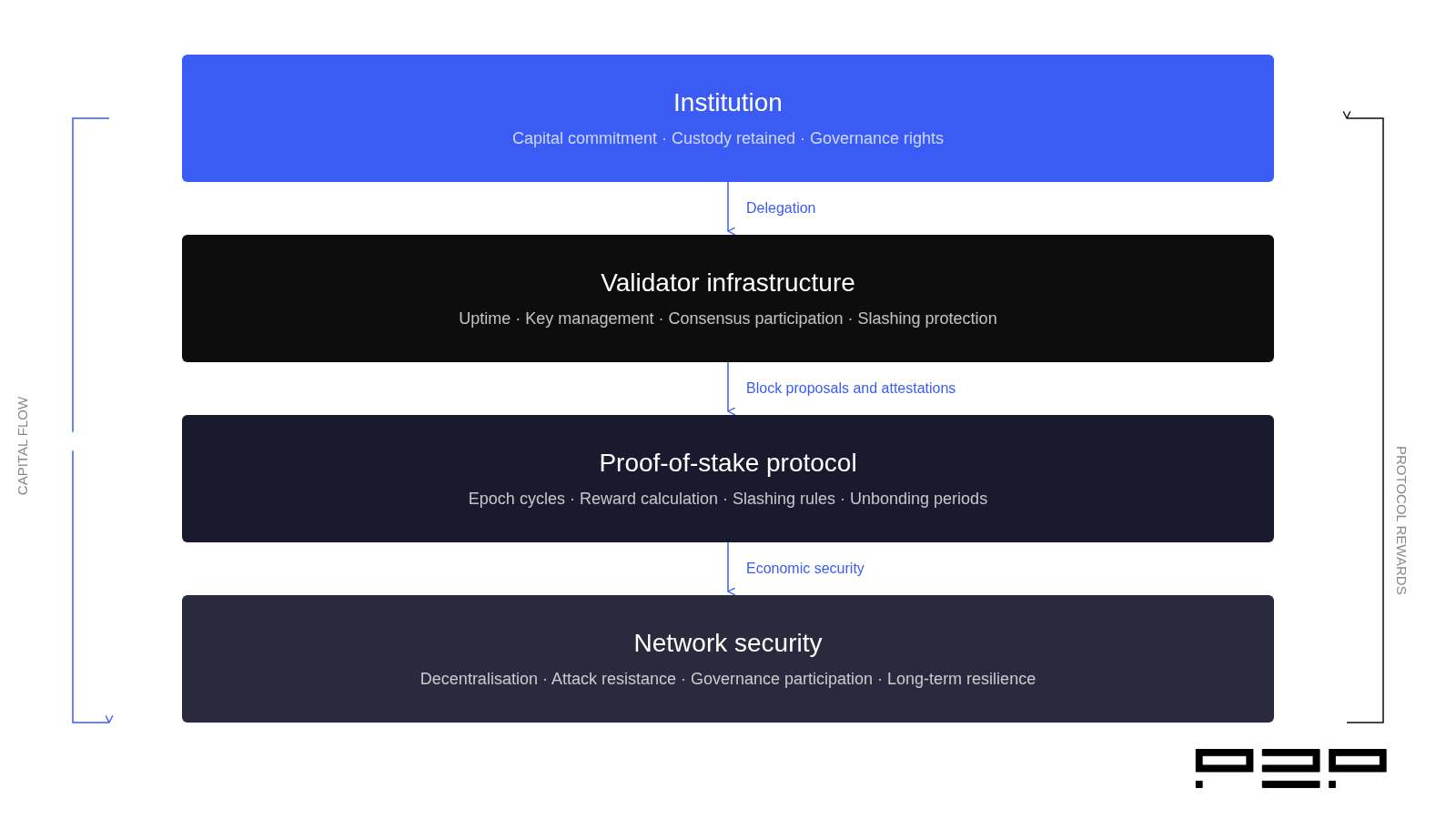
The proof-of-stake participation stack. Four layers from institution to network security, showing capital flow down and protocol rewards up.
To understand institutional staking, you first need to understand the mechanism it is built on: proof-of-stake consensus.
Blockchain networks need a way to agree on which transactions are valid and in what order they occurred, without relying on a central authority. This agreement mechanism is called consensus. There are two dominant models.
Proof-of-work, used by Bitcoin, requires validators to solve computationally intensive mathematical problems to earn the right to add a block of transactions. The process consumes significant energy and has become increasingly impractical for large-scale institutional participation.
Proof-of-stake replaces computational work with economic commitment. Validators lock up a quantity of the network's native token as collateral. The protocol then selects validators to propose and attest to new blocks, weighted by the size of their stake. Validators that behave correctly earn protocol rewards. Validators that behave incorrectly, through downtime or malicious action, face penalties including the partial destruction of their staked capital, a mechanism known as slashing.
The networks running proof-of-stake today include Ethereum, Solana, Polkadot, Cosmos, Cardano, and dozens of others. Together, they secure hundreds of billions of dollars in on-chain value and process the majority of decentralised finance, tokenisation, and digital payment activity globally.
For institutions, proof-of-stake is important for two reasons. First, it creates a mechanism for earning protocol-generated rewards on digital asset holdings without selling them or lending them to a counterparty. Second, it makes large capital holders structurally important to network security, giving institutional participants a governance role that did not exist in proof-of-work systems.
What Is Institutional Staking
Institutional staking is the participation of large-scale organisations in proof-of-stake network consensus. In practical terms, it means an institution delegates or operates validator infrastructure on a proof-of-stake network, commits capital as collateral, and earns protocol-generated rewards in return.
The distinction between retail and institutional staking is not simply one of scale. It is one of operational complexity, compliance requirements, governance obligations, and risk management frameworks. Banks, asset managers, hedge funds, pension funds, venture capital firms, and centralised exchanges have all moved into the sector. Staking solutions designed specifically for professional investors have gained significant momentum, shaping a distinct vertical now known as staking-as-a-service, tailored to the operational, regulatory, and custody requirements of large financial institutions (Source: CoinShares).
Where a retail participant might stake through a consumer wallet and accept whatever rewards the protocol delivers, an institutional staking program involves validator selection or operation, key management architecture, reward reporting for accounting and audit purposes, slashing risk controls, compliance documentation, and governance participation policies. Each of these dimensions requires deliberate design.
The scale of institutional commitment is now measurable. Ethereum's staking ratio reached a record 31.1% of total supply in March 2026, with institutional staking demand rising as BlackRock's staked Ethereum trust reached approximately $254 million in AUM in its first week. CoinLaw's Institutional investor surveys show 67% of professional players intend to increase their crypto holdings, with regulatory signals reducing uncertainty as a primary driver of institutional engagement (Source: CoinLaw).
How Institutional Staking Works in Practice
The mechanics of institutional staking vary by network, but the core structure is consistent across proof-of-stake systems.
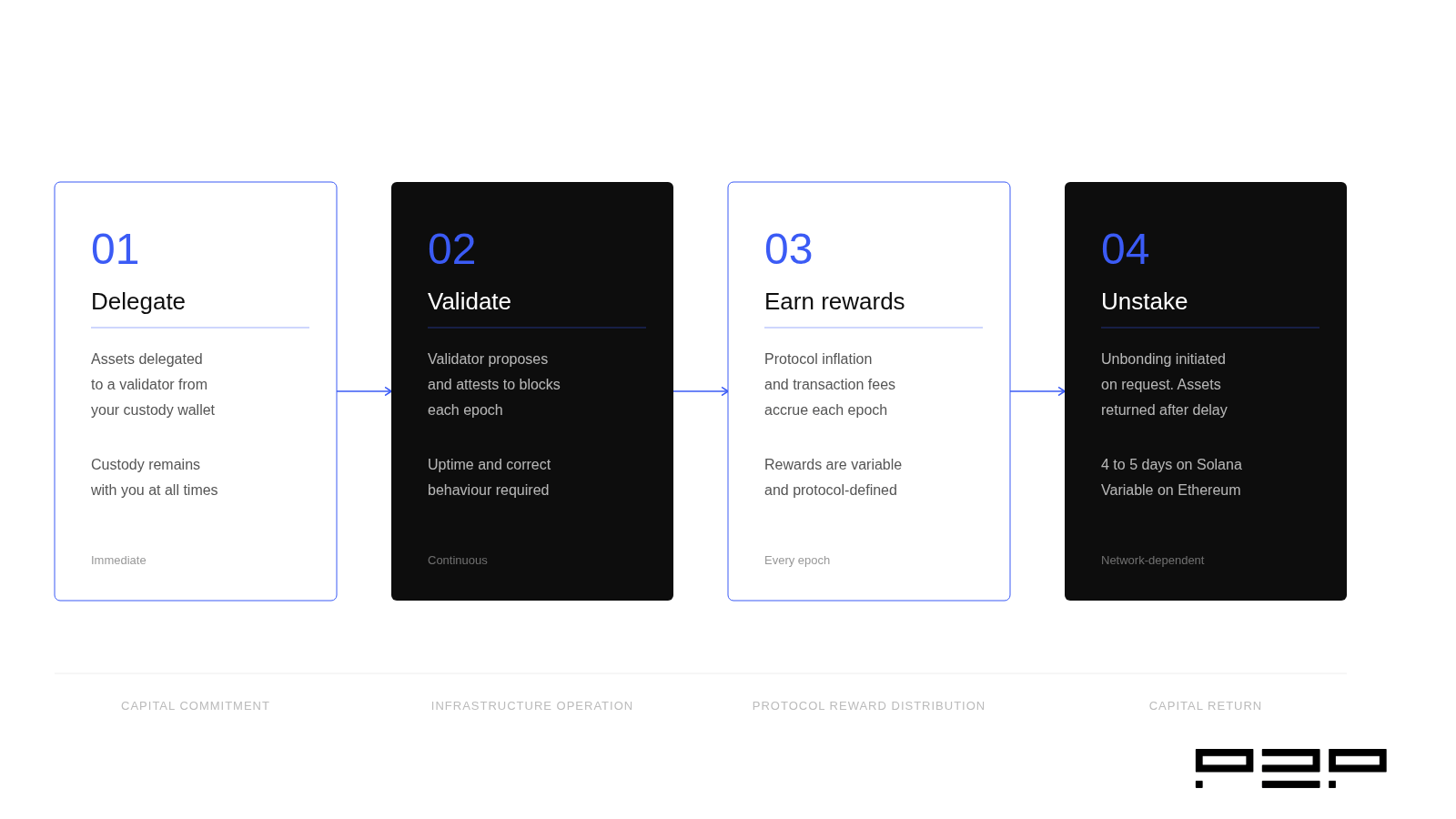
Delegation
An institution delegates its digital assets to a validator. The validator includes that stake in its total voting weight, which determines its probability of being selected to propose and attest blocks. The assets remain under the institution's custody. They are not transferred to the validator.
Validation
The validator operates infrastructure that stays online, participates in consensus rounds, and proposes or attests to blocks in accordance with the protocol's rules. Performance directly affects reward outcomes: validators with high uptime and correct behaviour earn higher effective rewards. Ethereum currently supports over 1.1 million active validators, with average validator uptime near 99.2% across the network (Source: CoinLaw).
Reward distribution
Protocol rewards accrue each epoch, the network's defined time unit for consensus participation. On Ethereum, an epoch is approximately 6.4 minutes. On Solana, it is approximately two days. Rewards are denominated in the network's native token and compound automatically into the staked balance.
Unstaking
When an institution wants to withdraw its stake, it initiates an unbonding process. The timeline varies by network. On Solana, unstaking takes approximately four to five days. On Ethereum, withdrawal timelines are variable depending on network conditions and the number of validators attempting to exit simultaneously. This lock-up timeline is a material liquidity consideration that must be integrated into any institutional staking program.
The institutional staking lifecycle in four stages: delegation, validation, reward distribution, and unstaking, with timing references for each.
How Protocol Rewards Are Generated
Understanding where rewards come from is essential for any institution building a staking program. Protocol rewards are not generated by P2P.org or any other staking provider. They are determined entirely by the protocol itself, based on network conditions and participation.
On most proof-of-stake networks, rewards come from two sources.
Protocol inflation
The network issues new tokens to reward validators and delegators for securing the chain. The issuance rate is governed by protocol parameters and typically decreases over time as the staking ratio increases. Base ETH staking rewards generally range from 3% to 4% annually, while restaking incentives can temporarily lift combined yields above 8% to 15% (Source: CoinLaw). On Solana, native staking currently generates 5 to 7% APY depending on validator performance and commission rates.
Institutional participants need to understand
Validators also earn a share of transaction fees generated by network activity. On Solana and other high-throughput networks, maximal extractable value (MEV), the additional value validators can capture through transaction ordering, has become a significant component of total validator revenue.
Institutional participants need to understand that these reward rates are variable. They change with network participation levels, protocol upgrades, and broader market conditions. No staking provider controls or guarantees reward rates.
Network conditions determine protocol-generated rewards and are variable. P2P.org does not control or set reward rates.
The Risk Categories Every Institution Must Understand
Institutional staking is not risk-free. The risk profile is distinct from most traditional asset classes and requires explicit assessment before any program is designed.
Slashing risk
Slashing is the protocol-level penalty applied to validators that violate consensus rules, primarily through double-signing or prolonged inactivity. A portion of staked capital is permanently destroyed. Slashing is rare on established networks like Ethereum, but its potential severity makes it the most scrutinised risk in institutional staking programs. Slashing risks are protocol-defined and client-borne. Operational safeguards can reduce exposure but cannot eliminate it.
Operational risk
The validator infrastructure itself introduces operational risk. Downtime, software misconfigurations, key management failures, and infrastructure outages can all result in missed rewards or, in severe cases, conditions that trigger slashing. The main risks in native staking are slashing and operational or custody failures. Institutions limit this risk by using providers with high uptime, redundancy and strong security. Custody and operational issues often occur when institutions run validators themselves without the required expertise (Source: CoinShares).
Liquidity risk
Staked capital is subject to unbonding periods. For institutions managing redemption obligations, fund liquidity covenants, or treasury mandates, the inability to access staked assets immediately is a balance sheet constraint that must be planned for. Many proof-of-stake networks impose lock-up or unbonding periods, restricting liquidity relative to traditional financial assets. These risks have always existed for retail users, but the scale of institutional capital amplifies their potential impact (Source: CoinShares).
Smart contract risk
Institutions using liquid staking protocols or DeFi-integrated staking products introduce smart contract risk, the possibility that a vulnerability in the protocol's code results in loss of capital. This risk does not exist in native staking at the protocol layer.
Regulatory and compliance risk
The regulatory treatment of staking rewards, custody arrangements, and reporting obligations varies by jurisdiction. While the March 2026 SEC and CFTC joint interpretation removed the primary U.S. securities law uncertainty, institutions operating across multiple jurisdictions must assess compliance requirements for each operating market.
What Is Staking-as-a-Service and When Does It Make Sense
Most institutional participants in proof-of-stake networks do not run their own validator infrastructure. Instead, they use staking-as-a-service, a model in which a specialist infrastructure provider operates validators on the institution's behalf.
In a staking-as-a-service arrangement, the institution retains full custody of its digital assets. The validator provider operates the infrastructure, manages key operations, monitors performance, and handles protocol upgrades. The institution receives validator-level reward reporting and retains governance rights.
Staking-as-a-service makes sense for institutions that want exposure to protocol rewards without building or maintaining the specialised infrastructure required to operate validators safely at scale. It is particularly relevant for digital asset custodians managing client assets, ETF issuers with staking-integrated products, treasury teams with long-term digital asset holdings, and crypto-native funds with institutional-grade compliance requirements.
The global crypto staking platform market was valued at $3.8 billion in 2025 and is projected to grow at a CAGR of 21.9% from 2026 to 2034, reaching approximately $22.6 billion by the end of the forecast period, driven by accelerating adoption of proof-of-stake blockchain networks, surging institutional participation, and the rapid expansion of DeFi ecosystems worldwide (Source: Market Intelo).
The critical distinction in any staking-as-a-service evaluation is whether the model is custodial or non-custodial. In a non-custodial arrangement, client assets remain under the institution's control at all times. The validator provider never holds the assets. This is the architecture that institutional compliance frameworks typically require.
P2P.org operates non-custodial validator infrastructure across more than 40 proof-of-stake networks, supporting custodians, funds, ETF issuers, and treasury teams with institutional-grade staking programs. You can explore our infrastructure and supported networks at p2p.org/networks/ethereum and review our technical integration documentation at docs.p2p.org.
Building an institutional staking program?P2P.org provides non-custodial staking-as-a-service across 40+ proof-of-stake networks, with validator-level reporting and operational safeguards designed for institutional requirements. Explore P2P.org Staking InfrastructureNetwork conditions determine protocol-generated rewards
Where Institutional Staking Fits in a Digital Asset Strategy
Institutional staking does not exist in isolation. It sits within a broader framework of how institutions deploy and manage digital assets, and its role is evolving rapidly.
For long-term holders, staking transforms passive digital asset exposure into productive capital participation. Institutions now regard staking rewards much like bond yields or dividend income, offering steady returns that support long-term portfolio resilience (Source: CoinShares).
For custodians, staking is becoming a standard service offering. The custody of digital assets and the operation of staking programs on behalf of clients are increasingly inseparable activities. Custodians that cannot offer or support staking are at a structural disadvantage in institutional client acquisition.
For ETF and ETP issuers, staking is now a product design requirement. BlackRock's staked Ethereum trust reached approximately $254 million in AUM in its first week of trading, demonstrating institutional demand for staking-integrated regulated products (Source: CoinLaw). Staking integration is no longer optional for competitive ETF products across proof-of-stake assets.
For treasury teams, staking offers a mechanism to offset the inflationary dilution that comes from holding unstaked assets on networks where new tokens are continuously issued to stakers. Holding unstaked assets on a proof-of-stake network without participating in staking is, in economic terms, a decision to accept dilution.
The integration of staking services into regulated financial products, including exchange-traded products, separately managed accounts, and fund-of-funds structures, is expanding the addressable market dramatically. The launch of staking-enabled spot Ethereum ETFs in multiple jurisdictions through 2025 and 2026 is expected to be a further institutional catalyst (Source: Market Intelo).
The institutions that are establishing staking programs today are not doing so speculatively. They are building infrastructure that will define how they participate in blockchain networks for the next decade.
Due Diligence Checklist: Getting Started with Institutional Staking
For institutions evaluating or initiating a staking program, these are the foundational questions to answer before committing capital:
[ ] Which proof-of-stake networks are relevant to your existing or planned digital asset holdings?
[ ] Does your mandate permit staking, and has legal confirmed the applicable regulatory treatment in your jurisdiction?
[ ] Is your custody architecture non-custodial, and does it support delegation to external validator infrastructure?
[ ] Have you selected a staking-as-a-service provider and evaluated their infrastructure, incident history, and slashing risk controls?
[ ] Is your liquidity management framework designed around the unbonding timelines of the networks you plan to stake on?
[ ] Does your accounting and reporting framework support validator-level reward attribution?
[ ] Has your risk committee reviewed the slashing, operational, and liquidity risk categories relevant to your program?
[ ] Is there a documented governance participation policy for protocol upgrades?
Key Takeaway
Institutional staking is the participation of funds, custodians, ETF issuers, and treasury teams in proof-of-stake network consensus. It generates protocol-defined rewards in exchange for validator infrastructure and capital commitment. It is not a yield product, and it is not passive. It requires deliberate design across custody architecture, risk management, reward reporting, and governance policy.
The regulatory environment in 2026 has removed the primary legal barriers to institutional participation. The infrastructure has matured to support non-custodial, institutional-grade staking programs at scale. The institutions that build a rigorous foundation now will be best positioned as staking becomes a standard component of digital asset strategy across every institutional segment.
The next article in this series goes one level deeper: how validator infrastructure works, how rewards are calculated at the network level, and what the risk architecture of a well-designed institutional staking program actually looks like.
Network conditions determine protocol-generated rewards and are variable. P2P.org does not control or set reward rates. Slashing risks are protocol-defined and client-borne. Operational safeguards are implemented to reduce slashing exposure, but do not eliminate protocol-level risk.
Frequently Asked Questions (FAQ)
What is institutional staking?
Institutional staking is the participation of large-scale organisations, including funds, custodians, ETF issuers, exchanges, and treasury teams, in proof-of-stake blockchain networks. Institutions delegate or operate validator infrastructure, commit digital assets as collateral, and earn protocol-generated rewards in return. It differs from retail staking primarily in its operational complexity, compliance requirements, and risk management frameworks.
How are staking rewards generated?
Staking rewards are generated by the proof-of-stake protocol itself, not by any staking provider. They come from two sources: protocol inflation, where new tokens are issued to reward validators and delegators for securing the network, and transaction fees or MEV captured during block production. Reward rates are variable and change with network conditions, participation levels, and protocol upgrades.
Is institutional staking regulated?
In the United States, the SEC and CFTC joint interpretation issued on March 17, 2026, explicitly confirmed that protocol staking across all four models, including solo, self-custodial, custodial, and liquid, does not constitute a securities transaction. In Europe, MiCA provides a regulatory framework for staking within licensed digital asset service providers. The regulatory treatment of staking rewards and custody arrangements varies by jurisdiction and warrants specific legal advice for each operating market.
What is staking-as-a-service?
Staking-as-a-service is a model in which a specialist infrastructure provider operates validator nodes on behalf of an institution. The institution retains full custody of its digital assets at all times. The provider handles validator operations, key management, performance monitoring, and reporting. It is the most common model for institutional staking participation, as it removes the need to build and maintain specialised validator infrastructure in-house.
What is the difference between custodial and non-custodial staking?
In non-custodial staking, the institution's digital assets remain under the institution's control throughout the staking process. The validator provider operates infrastructure but never holds the assets. In custodial staking, the assets are transferred to the custody of the staking provider or a third-party custodian. For most institutional compliance frameworks, non-custodial staking is the required architecture, as it avoids the custody implications that would trigger additional regulatory obligations.
What risks does institutional staking carry?
The primary risk categories are slashing risk (protocol-level penalties for validator misbehaviour), operational risk (infrastructure failures, downtime, key management errors), liquidity risk (unbonding timelines restricting access to capital), smart contract risk (relevant to liquid staking protocols), and regulatory and compliance risk (varying treatment across jurisdictions). Each of these categories requires explicit assessment and mitigation as part of any institutional staking program design.
How long does it take to unstake digital assets?
Unbonding timelines vary by network. On Solana, unstaking takes approximately four to five days under normal conditions. On Ethereum, withdrawal timelines are variable, typically several days under normal conditions but potentially extending during periods of high validator exit activity. These timelines must be integrated into any institution's liquidity management framework.
What is the minimum stake required for institutional staking?
Minimum stake requirements vary by network and staking model. On Ethereum, running an independent validator requires exactly 32 ETH. Through a staking-as-a-service provider or delegation model, there is typically no minimum, or the minimum is set by the provider's commercial terms. Institutions should confirm minimum requirements with their chosen staking provider for each network they intend to participate in.
Subscribe to P2P-economy
Get the latest posts delivered right to your inbox
<p>The start of April 2026 has brought several significant developments across Ethereum staking infrastructure, tokenized asset markets, ETF product evolution, and the convergence of traditional and on-chain finance.</p><p>From the Ethereum Foundation completing a landmark treasury shift to Apollo Global Management deepening its on-chain lending infrastructure commitment, this edition highlights five developments shaping how institutional capital interacts with decentralized networks.</p><p>👉 Subscribe to our newsletter at the bottom of this page to receive a monthly summary of the latest DeFi and staking developments, curated for institutional participants.</p><h2 id="quick-learning-for-busy-readers"><strong>Quick Learning for Busy Readers</strong></h2><ul><li>The Ethereum Foundation has completed its 70,000 ETH staking commitment, shifting from ETH sales to a protocol-native yield model</li><li>Grayscale's Ethereum Staking ETF has operationalized new liquidity mechanics for managing staked asset redemptions</li><li>Tokenized U.S. Treasuries have crossed $12.88 billion in distributed asset value, with represented asset value up 31% in thirty days</li><li>Major financial institutions are actively transitioning parts of the repo market onto blockchain settlement infrastructure</li><li>Apollo Global Management has entered a structured cooperation agreement with Morpho, committing to acquire up to 9% of the protocol's governance token supply over four years</li></ul><p>Missed the previous DeFi Dispatch? Catch up on the latest DeFi news and signals from the previous edition:</p><p>👉 <a href="https://p2p.org/economy/defi-dispatch-defi-news-and-signals-march-2026-issue-2/">https://p2p.org/economy/defi-dispatch-defi-news-and-signals-march-2026-issue-2/</a></p><h2 id="whats-driving-defi-markets-at-the-start-of-april-2026"><strong>What's driving DeFi markets at the start of April 2026?</strong></h2><p>The developments at the opening of April 2026 reflect a market in structural transition. Institutional participants are moving from observing blockchain infrastructure to actively embedding capital within it, whether through staking treasury strategies, ETF product development, on-chain settlement systems, or direct protocol governance positions.</p><p>Below, we break down five key developments and why they matter for asset managers, custodians, hedge funds, ETF issuers, exchanges, and staking teams.</p><h3 id="1-the-ethereum-foundation-completes-its-70000-eth-staking-commitment"><strong>1. The Ethereum Foundation Completes Its 70,000 ETH Staking Commitment</strong></h3><p>The Ethereum Foundation has staked roughly $143 million worth of ether, effectively completing its previously announced 70,000 ETH staking target. The move shifts the foundation from regularly selling ETH to fund its approximately $100 million in annual expenses toward earning a staking yield of an estimated $3.9 million to $5.4 million a year instead.</p><p>The goal is to generate staking rewards to fund protocol research, grants, and operations, replacing the previous practice of selling ETH, which often created sell pressure in the market. The program uses open-source tools for distributed signing and validator management with diverse client pairings for security and decentralization, with no reliance on centralized providers.</p><p>Sources: <a href="https://www.coindesk.com/markets/2026/04/03/ethereum-foundation-stakes-another-usd93-million-ether-reaching-its-70-000-eth-target?ref=p2p.org" rel="noreferrer">CoinDesk</a>, <a href="https://www.tekedia.com/ethereum-foundation-stakes-22517-eth-via-the-treasurys-multisignature-wallet/?ref=p2p.org" rel="noreferrer">Tekedia</a></p><h4 id="why-is-this-important"><strong>Why is this important?</strong></h4><p>This development matters for several interconnected reasons:</p><ul><li>It signals that even the network's own foundation views staking as a preferred capital management mechanism over market liquidations.</li><li>It reduces structural ETH sell pressure from one of the ecosystem's largest treasury holders.</li><li>It demonstrates how large institutional entities can use proof-of-stake mechanics to generate protocol-native yield without relying on centralized staking providers.</li><li>It reinforces the importance of validator infrastructure as the operational layer enabling these treasury strategies at scale.</li></ul><p>For validator operators and staking teams, the Ethereum Foundation's shift models a treasury playbook that asset managers and treasury committees are increasingly considering.</p><h3 id="2-grayscale-ethereum-staking-etf-operationalizes-new-redemption-mechanics"><strong>2. Grayscale Ethereum Staking ETF Operationalizes New Redemption Mechanics</strong></h3><p>Beginning on April 6, 2026, Grayscale's Ethereum Staking ETF introduced new liquidity tools for handling share redemptions when Ethereum liquidity is constrained, including the ability to use delayed delivery orders where digital assets owed to a liquidity provider are delivered once specific staked assets become transferable.</p><p>The formalization of a liquidity provider agreement represents a significant operational milestone, designed to ensure the ETF functions smoothly on NYSE Arca with proper mechanisms for share creation, redemption, and trading. </p><p>Sources: <a href="https://www.stocktitan.net/sec-filings/ETHE/8-k-grayscale-ethereum-staking-etf-reports-material-event-f99833794056.html?ref=p2p.org" rel="noreferrer">Stocktitan</a>, <a href="https://www.minichart.com.sg/2026/04/07/grayscale-ethereum-staking-etf-files-8-k-with-sec-key-details-and-registration-information/?ref=p2p.org">Minichart</a>.</p><h4 id="why-is-this-important-1"><strong>Why is this important?</strong></h4><p>Staking within an ETF structure introduces liquidity management challenges that do not exist in standard spot products. The unbonding period on Ethereum means staked assets cannot be instantly liquidated to meet redemptions. The operationalization of delayed delivery mechanisms is a direct response to this constraint, and its formal codification signals:</p><ul><li>ETF issuers are actively solving the redemption mechanics that staking introduces into regulated product structures.</li><li>Infrastructure decisions at the custody and validator layer directly affect how ETF products perform under redemption pressure.</li><li>As more issuers develop staking-enabled products, these operational frameworks become reference architecture for the broader market.</li></ul><p>For custodians, exchanges, and institutional staking teams, this is the mechanics layer that determines whether staking ETFs scale.</p><h3 id="3-tokenized-us-treasuries-cross-1288-billion-in-distributed-asset-value"><strong>3. Tokenized U.S. Treasuries Cross $12.88 Billion in Distributed Asset Value</strong></h3><p>As of early April 2026, tokenized U.S. Treasuries hold approximately $12.88 billion in total value across distributed and represented assets, having grown from roughly $5 billion in late 2024, reflecting sustained institutional demand. </p><p>Represented asset value across the broader tokenization ecosystem stood at $441.38 billion as of April 6, up 31.61% over the prior thirty days. A joint statement from the Federal Reserve, OCC, and FDIC in Q1 2026 clarified that the capital rule is technology-neutral, meaning an eligible tokenized security receives the same capital treatment as the non-tokenized form of the same security. </p><p>Sources: <a href="https://metamask.io/news/types-of-tokenized-real-world-assets-rwa-categories?ref=p2p.org">MetaMask</a>, <a href="https://www.fintechweekly.com/news/real-world-asset-tokenization-explainer-institutional-2026?ref=p2p.org">FinTech News</a>.</p><h4 id="why-is-this-important-2"><strong>Why is this important?</strong></h4><p>Tokenized government securities are becoming the benchmark low-risk asset for compliant institutional capital on-chain. The growth from $5 billion to nearly $13 billion in roughly 18 months reflects:</p><ul><li>A shift from experimentation to production-scale deployment among asset managers and funds.</li><li>Regulatory guidance providing the framework for banks and asset managers to treat tokenized instruments the same as their non-tokenized equivalents.</li><li>The emergence of programmable treasury management as a genuine institutional tool, not a pilot category.</li></ul><p>As tokenized assets scale, the reliability and security of the blockchain networks settling these instruments becomes increasingly central to institutional risk assessment.</p><h3 id="4-major-financial-institutions-move-repo-market-infrastructure-on-chain"><strong>4. Major Financial Institutions Move Repo Market Infrastructure On-Chain</strong></h3><p>As of April 6, 2026, major financial institutions are actively transitioning parts of the $12.5 trillion repo market onto Ethereum, representing one of the most significant signals of traditional finance embedding blockchain infrastructure into core settlement operations. </p><p>Institutional crypto in 2026 is increasingly centred on controlled access, with large financial firms using on-chain systems for repo, treasury activity, and cash management inside environments built around compliance and permissions, while simultaneously seeking access to the liquidity available on public chains. </p><p>Sources: <a href="https://coinmarketcap.com/cmc-ai/ethereum/latest-updates/?ref=p2p.org">CoinMarketCap</a>, <a href="https://beincrypto.com/on-chain-economy-splitting-in-two/?ref=p2p.org">BeInCrypto</a>.</p><h4 id="why-is-this-important-3"><strong>Why is this important?</strong></h4><p>The repo market is one of the most foundational mechanisms in global finance, functioning as the overnight collateral and liquidity backbone for banks, funds, and financial market participants. Its migration toward blockchain settlement infrastructure signals:</p><ul><li>Blockchain is no longer being evaluated as an alternative to traditional finance, but as the settlement layer for it.</li><li>On-chain settlement for repo creates direct demand for stable, high-performance validator infrastructure to process and finalize transactions reliably.</li><li>As permissioned and public chain environments begin connecting, validator operators supporting public networks become part of the institutional settlement stack.</li></ul><p>For hedge funds, custodians, and treasury teams, this is the convergence point many have been anticipating.</p><h3 id="5-apollo-global-management-enters-structured-cooperation-agreement-with-morpho"><strong>5. Apollo Global Management Enters Structured Cooperation Agreement With Morpho</strong></h3><p>Apollo Global Management struck a cooperation agreement to support lending markets built on Morpho's on-chain protocol. The deal allows Apollo to acquire up to 90 million MORPHO tokens over 48 months, which would represent approximately 9% of the protocol's governance token supply. The move follows BlackRock's push into decentralized finance, listing its tokenized fund and acquiring tokens of decentralized exchange Uniswap. </p><p>The Apollo deal follows several high-profile institutional partnerships that have helped Morpho strengthen its position in decentralized lending. In late January 2026, Bitwise Asset Management introduced its first on-chain vault on Morpho, offering USDC deposits with yields of up to 6%. Morpho currently holds approximately $5.8 billion in total value locked. </p><p>Sources: <a href="https://www.coindesk.com/business/2026/02/15/wall-street-giant-apollo-deepens-crypto-push-with-morpho-token-deal?ref=p2p.org">CoinDesk</a>, <a href="https://crypto.news/apollo-morpho-token-acquisition-defi-lending-2026/?ref=p2p.org">Crypto News</a>.</p><h4 id="why-is-this-important-4"><strong>Why is this important?</strong></h4><p>Apollo managing approximately $940 billion in assets, acquiring a governance stake in a DeFi lending protocol is not a portfolio allocation. It is a structural commitment to on-chain credit infrastructure:</p><ul><li>It signals that alternative asset managers are evaluating DeFi lending protocols as operational infrastructure, not speculative positions.</li><li>The cooperation agreement component, focused on supporting lending markets built on Morpho, means Apollo is embedding its credit expertise directly into on-chain vault design.</li><li>Morpho's curated vault architecture, where professional risk teams allocate capital across isolated lending markets, is increasingly the model that institutions recognize as compatible with their risk management requirements.</li></ul><p>For staking product managers, DeFi infrastructure teams, and risk committees, the Apollo deal is the clearest signal yet that institutional capital is moving beyond observation and into direct protocol-level engagement.</p><h2 id="key-takeaways-for-asset-managers-custodians-hedge-funds-etf-issuers-exchanges-and-staking-teams"><strong>Key Takeaways for Asset Managers, Custodians, Hedge Funds, ETF Issuers, Exchanges, and Staking Teams</strong></h2><p>The start of April 2026 highlights several converging trends:</p><ul><li>Staking is becoming a treasury management tool for major ecosystem participants, not only a validator activity.</li><li>ETF products are operationalizing the liquidity mechanics that staking introduces into regulated structures.</li><li>Tokenized real-world assets are moving from pilot to production at an institutional scale.</li><li>Traditional financial infrastructure, including repo markets, is beginning to settle on blockchain networks.</li><li>Alternative asset managers are acquiring direct governance positions in DeFi lending protocols.</li></ul><p>These developments reinforce how blockchain infrastructure is transitioning from an alternative financial layer to the settlement and operational backbone of institutional capital markets.</p><h2 id="frequently-asked-questions-faqs"><strong>Frequently Asked Questions (FAQs)</strong><br></h2><h3 id="why-is-defi-news-relevant-for-staking-participants"><strong>Why is DeFi news relevant for staking participants?</strong></h3><p>DeFi news reflects how capital flows through blockchain ecosystems. These flows influence staking participation rates, validator demand, and the economic conditions in which staking infrastructure operates.</p><h3 id="what-is-the-repo-market-and-why-does-its-move-on-chain-matter"><strong>What is the repo market,</strong> <strong> and why does its move on-chain matter?</strong></h3><p>The repo market is the mechanism by which financial institutions lend and borrow against collateral on a short-term basis. It underpins global liquidity. When it moves on-chain, it creates direct demand for the blockchain infrastructure that processes and finalizes those transactions.</p><h3 id="are-staking-yields-within-etf-structures-the-same-as-staking-directly"><strong>Are staking yields within ETF structures the same as staking directly?</strong></h3><p>No. ETF staking yields are affected by the proportion of assets staked, unbonding periods, custodian service fees, and the need to maintain liquidity reserves for redemptions. These factors mean ETF staking yields are typically lower than direct on-chain staking yields.</p><h3 id="what-does-tokenized-treasury-growth-mean-for-defi-infrastructure"><strong>What does tokenized Treasury growth mean for DeFi infrastructure?</strong></h3><p>As tokenized Treasuries scale, they require the blockchain networks settling them to maintain high uptime, security, and reliability. Validator infrastructure supporting those networks becomes part of the financial infrastructure stack.</p><h3 id="what-is-a-curated-defi-vault-and-why-are-institutions-interested"><strong>What is a curated DeFi vault, and why are institutions interested?</strong></h3><p>A curated vault is a smart contract managed by professional risk teams that allocates depositor capital across isolated lending markets with defined risk parameters. Institutions are attracted to the combination of on-chain transparency, non-custodial asset control, and structured risk management that curated vaults provide.</p><hr><p>👉 <strong>Subscribe to our newsletter </strong>to receive a monthly summary of the latest DeFi and staking developments, curated for institutional participants. </p><p>👉 <strong>Or follow us on </strong><a href="https://ky.linkedin.com/company/p2p-org?ref=p2p.org" rel="noreferrer"><strong>LinkedIn</strong></a><strong> or </strong><a href="https://x.com/P2Pvalidator?ref=p2p.org" rel="noreferrer"><strong>X</strong></a> to stay updated when new DeFi Dispatch editions are published.</p>
<p>P2P Certified | Compliance</p><h2 id="introduction">Introduction</h2><p>Compliance claims are easy to make. In an industry where regulatory expectations are rising faster than most firms realise, the difference between a compliance page and genuine compliance practice is measured not in words but in independent validation.</p><p>At <a href="http://p2p.org/?ref=p2p.org">P2P.org</a>, we have built our customer due diligence (CDD) framework as a living system, one designed for where regulation is heading rather than where it has been. That commitment recently received external recognition from Sumsub in the form of their Risk Intolerant Sentinel designation, a badge awarded to organisations that demonstrate proactive, comprehensive standards across KYC, AML monitoring, fraud prevention and identity verification.</p><p>This post explains what that recognition means, how it was earned, and what it signals to the institutions and regulated businesses that partner with P2P.org.</p><h2 id="key-learnings-for-busy-readers">Key learnings for busy readers</h2><p>If you are short on time, here is what this article covers:</p><p>P2P.org has been awarded the <a href="https://sumsub.com/risk-intolerant/?ref=p2p.org" rel="noreferrer">Sumsub Risk Intolerant Sentinel</a> designation, an independent recognition awarded by a globally trusted compliance and identity verification platform operating across 220+ countries. The designation is not self-reported. It is the result of a third-party assessment of P2P.org's use of Sumsub's verification and monitoring infrastructure across our compliance operations. For institutional partners and regulated businesses, this is a concrete, externally verified signal of the compliance standards they are dealing with when they work with <a href="http://p2p.org/?ref=p2p.org">P2P.org</a>. Our CDD framework was reviewed against current AMLR expectations as a deliberate investment in partnership quality, not as a reactive compliance exercise.</p><h2 id="independent-recognition-in-an-industry-where-it-matters-most">Independent recognition in an industry where it matters most</h2><p>Recognition of compliance standards is only meaningful when it comes from outside the organisation. Anyone can write a compliance page. Third-party validation from a globally recognised authority is a different kind of signal.</p><p><a href="https://sumsub.com/about/?ref=p2p.org" rel="noreferrer">Sumsub</a> is a global compliance and identity verification platform trusted by thousands of regulated businesses across fintech, crypto, traditional financial institutions and digital asset businesses worldwide. Their infrastructure spans KYC, KYB, AML monitoring, transaction screening and fraud prevention across more than 220 countries and territories.</p><p>The Risk Intolerant initiative was created specifically to address what Sumsub describes as a gap in the industry: compliance work is largely invisible until something goes wrong. The project shifts that dynamic by publicly recognising organisations that manage risk proactively, turning otherwise unseen compliance efforts into verifiable, public proof.</p><p>The Sentinel designation is awarded following Sumsub's assessment of a company's KYC, AML, fraud prevention and compliance systems. It goes to organisations whose risk mitigation practices are comprehensive, current and effective. Importantly, it is not a self-reported badge. It requires assessment against Sumsub's global client base and the standards they apply across their entire platform.</p><p><a href="http://p2p.org/?ref=p2p.org">P2P.org</a> has received this designation based on our use of Sumsub's verification and monitoring infrastructure across our compliance operations. For our partners, it means one thing practically: your counterpart at <a href="http://p2p.org/?ref=p2p.org">P2P.org</a> has been independently evaluated by a recognised global compliance authority.</p><p>You can read more about the Risk Intolerant initiative directly at <a href="https://sumsub.com/risk-intolerant/?ref=p2p.org">sumsub.com/risk-intolerant</a>.</p><h2 id="the-thinking-behind-our-compliance-approach">The thinking behind our compliance approach</h2><p>Compliance is not a static checklist at <a href="http://p2p.org/?ref=p2p.org">P2P.org</a>. It is a framework we treat as an ongoing investment in the quality of our partnerships.</p><figure class="kg-card kg-image-card kg-card-hascaption"><img src="https://p2p.org/economy/content/images/2026/04/-p2p-org-sumsub-compliance-validation-flow.png" class="kg-image" alt="Diagram showing how P2P.org compliance operations connect through Sumsub's verification platform to the Risk Intolerant Sentinel designation, resulting in independently verified partner trust for institutions and regulated businesses." loading="lazy" width="1600" height="900" srcset="https://p2p.org/economy/content/images/size/w600/2026/04/-p2p-org-sumsub-compliance-validation-flow.png 600w, https://p2p.org/economy/content/images/size/w1000/2026/04/-p2p-org-sumsub-compliance-validation-flow.png 1000w, https://p2p.org/economy/content/images/2026/04/-p2p-org-sumsub-compliance-validation-flow.png 1600w" sizes="(min-width: 720px) 720px"><figcaption><i><em class="italic" style="white-space: pre-wrap;">How </em></i><span style="white-space: pre-wrap;">P2P.org</span><i><em class="italic" style="white-space: pre-wrap;">'s CDD framework and Sumsub's global platform combine to produce independent compliance validation.</em></i></figcaption></figure><p>As the <a href="http://p2p.org/?ref=p2p.org">P2P.org</a> Compliance team put it:</p><blockquote>"Compliance in this industry is moving faster than most firms realise. We made the decision early on to treat our CDD framework as a living system, one that needs to be built for where regulation is going, not where it has been. The AMLR review was not a defensive move. It was a deliberate investment in the quality of the partnerships we want to maintain."</blockquote><p>The EU Anti-Money Laundering Regulation (AMLR) is reshaping expectations for regulated and high-risk sectors across financial services, crypto and digital assets. Rather than waiting to react, <a href="http://p2p.org/?ref=p2p.org">P2P.org</a> reviewed and aligned our CDD processes against AMLR requirements as a deliberate, proactive step.</p><p>The diagram above illustrates how our internal compliance operations connect through Sumsub's platform infrastructure to the independent assessment process, culminating in the Sentinel designation that now represents verified partner trust for the institutions and funds working with us.</p><h2 id="what-the-sentinel-designation-means-in-practice">What the Sentinel designation means in practice</h2><p>The Risk Intolerant project structures recognition across tiers based on assessment results. The Sentinel designation reflects a proactive, best-in-class approach to fraud prevention, AML screening, identity verification and customer onboarding. It is not awarded by request alone. It follows Sumsub's evaluation of how a company's systems are designed, operated and updated.</p><p>For institutions evaluating staking infrastructure providers or digital asset service partners, compliance validation from a recognised global platform provides a layer of due diligence assurance that internal claims cannot offer. When P2P.org's compliance standards are assessed by the same platform that serves thousands of regulated businesses globally, the result carries a weight that self-certification does not.</p><p>This is particularly relevant given the direction regulatory frameworks are moving. FATF's 2025 guidance and the EU's broader AML package are pushing regulated industries toward a unified, risk-based approach where continuous monitoring and adaptive controls are the expectation, not the exception. P2P.org's investment in a living CDD framework, validated independently through Sumsub, places us ahead of that curve rather than behind it.</p><h2 id="why-independent-validation-matters-for-institutional-partners">Why independent validation matters for institutional partners</h2><p>Institutions choosing infrastructure partners in the staking and digital asset space carry compliance obligations of their own. They are not just choosing a technology provider. They are choosing a counterparty whose compliance posture either supports or complicates their own regulatory standing.</p><p>A self-reported compliance page provides limited assurance. What institutions need is a signal they can actually rely on: an assessment conducted by a third party with the global reach and technical authority to evaluate compliance infrastructure objectively.</p><p>The Sumsub Risk Intolerant Sentinel designation provides exactly that. It is a third-party determination, applied consistently across a global client base, that P2P.org's approach to risk management meets the standard Sumsub sets for comprehensive, proactive compliance.</p><p>When you partner with <a href="http://p2p.org/?ref=p2p.org">P2P.org</a> for staking infrastructure across our 40+ supported networks, you are working with a business that has been independently evaluated, not just one that has declared its own compliance. That distinction matters increasingly in the regulatory environment we are all operating in.</p><h2 id="p2porg-compliance-as-part-of-a-broader-standard">P2P.org compliance as part of a broader standard</h2><p>The Sumsub recognition sits alongside P2P.org's existing compliance achievements. We achieved SOC 2 Type II certification in 2025, confirming that our security and operational frameworks meet the standards institutional clients require. Our infrastructure supports more than $10 billion in assets under management across 40+ blockchain networks, with a zero-slashing incident record and 99.9% uptime across all validator infrastructure.</p><p>Compliance and operational excellence are not separate tracks at P2P.org. They are part of the same commitment to being a partner that regulated institutions can rely on.</p><p>If you would like to explore our institutional staking products and understand how our compliance framework supports the businesses we work with, visit <a href="https://www.p2p.org/products/staking-as-a-business?ref=p2p.org">P2P.org Staking-as-a-Business</a>.</p><p>For more compliance coverage and updates from the P2P Certified series, explore the <a href="https://www.p2p.org/economy/?ref=p2p.org">P2P.org blog</a>.</p><h2 id="key-takeaways">Key takeaways</h2><p>P2P.org has received the Sumsub Risk Intolerant Sentinel designation following an independent third-party assessment of our compliance and verification infrastructure. The designation reflects a proactive, comprehensive approach to KYC, AML, fraud prevention and CDD, aligned with where regulation is heading under AMLR and broader global AML frameworks. For institutional partners and regulated businesses, this is a verifiable external signal of the compliance standards P2P.org operates to, not a self-declared claim. Our CDD framework is built as a living system, designed to evolve ahead of regulatory expectations rather than react to them.</p><h2 id="frequently-asked-questions-faqs">Frequently Asked Questions (FAQs)</h2><h3 id="what-is-the-sumsub-risk-intolerant-sentinel-designation"><br><strong>What is the Sumsub Risk Intolerant Sentinel designation?</strong> </h3><p>The Risk Intolerant Sentinel is a recognition awarded by Sumsub as part of their Risk Intolerant initiative, which publicly identifies companies that demonstrate comprehensive, proactive standards in KYC, AML, fraud prevention and identity verification. It is based on a third-party assessment of a company's compliance systems, not a self-reported application.</p><h3 id="is-this-the-highest-designation-in-the-risk-intolerant-programme"><strong>Is this the highest designation in the Risk Intolerant programme?</strong> </h3><p>The Risk Intolerant project has three tiers: Vanguard, Sentinel and Titan. The Sentinel designation is awarded to companies that demonstrate a proactive, best-in-class approach to compliance and fraud prevention, going beyond baseline requirements.</p><h3 id="what-is-sumsub-and-why-does-its-recognition-matter"><strong>What is Sumsub, and why does its recognition matter?</strong> </h3><p>Sumsub is a global compliance and identity verification platform operating in 220+ countries, trusted by thousands of regulated businesses, including traditional financial institutions, fintech companies and digital asset businesses. Their assessment reflects global compliance benchmarks, which is why their recognition carries weight beyond the digital asset sector.</p><h3 id="what-is-the-amlr-and-why-did-p2porg-review-its-cdd-framework-against-it"><strong>What is the AMLR, and why did P2P.org review its CDD framework against it?</strong> </h3><p>The EU Anti-Money Laundering Regulation (AMLR) is reshaping compliance expectations across financial services and digital assets. P2P.org reviewed and aligned our CDD framework against AMLR as a proactive investment in compliance quality and partnership standards, not as a reactive measure to regulatory pressure.</p><h3 id="does-p2porg-hold-any-other-compliance-certifications"><strong>Does P2P.org hold any other compliance certifications?</strong> </h3><p>Yes. P2P.org achieved SOC 2 Type II certification in 2025, confirming that our security and operational control frameworks meet institutional standards. The Sumsub Sentinel designation adds an independent layer of compliance-specific validation to that foundation.</p><h3 id="how-does-this-affect-institutional-partners-working-with-p2porg"><strong>How does this affect institutional partners working with P2P.org?</strong> </h3><p>Institutional partners carry their own compliance obligations when selecting counterparties. The Sumsub Sentinel designation gives them an independently verified signal of P2P.org's compliance standards, one assessed by a globally recognised authority rather than declared internally.</p>
 ALL
Agoric
Aptos
Auth
Avail
Avalanche
Axelar
Babylon
Bitcoin
BTC
Cardano
Celestia
certifications
Chainlink
compliance
Cosmos
Crescent
Cyberway
DAOBet
DeFi
defi news
DVT
Dymension
Economy
Education
EigenLayer
Elrond
Ethereum
Evmos
Explain Like I'm Five
Guide
how to
HR
infrastructure
Kava
Kusama
landing
Lido
LSP
Manta
Mantle
Marlin
Matic
Moonbeam
MultiversX
Near
News
NuCypher
Oasis
Origin
Partnership
Persistence
playbook
Pocket
Polkadot
Polygon
product
products
Quicksilver
Regen
regulation
Renzo
restaking
RPC Node
Sender
Serum
slashing
Solana
SSV.Network
Staking
Starknet
Sui
symbiotic
Syncro
syncro sender
Terra
Tezos
TheGraph
Threshold
Update
validator
Vara
vault
Vega
ALL
Agoric
Aptos
Auth
Avail
Avalanche
Axelar
Babylon
Bitcoin
BTC
Cardano
Celestia
certifications
Chainlink
compliance
Cosmos
Crescent
Cyberway
DAOBet
DeFi
defi news
DVT
Dymension
Economy
Education
EigenLayer
Elrond
Ethereum
Evmos
Explain Like I'm Five
Guide
how to
HR
infrastructure
Kava
Kusama
landing
Lido
LSP
Manta
Mantle
Marlin
Matic
Moonbeam
MultiversX
Near
News
NuCypher
Oasis
Origin
Partnership
Persistence
playbook
Pocket
Polkadot
Polygon
product
products
Quicksilver
Regen
regulation
Renzo
restaking
RPC Node
Sender
Serum
slashing
Solana
SSV.Network
Staking
Starknet
Sui
symbiotic
Syncro
syncro sender
Terra
Tezos
TheGraph
Threshold
Update
validator
Vara
vault
Vega