Institutional DeFi Infrastructure: A Complete Guide for Funds, Custodians, and Treasury Teams
Series: Hub | Institutional DeFi Infrastructure
The Institutional DeFi Infrastructure Hub is P2P.org's definitive reference for regulated institutions evaluating on-chain capital allocation. From vault architecture and mandate validation to the protection layer and compliance infrastructure, each article builds on the last to give funds, custodians, exchanges, and treasury teams a complete operational picture of what institutional DeFi participation actually requires.
DeFi has crossed a threshold. Total DeFi TVL across all chains sits at around $130 to $140 billion in early 2026, and on-chain DeFi lending captured roughly two-thirds of the record $73.6 billion crypto-collateralised lending market by late 2025. The protocols are mature, audited, and increasingly well understood. The regulatory environment is beginning to clarify. Institutional investors and asset managers are expected to expand their DeFi participation at a 32.55% CAGR through 2031, driven by regulated access, tokenisation, and payment-grade settlement.
Yet institutional allocation into DeFi remains structurally constrained. The gap is not protocol-level. The protocols work. The gap is infrastructure-level. Most DeFi vaults and yield products were designed for retail capital, and the assumptions built into that design create problems that regulated institutions cannot work around: no mandate validation before execution, no separation between the infrastructure layer and the strategy layer, and no audit trail compatible with institutional reporting requirements.
Institutional DeFi infrastructure is the layer that sits between regulated capital and DeFi execution environments. It is what makes on-chain allocation operationally viable for entities that operate under custody obligations, mandate constraints, risk committee governance, and regulatory reporting requirements.
This article explains what that infrastructure is, how it works, and what institutions evaluating DeFi participation need to understand before committing capital.
Learnings for Busy Readers
What this article covers:
What institutional DeFi infrastructure is and what problem it solves
Why standard DeFi vault architecture falls short for regulated allocators
What the protection layer is and where it sits in the execution stack
The risk categories specific to institutional DeFi participation
How mandate validation works at the transaction level
What compliance infrastructure DeFi allocations require
Where P2P.org sits in this architecture
A due diligence checklist for evaluating institutional DeFi infrastructure
The core argument: Institutional DeFi infrastructure is not a wrapper around DeFi. It is an independent execution layer that validates every transaction against mandate parameters before anything settles on-chain. The institution's capital never reaches a protocol that falls outside its approved parameters. That is the structural requirement that standard vault design does not meet.
What Institutional DeFi Infrastructure Is
Institutional DeFi infrastructure is the set of technical and operational systems that enable regulated institutions to allocate capital into DeFi execution environments while maintaining custody integrity, mandate compliance, and audit capability throughout.
It differs from retail DeFi access in the same way that institutional staking differs from retail staking: not primarily in scale, but in operational architecture. A retail participant interacting with a DeFi vault accepts the vault curator's allocation decisions, assumes smart contract risk directly, and has no mechanism for enforcing mandate constraints at the transaction level. An institutional participant requires something structurally different.
The institutional requirement has four dimensions.
Custody integrity
Capital must remain under the institution's control throughout the allocation lifecycle. Assets are not transferred to a vault operator, a curator, or an infrastructure provider. Delegation happens at the protocol level, and the institution retains withdrawal authority.
Mandate compliance
Every transaction must be validated against the institution's mandate parameters before execution. Concentration limits, protocol allowlists, counterparty restrictions, slippage thresholds, and oracle integrity requirements must all be enforced at the infrastructure layer, not left to the discretion of a vault curator.
Audit capability
The institution must be able to produce a complete, timestamped record of every transaction, every allocation decision, and every mandate validation event for accounting, tax reporting, compliance review, and audit purposes.
Governance separation
The entity operating the infrastructure must be independent of the entity making allocation decisions. When both functions are controlled by the same party, the institution has no structural protection against allocation decisions that optimise for the operator's interests rather than the institution's mandate.
These four requirements define what institutional DeFi infrastructure must deliver. Standard DeFi vault architecture does not deliver any of them by design.
Why Standard DeFi Vault Architecture Falls Short
Most DeFi vaults were built for a different capital profile. The governance assumptions, custody models, and reporting capabilities that exist in standard vault architecture reflect the requirements of retail participants, not regulated institutions.
The curator's discretion problem
Standard DeFi vaults delegate allocation authority to a curator. The curator decides which protocols receive capital, in what concentrations, and when. The institution has no mechanism to constrain that discretion against its own mandate parameters. If the curator routes capital to a protocol outside the institution's approved list or builds a concentration that exceeds the institution's risk limits, the institution has no structural protection. It can only exist after the fact.
The conflict of interest problem
Many vault operators are also protocol participants, liquidity providers, or token holders in the protocols to which they are allocated. The incentive structure that governs allocation decisions is not necessarily aligned with the institution's mandate. Routing that optimises for TVL, fee capture, or token appreciation can conflict directly with mandate alignment. DeFi displaces the institutional compliance infrastructure that has historically ensured transparency, accountability, and stability. By diffusing core intermediary functions across technical systems and human actors, DeFi introduces anonymity, regulatory arbitrage, and systemic risk.
The reporting gap
Institutional accounting requires validator-level attribution, timestamped transaction records, and data in formats compatible with back-office systems. Standard vault products do not produce this data. They produce on-chain records that require significant post-processing to become usable for institutional reporting purposes.
The regulatory compliance gap
DeFi compliance is no longer just an idea — it is a requirement for any project that wants to attract large-scale investment. Global regulators have moved from watching the market to actively enforcing rules, with FATF updating its global standards and MiCA introducing obligations for identifiable governance bodies, foundations, and token issuers. Standard vault architecture was not designed to accommodate these requirements. The compliance gap is not cosmetic. It is the reason most institutional DeFi allocations never clear internal approval.
What the Protection Layer Is
The protection layer is the infrastructure component that sits between the institution's capital and DeFi execution environments. It is independent of the vault curators who manage allocation strategies. Its function is to validate every transaction against mandate parameters before anything settles on-chain.
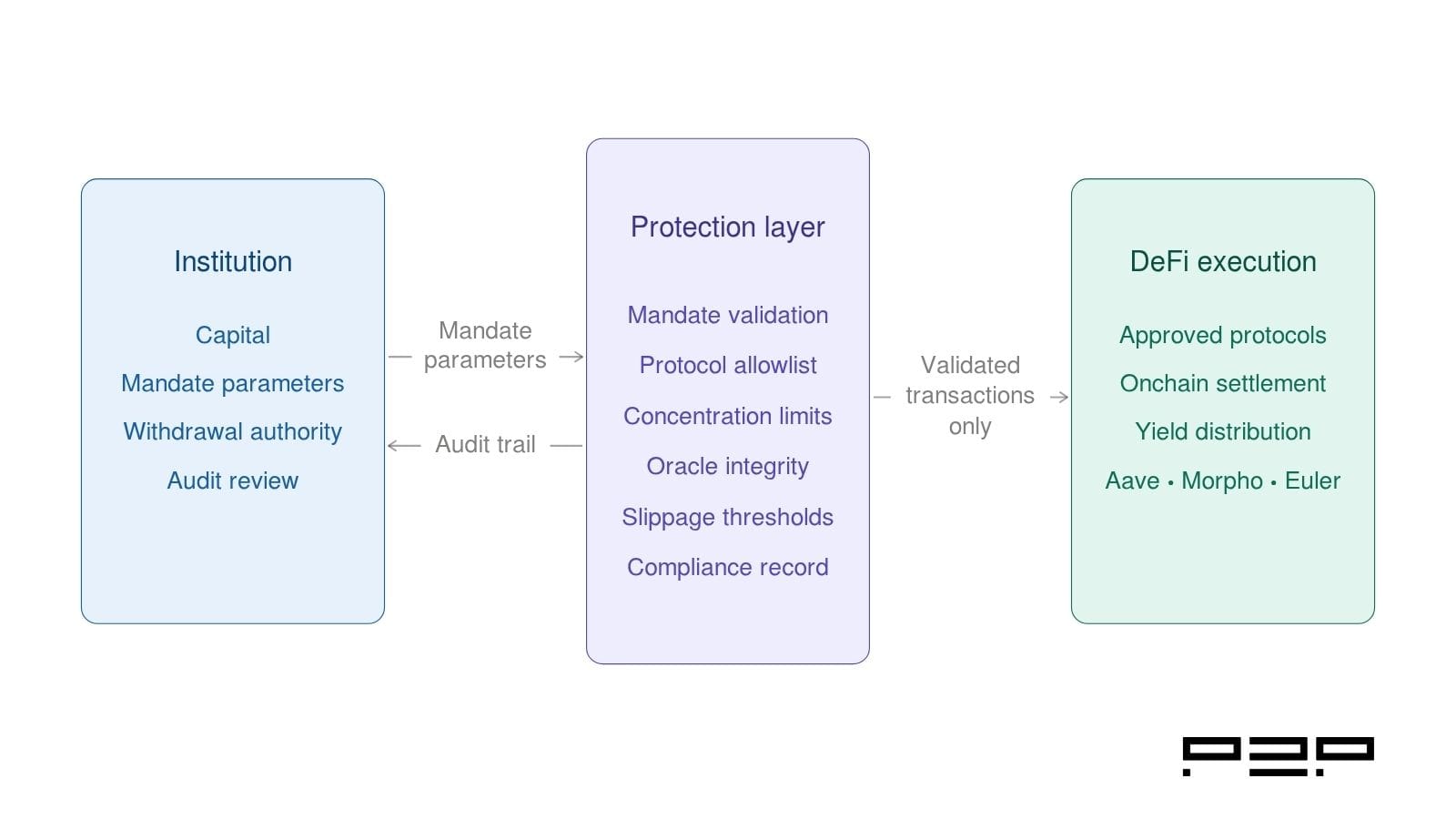
The institutional DeFi execution stack. The protection layer sits between the institution and DeFi execution environments, validating every transaction against mandate parameters before anything settles on-chain.
The protection layer operates at the transaction level. Before capital is routed to any protocol, the protection layer checks:
Is this protocol on the institution's approved allowlist?
Does this allocation create a concentration that exceeds the institution's limits?
Is the oracle providing price data for this transaction reliable and within acceptable parameters?
Does the slippage on this transaction fall within the institution's approved threshold?
Does this transaction comply with the institution's counterparty and jurisdiction restrictions?
If any check fails, the transaction does not execute. The institution's capital does not reach a protocol that falls outside its approved parameters. This is mandate validation at execution, and it is the structural requirement that distinguishes institutional DeFi infrastructure from standard vault products.
The protection layer's independence from the curator is not an operational detail. It is the architectural requirement. An operator that controls both the protection layer and the allocation strategy has the ability to modify or bypass mandate validation in ways that benefit the allocation strategy. Institutional compliance frameworks require that these functions be held by separate, independent entities.
P2P.org operates the protection layer independently of vault curators. Our infrastructure validates transactions against institutional mandate parameters before execution, without discretion over allocation strategy. The curator allocates. The protection layer validates. The institution controls withdrawal authority throughout.
The Risk Categories Specific to Institutional DeFi
Institutional DeFi participation carries a risk profile that is distinct from both traditional asset management and from institutional staking. Each category requires explicit assessment before any program is designed.
Smart contract risk
DeFi protocols operate on smart contracts. A vulnerability in a smart contract can result in loss of capital without the intervention of any human actor. Smart contract risk exists at the protocol layer and cannot be eliminated, only managed through protocol selection, concentration limits, and allowlist governance. This risk does not exist in native staking at the protocol layer.
Curator risk
In any vault arrangement, the institution is exposed to the decisions of the party controlling allocation. Curator risk includes misalignment of incentives, allocation to unapproved protocols, conflict of interest in routing decisions, and operational failure. The protection layer addresses curator risk at the transaction level by validating allocations against mandate parameters before execution, but it does not eliminate the underlying incentive misalignment that curator models create.
Oracle risk
DeFi protocols rely on price oracles to determine collateralisation ratios, liquidation thresholds, and yield calculations. An oracle failure or manipulation event can cause unexpected liquidations or incorrect valuations. Institutional DeFi infrastructure must include oracle integrity checks as part of the mandate validation stack.
Liquidity risk
Capital deployed into DeFi vaults may be subject to lock-up periods, withdrawal queues, or liquidity constraints that restrict access during market stress. For institutions managing redemption obligations or treasury mandates, the liquidity profile of any DeFi allocation must be explicitly assessed and integrated into the institution's liquidity management framework.
Regulatory and compliance risk
Regulators across the world, including in the US and EU, are exploring how AML laws apply to DeFi platforms, which often operate in a grey area. This could mean integrating compliance-friendly mechanisms such as on-chain identity attestations. DeFi firms will likely need to prepare for the same-risk, same-rule enforcement across decentralised networks. Institutions operating across multiple jurisdictions must assess the compliance requirements for each operating market before deploying capital.
Concentration risk
Unmanaged concentration in a single protocol, chain, or asset type creates exposure to correlated failure events. Institutional mandate parameters typically include explicit concentration limits. Enforcing those limits at the transaction level, before execution, is an infrastructure requirement.
How Mandate Validation Works at the Transaction Level
Mandate validation is the process by which each transaction is checked against a defined set of institutional parameters before it executes on-chain. It is not a post-trade review. It is a pre-execution gate.
The mandate parameters an institution defines typically include:
Protocol allowlist: the set of protocols the institution has approved for capital allocation
Concentration limits: maximum exposure to any single protocol, chain, or asset
Counterparty restrictions: jurisdictional or entity-level restrictions on protocol interaction
Oracle parameters: acceptable price sources and deviation thresholds
Slippage limits: maximum acceptable execution slippage per transaction type
Liquidity thresholds: minimum liquidity requirements for any protocol receiving allocation
When a vault curator generates an allocation instruction, the protection layer checks the instruction against each parameter in the mandate. A transaction that passes all checks executes. A transaction that fails any check does not execute and generates a compliance record documenting the failure and the parameter it violated.
This architecture means the institution does not need to trust the curator's judgment on mandate compliance. The mandate is enforced mechanically, at the infrastructure layer, before capital moves. The audit trail produced by the validation process is available for compliance review, internal reporting, and external audit.
What Compliance Infrastructure DeFi Allocations Require
Institutional DeFi allocations require a compliance infrastructure that standard vault products do not provide. The gap is not primarily regulatory interpretation. It is operational capability.
Transaction-level audit trails
Every allocation instruction, every validation event, every execution outcome, and every failed mandate check must be captured in a timestamped, tamper-evident record. This record must be producible on demand for internal compliance review, external audit, and regulatory examination.
Role separation and access controls
The institution must be able to define and enforce separation between the parties with authority to set mandate parameters, the parties with authority to generate allocation instructions, and the parties with authority to operate the validation infrastructure. These roles must be documented and auditable.
Reporting compatibility
Reward and yield attribution must be available at the transaction level and in formats compatible with institutional accounting and tax reporting systems. Protocol-level aggregates are not sufficient for institutional purposes.
Regulatory reporting capability
As DeFi compliance requirements evolve under MiCA, FATF guidance, and emerging US frameworks, the infrastructure must be capable of producing the reporting that regulatory obligations require. Institutions should assess whether their infrastructure provider has the capability to adapt reporting to new regulatory requirements without requiring architectural changes.
SOC 2 Type II certification, achieved by P2P.org in December 2025, independently validates the operational controls governing the infrastructure layer, including availability, security, and the integrity of the audit trail.
Where P2P.org Sits in This Architecture
P2P.org builds the protection layer that sits between regulated institutions and DeFi execution environments, independently of the curators who manage allocation strategies.
Our infrastructure validates every transaction against institutional mandate parameters before execution. We do not manage the allocation strategy. We do not hold client assets. We do not participate in the protocols that our infrastructure routes capital to. Our role is to ensure that capital allocated through our infrastructure only reaches protocols that the institution has approved, under the conditions the institution has defined.
Across the DeFi Infrastructure for Institutions series, we explain each component of this architecture in detail: why standard vault design creates the curator conflict, how mandate validation operates at the transaction level, and what the compliance infrastructure for a regulated DeFi program looks like in practice.
If you are evaluating the infrastructure requirements for a DeFi allocation program, reach out to our team.
Due Diligence Checklist: Evaluating Institutional DeFi Infrastructure
For institutions evaluating infrastructure providers or initiating a DeFi allocation program, these are the foundational questions to answer before committing capital.
Custody and control
[ ] Does the infrastructure provider hold client assets at any point in the allocation lifecycle?
[ ] Does the institution retain withdrawal authority throughout?
[ ] Is the custody model non-custodial, and is that independently documented?
Mandate validation
[ ] Does the infrastructure validate transactions against mandate parameters before execution, or only after?
[ ] Can the institution define and modify its own mandate parameters independently of the infrastructure provider?
[ ] Is the validation logic documented, auditable, and independent of the allocation strategy?
Protection layer independence
[ ] Is the infrastructure provider independent of the vault curators managing allocation strategy?
[ ] Does the provider have any financial interest in the protocols it routes capital to?
[ ] Is there a documented governance separation between infrastructure operation and allocation decisions?
Compliance and reporting
[ ] Does the infrastructure produce transaction-level audit trails compatible with institutional reporting requirements?
[ ] Can the provider deliver reporting in formats compatible with the institution's accounting and tax systems?
[ ] Does the provider hold SOC 2 Type II or equivalent independent certification?
Risk controls
[ ] Does the infrastructure enforce protocol allowlists, concentration limits, and oracle integrity checks at the transaction level?
[ ] What is the documented process for updating mandate parameters in response to new protocol approvals or risk events?
[ ] How does the provider handle oracle failure or protocol-level incidents?
Regulatory capability
[ ] Is the provider capable of adapting compliance reporting to new regulatory requirements without architectural changes?
[ ] Does the provider have documented AML and KYC procedures relevant to institutional DeFi operations?
[ ] Has the provider's infrastructure been reviewed or assessed by external legal or compliance advisors?
Key Takeaway
Institutional DeFi infrastructure is the execution layer that makes on-chain capital allocation viable for regulated institutions. It enforces mandate compliance at the transaction level, maintains custody integrity throughout the allocation lifecycle, produces the audit trail that compliance and reporting require, and operates independently of the curators who manage allocation strategy.
The protocols have matured. The regulatory environment is clarifying. The infrastructure to connect regulated capital to DeFi execution environments now exists. The institutions building compliant DeFi allocation programs today are establishing the operational foundation for a category that will define how regulated capital participates in on-chain markets for the next decade.
Network conditions and protocol yields are variable. P2P.org does not control or set DeFi yield rates. Smart contract risks are protocol-defined and client-borne. Operational safeguards are implemented to reduce exposure, but do not eliminate protocol-level risk.
Frequently Asked Questions (FAQs)
What is institutional DeFi infrastructure?
Institutional DeFi infrastructure is the set of technical and operational systems that enable regulated institutions to allocate capital into DeFi execution environments while maintaining custody integrity, mandate compliance, and audit capability throughout. It includes the protection layer that validates transactions before execution, the audit trail infrastructure that captures compliance records, and the governance architecture that separates infrastructure operation from allocation strategy. It is distinct from standard DeFi vault products, which were designed for retail capital and do not deliver the mandate validation, custody integrity, or reporting capability that regulated institutions require.
What is the protection layer?
The protection layer is the infrastructure component that sits between the institution's capital and DeFi execution environments. It validates every transaction against the institution's mandate parameters before anything settles on-chain. If a transaction would route capital to an unapproved protocol, breach a concentration limit, fail an oracle integrity check, or exceed a slippage threshold, the transaction does not execute. The protection layer operates independently of vault curators and does not have discretion over allocation strategy. Its function is mandate enforcement at the transaction level.
Why do standard DeFi vaults fall short for institutions?
Standard DeFi vaults delegate allocation authority to a curator without providing the institution any mechanism to constrain that discretion against its own mandate parameters. The curator decides which protocols receive capital, in what concentrations, and when. The institution has no structural protection against allocations that fall outside its mandate. Standard vaults also do not produce the transaction-level audit trails that institutional reporting requires, and their governance architecture does not separate the infrastructure operator from the allocation strategy, creating the conditions for curator conflict of interest.
What risks are specific to institutional DeFi participation?
The primary risk categories are smart contract risk (protocol-level code vulnerabilities), curator risk (misaligned incentives in allocation decisions), oracle risk (price feed failures or manipulation), liquidity risk (lock-up periods or withdrawal constraints), regulatory and compliance risk (varying treatment across jurisdictions), and concentration risk (unmanaged exposure to correlated failure events). Each category requires explicit assessment and mitigation as part of any institutional DeFi program design. The protection layer addresses mandate validation and concentration risk at the transaction level, but does not eliminate smart contract risk or underlying curator incentive misalignment.
What does mandate validation at execution mean?
Mandate validation at execution means that every transaction is checked against a defined set of institutional parameters before it executes on-chain. The parameters typically include a protocol allowlist, concentration limits, counterparty restrictions, oracle integrity thresholds, slippage limits, and liquidity requirements. A transaction that passes all checks executes. A transaction that fails any check does not execute and generates a compliance record. This is a pre-execution gate, not a post-trade review. It means the institution does not rely on the curator's judgment for mandate compliance. The mandate is enforced mechanically at the infrastructure layer before capital moves.
What compliance infrastructure does a DeFi allocation require?
Institutional DeFi allocations require transaction-level audit trails, role separation between mandate governance and allocation execution, reporting compatibility with institutional accounting and tax systems, and the capability to adapt to evolving regulatory requirements. The infrastructure provider should hold independent certification such as SOC 2 Type II, which validates that operational controls governing availability, security, and audit trail integrity are operating as documented. Institutions should assess whether their infrastructure provider can produce the compliance reporting their regulators require without requiring architectural changes to the infrastructure.
What is the difference between custodial and non-custodial DeFi infrastructure?
In non-custodial DeFi infrastructure, the institution's assets remain under the institution's control throughout the allocation lifecycle. The infrastructure provider operates the validation and execution layer but never holds the assets. Withdrawal authority remains with the institution. In custodial arrangements, assets are transferred to the infrastructure provider or a third-party custodian, which triggers additional regulatory obligations in most institutional compliance frameworks. Non-custodial architecture is the standard requirement for regulated institutions participating in DeFi, as it preserves custody integrity and avoids the regulatory implications of asset transfer.
P2P.org builds the protection layer that sits between regulated institutions and DeFi execution environments, independently of the curators who manage allocation strategies. If you are evaluating the infrastructure requirements for a DeFi allocation program, talk to our team.
Disclaimer
This article is provided for informational purposes only and does not constitute legal, regulatory, compliance, or investment advice. Regulatory obligations may vary depending on jurisdiction and specific business activities. Readers should consult their own legal and compliance advisors regarding applicable requirements.
Subscribe to P2P-economy
Get the latest posts delivered right to your inbox
<hr><h2 id="series-institutional-lens-validation-infrastructure"><strong>Series:</strong> Institutional Lens | Validation Infrastructure</h2><p>The Institutional Lens series unpacks the protocol mechanics, infrastructure decisions, and governance considerations that matter most for institutional participants in proof-of-stake networks. Each article is written for professionals operating at the intersection of traditional finance and blockchain infrastructure, including digital asset custodians, crypto-native funds, ETF issuers, treasury teams, and staking product managers.</p><p><strong>Previously in the series:</strong></p><ul><li><a href="https://p2p.org/economy/why-institutional-capital-needs-a-protection-layer-in-proof-of-stake-networks/">Why Institutional Capital Needs a Protection Layer in Proof-of-Stake Networks</a></li><li><a href="https://p2p.org/economy/solana-staking-for-institutions-native-vs-liquid-a-decision-framework/">Solana Staking for Institutions: Native vs. Liquid. A Decision Framework.</a></li></ul><h2 id="learnings-for-busy-readers">Learnings for Busy Readers</h2><p>The previous two articles in this series established the case for a protection layer in proof-of-stake networks and the specific decision framework for Solana. This article moves one level up: from single-network decisions to full institutional staking program design.</p><p>What you will find below is not a yield comparison. It is a program architecture framework.</p><p>The core argument is this: most institutions entered proof-of-stake through a single network, usually Ethereum, because that was the only one with an unambiguous legal status in the United States. The March 17, 2026, SEC and CFTC joint interpretation changed that. Sixteen assets are now classified as digital commodities, including SOL, ADA, and DOT. The legal basis that restricted most compliance teams to Ethereum-only programs is gone.</p><p>What remains is a program design problem. Multi-network institutional staking programs are structurally different from single-network ones. Each network has its own unbonding timeline, reward mechanics, slashing conditions, governance obligations, and reporting requirements. A program that treats each network as an isolated position will accumulate operational fragmentation, compliance gaps, and unmodeled liquidity risk.</p><p>This article explains how to design the program correctly from the start.</p><h2 id="who-this-article-is-for">Who This Article Is For</h2><p>This guide is written for professionals building or governing multi-network staking programs at an institutional scale, including:</p><ul><li>Digital asset custodians evaluating program expansion beyond Ethereum</li><li>Crypto-native hedge funds and asset managers are adding PoS assets to mandates</li><li>ETF and ETP issuers with staking-integrated products across multiple networks</li><li>Treasury teams holding Ethereum, Solana, and other newly classified commodities</li><li>Staking product managers designing validator programs for institutional clients</li><li>Infrastructure engineers responsible for multi-network validator operations</li><li>Validator risk committees reviewing program architecture and provider relationships</li></ul><p><a href="http://p2p.org/?ref=p2p.org">P2P.org</a> operates non-custodial validator infrastructure in a client-controlled architecture aligned with protocol rules across more than 40 proof-of-stake networks.</p><h2 id="why-single-network-programs-no-longer-match-the-market">Why Single-Network Programs No Longer Match the Market</h2><p>Until March 2026, most institutional staking programs were built on a single-network foundation. Ethereum was the default because it carried the clearest regulatory posture in the United States. SOL, ADA, DOT, and other proof-of-stake assets remained either restricted or unaddressed in most institutional mandates, not because of operational concerns, but because of legal uncertainty.</p><p>The March 17, 2026, SEC and CFTC joint interpretation removed that uncertainty. The ruling explicitly confirmed that protocol staking across solo, self-custodial, custodial, and liquid models does not constitute a securities transaction for any of the 16 named digital commodities. SOL, ADA, DOT, XRP, and others are now classified as digital commodities with a staking posture that compliance departments can support without securities risk concerns (Source: <a href="https://phemex.com/blogs/sec-ruling-crypto-etfs-staking?ref=p2p.org">Phemex</a>).</p><p>At the same time, institutional capital has moved:</p><ul><li>Ethereum's staking ratio reached a record 31.1% of total supply in March 2026</li><li>Solana ETFs passed $1 billion in cumulative inflows in early March 2026, with Goldman Sachs disclosing $108 million in SOL ETF holdings as of April 2026</li><li>BlackRock's ETHB, the first staking-integrated ETF from a major asset manager, debuted at $107 million and reached approximately $254 million in AUM within its first week</li><li>DOT's unbonding period was reduced from 28 days to 24 to 48 hours in March 2026, materially changing the liquidity profile of Polkadot staking for institutions</li></ul><p>The market is now structurally multi-network. Institutions that design their staking programs as single-network operations are leaving addressable exposure unmanaged and, in many cases, accepting dilution on proof-of-stake assets they already hold but are not staking (Source: <a href="https://coinlaw.io/cryptocurrency-staking-statistics/?ref=p2p.org">CoinLaw</a>).</p><h2 id="the-four-dimensions-of-multi-network-program-design">The Four Dimensions of Multi-Network Program Design</h2><p>A well-designed institutional staking program across multiple networks requires explicit decisions across four dimensions: liquidity architecture, risk layering, reporting infrastructure, and governance policy. Each dimension behaves differently network by network, and all four must be designed at the program level before capital is allocated at the network level.</p><h3 id="dimension-1-liquidity-architecture">Dimension 1: Liquidity Architecture</h3><p>The most underappreciated element of multi-network staking programs is liquidity. Each proof-of-stake network imposes its own unbonding timeline, and those timelines are not aligned with each other or with the liquidity frameworks institutions typically apply to other asset classes.</p><p>As of May 2026, the relevant unbonding parameters for the networks most commonly included in institutional programs are:</p><p><strong>Ethereum:</strong> Variable withdrawal queue. Under normal conditions, exit processing takes one to five days. During periods of elevated exit demand, such as the September 2025 peak where 2.67 million ETH was queued and wait times exceeded 46 days, the timeline can extend materially. The queue is always dynamic and must be monitored in real time. (Source: <a href="https://www.validatorqueue.com/?ref=p2p.org">ValidatorQueue.com</a>)</p><p><strong>Solana:</strong> Approximately two to three days under standard conditions. The epoch structure means unstaking initiated at the start of an epoch completes at the end of the following epoch, creating a predictable but not instant exit timeline.</p><p><strong>Polkadot:</strong> Reduced to 24 to 48 hours as of March 2026, down from 28 days. This is a material change that significantly improves Polkadot's liquidity profile for institutional programs. (Source: <a href="https://cryptoyieldguide.com/blog/staking-rewards-comparison-2026/?ref=p2p.org">Passive Yield Lab</a>)</p><p><strong>Cosmos (ATOM):</strong> 21-day unbonding period. This remains among the longest lock-ups in the institutional PoS landscape and requires specific liquidity planning.</p><p><strong>Cardano (ADA):</strong> No lock-up period. Staked ADA can be spent or transferred at any time without unstaking. This is structurally unusual and gives ADA a liquidity profile closer to an unencumbered holding than a locked position.</p><p>The institutional implication is that multi-network programs should be designed around a liquidity ladder: an allocation framework that distributes staking exposure across networks with different unbonding characteristics, so that the program as a whole maintains liquidity at predictable points even when individual positions are in unbonding.</p><p>A liquidity ladder for a multi-network program might distribute exposure across three tiers:</p><p><strong>Tier 1: Liquid or near-liquid positions.</strong> ADA (no lock-up) and liquid staking token positions where the LST can be swapped near-instantly. These provide the program's liquidity buffer.</p><p><strong>Tier 2: Short-horizon positions.</strong> SOL (two to three days), ETH under normal queue conditions (one to five days), and DOT post-March 2026 (24 to 48 hours). These positions can be exited within a standard institutional settlement window under normal market conditions.</p><p><strong>Tier 3: Long-horizon positions.</strong> ATOM (21 days) and any other network with extended unbonding periods. These positions should be sized to the portion of the allocation that the institution can treat as genuinely illiquid over the unbonding window.</p><p>Portfolio managers, custodians, and treasury teams with redemption obligations should integrate these tiers into position sizing before allocating, not after.</p><figure class="kg-card kg-image-card kg-card-hascaption"><img src="https://p2p.org/economy/content/images/2026/05/multi-network-institutional-staking-program-matrix.jpg" class="kg-image" alt="A structured comparison table or matrix layout, not a flowchart. The visual should communicate at a glance that different networks require different institutional treatment across the same set of variables." loading="lazy" width="1600" height="900" srcset="https://p2p.org/economy/content/images/size/w600/2026/05/multi-network-institutional-staking-program-matrix.jpg 600w, https://p2p.org/economy/content/images/size/w1000/2026/05/multi-network-institutional-staking-program-matrix.jpg 1000w, https://p2p.org/economy/content/images/2026/05/multi-network-institutional-staking-program-matrix.jpg 1600w" sizes="(min-width: 720px) 720px"><figcaption><i><em class="italic" style="white-space: pre-wrap;">Multi-Network Institutional Staking Program Framework</em></i></figcaption></figure><h3 id="dimension-2-risk-layering">Dimension 2: Risk Layering</h3><p>Single-network staking programs carry one set of protocol risks. Multi-network programs carry multiple sets, and those sets do not behave the same way. Designing a multi-network program without mapping risk by network is equivalent to building a fixed-income portfolio without distinguishing credit qualities.</p><p>The relevant risk categories at the network level are:</p><p><strong>Slashing risk:</strong> Slashing conditions, triggers, and penalty magnitudes differ by network. On Ethereum, slashing is triggered by double-signing and surrounding votes, with a correlation multiplier that amplifies penalties when multiple validators are slashed simultaneously. On Solana, slashing is currently not implemented at the base layer, though this may change as the network matures. On Polkadot, the Nominated Proof-of-Stake model introduces slashing for both validators and their nominators, meaning institutional allocators who nominate a validator share in any slash applied to that validator. These distinctions require network-specific slashing risk policies.</p><p><strong>Concentration risk:</strong> Institutions allocating to multiple networks through a single infrastructure provider face correlated operational risk if that provider uses homogeneous infrastructure across networks. An operational failure that affects the provider's shared signing or monitoring systems could impact positions across all supported networks simultaneously. Multi-network programs should evaluate whether their infrastructure provider maintains operationally independent systems by network or uses shared architecture.</p><p><strong>Validator concentration risk on the network:</strong> On Solana, the active validator count dropped from approximately 2,500 to under 800 in 2026, raising network-level concentration concerns. When a network's validator set is concentrated, institutional delegators who choose poorly distributed validators amplify that concentration rather than mitigate it. Delegation strategy must account for network-level validator health, not just individual validator quality.</p><p><strong>Protocol upgrade risk:</strong> Each network has its own upgrade cadence and governance process. A staking program spanning five networks must account for the fact that protocol upgrades on any of those networks may affect slashing conditions, reward mechanics, or unbonding parameters, often with short notice. Institutions that do not monitor governance across their full network portfolio will be surprised by material changes, as they would have been by Polkadot's unbonding reduction in March 2026.</p><h3 id="dimension-3-reporting-infrastructure">Dimension 3: Reporting Infrastructure</h3><p>Single-network staking programs can often be managed with network-specific reporting tools. Multi-network programs cannot. The operational cost of maintaining five or more separate reporting stacks, each with different data formats, epoch timings, and reward calculation methodologies, grows rapidly and introduces reconciliation risk that compliance and audit teams cannot absorb at scale.</p><p>Institutional-grade multi-network reporting requires:</p><p><strong>Reward attribution at the validator level, by epoch, for every supported network.</strong> A consolidated view is useful for treasury oversight. An audit-ready record must be disaggregated by network, validator, and period.</p><p><strong>Unified reward classification.</strong> Different networks produce rewards from different sources: base protocol issuance, transaction fees, and MEV-equivalent mechanisms. Multi-network reporting must classify reward types consistently across networks so that accounting teams can apply appropriate treatment under applicable standards.</p><p><strong>Unbonding and exit event tracking.</strong> A program spanning multiple networks will have validators entering and exiting the unbonding process continuously. Reporting infrastructure must capture these events with timestamps for audit and reconciliation purposes.</p><p><strong>Network-specific slashing event logging.</strong> Any slashing event, regardless of network, must be captured with root cause, timestamp, and amount for regulatory disclosure purposes where applicable.</p><p><strong>Format compatibility with institutional back-office systems.</strong> Reward data that cannot be ingested by the institution's existing accounting, risk management, or custody platform creates manual reconciliation work that scales with program size.</p><p>Institutions evaluating infrastructure providers for multi-network programs should request sample reporting packs for every network in their target allocation, not just for Ethereum. The quality gap between providers on reporting is often more significant on smaller networks than on Ethereum, where baseline tooling is well established.</p><h3 id="dimension-4-governance-policy">Dimension 4: Governance Policy</h3><p>In single-network Ethereum programs, governance participation is often treated as a secondary consideration. In multi-network programs, it becomes a first-order governance obligation.</p><p>Every proof-of-stake network where an institution holds staked assets has governance processes. Protocol upgrades, parameter changes, reward rate adjustments, and slashing condition modifications are all governed through validator and delegator participation. When an institution delegates to a validator, it delegates governance representation to that validator. For regulated entities with fiduciary obligations, this is not a passive decision.</p><p>A multi-network institutional staking program requires a documented governance participation policy that addresses:</p><p><strong>Which networks have material governance decisions pending or expected?</strong> Not all networks are equally active in governance. Ethereum governance is slow and deliberate. Cosmos governance is more frequent. Polkadot's OpenGov model enables continuous on-chain voting. Programs must identify which networks require active governance tracking.</p><p><strong>How the institution's delegation choices affect governance representation?</strong> On Cosmos, delegators vote independently of their validators. On Ethereum, validators vote on behalf of their stake in protocol upgrade decisions. These models produce different governance obligations and different levels of delegation accountability.</p><p><strong>What is the institution's policy on protocol upgrade participation?</strong> This includes whether the institution has a formal position on contentious upgrades, whether it delegates governance decisions entirely to the validator, and what the escalation path is when a validator votes against the institution's interests.</p><p><strong>How governance participation is documented?</strong> For custodians managing staked assets on behalf of clients, governance documentation is an extension of fiduciary record-keeping. For ETF issuers, governance decisions on staked assets may eventually carry disclosure obligations.</p><h2 id="the-program-level-due-diligence-checklist">The Program-Level Due Diligence Checklist</h2><p>For staking product managers, validator risk committees, and compliance teams building or reviewing a multi-network institutional staking program.</p><h3 id="liquidity-architecture">Liquidity architecture</h3><ul><li>[ ] Has a liquidity tier analysis been completed for every network in the program?</li><li>[ ] Is the liquidity ladder documented and integrated into position sizing?</li><li>[ ] Are unbonding timelines current and verified at the network level, including any recent parameter changes?</li><li>[ ] Is exit queue monitoring in place for Ethereum and any other networks with variable queues?</li><li>[ ] Are redemption obligations, fund liquidity covenants, or treasury mandates mapped against the worst-case unbonding scenario for each network?</li></ul><h3 id="risk-layering">Risk layering</h3><ul><li>[ ] Is there a network-specific slashing risk policy for every network in the program?</li><li>[ ] Is the program's infrastructure provider evaluated for correlated operational risk across networks?</li><li>[ ] Is validator concentration risk assessed at the network level for each delegation?</li><li>[ ] Is there a protocol governance monitoring process that covers all networks in scope?</li><li>[ ] Are tail risk scenarios (correlated slashing, simultaneous exit queue events) modelled at the program level?</li></ul><h3 id="reporting-infrastructure">Reporting infrastructure</h3><ul><li>[ ] Can the infrastructure provider deliver validator-level, epoch-level reward attribution for every network in scope?</li><li>[ ] Is reward classification consistent and documented across networks for accounting purposes?</li><li>[ ] Are exit, unbonding, and slashing events logged with timestamps compatible with audit requirements?</li><li>[ ] Is reporting output compatible with the institution's back-office systems for all supported networks?</li><li>[ ] Has a sample reporting pack been reviewed for each network in the target allocation?</li></ul><h3 id="governance-policy">Governance policy</h3><ul><li>[ ] Is there a documented governance participation policy covering every network in the program?</li><li>[ ] Is the policy reviewed and updated following material protocol upgrades or governance parameter changes?</li><li>[ ] Are delegation decisions evaluated for their governance implications, not just their operational quality?</li><li>[ ] For regulated entities: is there a process for documenting governance decisions for fiduciary record-keeping purposes?</li></ul><h2 id="evaluating-infrastructure-providers-for-multi-network-programs">Evaluating Infrastructure Providers for Multi-Network Programs</h2><p>The selection criteria for a validator infrastructure provider shift materially when the program spans multiple networks. Single-network evaluations can focus deeply on one protocol. Multi-network evaluations must assess depth, consistency, and integration across every network in scope.</p><p>Key questions for multi-network program evaluation:</p><p>What is the provider's operational track record on each specific network in the target allocation? Depth on Ethereum does not imply depth on Polkadot or Cosmos. Request network-specific incident history and performance data.</p><p>Are the infrastructure, key management, and slashing protection controls operationally consistent across networks, or does the provider use different architectures and standards per network?</p><p>Can the provider deliver consolidated reporting that covers every network in the program within a single integrated system, or will reporting require separate per-network integrations?</p><p>Does the provider monitor protocol governance across all supported networks, and how does it communicate material governance developments to institutional clients?</p><p><a href="http://p2p.org/?ref=p2p.org">P2P.org</a> supports non-custodial validator infrastructure across more than 40 proof-of-stake networks, with consistent operational standards and validator-level reporting across each. Infrastructure details and integration documentation for institutional programs are available at <a href="https://p2p.org/staking?ref=p2p.org">p2p.org/staking</a> and <a href="https://p2p.org/networks/ethereum-staking-service?ref=p2p.org">p2p.org/networks</a>. For multi-network reporting and institutional integration architecture, see <a href="https://docs.p2p.org/?ref=p2p.org">docs.p2p.org</a>.</p><p>For the foundational institutional staking due diligence framework, including the seven dimensions of validator evaluation that apply across all networks, see the Validator Playbook series article: <a href="https://p2p.org/economy/validator-due-diligence-framework-what-institutions-really-need-to-evaluate/">Validator Due Diligence Framework: What Institutions Really Need to Evaluate</a>.</p><div class="kg-card kg-callout-card kg-callout-card-grey"><div class="kg-callout-text"><b><strong style="white-space: pre-wrap;">The institutional digital asset space moves fast.</strong></b> Our subscribers get structured analysis across staking, DeFi vaults, and regulation through <i><em class="italic" style="white-space: pre-wrap;">DeFi Dispatch</em></i>, <i><em class="italic" style="white-space: pre-wrap;">Institutional Lens</em></i>, <i><em class="italic" style="white-space: pre-wrap;">DeFi Infrastructure for Institutions</em></i>, and <i><em class="italic" style="white-space: pre-wrap;">Legal Layer</em></i>. No noise. Just the signals that matter. <b><strong style="white-space: pre-wrap;">Subscribe to the newsletter at the bottom of this page.</strong></b></div></div><h2 id="key-takeaway-for-custodians-funds-etf-issuers-and-treasury-teams">Key Takeaway for Custodians, Funds, ETF Issuers, and Treasury Teams</h2><p>The March 2026 regulatory shift did not just expand the universe of assets available for institutional staking. It exposed a program design gap that most institutions have not yet addressed.</p><p>Single-network staking programs were built for a single-network regulatory world. That world is gone. Institutions holding Ethereum, Solana, Polkadot, Cosmos, and Cardano across their portfolios now have the legal basis, the infrastructure, and the market context to build multi-network programs. The question is whether the program architecture can support that expansion without accumulating unmodeled liquidity risk, fragmented reporting, and undocumented governance obligations.</p><p>The four dimensions covered in this article, including liquidity architecture, risk layering, reporting infrastructure, and governance policy, are not independent checklists. They are interdependent elements of a program-level design decision. Institutions that address them together before allocating across networks will operate with the same discipline they apply to every other multi-asset program. Institutions that treat each network as a standalone position will eventually encounter the integration failures that come with fragmented program design.</p><p>Protocol-generated rewards are determined by network conditions and are variable. <a href="http://p2p.org/?ref=p2p.org">P2P.org</a> does not control or set reward rates. Slashing risks are protocol-defined and client-borne. Operational safeguards are implemented to reduce slashing exposure, but do not eliminate protocol-level risk.</p><h2 id="frequently-asked-questions-faqs">Frequently Asked Questions (FAQs)<br></h2><h3 id="what-is-an-institutional-staking-program">What is an institutional staking program?</h3><p>An institutional staking program is the structured approach through which a regulated organization (a custodian, fund, ETF issuer, or treasury team) participates in proof-of-stake consensus across one or more blockchain networks. Unlike retail staking, an institutional staking program requires deliberate design across custody architecture, risk management, liquidity planning, reward reporting, and governance policy. At the multi-network level, it also requires a framework that accounts for the different mechanics, timelines, and obligations of each network in scope.</p><h3 id="why-does-the-march-2026-sec-and-cftc-ruling-matter-for-multi-network-staking-programs">Why does the March 2026 SEC and CFTC ruling matter for multi-network staking programs?</h3><p>The ruling explicitly confirmed that protocol staking across all four models, including solo, self-custodial, custodial, and liquid, does not constitute a securities transaction for any of the 16 named digital commodities, including SOL, ADA, DOT, and XRP. This removed the primary legal basis that had restricted most institutional compliance teams to Ethereum-only staking programs. Institutions can now build multi-network programs across the full set of named commodities without the securities risk concern that previously limited them.</p><h3 id="what-is-a-liquidity-ladder-in-the-context-of-an-institutional-staking-program">What is a liquidity ladder in the context of an institutional staking program?</h3><p>A liquidity ladder is an allocation framework that distributes staking exposure across networks with different unbonding timelines, so that the program as a whole maintains liquidity at predictable points even when individual positions are in unbonding. Tier 1 positions use networks with no lock-up or near-instant exit (ADA, LST positions). Tier 2 positions use networks with short unbonding periods (SOL, DOT post-March 2026, ETH under normal queue conditions). Tier 3 positions use networks with longer unbonding periods (ATOM at 21 days). Position sizing in each tier should be calibrated against the institution's redemption obligations and liquidity covenants.</p><h3 id="how-do-unbonding-timelines-differ-across-the-main-proof-of-stake-networks-in-2026">How do unbonding timelines differ across the main proof-of-stake networks in 2026?</h3><p>As of May 2026, Cardano has no lock-up. Polkadot reduced its unbonding period to 24 to 48 hours in March 2026, down from 28 days. Solana requires approximately two to three days. Ethereum has a variable withdrawal queue that takes one to five days under normal conditions, but extended beyond 46 days during the September 2025 exit queue peak. Cosmos requires a 21-day unbonding period. These differences are material for liquidity planning and must be integrated into position sizing before capital is allocated.</p><h3 id="how-does-polkadots-nominated-proof-of-stake-model-create-different-slashing-exposure-than-ethereum">How does Polkadot's Nominated Proof-of-Stake model create different slashing exposure than Ethereum?</h3><p>On Polkadot, slashing penalties apply to both the validator and its nominators in proportion to their stake. This means institutional allocators who nominate a validator share in any slash applied to that validator. On Ethereum, slashing penalties apply to the validator's own stake and do not directly reduce delegator balances. Institutions entering Polkadot staking must account for this structural difference in their slashing risk policy and in the due diligence they apply to validator selection.</p><h3 id="what-should-institutional-reporting-look-like-for-a-multi-network-staking-program">What should institutional reporting look like for a multi-network staking program?</h3><p>Institutional reporting for a multi-network program should provide validator-level, epoch-level reward attribution for every network in the program, with consistent reward classification across networks for accounting treatment, timestamped logging of all exit, unbonding, and slashing events, and output formats compatible with the institution's existing back-office systems. Consolidated reporting that spans all networks in a single integrated system is preferable to per-network reporting stacks that require manual reconciliation.</p><h3 id="what-governance-obligations-does-a-multi-network-staking-program-create">What governance obligations does a multi-network staking program create?</h3><p>Every proof-of-stake network in a multi-network program has governance processes. Protocol upgrades, reward parameter changes, and slashing condition modifications are all governed through validator and delegator participation. When an institution delegates to a validator, it delegates governance representation to that validator. Regulated entities with fiduciary obligations should maintain a documented governance participation policy covering all networks in scope, including how delegation choices affect governance representation, how protocol upgrades are evaluated, and how governance decisions are logged for fiduciary record-keeping purposes.</p><hr><h2 id="about-p2porg">About P2P.org</h2><p><a href="http://p2p.org/?ref=p2p.org">P2P.org</a> builds the protection layer that sits between regulated institutions and DeFi execution environments, independently of the curators who manage allocation strategies. If you are evaluating the infrastructure requirements for a DeFi allocation program, <a href="https://p2p.org/?ref=p2p.org#form">talk to our team</a>.</p><hr><h3 id="disclaimer">Disclaimer</h3><p>This article is provided for informational purposes only and does not constitute legal, regulatory, compliance, or investment advice. Regulatory obligations may vary depending on jurisdiction and specific business activities. Readers should consult their own legal and compliance advisors regarding applicable requirements.</p>
 ALL
Agoric
Aptos
Auth
Avail
Avalanche
Axelar
Babylon
Bitcoin
BTC
capital flow
Cardano
Celestia
certifications
Chainlink
compliance
Cosmos
Crescent
curator
Cyberway
DAOBet
DeFi
defi infrastrcuture
defi infrastructure
defi news
defi vault
due diligence
DVT
Dymension
Economy
Education
EigenLayer
Elrond
employee
employee advocacy
employee interviews
Ethereum
Evmos
exit queue
Explain Like I'm Five
Guide
how to
HR
HUB series
infrastructure
institutional lens
Kava
Kusama
landing
legal layer
Lido
LSP
Manta
Mantle
Marlin
Matic
MiCA
Moonbeam
MultiversX
Near
News
NuCypher
Oasis
Origin
P2P Verified
Partnership
Persistence
playbook
Pocket
Polkadot
Polygon
product
products
Quicksilver
Regen
regulation
Renzo
restaking
RPC Node
Sender
Serum
slashing
Solana
SSV.Network
Staking
staking program
Starknet
Sui
symbiotic
Syncro
syncro sender
Terra
Tezos
TheGraph
ALL
Agoric
Aptos
Auth
Avail
Avalanche
Axelar
Babylon
Bitcoin
BTC
capital flow
Cardano
Celestia
certifications
Chainlink
compliance
Cosmos
Crescent
curator
Cyberway
DAOBet
DeFi
defi infrastrcuture
defi infrastructure
defi news
defi vault
due diligence
DVT
Dymension
Economy
Education
EigenLayer
Elrond
employee
employee advocacy
employee interviews
Ethereum
Evmos
exit queue
Explain Like I'm Five
Guide
how to
HR
HUB series
infrastructure
institutional lens
Kava
Kusama
landing
legal layer
Lido
LSP
Manta
Mantle
Marlin
Matic
MiCA
Moonbeam
MultiversX
Near
News
NuCypher
Oasis
Origin
P2P Verified
Partnership
Persistence
playbook
Pocket
Polkadot
Polygon
product
products
Quicksilver
Regen
regulation
Renzo
restaking
RPC Node
Sender
Serum
slashing
Solana
SSV.Network
Staking
staking program
Starknet
Sui
symbiotic
Syncro
syncro sender
Terra
Tezos
TheGraph