The Institutional Lens series examines protocol mechanics, infrastructure decisions, and governance considerations for institutions participating in proof-of-stake networks. It is written for professionals operating at the intersection of traditional finance and blockchain infrastructure, including digital asset custodians, asset managers, ETF issuers, treasury teams, and staking product managers.
Staking ETFs have moved from a regulatory experiment to a live institutional product. The infrastructure decisions that sit beneath them have not received the same level of attention as the product structure decisions above them. This article closes that gap.
The core argument is this: a staking ETF is only as operationally sound as the validator infrastructure beneath it. ETF issuers and their custodians that treat validator selection as a secondary procurement question are accepting operational, compliance, and reputational risk that sits outside the product's regulatory wrapper.
What this article covers:
How the staking ETF market reached its current state and why the validator infrastructure layer is now the critical differentiator between competing products
The four procurement criteria that ETF issuers and custodians should apply when evaluating validator operators for staking ETF infrastructure
How NAV calculation, reward distribution, and redemption mechanics interact with validator infrastructure decisions
The specific governance and compliance obligations that arise from the validator relationship in a regulated fund structure
A due diligence framework for ETF issuers evaluating or reviewing their current validator infrastructure arrangements
🗞️
The institutional digital asset space moves fast. Our subscribers get structured analysis across staking, DeFi vaults, and regulation through DeFi Dispatch, Institutional Lens, DeFi Infrastructure for Institutions, and Legal Layer. No noise. Just the signals that matter. Subscribe to the newsletter at the bottom of this page.
How Staking ETFs Reached This Point
The regulatory barrier that had prevented ETF issuers from staking underlying assets was removed on March 17, 2026, when the SEC and CFTC issued a joint interpretive release classifying protocol staking of non-security digital commodities, including ETH, as outside the scope of Securities Act registration requirements. The release applied to all four staking models: solo, self-custodial, custodial, and liquid.
BlackRock had been preparing its filing since December 2025. The iShares Staked Ethereum Trust ETF, ticker ETHB, began trading on Nasdaq on March 12, 2026 with $107 million in seed capital, approved by the SEC under Chair Paul Atkins, whose posture on staking ETF structures differed materially from his predecessor. The March 17 SEC and CFTC joint interpretive release followed five days later, providing formal written confirmation that protocol staking of non-security digital commodities does not trigger Securities Act registration requirements. Source: CoinDesk
ETHB's structure established what is now effectively the reference architecture for US staking ETFs. The fund holds ETH, stakes between 70% and 95% of those holdings through validator operators, including Coinbase Prime, distributes 82% of gross staking rewards to shareholders monthly, and retains 18% to cover validator operations and the 0.25% annual sponsor fee. Source: BlackRock
What the product filings do not fully surface is the operational architecture beneath the staking layer: how validator operators are selected, what governance applies to that relationship, and how the infrastructure decisions at the validator level flow through to NAV, redemption mechanics, and compliance posture at the fund level. That is the question this article addresses.
The broader market direction is clear. As Grayscale Research noted in its 2026 Digital Asset Outlook, the ability of crypto ETPs to stake will likely make staking the default structure for holding investment positions in proof-of-stake tokens, with higher stake ratios and corresponding pressure on reward rates as more ETF capital enters the validator queue. Source: Grayscale Research
For ETF issuers whose products are now live or in the regulatory pipeline, the operational question is no longer whether to stake. It is who runs the validators, under what governance, and to what operational standard.
Why Validator Infrastructure Is the Product Decision That Matters Now
A staking ETF is not a passive product. Unlike a spot ETF that holds an asset and tracks its price, a staking ETF requires active participation in blockchain consensus. The fund's custodian delegates ETH to validator operators who run the software and hardware required to participate in Ethereum's proof-of-stake consensus. When validators successfully propose and attest to blocks, the Ethereum protocol issues rewards that accrue to the fund's staked balance.
This means that for the first time, an ETF wrapper depends on the operational performance of external blockchain infrastructure to generate its core yield. The validator operator is not a service provider in the conventional sense. It is the operational layer through which the fund participates in network consensus. Its uptime record, slashing protection controls, client diversity strategy, and governance discipline directly affect:
The fund's protocol-attributed reward rate and, by extension, its NAV accretion
The fund's exposure to slashing events that reduce staked balance
The fund's ability to process redemptions through the exit queue during stress periods
The fund's compliance posture in jurisdictions where validator governance obligations are emerging
Most ETF product design conversations focus on fee structure, reward distribution mechanics, and custody arrangements. The validator infrastructure layer sits beneath all of these and affects each of them. It deserves the same diligence rigor.
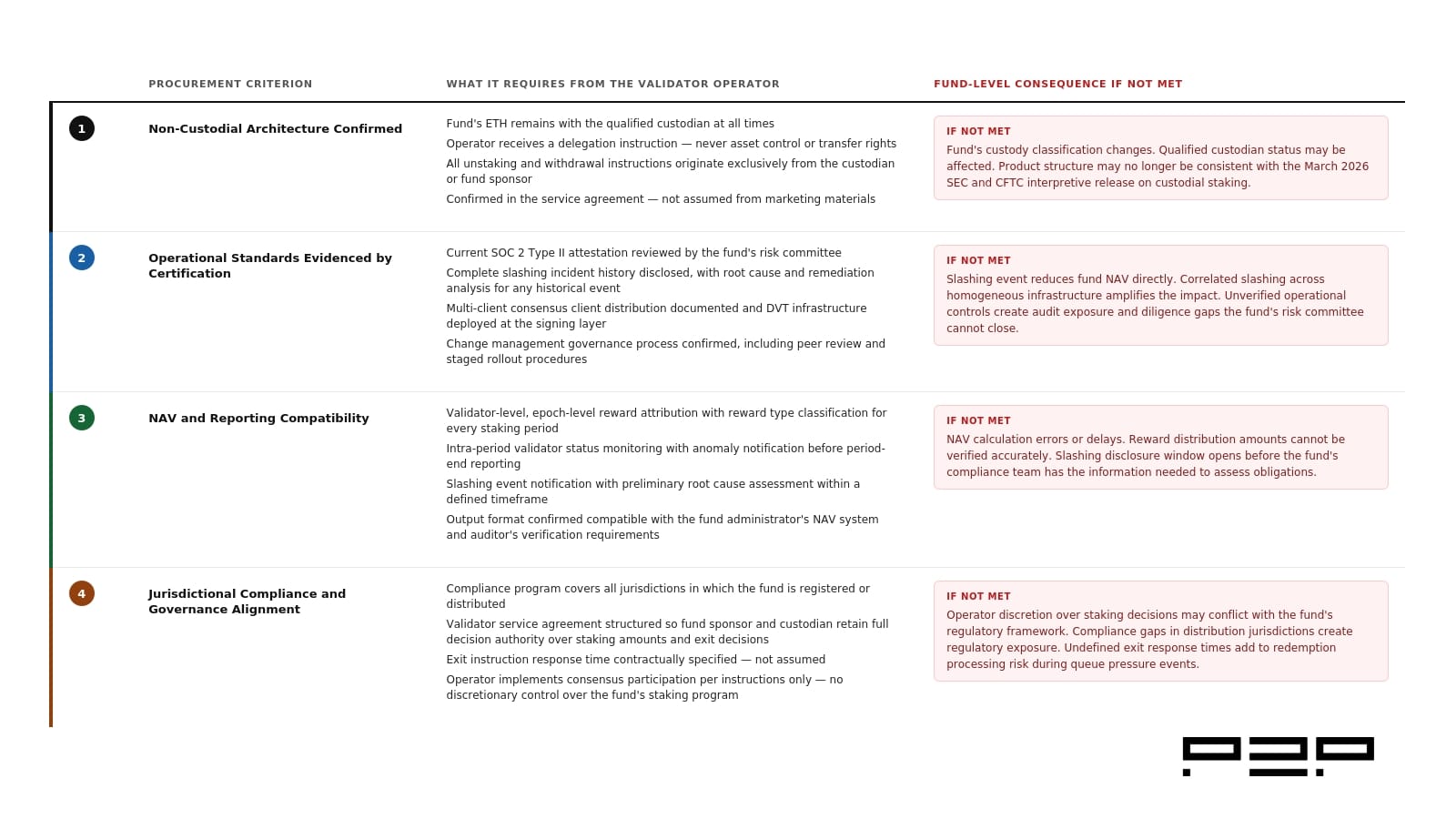
Four procurement criteria, what each requires from the validator operator, and the fund-level consequence if it is not met. The validator infrastructure decisions made before a staking ETF launches determine its operational outcomes after it.
The Four Procurement Criteria for Staking ETF Validator Infrastructure
ETF issuers and custodians evaluating validator operators for staking ETF infrastructure should apply four procurement criteria. These extend the standard vendor evaluation framework that institutional fund operations teams already use, translated into the specific operational and compliance requirements of a staking ETF product.
Criteria 1: Non-Custodial Architecture Confirmed
The validator operator must operate on a fully non-custodial basis. The fund's ETH must remain in the custody of the qualified custodian at all times. The validator operator receives a delegation instruction, not a transfer of assets. It never holds, controls, or moves the staked ETH.
This is not a preference. It is a structural requirement for a regulated fund product. A staking arrangement where the validator operator takes custody of the fund's ETH changes the fund's custody classification under applicable regulations and may affect its qualified custodian status and its treatment under the Investment Company Act.
The non-custodial architecture confirmation should be documented in the validator service agreement, not assumed from the operator's marketing materials. The agreement should explicitly state that the operator cannot transfer, encumber, or otherwise control the fund's ETH, and that all unstaking and withdrawal instructions originate exclusively from the custodian or fund sponsor.
Criteria 2: Operational Standards Evidenced by Certification
ETF issuers' risk committees evaluate validator operators the way they evaluate prime brokers and qualified custodians: on documented controls and counterparty standing, not on advertised performance rates.
The operational standards relevant to staking ETF infrastructure are:
SOC 2 Type II attestation confirms that the operator's security, availability, processing integrity, confidentiality, and privacy controls have been independently audited over a defined period. For ETF issuers whose own compliance programs reference SOC 2 as a vendor diligence standard, a SOC 2 Type II attestation from the validator operator reduces the diligence cycle and provides a documented control mapping that risk committees can assess directly.
Slashing incident history is the operational track record that matters most. A validator operator that has experienced slashing events requires a detailed post-incident analysis of the root cause, the remediation implemented, and the current controls in place. An operator with a zero-slashing-incident track record across its operating history provides a materially stronger counterparty risk profile for a regulated fund product where slashing directly reduces NAV.
Client diversity across Ethereum consensus clients reduces the correlated failure risk that homogeneous infrastructure creates. An operator running all validators on a single client version exposes the fund to the scenario where a client-level bug affects all of the fund's staked ETH simultaneously. A documented multi-client distribution strategy reduces this exposure.
DVT infrastructure deployment indicates that the operator has addressed the single-point-of-failure risk at the signing layer. Validators that operate without a distributed signing architecture carry the failure modes that DVT was specifically designed to eliminate.
Criteria 3: NAV and Reporting Compatibility
The validator operator must be able to deliver reporting that integrates with the fund's NAV calculation process. For a staking ETF, NAV accrues through staking rewards that accumulate on the consensus layer. The fund's administrator needs reward data at the validator level, by epoch, with consistent classification of reward types, to calculate accurate daily NAV.
The reporting requirements for a staking ETF validator relationship include:
Validator-level reward attribution by epoch for every staking period, with clear separation of consensus layer rewards and execution layer fees. The fund's accounting treatment for these reward types may differ, and the reporting must support that separation.
Real-time or near-real-time validator status monitoring so that the fund's operations team can identify any validator performance issue before it accumulates into a material NAV impact. An operator that provides only period-end reporting without intra-period visibility creates operational blind spots that a regulated fund product cannot accept.
Slashing event notification with immediate reporting requirements. Any slashing event affecting the fund's staked ETH must be reported to the custodian and fund sponsor immediately, with a preliminary root cause assessment within a defined timeframe. The fund's compliance team needs this information to assess disclosure obligations before the next NAV calculation.
Exit event tracking with full audit trail. All unstaking requests, exit queue entry and exit events, and reward sweep transactions must be logged with timestamps compatible with the fund's audit requirements.
Criteria 4: Jurisdictional Compliance and Governance Alignment
The validator operator must operate within the regulatory perimeter relevant to the fund's jurisdiction of domicile and the custodian's regulatory framework. For US-domiciled staking ETFs, the March 2026 interpretive release established that custodial staking through a third-party validator, where the custodian acts as agent and does not determine staking amounts or fix reward rates, is outside securities registration requirements.
The validator relationship must be structured consistently with this interpretation. Specifically, the fund sponsor and custodian, not the validator operator, must retain decision authority over staking amounts, reward distribution timing, and exit decisions. The validator operator implements consensus participation according to instructions from the custodian; it does not exercise discretion over the fund's staking program.
For ETF issuers with products registered or distributed across multiple jurisdictions, the validator operator's compliance program must extend to relevant frameworks, including MiCA for EU-distributed products, the UK FCA's digital asset framework, and any applicable DORA requirements for operational resilience. A validator operator that holds only a single jurisdiction certification may not satisfy the compliance requirements of a multi-jurisdiction product.
How Validator Infrastructure Decisions Interact With Fund Operations
The four procurement criteria above govern the selection decision. Three operational areas require ongoing attention once the validator relationship is established.
Redemption Mechanics Under Exit Queue Pressure
A staking ETF that holds a significant percentage of its ETH in active validators faces a structural tension between its daily redemption obligations and the Ethereum exit queue. Under normal conditions, exit processing takes one to five days. During periods of elevated exit demand, such as the September 2025 peak when exit wait times exceeded 46 days, the tension becomes material.
ETF issuers manage this tension through a liquidity buffer: a portion of the fund's ETH held unstaked and available for same-day redemption processing, with the staked portion sized to balance reward generation against the expected redemption demand. ETHB's structure of staking between 70% and 95% of assets reflects this balance, with the unstaked portion providing the liquidity buffer.
The validator operator's relationship to this buffer is indirect but important. The operator must be able to initiate exit procedures for specific validators on instruction from the custodian without operational delay. Exit instructions that require extended internal processing at the operator level add to the effective exit timeline the fund faces. The service agreement should specify maximum response times for exit instruction execution.
Slashing Event Management and Disclosure
A slashing event affecting a staking ETF's validator infrastructure is a NAV-impacting event. The Ethereum protocol automatically reduces the validator's effective balance when slashing occurs, which reduces the fund's staked ETH position and, by extension, its NAV.
The fund's disclosure obligations following a slashing event depend on the magnitude of the balance reduction relative to total fund assets, the fund's prospectus risk disclosures, and the regulatory framework of the fund's jurisdiction. A slashing event that is material relative to the fund's assets may require immediate disclosure to shareholders and regulators.
This means the validator operator's incident response timeline is not only an operational consideration. It is a compliance consideration. The fund's compliance team cannot assess its disclosure obligations until it has a preliminary understanding of the slashing event, its root cause, and the expected balance impact. An operator that cannot provide this assessment within hours of a slashing event creates a compliance window that a regulated fund cannot accept.
Reward Distribution and Tax Treatment
How protocol-attributed staking rewards are handled at the fund level depends on the fund's elected distribution method and its tax treatment of staking rewards. ETHB distributes 82% of gross rewards as monthly cash distributions. Grayscale's staking ETF uses a cash distribution model. Other products may accrete rewards to NAV.
The validator operator's reward reporting must support the fund's elected distribution method. For cash distribution funds, the operator must report gross rewards with sufficient precision for the fund to calculate the correct distribution amount and the retained operational fee. For NAV accretion funds, the operator must provide epoch-level reward data that the fund's administrator can integrate into daily NAV calculations.
The tax treatment of staking rewards at the fund level remains an area of evolving regulatory guidance. ETF issuers should confirm that their validator operator's reporting format supports the fund's tax reporting obligations and is compatible with the fund's auditor's requirements for reward verification.
The Validator Infrastructure Due Diligence Framework for ETF Issuers
For ETF product teams, fund compliance officers, and staking product managers reviewing or establishing validator infrastructure arrangements.
A. Non-custodial architecture
[ ] Is the validator service agreement explicit that the operator holds no custody over the fund's ETH at any point?
[ ] Does the agreement confirm that unstaking and withdrawal instructions originate exclusively from the custodian or fund sponsor?
[ ] Has the fund's legal counsel reviewed the service agreement for consistency with the qualified custodian requirements of the applicable regulatory framework?
B. Operational standards
[ ] Does the operator hold a current SOC 2 Type II attestation, and has the fund's risk committee reviewed the attestation report?
[ ] What is the operator's complete slashing incident history across its operating life, and has a root cause and remediation analysis been reviewed for any historical incidents?
[ ] What is the operator's client diversity distribution across Ethereum consensus clients, and is DVT infrastructure deployed at the signing layer?
[ ] What is the operator's change management governance process for infrastructure updates, and does it include peer review and staged rollout procedures?
C. NAV and reporting
[ ] Can the operator deliver validator-level, epoch-level reward attribution with reward type classification for every staking period?
[ ] Is intra-period validator status monitoring available, and how are anomalies surfaced to the fund's operations team?
[ ] What is the operator's slashing event notification protocol, including the timeline for preliminary root cause assessment?
[ ] Has the operator's reporting format been confirmed compatible with the fund administrator's NAV calculation system and the fund auditor's verification requirements?
D. Jurisdictional compliance
[ ] Does the operator's compliance program cover all jurisdictions in which the fund is registered or distributed?
[ ] Is the validator service agreement structured consistently with the March 2026 SEC and CFTC interpretive release on custodial staking?
[ ] What is the operator's response time for exit instruction execution, and is this contractually specified in the service agreement?
[ ] Has the fund's compliance team confirmed that the validator relationship does not create discretionary decision authority at the operator level over the fund's staking program?
🗞️
The institutional digital asset space moves fast. Our subscribers get structured analysis across staking, DeFi vaults, and regulation through DeFi Dispatch, Institutional Lens, DeFi Infrastructure for Institutions, and Legal Layer. No noise. Just the signals that matter. Subscribe to the newsletter at the bottom of this page.
Evaluating Validator Infrastructure for Staking ETF Products
P2P.org helps institutional capital access protected yield for digital assets through non-custodial staking infrastructure across 40+ proof-of-stake networks. With a zero-slashing-incident track record since 2018, SOC 2 Type II attestation, and 190+ institutional clients, P2P.org operates validator infrastructure designed to meet the operational, compliance, and reporting standards that regulated fund products require.
For ETF issuers and custodians evaluating ETH staking infrastructure, P2P.org ETH Staking provides the validator layer for institutional staking programs. For multi-network staking program management, P2P.org Hub supports program oversight across networks from a single institutional platform.
Key Takeaway for ETF Issuers, Custodians, and Staking Product Managers
BlackRock's ETHB launched on March 12, 2026. Five additional issuers have staking ETF amendments in the SEC review pipeline. The product category is moving from first-mover to a competitive market in a single year.
As the category matures, the differentiators between staking ETF products will shift from fee structure and regulatory novelty to operational reliability and compliance architecture. The validator infrastructure layer is where that operational reliability is determined, and where compliance architecture either holds or fails under pressure.
ETF issuers that treat validator selection as a secondary operational question are accepting risks that sit outside their product's regulatory wrapper but inside their fiduciary obligations. A slashing event that reduces NAV, an exit queue delay that creates a redemption gap, or a validator incident that triggers a disclosure obligation are all consequences of infrastructure decisions made before the product launched.
The four criteria covered in this article, non-custodial architecture, operational standards evidenced by certification, NAV and reporting compatibility, and jurisdictional compliance, are the evaluation framework that brings validator infrastructure into the same diligence rigor that ETF product teams already apply to every other counterparty relationship.
Protocol-attributed staking rewards are determined by network conditions and are variable. P2P.org does not control or set reward rates. Slashing risks are protocol-defined and client-borne. Operational safeguards are implemented to reduce slashing exposure but do not eliminate protocol-level risk.
Frequently Asked Questions (FAQ)
What is a staking ETF, and how does it differ from a spot ETH ETF?
A staking ETF holds a proof-of-stake asset and stakes a portion of those holdings on the network to generate protocol-attributed rewards, which it distributes to shareholders or accrues to NAV. A spot ETF holds the asset and tracks its price without participating in network consensus. The structural difference is that a staking ETF's performance depends not only on the price of the underlying asset but also on the operational performance of the validator infrastructure staking that asset. BlackRock's ETHB, listed on Nasdaq on March 12, 2026, stakes between 70% and 95% of its ETH holdings and distributes 82% of gross staking rewards to shareholders monthly.
Why does validator infrastructure selection matter for a staking ETF product?
The validator operator is the layer through which a staking ETF participates in network consensus. Its uptime performance, slashing protection controls, and governance discipline directly affect the fund's protocol-attributed reward rate, its exposure to slashing events that reduce NAV, its ability to process redemptions through the exit queue during stress periods, and its compliance posture in jurisdictions where validator governance obligations are emerging. A staking ETF is operationally dependent on its validator infrastructure in a way that a spot ETF is not.
What does non-custodial architecture mean for a staking ETF validator arrangement?
In a non-custodial validator arrangement, the fund's ETH remains in the custody of the qualified custodian at all times. The validator operator receives a delegation instruction and participates in network consensus on behalf of the fund, but never holds, controls, or can move the staked ETH. The custodian or fund sponsor retains exclusive authority over staking amounts, exit decisions, and reward distribution. This structure is consistent with the March 2026 SEC and CFTC interpretive release on custodial staking and is a structural requirement for a regulated fund product.
How do slashing events affect a staking ETF?
A slashing event reduces the validator's effective balance on the Ethereum protocol, which reduces the fund's staked ETH position and, by extension, its NAV. Depending on the magnitude of the balance reduction relative to total fund assets, the fund may have disclosure obligations to shareholders and regulators. The fund's compliance team cannot assess those obligations until it has a preliminary root cause assessment from the validator operator. This makes the operator's incident response timeline a compliance consideration, not only an operational one.
What reporting does a staking ETF require from its validator operator?
A staking ETF requires validator-level, epoch-level reward attribution with reward type classification for every staking period, intra-period validator status monitoring with anomaly notification, immediate slashing event reporting with a preliminary root cause assessment within a defined timeframe, and exit event tracking with full audit trail. The reporting format must be compatible with the fund administrator's NAV calculation system and the fund auditor's verification requirements.
How is the staking ETF market developing beyond Ethereum in 2026?
Solana staking ETFs from Bitwise and VanEck launched in late 2025. Cardano and Polkadot staking ETF applications are in front of the SEC. The March 2026 commodity classification opened the staking ETF structure to all 16 named digital commodities. Multi-asset and basket staking ETF products are a likely direction as the category matures. For ETF issuers building multi-network staking products, the validator infrastructure evaluation framework covered in this article applies across networks, with network-specific adaptations for the different staking models, unbonding mechanics, and slashing conditions of each network.
Founded in 2018, P2P.org helps institutional capital protect digital asset yield across non-custodial staking infrastructure and curated DeFi strategies. With over $10B in assets secured and operating on 40+ proof-of-stake networks, P2P.org maintains a zero-slashing-incident track record, is trusted by over 190 institutional clients and is SOC 2 Type II certified.
Disclaimer
This article is provided for informational purposes only and does not constitute legal, regulatory, compliance, or investment advice. Regulatory obligations may vary depending on jurisdiction and specific business activities. Readers should consult their own legal and compliance advisors regarding applicable requirements.
Subscribe to P2P-economy
Get the latest posts delivered right to your inbox
<p><strong>Investing in local partnerships across Argentina, Brazil, and Mexico as institutional demand for digital assets accelerates in the region.</strong></p><h2 id="learnings-for-busy-readers"><strong>Learnings for Busy Readers</strong></h2><p><br>⟡ Latin America received over $318.8 billion in crypto value between mid 2024 and mid 2025, and institutional infrastructure has not kept pace with that demand</p><p>⟡ P2P.org is partnering with BoulderTech, part of Shefa Group, as its regional development partner across Argentina, Brazil, and Mexico</p><p>⟡ Brazil's Central Bank and CVM are actively formalizing digital asset regulation, pushing banks and asset managers toward digital asset desks</p><p>⟡ P2P.org is assessing the feasibility of validator infrastructure in Argentina, which would mark a new physical location on its global platform</p><p>⟡ Institutions in the region are asking for yield infrastructure, institutional DeFi rewards mandates, and treasury solutions, not generic market access</p><h2 id="introduction">Introduction</h2><p>Latin America has become one of the more active regions in institutional crypto adoption, and P2P.org is investing to match that momentum. According to Chainalysis, the region received over $318.8 billion in crypto value between mid 2024 and mid 2025. Brazil has moved to formalize the market, with the Central Bank and CVM building out a regulatory framework this year that is already pushing banks and asset managers to launch digital asset desks. Argentina and Mexico are following a similar trajectory, each with their own pace of institutional adoption and regulatory development.</p><h2 id="building-locally-not-just-entering-the-market">Building locally, not just entering the market.</h2><p>P2P.org's approach to Latin America is to build with local partners rather than operate the region remotely. That starts with a strategic partnership with BoulderTech, part of Shefa Group, a Latin America-focused institutional network with relationships across the region's exchanges, banks, custodians, and funds. BoulderTech becomes P2P.org's regional development partner, leading institutional outreach and market intelligence, beginning in Argentina, Brazil, and Mexico.</p><div class="kg-card kg-callout-card kg-callout-card-grey"><div class="kg-callout-text"><i><em class="italic" style="white-space: pre-wrap;">"Banks, exchanges, and asset managers want credible institutional-grade yield infrastructure, and P2P.org's record is exactly the kind of proof our network asks for."</em></i><br><br>- <b><strong style="white-space: pre-wrap;">Rodrigo Benzaquen</strong></b>, CEO and Founder of BoulderTech </div></div><p> Mr Benzaquen, who will also act as P2P.org's Strategic Advisor for the region, commented: "We already have some of the highest crypto adoption anywhere in the world and an increasingly stringent regulatory landscape. This partnership gives institutions access to both an established provider and local familiarity."</p><p>Through BoulderTech's network, P2P.org is bringing yield infrastructure for exchanges and neobanks, institutional DeFi rewards mandates for banks and asset managers, and treasury solutions for funds through BoulderTech's Crypto VC Community Hub, tailored to what institutions across Argentina, Brazil, and Mexico are actually asking for.</p><h2 id="what-local-investment-looks-like-beyond-distribution">What local investment looks like beyond distribution</h2><p>Local investment is not limited to distribution. P2P.org is also assessing the feasibility of deploying validator infrastructure in Argentina, supported by IRSA backed facilities. If it moves forward, it would add a new physical location to P2P.org's globally distributed platform, a step toward network resilience as much as regional presence.</p><p>"In eight years of running compliance-ready, institutional-grade yield infrastructure, from Europe to Asia, we have extensive experience of operating in dynamic digital assets markets," said Artemiy Parshakov, VP of Strategic Solutions at P2P.org. "In Latin America, the demand for digital assets is already here, with a need for infrastructure that supports that, built on the ground. We're delighted to be expanding our presence in the region, and this partnership with Rodrigo and the team enables us to establish a structured and scalable Latin American platform."</p><p>P2P.org does not hold or control client assets, and staking rewards remain protocol-generated and variable rather than guaranteed.</p><h2 id="key-takeaway">Key Takeaway</h2><p>Latin America's institutional appetite for digital assets has outpaced the local infrastructure built to serve it. P2P.org's partnership with BoulderTech is a bet on building with regional expertise from the ground up rather than entering the market remotely, with validator infrastructure in Argentina as a potential next step.</p><h2 id="faqs">FAQs</h2><h3 id="why-is-p2porg-expanding-into-latin-america-now">Why is P2P.org expanding into Latin America now?</h3><p>Latin America received over $318.8 billion in crypto value between mid 2024 and mid 2025 according to Chainalysis, and regulatory frameworks in Brazil, Argentina, and Mexico are maturing at a pace that is pushing banks and asset managers toward institutional digital asset infrastructure.</p><h3 id="what-does-the-p2porg-and-bouldertech-partnership-cover">What does the P2P.org and BoulderTech partnership cover?</h3><p>BoulderTech, part of Shefa Group, becomes P2P.org's regional development partner, leading institutional outreach and market intelligence across Argentina, Brazil, and Mexico, and connecting P2P.org to exchanges, banks, custodians, and funds through its existing network.</p><h3 id="will-p2porg-operate-validator-infrastructure-in-latin-america">Will P2P.org operate validator infrastructure in Latin America?</h3><p>P2P.org is assessing the feasibility of deploying validator infrastructure in Argentina, supported by IRSA backed facilities. If it moves forward, it would add a new physical location to P2P.org's globally distributed platform.</p><h3 id="does-p2porg-hold-or-control-client-assets-in-this-partnership">Does P2P.org hold or control client assets in this partnership?</h3><p>No. P2P.org operates non-custodial infrastructure, and staking rewards remain protocol-generated and variable rather than guaranteed.</p><h3 id="who-should-reach-out-about-institutional-staking-or-defi-infrastructure-in-latin-america">Who should reach out about institutional staking or DeFi infrastructure in Latin America?</h3><p>Any institution exploring staking or DeFi infrastructure in the region, including exchanges, neobanks, banks, asset managers, and funds, can get in touch with the P2P.org team directly.</p><hr><p><strong>About P2P.org</strong></p><p>Founded in 2018, P2P.org helps institutional capital protect digital asset yield across non-custodial staking infrastructure and curated DeFi strategies. With over $10B in assets secured and operating on 40+ proof-of-stake networks, P2P.org maintains a zero-slashing-incident track record, is trusted by over 190 institutional clients and is SOC 2 Type II attested. To explore how P2P.org can support your institution's staking or DeFi infrastructure needs, get in touch with our team [linked to <a href="https://p2p.org/contact?ref=p2p.org">https://p2p.org/contact</a>].</p><hr><p><strong>Disclaimer</strong></p><p>This material is provided for informational purposes only and does not constitute investment, financial, legal, or tax advice. P2P.org accepts no liability for any actions taken based on it. Latency and performance figures referenced are estimates based on internal benchmarks and may vary depending on network conditions, geography, and client infrastructure. Past performance is not indicative of future results.</p>
<p>Legal Layer is P2P.org's monthly regulatory intelligence series for custodians, ETF issuers, treasury teams, staking product managers, and validator risk committees navigating the intersection of institutional finance, proof-of-stake infrastructure, and on-chain capital markets. Each edition covers the regulatory developments, legislative updates, and policy signals that matter most for institutions building or evaluating staking and DeFi strategies.</p><p>Previously in the series: <a href="https://p2p.org/economy/legal-layer-institutional-staking-defi-regulatory-update-june-2026/">Legal Layer: Institutional Staking & DeFi Regulatory Update — June 2026</a></p><div class="kg-card kg-callout-card kg-callout-card-blue"><div class="kg-callout-emoji">🗞️</div><div class="kg-callout-text"><b><strong style="white-space: pre-wrap;">Subscribe to our newsletter</strong></b> at the bottom of this page to receive a monthly summary of the latest staking and DeFi regulatory developments, curated for institutional participants.</div></div><hr><h2 id="quick-learnings-for-busy-readers">Quick Learnings for Busy Readers</h2><p>Short on time? Here are the key takeaways. For the full analysis, continue reading below.</p><ul><li>CLARITY Act missed its July 4 political target date and is now racing against the Senate's shrinking legislative window before the August recess. With August 7 widely viewed as the final practical pre-recess date for Senate action, the bill's 2026 prospects have become increasingly uncertain.</li><li>MiCA full enforcement began July 1, 2026. Approximately 80% of the 1,200-plus pre-MiCA registered entities failed to obtain CASP authorization. Major platforms including Binance, MEXC, Bybit, and KuCoin exited the EU market or restricted services, while licensed platforms including Kraken, OKX Europe, and Bitstamp absorbed the consolidating liquidity.</li><li>The GENIUS Act rulemaking deadline passed on July 18, with no coordinated set of final rules published by the federal agencies required to act. Key comment periods run into August, pushing the Act's effective date toward January 18, 2027 at the earliest.</li><li>Japan's parliament approved landmark legislation on July 15 reclassifying approximately 105 crypto assets, including Bitcoin, Ethereum, and XRP as financial instruments under the Financial Instruments and Exchange Act, paving the way for spot Bitcoin ETFs and a flat 20% capital gains tax effective January 2028.</li><li>Brazil's Travel Rule framework entered into force on February 2, 2026, with mandatory domestic compliance beginning February 2, 2027 and cross-border requirements following in February 2028. Combined with the Central Bank's stablecoin framework already in effect, Brazil now operates the most formally regulated crypto infrastructure in Latin America, drawing compliance scrutiny on multi-jurisdictional staking and DeFi programs that use stablecoin collateral across the region.</li></ul><h2 id="what-does-july-2026s-regulation-news-mean-for-institutions-building-staking-and-defi-programs">What does July 2026's regulation news mean for institutions building staking and DeFi programs?</h2><p>In the United States, the CLARITY Act has entered its most perilous legislative stretch since committee passage, with Senate leadership acknowledging the bill may miss the August recess while the GENIUS Act rulemaking deadline passed without final rules, pushing implementation toward 2027. In Europe, MiCA's hard enforcement began on July 1, consolidating the EU crypto market dramatically overnight and establishing a new counterparty risk baseline for institutional staking and custody stacks. In Asia, Japan passed the most consequential crypto legislation in its history, reclassifying digital assets as financial instruments and opening a clear path to regulated ETF products and materially lower tax rates. And in Latin America, Brazil's stacking of Travel Rule implementation onto its existing stablecoin framework is creating the most complex multi-layer compliance environment for institutional on-chain programs in the region.</p><h2 id="1-clarity-act-races-final-pre-recess-deadline-as-senate-leadership-signals-possible-slip">1. CLARITY Act Races Final Pre-Recess Deadline as Senate Leadership Signals Possible Slip</h2><p>Senate Majority Leader John Thune told reporters on July 23 that the CLARITY Act was not expected to find floor time before the August recess, delivering the most significant acknowledgment yet that the bill's pre-recess window may close without a vote. The industry and congressional negotiators working on crypto market structure legislation had focused on August 7 as the hard deadline for pre-recess passage. White House crypto adviser Patrick Witt quickly pushed back, telling CoinDesk he still believes the first week of August carries potential, noting that getting the floor process started before recess could preserve viability in a brief September window, though election politics and competing priorities will be looming.</p><p>As of July 31, Senator Cynthia Lummis confirmed to crypto journalist Eleanor Terrett that Senate leadership is still seeking a floor vote on the CLARITY Act before recess. Lummis acknowledged that lawmakers have one more week in Washington and that multiple competing priorities including nominations, a continuing resolution, and sanctions votes on Iran and Russia-Ukraine are fighting for the same floor time. She noted that Senate Majority Leader Thune has kept a place for the CLARITY Act on the agenda for many, many weeks.</p><p>Source: <a href="https://www.coindesk.com/policy/2026/07/23/clarity-act-expected-to-miss-its-window-before-congress-summer-break-leadership-says?ref=p2p.org">CoinDesk</a>, <a href="https://coingape.com/senator-lummis-confirms-clarity-act-senate-floor-vote-next-week-ahead-august-recess/?ref=p2p.org">Coingape</a>, <a href="https://www.techtimes.com/articles/320563/20260715/clarity-act-heads-federal-hall-senate-vote-doubt-after-ethics-impasse.htm?ref=p2p.org">TechTimes</a>, July 2026.</p><h3 id="why-relevant-for-validators-and-the-staking-ecosystem">Why relevant for validators and the staking ecosystem:</h3><ul><li>Thune's acknowledgement that the bill may miss the recess represents a material shift in the legislative probability distribution. A bill that fails to clear the Senate before August 7 faces a fall calendar crowded by midterm election positioning, reducing the probability of 2026 passage below Galaxy Research's earlier estimate, which had already fallen to 50% by late June, even further.</li><li>If the CLARITY Act does not pass in 2026, the legal classification of staking as a non-securities activity under the March 17 SEC-CFTC joint interpretation remains reversible administrative guidance rather than binding statute for at least two more years, preserving the compliance uncertainty that has constrained institutional staking program development.</li><li>The narrowing window has a direct operational implication: institutions that have built compliance timelines assuming 2026 CLARITY Act passage should immediately activate their contingency planning frameworks for a 2027 or later rulemaking scenario.</li></ul><h2 id="2-mica-transitional-period-ends-july-1-raising-the-bar-for-eu-crypto-market-access">2. MiCA Transitional Period Ends July 1, Raising the Bar for EU Crypto Market Access</h2><p>MiCA regulation entered full enforcement on July 1, 2026, with EU law requiring all crypto-asset service providers serving EU clients to hold a full MiCA CASP license or cease operations immediately. Only 17% to 20% of crypto firms secured licenses, triggering what analysts described as a massive market consolidation. Firms that failed to convert their old national VASP registrations into MiCA CASP licenses were expected to guide existing clients through fund withdrawals and account closures. OKX Europe delisted stablecoins including USDT to comply with MiCA's stablecoin provisions. Binance began implementing restrictions on certain services for EU-based clients as regulatory pressure mounted through the first half of 2026.</p><p>MEXC issued an official communication in June 2026 advising EU users to withdraw their funds before July 1. Bybit, KuCoin, <a href="http://gate.io/?ref=p2p.org">Gate.io</a>, Bitget, HTX, BingX, Phemex, CoinEx, and BloFin did not appear on the ESMA interim CASP register as of late June 2026. Their combined EU user base was estimated at over 25 million accounts. The consequences of operating without a license after July 1 range from forced user offboarding and asset freezes to criminal prosecution of exchange directors in some EU member states, including up to two years of imprisonment and a 30,000 euro fine for directors in France.</p><p>Source: <a href="https://cryptobriefing.com/mica-crypto-regulation-eu-enforcement/?ref=p2p.org">CryptoBriefing</a>, <a href="https://hyperdash.com/learn/mica-crypto-exchange-ban-europe-2026?ref=p2p.org">Hyperdash</a>, July 2026.</p><h3 id="why-relevant-for-validators-and-the-staking-ecosystem-1">Why relevant for validators and the staking ecosystem:</h3><ul><li>The exit of Binance, MEXC, Bybit, and KuCoin from EU markets concentrates EU crypto liquidity among a small number of licensed platforms, creating direct counterparty concentration risk for institutional staking programs that rely on these venues for ETH and SOL liquidity management.</li><li>The criminal liability provisions now active across EU member states for unlicensed operation mean that institutional compliance departments must verify CASP authorization not just for primary counterparties but for any downstream service provider in their staking and custody stack operating in EU jurisdictions.</li><li>Restrictions on non-MiCA-compliant stablecoins, including USDT on some EU-regulated platforms, are reshaping the stablecoin collateral mix available to European institutions building DeFi vault strategies and stablecoin yield programs.</li></ul><h2 id="3-genius-act-rule-making-deadline-passes-on-july-18-with-final-rules-still-in-proposed-form">3. GENIUS Act Rule making Deadline Passes on July 18 With Final Rules Still in Proposed Form</h2><p>July 18, 2026 marked the one-year statutory deadline for six U.S. federal agencies to finalize implementing rules for the GENIUS Act, covering a $309.5 billion payment stablecoin market where USDT and USDC together account for approximately $257 billion or 83% of total supply. As of July 16, no coordinated set of final rules was publicly visible across all agencies. Key comment periods for the OCC's AML rules close July 24, the FDIC's compliance framework closes August 4, and a five-agency customer identification rule closes August 21, all after the statutory deadline. The Act's effective date remains the earlier of January 18, 2027, or 120 days after primary federal regulators issue final implementing regulations.</p><p>A joint proposal from five federal agencies, including the Federal Reserve Board, was published on June 22, 2026, with a comment period running to August 21. The July 18 deadline is not a stablecoin shutdown date. The broad restriction on U.S. digital-asset service providers offering non-permitted stablecoins begins July 18, 2028, giving the market a two-year runway from the missed rulemaking deadline. The OCC's proposed rule sets a $5 million minimum capital floor for new stablecoin issuers seeking federal approval, with a three-tier liquidity framework requiring 10% same-day redemption capability.</p><p>Source: <a href="https://stablecoininsider.org/the-genius-act-july-18-rulemaking-deadline-has-arrived-the-rules-are-not-ready/?ref=p2p.org">Stablecoin Insider</a>, <a href="https://www.financemagnates.com/cryptocurrency/regulation/ten-days-to-the-genius-act-deadline-what-the-draft-rules-already-reveal/?ref=p2p.org">Finance Magnates</a>, <a href="https://www.thebrightminded.com/news/genius-act-rulemaking-deadline-the-agencies-opened-a-comment-window-that-closes-a-month-after-it/?ref=p2p.org">The Bright Minded</a>, July 2026.</p><h3 id="why-relevant-for-validators-and-the-staking-ecosystem-2">Why relevant for validators and the staking ecosystem:</h3><ul><li>The missed July 18 statutory deadline pushes the GENIUS Act effective date toward January 18, 2027 at the latest, meaning the stablecoin issuance framework that determines which reserve assets, custody arrangements, and yield structures are compliant will not be final before the end of 2026 at the earliest.</li><li>The no-yield prohibition, which bans permitted payment stablecoin issuers from paying direct interest to holders, is the most commercially significant element of the entire framework. Its finalization directly affects the structural advantage of staking as the primary mechanism through which institutional capital earns protocol-native returns on-chain, as constrained stablecoin yield redirects institutional demand toward proof-of-stake participation.</li><li>The OCC's proposed $5 million capital floor and three-tier liquidity framework, including a 10% same-day redemption requirement, will directly affect how bank-affiliated stablecoin issuers structure their reserve assets. Issuers that hold tokenized Treasury instruments or on-chain yield-bearing assets to meet liquidity tiers will require the proof-of-stake networks settling those instruments to operate at institutional-grade reliability standards.</li></ul><h2 id="4-japan-passes-landmark-fiea-reform-reclassifying-crypto-as-financial-instruments-and-paving-the-way-for-etfs">4. Japan Passes Landmark FIEA Reform, Reclassifying Crypto as Financial Instruments and Paving the Way for ETFs</h2><p>Japan's parliament officially approved legislation moving crypto regulation under the Financial Instruments and Exchange Act on July 15, 2026, paving the way for a 20% separate tax treatment on eligible crypto gains once the law takes effect. The bill cleared the Upper House on July 15 after passing the House of Representatives and the Finance and Banking Committee last month, winning final approval in Japan's National Diet. The reforms transfer oversight of crypto trading from the Payment Services Act to the FIEA, with the Financial Services Agency treating crypto assets as financial products distinct from traditional securities.</p><p>The reform reclassifies approximately 105 tokens, including Bitcoin, Ethereum, and XRP, as financial instruments. The 2026 Tax Reform Outline proposes replacing the current progressive tax rate, which can reach as high as 55%, with a flat 20% rate matching the treatment applied to stocks and bonds, along with a three-year loss carry-forward provision. That tax change is not scheduled to take effect until January 2028, roughly a year after the FIEA framework itself becomes operative in fiscal 2027. Japan's Finance Minister designated 2026 a year for financial reform, with the FSA opening a public consultation on licensing, stablecoin issuance, taxation, and custody, aiming to finalize the framework by the end of 2026.</p><p>Source: <a href="https://www.coindesk.com/policy/2026/07/15/japan-reclassifies-crypto-as-a-financial-asset-paves-way-for-tax-cuts?ref=p2p.org">CoinDesk</a>, <a href="https://www.techtimes.com/articles/320705/20260716/japan-passes-crypto-law-etfs-could-arrive-before-tax-rate-drops-20-percent.htm?ref=p2p.org">TechTimes</a>, July 2026.</p><h3 id="why-relevant-for-validators-and-the-staking-ecosystem-3"><strong>W</strong>hy relevant for validators and the staking ecosystem:</h3><ul><li>The FIEA reclassification of approximately 105 tokens as financial instruments brings Japan's crypto market under the same regulatory perimeter as its securities markets, applying insider-trading prohibitions, disclosure requirements, and investor-protection rules that directly affect how institutional participants in Japan structure staking and DeFi allocation programs.</li><li>The path toward spot Bitcoin and potentially Ethereum ETFs on the Tokyo Stock Exchange, expected in 2027 to 2028, represents a new institutional access channel for Japanese asset managers, pension funds, and insurance companies, creating a multi-year demand driver for validator infrastructure capable of serving regulated product structures in one of Asia's largest institutional capital markets.</li><li>The staking and DeFi income tax treatment remains unchanged at progressive rates potentially reaching 55% until January 2028. Institutions planning Japan-facing staking programs in the 2026 to 2028 window should model the pre-reform tax environment as the operative framework, and time product launches carefully around the tax cliff.</li></ul><h2 id="5-brazil-travel-rule-takes-full-effect-adding-compliance-layer-to-multi-jurisdictional-staking-programs">5. Brazil Travel Rule Takes Full Effect, Adding Compliance Layer to Multi-Jurisdictional Staking Programs</h2><p>Brazil's Travel Rule framework entered into force on February 2, 2026, with mandatory domestic compliance beginning February 2, 2027 and cross-border requirements following in February 2028. The rule applies to firms operating with a substantive Brazilian presence or serving Brazilian clients. Combined with the Central Bank's stablecoin framework that took full effect in early 2026, Brazil now operates the most formally regulated crypto compliance infrastructure in Latin America.</p><p>Brazil receives nearly one-third of all Latin American crypto volume, making it effectively the LATAM market. With $318.8 billion in on-chain volume in 2025, any significant policy development in Brazil carries outsized consequences across the region. Colombia, Peru, Panama, and Uruguay are drafting VASP and AML laws expected between 2025 and 2026, using Brazil's framework as a regional reference point. The outcome of Brazil's stablecoin consultation, specifically whether foreign stablecoins will be restricted in domestic payments, could have a direct impact on the most traded asset class in the region's dominant market.</p><p>Source: <a href="https://gomarkets.com/en/articles/latin-americas-crypto-moment-why-2026-could-be-latams-biggest-year-yet?ref=p2p.org">GoMarkets</a>, <a href="https://hackenproof.com/blog/for-business/crypto-regulations-latin-america-2025-2026?ref=p2p.org">HackenProof</a>, July 2026.</p><h3 id="why-relevant-for-validators-and-the-staking-ecosystem-4">Why relevant for validators and the staking ecosystem:</h3><ul><li>Brazil's Travel Rule framework is now in force, with mandatory domestic compliance beginning February 2027. Institutions with Brazilian client exposure have a defined window to build transaction monitoring and data-sharing architecture before the domestic requirement becomes enforceable.</li><li>The phased timeline gives multi-jurisdictional staking infrastructure providers a structured planning window: domestic compliance architecture must be in place by February 2027, with cross-border data-sharing requirements following in February 2028.</li><li>As Colombia, Peru, and Argentina develop their own licensing frameworks using Brazil as a reference, the compliance infrastructure that validator and staking providers build for Brazil positions them ahead of the broader Latin American regulatory buildout, where institutional staking demand is growing alongside adoption rates that are three times faster than the U.S.</li></ul><h2 id="frequently-asked-questions-faq">Frequently Asked Questions (FAQ)</h2><h3 id="what-does-the-clarity-act-missing-its-pre-recess-deadline-mean-for-institutions-that-have-already-launched-staking-programs">What does the CLARITY Act missing its pre-recess deadline mean for institutions that have already launched staking programs?</h3><p>Existing staking programs are not affected by the bill's failure to pass before the August recess. The March 17 SEC-CFTC joint interpretation, which classified protocol staking as a non-securities activity across all four operational models, remains in effect as the operative compliance framework regardless of whether the CLARITY Act passes. What changes is the durability of that protection: administrative guidance can be rescinded by a future administration, while statute cannot. Institutions with active staking programs should treat the current compliance environment as stable but not permanent, and build their governance documentation to withstand a scenario where the guidance is revisited.</p><h3 id="what-does-mica-full-enforcement-mean-for-institutions-that-use-unlicensed-custody-or-execution-venues-in-their-staking-stacks">What does MiCA full enforcement mean for institutions that use unlicensed custody or execution venues in their staking stacks?</h3><p>After July 1, 2026, any institution using an unlicensed CASP as a custody or execution counterparty for EU-facing staking programs is operating with a live compliance gap. The gap is not theoretical. Criminal liability for directors is now active in multiple EU member states, and forced offboarding procedures at unlicensed platforms can disrupt staking positions held during unbonding periods. Institutions should conduct an immediate audit of every counterparty in their EU-facing staking and custody stack against the ESMA CASP register, and replace any unlicensed provider before their next audit cycle.</p><h3 id="what-does-the-genius-act-rulemaking-deadline-passing-without-final-rules-mean-for-stablecoin-backed-defi-vault-strategies">What does the GENIUS Act rulemaking deadline passing without final rules mean for stablecoin-backed DeFi vault strategies?</h3><p>The July 18 deadline passing without final rules does not change the operational status of existing stablecoin products. The GENIUS Act takes effect on the earlier of January 18, 2027, or 120 days after final rules are published. The broad restriction on non-permitted stablecoins begins July 18, 2028. For institutions running DeFi vault strategies that use stablecoin collateral, the practical implication is that the compliance environment for those strategies will not be fully defined until late 2026 at the earliest. Institutions should monitor the remaining comment periods, particularly the five-agency customer identification rule closing August 21, as these will shape the AML and KYC obligations that apply to stablecoin-backed vault positions.</p><h3 id="what-does-japans-fiea-reclassification-mean-for-institutions-evaluating-ethereum-staking-programs-in-the-asia-pacific-region">What does Japan's FIEA reclassification mean for institutions evaluating Ethereum staking programs in the Asia-Pacific region?</h3><p>Japan's reclassification of approximately 105 tokens, including Ethereum, as financial instruments brings crypto assets under the same investor-protection, disclosure, and insider-trading framework as securities. For institutions evaluating Ethereum staking programs in Japan, this means that the compliance framework governing staking arrangements will increasingly resemble the securities compliance framework rather than the payments compliance framework that applied previously. The 55% progressive tax on staking income remains in effect until January 2028, making the tax efficiency of staking programs in Japan materially lower than in jurisdictions that have adopted flat rates. Institutions should factor this into the economics of Japan-facing staking product timelines.</p><h3 id="why-does-brazils-travel-rule-matter-for-non-brazilian-staking-programs">Why does Brazil's Travel Rule matter for non-Brazilian staking programs?</h3><p>Brazil's Travel Rule framework entered into force on February 2, 2026, with mandatory domestic compliance beginning February 2, 2027 and cross-border requirements following in February 2028. For non-Brazilian staking providers serving Brazilian institutional clients, this means that any transaction flow touching a Brazilian-regulated VASP, including custody transfers related to staking positions, must be structured to support data-sharing obligations. The more significant forward-looking risk is the potential restriction on foreign stablecoins in domestic payments, which could directly affect the stablecoin collateral layer used in DeFi vault strategies targeting Brazilian institutional capital. Providers building multi-jurisdictional staking and DeFi programs should treat Brazil's regulatory trajectory as the leading indicator for LATAM compliance requirements broadly.</p><div class="kg-card kg-callout-card kg-callout-card-blue"><div class="kg-callout-emoji">🗞️</div><div class="kg-callout-text"><b><strong style="white-space: pre-wrap;">Subscribe to our newsletter</strong></b> at the bottom of this page to receive a monthly summary of the latest staking and DeFi regulatory developments, curated for institutional participants.</div></div><hr><p><strong>About </strong><a href="http://p2p.org/?ref=p2p.org"><strong>P2P.org</strong></a></p><p>Founded in 2018, <a href="http://p2p.org/?ref=p2p.org">P2P.org</a> helps institutional capital protect Digital Asset Yield across non-custodial staking infrastructure and curated DeFi strategies. With over $10B in assets secured and operating on 40+ proof-of-stake networks, <a href="http://p2p.org/?ref=p2p.org">P2P.org</a> maintains a zero slashing incident track record, is trusted by over 190 institutional clients and is SOC 2 Type II attested. To explore how <a href="http://p2p.org/?ref=p2p.org">P2P.org</a> can support your institution's staking or DeFi infrastructure needs, <a href="https://p2p.org/contact?ref=p2p.org">get in touch with our team</a>.</p><hr><p><strong>Disclaimer</strong></p><p>This material is provided for informational purposes only and does not constitute investment, financial, legal, or tax advice. <a href="http://p2p.org/?ref=p2p.org">P2P.org</a> accepts no liability for any actions taken based on it. Latency and performance figures referenced are estimates based on internal benchmarks and may vary depending on network conditions, geography, and client infrastructure. Past performance is not indicative of future results.</p>
 ALL
Agoric
Aptos
Auth
Avail
Avalanche
Axelar
Babylon
Bitcoin
bouldertech
BTC
capital flow
Cardano
Celestia
certifications
Chainlink
compliance
Cosmos
Crescent
curator
Cyberway
DAOBet
Data stream
DeFi
defi dispatch
defi infrastrcuture
defi infrastructure
defi news
defi vault
due diligence
DVT
Dymension
Economy
Education
EigenLayer
Elrond
employee
employee advocacy
employee interviews
ETF
Ethereum
Evmos
exit queue
Explain Like I'm Five
Governance
Guide
hedge fund
how to
HR
HUB series
Hyperliquid
infrastructure
institutional lens
institutional staking
ISO 27001
ISO/IEC 27001:2022
Issuer
Kava
Kusama
landing
latin america
legal layer
legislation
Lido
liquid staking
LSP
Manta
Mantle
Marlin
Matic
MEV
MiCA
Moonbeam
MultiversX
Near
Networks
News
NuCypher
Oasis
Obol
Origin
P2P Verified
Partnership
pectra
Persistence
playbook
Pocket
Polkadot
Polygon
product
products
Quicksilver
Regen
regulation
ALL
Agoric
Aptos
Auth
Avail
Avalanche
Axelar
Babylon
Bitcoin
bouldertech
BTC
capital flow
Cardano
Celestia
certifications
Chainlink
compliance
Cosmos
Crescent
curator
Cyberway
DAOBet
Data stream
DeFi
defi dispatch
defi infrastrcuture
defi infrastructure
defi news
defi vault
due diligence
DVT
Dymension
Economy
Education
EigenLayer
Elrond
employee
employee advocacy
employee interviews
ETF
Ethereum
Evmos
exit queue
Explain Like I'm Five
Governance
Guide
hedge fund
how to
HR
HUB series
Hyperliquid
infrastructure
institutional lens
institutional staking
ISO 27001
ISO/IEC 27001:2022
Issuer
Kava
Kusama
landing
latin america
legal layer
legislation
Lido
liquid staking
LSP
Manta
Mantle
Marlin
Matic
MEV
MiCA
Moonbeam
MultiversX
Near
Networks
News
NuCypher
Oasis
Obol
Origin
P2P Verified
Partnership
pectra
Persistence
playbook
Pocket
Polkadot
Polygon
product
products
Quicksilver
Regen
regulation