The Institutional Lens series examines protocol mechanics, infrastructure decisions, and governance considerations for institutions participating in proof-of-stake networks. It is written for professionals operating at the intersection of traditional finance and blockchain infrastructure, including digital asset custodians, asset managers, ETF issuers, treasury teams, and staking product managers.
Pectra's EIP-7251 raised the maximum effective balance per Ethereum validator from 32 ETH to 2,048 ETH. For institutions that previously managed hundreds of separate validators, this represents the most significant operational change to Ethereum staking since The Merge. Within six months of Pectra, the share of all staked ETH held in consolidated validators rose from about 2% to over 11%, and roughly 1.4% of validators now account for close to 25% of all staked ETH. Source: Journal of Financial Economics
The consolidation trend is real and accelerating. That does not make it the right decision for every institution.
This article is not about how consolidation works mechanically. The Validator Playbook series covers that in detail. This article addresses the prior question: should your institution consolidate, and what does that decision require at the program level?
The core argument is this:
Consolidation reduces operational overhead and unlocks auto-compounding, but concentrates on slashing exposure in ways that require updated risk models before any migration is executed.
The validator entry queue reached 3,589,414 ETH with a wait time of 62 days as of May 20, 2026,* driven largely by institutional inflows from yield-distributing ETFs and corporate treasury staking. Consolidation decisions made now interact with a queue environment that is materially different from six months ago. Source: CoinShares
For institutions considering consolidation at scale, the signing architecture and operational resilience of high-balance validators should be assessed before migration. DVT can provide additional fault tolerance and reduce single-point-of-failure risk, but it is one possible risk-control approach rather than a protocol prerequisite.
ETF issuers, custodians, and treasury teams each face different consolidation trade-offs. A single framework does not fit all three.
The credential migration from 0x01 to 0x02 is irreversible. It is a governance decision that belongs in a risk committee conversation, not an operational default.
Queue data as of May 20, 2026. Entry queue conditions are dynamic and change continuously.
What Pectra Actually Changed for Institutional Operators
Before Pectra, an institution staking 2,048 ETH was required to operate 64 separate validators, each capped at 32 ETH. The operational burden of managing 64 validator keys, monitoring 64 attestation schedules, and maintaining 64 sets of slashing protection records was significant. For institutions with multi-thousand-ETH positions, the validator count reached into the hundreds or thousands.
Pectra's EIP-7251 raised the maximum effective balance for validators from 32 ETH to 2,048 ETH. Institutions can now consolidate their positions, reducing operational complexity while maintaining the same economic presence on the network. The same 2,048 ETH position that previously required 64 validators can now be held in a single consolidated validator. Source: Ethereum.org
Three other changes arrived alongside the balance increase.
Auto-compounding above 32 ETH
Validators using 0x02 compounding credentials automatically reinvest protocol-attributed participation rewards above the 32 ETH floor. Before Pectra, rewards above 32 ETH were swept to the withdrawal address and had to be manually redeployed to generate further returns. Auto-compounding allows ETH beyond 32 to be added incrementally at 1 ETH intervals, all the way up to 2,048 ETH. For long-horizon institutional positions, the compounding effect is material over time.
Exit queue mechanics shifted from validator count to ETH volume
The exit queue is now primarily governed by effective balance rather than simply validator count. This changes how large exits are modeled, a point covered in more detail in the liquidity section below.
Credential migration is irreversible
Converting from 0x01 to 0x02 withdrawal credentials cannot be undone. This is not a configuration change. It is a permanent architectural decision that affects how the validator behaves, how rewards are handled, and how future exits are processed.
The Four Institutional Trade-offs of Consolidation
Trade-off 1: Operational Efficiency vs. Concentration Risk
The operational case for consolidation is clear. Fewer validators mean fewer keys to manage, fewer attestation schedules to monitor, fewer slashing protection databases to maintain, and a lighter infrastructure footprint overall. Consolidation also reduces redundant validator operations, including excess beacon node instances, P2P messaging, and BLS signature aggregation, improving infrastructure efficiency and streamlining consensus workloads. Source: Tezos
The concentration risk case is equally clear. A single consolidated validator holding 2,048 ETH puts more capital behind fewer keys and fewer machines. If that signing infrastructure fails in a way that produces a consensus violation, the slashing exposure is concentrated rather than distributed.
The initial slashing penalty under Pectra's MaxEB parameter is lower in absolute terms than before. The initial slashing penalty changed under Pectra to 1/4,096 of the effective balance, which is equivalent to approximately 0.5 ETH for a validator at the maximum 2,048 ETH effective balance. That is what made Ethereum validator consolidation significantly more viable: a one-off double-sign no longer wipes out a fortune in the initial hit. Source: Changelly
The correlation penalty is the risk that requires updated modeling. If a mass slashing event occurs and a consolidated validator's full balance is exposed to the correlation multiplier, the penalty scales with effective balance in a way that distributed validators do not. Institutions consolidating significant positions without updating their correlation penalty models are accepting a risk they have not fully quantified.
One approach to mitigating this concentration risk is Distributed Validator Technology (DVT). By distributing signing responsibility across a threshold cluster of independent nodes, DVT can reduce single-point-of-failure risk while preserving the operational benefits of validator consolidation. However, DVT is one of several infrastructure approaches available to institutional operators rather than a protocol requirement for consolidation. Institutions should evaluate whether their signing architecture, redundancy model, slashing protection, monitoring, and operational controls are appropriate for the larger balances concentrated behind each validator. Consolidating onto a less resilient signing environment may increase the operational impact of a failure, particularly when more ETH is concentrated behind each validator key. Source: Cryptio
Trade-off 2: Auto-Compounding vs. Reduced Exit Granularity
Auto-compounding is the clearest quantifiable benefit of 0x02 credential migration. For institutions with long-horizon ETH positions that do not require periodic reward extraction, compounding above 32 ETH generates an incremental return that manual redeployment cannot replicate precisely.
The trade-off is to exit incrementally. Before consolidation, a 2,048 ETH position held across 64 validators could be partially exited in 32 ETH increments, with each exit processed independently. After consolidation into a single validator, the same position is more all-or-nothing. Partial exits are possible through EIP-7002 triggered exits, but the mechanics differ from the granular staged exits that a distributed validator fleet enables.
For institutions managing liquidity obligations, this trade-off requires explicit modeling. A treasury team with no near-term redemption obligations and a long-horizon ETH position may find auto-compounding clearly beneficial. A custodian managing assets on behalf of clients with variable redemption timelines needs to model the exit granularity impact before executing consolidation.
Trade-off 3: Queue Timing vs. Compounding Benefit
The validator entry queue reached 3,589,414 ETH with a wait time of 62 days as of May 20, 2026,* driven by yield-distributing ETFs and corporate treasury staking inflows. This queue environment has a direct impact on the consolidation decision for institutions that are not yet staked or that are considering rebalancing across providers. Source: CoinShares
For institutions already operating validators that are evaluating consolidation, the queue timing question applies to the exit side: if consolidation requires exiting existing validators and re-entering with consolidated credentials, the round-trip through exit and entry queues must be modeled as idle capital. Pectra's consolidation mechanic enables balance transfer between active validators without requiring exit and re-entry in many cases, which reduces this exposure significantly.
For institutions entering staking for the first time and deciding whether to enter with consolidated or distributed validators from the outset, the current entry queue environment means a 62-day activation wait must be incorporated into any return modeling.
Entry queue data as of May 20, 2026. Queue conditions are dynamic.
Trade-off 4: Credential Irreversibility vs. Future Protocol Changes
The 0x01 to 0x02 credential migration is permanent. Ethereum's governance roadmap continues to evolve, and future protocol changes could affect how consolidated validators operate, how exit queue mechanics work, or how compounding is structured. The Glamsterdam upgrade, expected during 2026, is headlined by enshrined proposer-builder separation and block-level access lists, and like every hard fork it requires validators to update clients before the fork. Source: ScienceDirect
Institutions executing irreversible credential migrations are doing so in a protocol environment that continues to change. This is not an argument against consolidation. It is an argument for ensuring that the governance process for approving the migration includes a forward-looking assessment of protocol roadmap risk, not just current-state analysis.
The Consolidation Decision by Institution Type
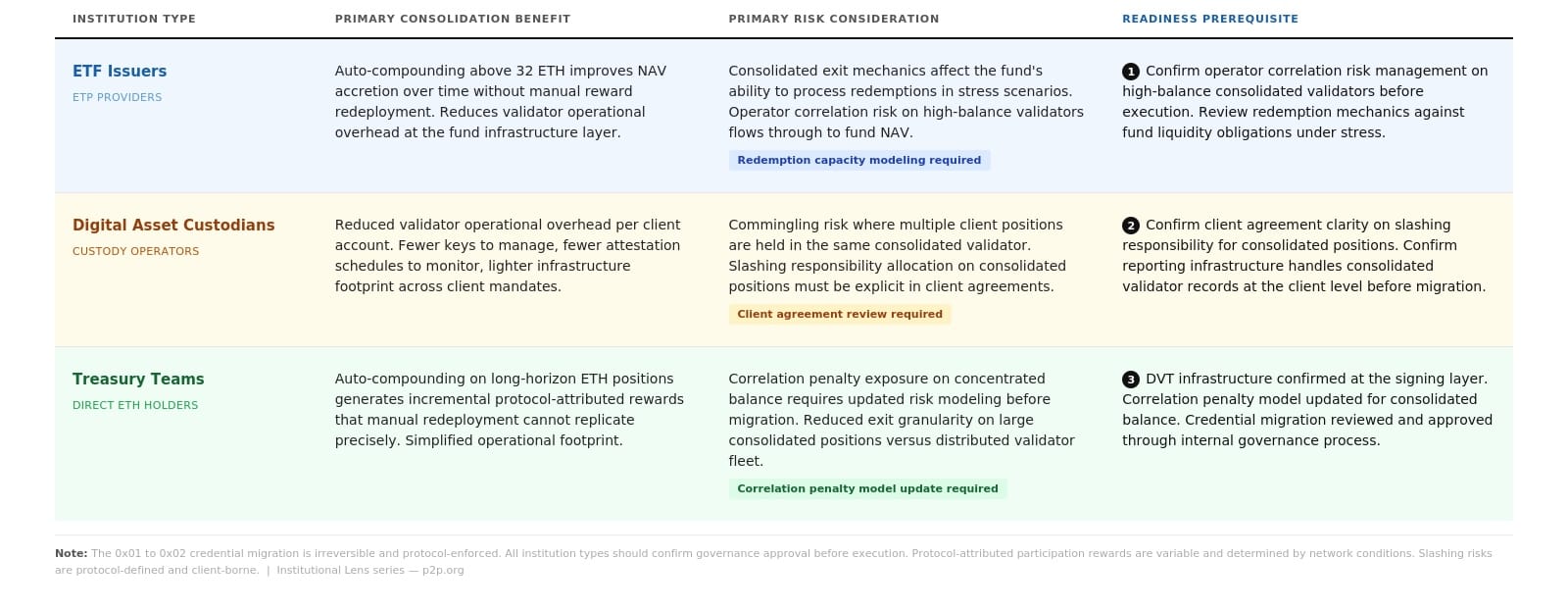
The consolidation trade-offs play out differently depending on the institutional structure. Three segments face materially different decision frameworks.
ETF Issuers and Staking-Integrated Products
For ETF issuers with staking-integrated products, the consolidation decision is primarily a NAV and reporting question, not an operational one. The validator infrastructure underlying a staking ETF is typically managed by the custodian's chosen validator operator. Staking through an Ethereum ETF is not the same as staking assets directly on the Ethereum protocol. The ETF relies on qualified custodians to manage the staked assets, who then delegate to validator operators who handle all the technical requirements. Source: Fireblocks
The ETF issuer's consolidation-relevant questions are:
Does the validator operator used by the custodian operate consolidated validators, and if so, how is the correlation risk of consolidated positions managed? What is the impact of consolidated validator exit mechanics on the fund's ability to process redemptions in a stress scenario? How does auto-compounding above 32 ETH affect NAV calculation and reward distribution timing?
The operational burden reduction that consolidation provides to self-operating institutions is less directly relevant to ETF issuers who do not operate validators themselves. The risk and liquidity questions are directly relevant to every ETF issuer whose product holds staked ETH.
Digital Asset Custodians
For custodians operating validator infrastructure on behalf of clients, consolidation is a client relationship and risk allocation question as much as an operational one. The key considerations are:
Who bears the concentration risk of a consolidated validator? If a custodian consolidates client ETH positions into fewer high-balance validators and a slashing event occurs, the client agreement must clearly define how slashing exposure is allocated. Consolidated positions held across multiple clients in the same validator introduce commingling risk that segregated validator architectures avoid.
How does consolidation affect client-level reporting? Custodians that provide client-level reward attribution at the validator level must confirm that their reporting infrastructure handles consolidated validator records correctly before migrating.
Does the client mandate permit consolidation? For custodians managing ETH on behalf of regulated funds or institutional clients with specific governance requirements, the consolidation decision may require client consent or trustee approval before execution.
Treasury Teams and Direct Holders
For institutional treasury teams holding ETH directly and operating or delegating validators, the consolidation decision is primarily an operational efficiency and risk management question.
Key considerations for consolidation readiness include whether the validator infrastructure and signing architecture are appropriate for high-balance validators; whether the slashing risk model has been updated to reflect correlation penalty exposure on consolidated balances; whether exit granularity requirements have been mapped against redemption obligations and liquidity covenants; and whether the credential migration has been reviewed and approved through an internal governance process.
DVT can strengthen the resilience of high-balance validators by distributing signing responsibility across multiple independent nodes, but it is one of several infrastructure approaches rather than a protocol requirement for consolidation. Institutions should assess whether the validator architecture operated internally or by a delegated provider aligns with their operational and risk management objectives.
Institutions that have assessed these considerations and are comfortable with the resulting risk profile may be well positioned to consolidate. Those that have not yet modeled correlation penalty exposure, reviewed the resilience of their validator infrastructure, or evaluated the governance implications of credential migration should address those areas before executing the transition.
Infrastructure and resilience review
The consolidation trade-off is not the same across institution types. ETF issuers, custodians, and treasury teams each face different primary benefits, risk considerations, and readiness prerequisites before executing the migration.
The Pre-Consolidation Checklist
For validator risk committees and staking product managers reviewing consolidation readiness.
Infrastructure and resilience review
[ ] The validator architecture (operated internally or by the delegated provider) has been assessed for resilience appropriate to high-balance validators.
[ ] If DVT is used, the DVT cluster has been reviewed for operator diversity, redundancy, and fault tolerance.
[ ] Slashing protection databases are confirmed to be persistent and migration-ready.
[ ] Remote signing architecture and key management controls have been reviewed for the consolidated validator.
Risk modeling
[ ] Correlation penalty exposure on the consolidated balance has been modelled under stress scenarios.
[ ] Exit granularity requirements have been mapped against liquidity obligations.
[ ] Entry and exit queue timing has been incorporated into return and idle capital models.
[ ] Credential irreversibility has been reviewed against the protocol upgrade roadmap.
Governance and compliance
[ ] Consolidation decision has been reviewed and approved through the institution's internal governance process.
[ ] Client or beneficiary consent has been obtained where required.
[ ] Client agreements have been reviewed for slashing responsibility allocation on consolidated positions.
[ ] Reporting infrastructure has been confirmed capable of handling consolidated validator records.
Provider evaluation
[ ] Validator provider has been asked how consolidated validators are operated, and what signing, redundancy, failover, and slashing-protection architecture is used.
[ ] Provider has confirmed their correlation risk management approach for high-balance consolidated validators.
[ ] Provider has confirmed reporting capability at the validator level for consolidated positions.
The institutional digital asset space moves fast. Our subscribers get structured analysis across staking, DeFi vaults, and regulation through DeFi Dispatch, Institutional Lens, DeFi Infrastructure for Institutions, and Legal Layer. No noise. Just the signals that matter. Subscribe to the newsletter at the bottom of this page.
Infrastructure and Reporting for Consolidated Validators
The operational efficiency case for consolidation is strongest when the underlying infrastructure is already designed to handle high-balance validators with protection engineered at the signing layer. Consolidation without an updated reporting infrastructure shifts the operational burden rather than reducing it.
P2P.org operates non-custodial validator infrastructure across 40+ proof-of-stake networks, with a track record of zero slashing incidents since 2018 and SOC 2 Type II attestation. For institutional operators evaluating Ethereum staking infrastructure that is consolidation-ready, p2p.org/products/eth-pectra covers the Pectra-specific infrastructure options available to institutional clients.
For the Validator Playbook article covering the mechanical details of consolidation, credential migration, and slashing penalty calculations under Pectra, see: Ethereum Validator Consolidation After Pectra.
Key Takeaway for Custodians, ETF Issuers, Funds, and Treasury Teams
Within six months of Pectra, roughly 1.4% of validators account for close to 25% of all staked ETH. Consolidation is the direction institutional Ethereum staking is moving. That is not a reason to consolidate without preparation. It is a reason to ensure the preparation is done correctly. Source: Financial Journal
The institutions best positioned to consolidate are those that have implemented and validated an operationally resilient signing architecture, assessed slashing and correlation risks for consolidated balances, confirmed that withdrawal and exit mechanics are compatible with their liquidity obligations, and reviewed the credential migration through an appropriate internal governance process. DVT may strengthen that architecture, but it is not required for consolidation.
Institutions that have not yet modeled correlation penalty exposure, assessed the resilience of their validator architecture, or confirmed that their reporting stack can support consolidated validator records should address those areas before executing the transition.
Pectra removed the penalty that made consolidation historically unattractive. What remains is a concentration question. The answer to that question depends on infrastructure readiness, risk modelling, and governance process. It does not depend on the direction of the market trend.
Protocol-attributed participation rewards are determined by network conditions and are variable. P2P.org does not control or set reward rates. Slashing risks are protocol-defined and client-borne. Operational safeguards are implemented to reduce slashing exposure, but do not eliminate protocol-level risk.
Frequently Asked Questions (FAQ)
What is Ethereum validator consolidation, and what did Pectra change?
Ethereum validator consolidation is the process of merging multiple 32 ETH validators into fewer high-balance validators using the maximum effective balance increase introduced by Pectra's EIP-7251. Before Pectra, every validator was capped at 32 ETH of effective balance. After Pectra, validators using 0x02 compounding credentials can hold up to 2,048 ETH, meaning an institution that previously required 64 validators for a 2,048 ETH position can now operate a single consolidated validator. Consolidation also enables auto-compounding of protocol-attributed participation rewards above 32 ETH and reduces operational overhead across key management, attestation monitoring, and reporting.
Does consolidation increase or decrease slashing risk for institutional operators?
It depends on how it is implemented. The initial slashing penalty under Pectra's MaxEB parameter is lower in absolute terms than before, at approximately 0.5 ETH for a fully consolidated 2,048 ETH validator. The correlation penalty is where concentration risk increases. If a consolidated validator is caught in a mass slashing event, the correlation multiplier applies to the full consolidated balance rather than a distributed subset of that position. Institutions consolidating significant ETH positions without DVT infrastructure in place are concentrating signing authority in ways that amplify correlation penalty exposure. DVT distributes signing responsibility across a threshold cluster, reducing the single-point-of-failure risk that high-balance consolidation creates.
Is the 0x01 to 0x02 credential migration reversible?
No. Converting from 0x01 to 0x02 withdrawal credentials is a permanent, protocol-enforced change. It cannot be undone after execution. This makes the credential migration a governance decision that should be reviewed and approved through the institution's internal process, not treated as a routine operational configuration change.
How does the current entry queue environment affect the consolidation decision?
As of May 20, 2026, the Ethereum validator entry queue held approximately 3,589,414 ETH with a wait time of approximately 62 days.* For institutions planning to consolidate using Pectra's balance transfer mechanism between active validators, the queue timing impact is reduced because the mechanic does not require a full exit and re-entry in many cases. For institutions entering staking for the first time or rebalancing across providers in a way that requires exit and reactivation, the queue timing adds a significant period of non-participating capital that must be incorporated into any return model.
Queue data as of May 20, 2026. Conditions are dynamic and change continuously.
What should ETF issuers evaluate regarding consolidation if they do not operate validators directly?
ETF issuers whose products hold staked ETH should evaluate three consolidation-relevant questions with their custodian and validator operator: how correlation risk on consolidated high-balance validators is managed by the operator; how consolidated validator exit mechanics affect the fund's ability to process redemptions in a stress scenario; and how auto-compounding above 32 ETH affects NAV calculation and reward distribution timing for the fund's accounting treatment.
What are the prerequisites for consolidation readiness at an institutional scale?
Institutions should assess four key areas before consolidating at scale**:** whether their validator infrastructure and signing architecture are appropriate for high-balance validators; whether their slashing risk model reflects correlation penalty exposure on consolidated balances; whether exit granularity has been evaluated against liquidity obligations and redemption requirements; and whether the irreversible credential migration has been reviewed through the institution’s internal governance process.
DVT can strengthen the resilience of high-balance validators by distributing signing responsibility across multiple independent nodes, but it is not a protocol requirement for consolidation. Institutions may choose other infrastructure approaches, provided they align with their operational resilience, security, and risk management objectives.
Founded in 2018, P2P.org helps institutional capital protect Digital Asset Yield across non-custodial staking infrastructure and curated DeFi strategies. With over $10B in assets secured and operating on 40+ proof-of-stake networks, P2P.org maintains a zero-slashing-incident track record, is trusted by over 190 institutional clients and is SOC 2 Type II attested. If you are evaluating the infrastructure requirements for a DeFi allocation program, talk to our team.
Disclaimer
This article is provided for informational purposes only and does not constitute legal, regulatory, compliance, or investment advice. Regulatory obligations may vary depending on jurisdiction and specific business activities. Readers should consult their own legal and compliance advisors regarding applicable requirements.
Subscribe to P2P-economy
Get the latest posts delivered right to your inbox
<hr><h2 id="series-defi-dispatch">Series: DeFi Dispatch</h2><p>DeFi Dispatch is <a href="http://p2p.org/?ref=p2p.org">P2P.org</a>'s twice-monthly roundup of DeFi developments for institutional participants navigating the intersection of traditional and on-chain finance. Each edition covers the signals that matter for asset managers, custodians, hedge funds, ETF issuers, exchanges, and staking teams operating at the frontier of institutional DeFi and proof-of-stake infrastructure.</p><p><em>👉 <strong>Subscribe to our newsletter</strong> at the bottom of this page to receive a monthly summary of the latest DeFi and staking developments, curated for institutional participants.</em></p><p>Missed the previous edition? Catch up here: <a href="https://p2p.org/economy/defi-dispatch-defi-news-june-2026-issue-2/">DeFi Dispatch: DeFi News and Signals June 2026 (Issue 2)</a></p><hr><h2 id="quick-learnings-for-busy-readers">Quick Learnings for Busy Readers</h2><p>Short on time? Here are the key takeaways. For the full analysis, continue reading below.</p><p>The start of July brought five developments that institutional participants in DeFi and staking infrastructure should track closely.</p><ul><li><strong>Robinhood launched the public mainnet of Robinhood Chain</strong> on July 1, an Ethereum Layer 2 built on Arbitrum's technology with Stock Tokens available in 120 countries, Uniswap and Chainlink integrated from day one, and a DeFi ecosystem operational at launch, marking the first time a major brokerage has shipped its own blockchain infrastructure at production scale.</li><li><strong>BlackRock's BUIDL tokenized Treasury fund crossed $2.87 billion in total multi-chain assets under management</strong>, with Avalanche now hosting the second-largest allocation after Ethereum, reinforcing proof-of-stake networks as the settlement layer for institutional-grade tokenized assets.</li><li><strong>Ethereum ETFs recorded $84 million in net inflows in the week ending July 11</strong>, breaking an eight-week outflow streak, with ETH recovering 20% from its 2026 low to cross $1,800, as staking-integrated products continued capturing the majority of inflows relative to non-staking alternatives.</li><li><strong>More than one-third of all ETH is now staked</strong>, a threshold the network has never crossed, driven by institutional adoption and staking ETF demand, with the Glamsterdam upgrade targeting parallel execution and gas-limit increases toward 200 million expected in Q3 2026.</li><li><strong>Ethereum spot ETF inflows have continued accumulating</strong> even as ETH's price declined more than 16% over three months, with staking-integrated products maintaining their structural advantage over non-staking alternatives and Standard Chartered maintaining a $40,000 ETH target for 2030 based on its role in stablecoins and tokenization.</li></ul><h2 id="introduction-whats-driving-defi-markets-in-the-first-half-of-july">Introduction: What's driving DeFi markets in the first half of July?</h2><p>The start of July 2026 is defined by a convergence of distribution and infrastructure. The launch of the Robinhood Chain on July 1 is not a crypto-native event. It is a brokerage with 23 million users turning its own settlement rails into a public blockchain, with tokenized equities, DeFi composability, and AI-native trading operational from day one. At the same time, BUIDL crossing $2.87 billion across multiple chains, one-third of all ETH now staked, and Ethereum ETF inflows reversing after eight consecutive weeks of outflows all point in the same direction: institutional capital is consolidating around Ethereum as the primary on-chain settlement infrastructure, even as short-term price performance remains challenged. For institutions focused on protecting Digital Asset Yield rather than chasing price momentum, the structural signals this month are more significant than the near-term price narrative.</p><p>Below, we break down five key developments and why they matter for asset managers, custodians, hedge funds, ETF issuers, exchanges, and staking teams.</p><h2 id="story-1-robinhood-chain-launches-public-mainnet-on-july-1-with-tokenized-stocks-in-120-countries">Story 1: Robinhood Chain Launches Public Mainnet on July 1 With Tokenized Stocks in 120 Countries</h2><p>On July 1, 2026, Robinhood officially launched the public mainnet of Robinhood Chain at its "The World is Flat" event in London. Built using the Arbitrum platform to institutional standards and natively connected to Robinhood's on-chain users, the Layer 2 blockchain launched with Uniswap, deploying a dedicated AMM as the primary public liquidity protocol, and deep integrations from Alchemy, BitGo, and Chainlink. Stock Tokens are available on the Robinhood Wallet in more than 120 countries. The chain features fast block times and out-of-the-box DeFi primitives, including lending and borrowing.</p><p>Robinhood Chain runs 100-millisecond block times, settles to Ethereum for security, and ships with Uniswap and Chainlink integrated from day one. The public testnet recorded 4 million transactions in its first week before the July 1 mainnet debut. The chain is permissionless and AI-native, designed for real-world assets, and supports ERC-4337 account abstraction out of the box, enabling gas sponsorship, batched transactions, and social recovery.</p><h3 id="why-this-matters-for-asset-managers-custodians-hedge-funds-etf-issuers-exchanges-and-staking-teams">Why this matters for asset managers, custodians, hedge funds, ETF issuers, exchanges, and staking teams:</h3><ul><li>A brokerage with 23 million users has launched its own permissionless Ethereum Layer 2. Tokenized equities are composable as DeFi collateral from day one. This is the clearest signal yet that the distribution gap between traditional finance and on-chain infrastructure is closing at the product layer, not only the regulatory layer.</li><li>Robinhood Chain settles to Ethereum for security. That means Ethereum's validator infrastructure now underpins the settlement layer for Stock Tokens traded across 120 countries. This adds a new category of institutional-grade real-world asset settlement to the demand base for Ethereum validator operations.</li><li>The chain's AI-native design and Agentic Trading integration signal that the next institutional DeFi infrastructure cycle will be built around automated execution. This raises the operational standards expected of the validator and protocol infrastructure that automated agents depend on.</li></ul><p>Sources: <a href="https://robinhood.com/us/en/newsroom/robinhood-accelerates-global-expansion-robinhood-chain-mainnet-stock-tokens-agentic-trading/?ref=p2p.org">Robinhood Newsroom</a>, <a href="https://cryptobriefing.com/robinhood-chain-launches-real-world-assets-layer-2/?ref=p2p.org">CryptoBriefing</a>, July 2026.</p><h2 id="story-2-blackrocks-buidl-crosses-287-billion-as-avalanche-becomes-second-largest-allocation">Story 2: BlackRock's BUIDL Crosses $2.87 Billion as Avalanche Becomes Second-Largest Allocation</h2><p>BUIDL's total value reached approximately $2.87 billion as tokenized Treasury demand continued growing across blockchains. RWA.xyz's BUIDL dashboard places the fund's total asset value at approximately $2.87 billion across supported networks, with Avalanche now holding close to one-third of the full fund, placing it behind Ethereum as BUIDL's second-largest network allocation. BUIDL remains concentrated among a limited number of approved investors, with RWA.xyz listing 113 holders even as the fund approaches $2.87 billion in value, reflecting its focus on qualified purchasers rather than broad retail access.</p><p>The BUIDL expansion across Avalanche is architecturally significant beyond the headline figure. Each new network allocation requires the proof-of-stake infrastructure supporting that network to meet the same reliability and performance standards that BlackRock applies to its Ethereum-based operations. Avalanche's addition as the second-largest BUIDL network means its validator ecosystem is now part of the settlement infrastructure for the world's largest tokenized Treasury fund, not simply a DeFi-native chain competing for liquidity.</p><h3 id="why-this-matters-for-asset-managers-custodians-hedge-funds-etf-issuers-exchanges-and-staking-teams-1">Why this matters for asset managers, custodians, hedge funds, ETF issuers, exchanges, and staking teams:</h3><ul><li>BUIDL crossing $2.87 billion across multiple proof-of-stake networks confirms that the multi-chain tokenized Treasury model is operational at an institutional scale, with each network hosting BUIDL assets requiring validator infrastructure that meets BlackRock's institutional operational standards.</li><li>The concentration of 113 holders managing $2.87 billion underscores that tokenized Treasury products at this stage remain institutional-only infrastructure, with per-holder averages reflecting capital deployment at the scale of asset managers, family offices, and treasury teams.</li><li>As BUIDL's Avalanche position illustrates, institutional capital is distributing across multiple proof-of-stake networks simultaneously rather than concentrating on a single chain, creating parallel demand for non-custodial validator infrastructure quality across every network where it operates.</li></ul><p>Sources: <a href="https://crypto.news/blackrocks-buidl-hits-900m-on-avalanche-as-rwa-race-grows/?ref=p2p.org">crypto.news</a>, <a href="https://rwa.xyz/?ref=p2p.org">RWA.xyz</a>, July 2026.</p><h2 id="story-3-ethereum-etfs-break-eight-week-outflow-streak-as-eth-recovers-20-from-2026-low">Story 3: Ethereum ETFs Break Eight-Week Outflow Streak as ETH Recovers 20% From 2026 Low</h2><p>ETH was trading near $1,767 as of July 6, far below the bullish expectations that surrounded the first U.S. spot Ethereum ETFs in 2024. ETF demand had been uneven and major banks had already cooled their Ether forecasts. Citi cut its 12-month Ether target from $3,175 to $2,240, citing negative ETF flows, weaker investor demand, limited regulatory momentum, and broader risk-off conditions. Ethereum staking currently generates roughly 2.6% to 3.0% annually, depending on the data source and measurement method.</p><p>That backdrop shifted materially in the second week of July. Ethereum's price surged past $1,800 on July 12, 2026, marking a 20% recovery from its 2026 low, fueled by spot ETF inflows and a bullish technical reversal pattern. The move was supported by more than $84 million in net inflows to U.S. spot Ethereum ETFs in the week ending July 11, ending an eight-week outflow streak that had been the longest sustained redemption period for any crypto ETF on record.</p><h3 id="why-this-matters-for-asset-managers-custodians-hedge-funds-etf-issuers-exchanges-and-staking-teams-2">Why this matters for asset managers, custodians, hedge funds, ETF issuers, exchanges, and staking teams:</h3><ul><li>The eight-week outflow streak ending on the back of $84 million in weekly inflows confirms that institutional demand for Ethereum ETF exposure is durable rather than event-driven, with staking-integrated products continuing to capture the majority of inflows relative to non-staking alternatives.</li><li>Citi's downward revision of its ETH price target alongside its maintained institutional coverage reflects the bifurcation in how sophisticated allocators are approaching Ethereum: short-term price caution coexisting with long-term structural conviction around proof-of-stake network participation and settlement infrastructure.</li><li>For ETF issuers with staking amendments still pending SEC approval, the reversal of the outflow streak reinforces the urgency of completing integration before the competitive gap between staking and non-staking products becomes permanent and reflected in AUM divergence.</li></ul><p>Sources: <a href="https://coinmarketcap.com/cmc-ai/ethereum/latest-updates/?ref=p2p.org">CoinMarketCap</a>, <a href="https://bitcoinfoundation.org/news/crypto-etfs-news/ethereum-etf-update-could-staking-etfs-become-eths-biggest-catalyst/?ref=p2p.org">Bitcoin Foundation</a>, July 2026.</p><h2 id="story-4-more-than-one-third-of-all-eth-is-now-staked-as-glamsterdam-targets-q3-2026">Story 4: More Than One-Third of All ETH Is Now Staked as Glamsterdam Targets Q3 2026</h2><p>Approximately 37 million ETH, representing more than one-third of the circulating supply, is now committed to staking, a threshold the Ethereum network has never crossed. The Glamsterdam upgrade targets mainnet activation in Q3 2026 and introduces two headline EIPs: EIP-7732, which moves block building on-chain through Enshrined Proposer-Builder Separation, and EIP-7928, which enables parallel execution through Block-Level Access Lists. Together, they target a gas limit increase from 60 million toward 200 million and a throughput of approximately 10,000 transactions per second.</p><p>Glamsterdam is Ethereum's pivot back to scaling the base layer, not just rollups, to rebuild the value that accrues to ETH. The upgrade hit final devnet testing in June 2026, with public testnet activation on Sepolia and Hoodi expected to follow before mainnet confirmation. It arrives as ETF issuers begin distributing protocol staking rewards to shareholders and regulators clarify how institutions participate in proof-of-stake yield, making the timing structurally significant for the institutional staking product landscape.</p><h3 id="why-this-matters-for-asset-managers-custodians-hedge-funds-etf-issuers-exchanges-and-staking-teams-3">Why this matters for asset managers, custodians, hedge funds, ETF issuers, exchanges, and staking teams:</h3><ul><li>One-third of all ETH being staked means that the liquid supply available for immediate market transactions has contracted materially, creating a structural supply dynamic that amplifies price sensitivity to marginal ETF inflow changes in a way that has no equivalent in Bitcoin's supply structure.</li><li>Glamsterdam's gas-limit increase toward 200 million and parallel execution implementation will directly expand Ethereum's capacity to support institutional-scale tokenized asset settlement and DeFi protocol activity simultaneously, making it the most consequential Ethereum upgrade for institutional infrastructure since Pectra.</li><li>For institutions evaluating proof-of-stake network participation as part of a Protected Yield for Digital Assets strategy, the combination of a record staking ratio and an approaching capacity upgrade strengthens the case for Ethereum as a durable non-custodial infrastructure layer.</li></ul><p>Sources: <a href="https://ethereum.org/roadmap/glamsterdam/?ref=p2p.org">ethereum.org</a>, <a href="https://www.datawallet.com/crypto/ethereum-glamsterdam-upgrade-explained?ref=p2p.org">Datawallet</a>, <a href="https://phemex.com/blogs/ethereums-glamsterdam-upgrade-explained?ref=p2p.org">Phemex</a>, July 2026.</p><h2 id="story-5-ethereum-etf-inflows-defy-price-weakness-as-institutional-positioning-decouples-from-spot-performance">Story 5: Ethereum ETF Inflows Defy Price Weakness as Institutional Positioning Decouples From Spot Performance</h2><p>The iShares Ethereum Trust ETF, ETHA, drew fresh inflows of $36.64 million on July 2, 2026, despite a soft spot market, representing roughly 0.83% of the fund's $4.40 billion in assets under management. ETH-USD was trading at $1,730, down about 16.94% over the prior three months. The contrast between negative spot performance and positive ETF flows suggests that market participants may be positioning for a medium-term rebound or favoring regulated vehicles over direct crypto holdings.</p><p>On-chain analytics firm Glassnode reported that exchange ETH balances fell to a multi-year low of approximately 8.3% of total supply in May 2026, suggesting that a significant portion of previously tradeable supply has moved into long-term custody or staking contracts. These dynamics create a structural supply squeeze that amplifies price sensitivity to marginal inflow changes. BlackRock's ETHA has captured approximately 47% of total cumulative net inflows as of May 23, 2026, with the nine-product ETH ETF field showing the same competitive concentration dynamic that characterized the Bitcoin ETF market.</p><h3 id="why-this-matters-for-asset-managers-custodians-hedge-funds-etf-issuers-exchanges-and-staking-teams-4">Why this matters for asset managers, custodians, hedge funds, ETF issuers, exchanges, and staking teams:</h3><ul><li>ETF inflows remaining positive through a 16.94% price drawdown confirms that institutional capital is treating Ethereum as a portfolio allocation with a duration horizon, not a tactical trade — a categorically different and more durable demand driver than the retail-driven cycles that preceded ETF approval.</li><li>Exchange ETH balances falling to a multi-year low of 8.3% of total supply, combined with growing staking commitments through ETF products, means that the liquid float available for institutional execution is structurally smaller than at any point in Ethereum's history, amplifying the price impact of sustained institutional inflows when they materialize.</li><li>BlackRock's 47% share of cumulative ETH ETF inflows mirrors its Bitcoin ETF dominance, establishing a pattern where the leading institutional distribution platform captures disproportionate share as the market matures, with direct implications for which non-custodial validator relationships receive the majority of ETF-driven staking demand.</li></ul><p>Sources: <a href="https://www.tipranks.com/news/cryptocurrencies/ethereum-etf-inflows-defy-slumping-token-price-as-institutional-cash-keeps-coming?ref=p2p.org">TipRanks</a>, <a href="https://yellow.com/research/ethereum-etf-inflows-btc-underperformance-gap-2026?ref=p2p.org">Yellow.com</a>, July 2026.</p><h2 id="frequently-asked-questions-faq">Frequently Asked Questions (FAQ)</h2><h3 id="what-does-robinhood-chains-launch-mean-for-ethereum-validator-infrastructure">What does Robinhood Chain's launch mean for Ethereum validator infrastructure?</h3><p>Robinhood Chain settles to Ethereum for security, meaning any transactions that are processed on the chain are ultimately recorded on Ethereum's base layer. As Stock Tokens across 120 countries and DeFi activity on Robinhood Chain grow, the settlement demand on Ethereum's non-custodial validator infrastructure scales proportionally. A brokerage-scale distribution channel pointing at Ethereum settlement is a qualitatively different demand driver from DeFi-native usage, because it brings retail and institutional equity trading volume onto the same settlement rails that proof-of-stake validators secure.</p><h3 id="why-does-more-than-one-third-of-eth-being-staked-matter-for-institutional-allocators">Why does more than one-third of ETH being staked matter for institutional allocators?</h3><p>The staking ratio matters because it directly affects the liquid supply of ETH available for immediate transactions and creates a structural supply constraint that amplifies price sensitivity to inflow changes. For institutional allocators focused on protecting Digital Asset Yield, it also signals that the network's security model is maturing: a higher staking ratio means more capital committed to network security, which strengthens the case for Ethereum as a durable settlement layer for institutional-grade financial products.</p><h3 id="what-does-the-decoupling-of-etf-inflows-from-eth-price-performance-mean-for-staking-programs">What does the decoupling of ETF inflows from ETH price performance mean for staking programs?</h3><p>Sustained ETF inflows during a 16.94% price drawdown indicate that institutional capital is treating Ethereum as a portfolio allocation with a duration horizon, not a tactical trade. For non-custodial staking programs operating within institutional mandates, this is a more favorable demand environment than price-correlated inflows, because capital committed through ETF-driven staking is less likely to exit during short-term price weakness, creating more stable validator set conditions and more predictable protocol reward participation for infrastructure operators.</p><h2 id="key-takeaways-for-asset-managers-custodians-hedge-funds-etf-issuers-exchanges-and-staking-teams">Key Takeaways for Asset Managers, Custodians, Hedge Funds, ETF Issuers, Exchanges, and Staking Teams</h2><p>The start of July 2026 surfaces five converging signals for institutional participants in on-chain infrastructure:</p><ul><li>Robinhood Chain launching with tokenized equities in 120 countries and full DeFi composability from day one marks the first time a major brokerage has deployed its own blockchain infrastructure at production scale, adding a new category of institutional real-world asset settlement demand to Ethereum's non-custodial validator ecosystem.</li><li>BUIDL crossing $2.87 billion with Avalanche as its second-largest network allocation confirms that the multi-chain tokenized Treasury model is operational at an institutional scale, with validator infrastructure quality across multiple proof-of-stake networks now a direct consideration for the world's largest asset manager.</li><li>Ethereum ETFs breaking an eight-week outflow streak with $84 million in weekly inflows, alongside a 20% price recovery from 2026 lows, signals that institutional conviction in Ethereum's settlement infrastructure role is reasserting itself after a period of tactical caution.</li><li>More than one-third of all ETH now being staked, combined with Glamsterdam's approaching parallel execution and gas-limit expansion toward 200 million, frames Q3 2026 as the period in which Ethereum's capacity to support institutional-scale tokenized asset settlement is tested at a new scale.</li><li>BlackRock's 47% share of cumulative ETH ETF inflows, alongside exchange balances falling to an 8.3% multi-year low, confirms that institutional capital concentration in Ethereum is deepening through regulated product wrappers rather than direct holdings, with non-custodial validator relationships attached to those products becoming a structurally important part of institutional digital asset infrastructure.</li></ul><hr><p>👉 <strong>Subscribe to our newsletter </strong>at the bottom of this page to receive a monthly summary of the latest DeFi and staking developments, curated for institutional participants. Or follow us on <a href="https://linkedin.com/company/p2p-org?ref=p2p.org">LinkedIn</a> and <a href="https://twitter.com/p2pvalidator?ref=p2p.org">X</a> to stay updated when new DeFi Dispatch editions are published.</p><hr><p><strong>About P2P.org</strong></p><p>Founded in 2018, P2P.org helps institutional capital protect Digital Asset Yield across non-custodial staking infrastructure and curated DeFi strategies. With over $10B in assets secured and operating on 40+ proof-of-stake networks, P2P.org maintains a zero-slashing-incident track record, is trusted by over 190 institutional clients and is SOC 2 Type II attested. To explore how P2P.org can support your institution's staking or DeFi infrastructure needs, <a href="https://p2p.org/contact?ref=p2p.org" rel="noreferrer">get in touch with our team</a>.</p><hr><p><strong>Disclaimer</strong></p><p>This material is provided for informational purposes only and does not constitute investment, financial, legal, or tax advice. P2P.org accepts no liability for any actions taken based on it. Latency and performance figures referenced are estimates based on internal benchmarks and may vary depending on network conditions, geography, and client infrastructure. Past performance is not indicative of future results.</p>
<h2 id="learnings-for-busy-readers"><strong>Learnings for Busy Readers</strong></h2><p>- The Vault has integrated P2P.org non-custodial validator infrastructure directly into its institutional custody platform.</p><p>- Clients can access protocol staking rewards on supported assets without moving those assets outside the custody environment.</p><p>- The integration launches with Ethereum (ETH) and TRON (TRX), with additional networks planned over time.</p><p>- Assets remain segregated and under client custody throughout. Delegation is non-custodial, so P2P.org never takes possession of client funds.</p><p>- The design removes a common tradeoff for regulated institutions: reaching staking infrastructure without stepping outside the controls they already operate.</p><h2 id="the-problem-staking-access-usually-means-leaving-custody"><strong>The Problem: Staking Access Usually Means Leaving Custody</strong></h2><p>For most institutions, putting on-chain assets to work has meant accepting operational complexity and additional counterparty exposure. Reaching staking infrastructure typically requires transferring assets from the custody environment, introducing friction that regulated entities often find operationally unacceptable.</p><p>That friction is not a matter of preference. It is a function of how these institutions are governed. Segregation of assets, defined approval workflows, and auditable movement of funds are baseline requirements, not optional controls. Any process that requires an institution to move assets outside its custody perimeter to access protocol rewards runs directly counter to those requirements.</p><p>The result is a familiar standoff. Demand for on-chain participation is real, but the operational path to it has carried tradeoffs that many institutions were not willing to make.</p><h2 id="who-the-vault-is"><strong>Who The Vault Is</strong></h2><p>The Vault is a Swiss and EU-regulated institutional infrastructure platform for digital assets. It covers the full lifecycle, from secure custody and treasury operations to back-office management and wallet infrastructure, and is built on proprietary threshold MPC cryptography developed by an in-house research team. It is available in three deployment models — SaaS, Hybrid, and On-Premise — with a bespoke modular architecture that can be customised to each company's needs and frameworks.</p><p>The platform serves institutional clients across several segments, including corporate treasuries, financial institutions, professional asset managers, family offices, and payment providers. It is available in three deployment models, SaaS, Hybrid, and On-Premise, with a modular architecture that can be configured to each institution's operating and compliance frameworks.</p><p>The P2P.org integration fits a broader roadmap: consolidating custody, treasury operations, and asset utilization within a single regulated framework, so institutions manage more of their on-chain activity in one controlled environment rather than across disconnected systems.</p><h2 id="the-integration-validator-infrastructure-inside-the-custody-perimeter"><strong>The Integration: Validator Infrastructure Inside the Custody Perimeter</strong></h2><p>The Vault embeds P2P.org institutional-grade validator infrastructure natively into its platform. Clients retain full custody of their assets while accessing protocol staking rewards through the same interface and workflows they already use.</p><p>The mechanism matters. P2P.org operates non-custodial validator infrastructure, which means delegation happens without transferring ownership of the underlying assets. Clients delegate to validators operated by P2P.org, and the assets remain segregated within The Vault's custody environment throughout. Rewards are generated by the network protocol, not by P2P.org, and accrue according to each network's reward schedule.</p><p>For the institution, the practical change is that staking stops being a separate operational track. It becomes a function inside the environment where custody, treasury operations, and reporting already live.</p><h2 id="operational-depth-how-delegation-works-in-practice"><strong>Operational Depth: How Delegation Works in Practice</strong></h2><p>Within The Vault's platform, delegation runs through the same authorization and approval controls that govern other asset movements. Institutions do not adopt a parallel workflow to stake.</p><p>Assets stay segregated and auditable. Because delegation is non-custodial, the custody relationship between the institution and The Vault is not altered by the act of staking. Real-time monitoring of validator performance sits with P2P.org, whose operations are SOC 2 Type II certified, audited by KirkpatrickPrice. Reporting on delegated positions and accrued protocol rewards is available within the platform, which keeps position data and treasury data in one place rather than split across systems.</p><p>The launch scope of Ethereum and TRON reflects two networks with distinct staking mechanics, and the roadmap adds further networks over time. Each additional network carries its own delegation parameters, reward schedule, and risk profile, which are evaluated before support is added.</p><h2 id="governance-and-capital-implications"><strong>Governance and Capital Implications</strong></h2><p>The governance point is the one that regulated institutions tend to weigh most heavily. Staking inside custody means the institution does not surrender control to participate.</p><p>Approval hierarchies, segregation of duties, and audit trails remain intact because the assets never leave the custody perimeter. The institution directs its own delegation. P2P.org provides the validator infrastructure and operates it, but does not take custody, does not exercise discretion over client assets, and does not act as an intermediary that holds funds. This distinction, between operating infrastructure and taking possession, is central to how the arrangement fits within institutional governance frameworks.</p><p>For treasuries and asset managers, the capital implication is straightforward. Assets that were previously idle in custody can access protocol rewards without a separate custody arrangement, a new counterparty relationship, or a break in the audit trail. The decision to stake becomes an operational choice inside existing controls rather than a structural exception to them.</p><h2 id="evaluating-the-validator-layer"><strong>Evaluating the Validator Layer</strong></h2><p>For institutions assessing this kind of integration, the validator operator is a core part of the diligence, not a detail. </p><p>A short checklist:</p><p>- Track record: length of operation and slashing history across networks. P2P.org has operated since 2018 with no slashing incidents across seven years.</p><p>- Certification: independent audit of operational controls. P2P.org is SOC 2 Type II certified, audited by KirkpatrickPrice, and holds an AAA Verified Staking Provider rating.</p><p>- Scale: delegated assets and network coverage as a signal of operational maturity. P2P.org secures over $10 billion in delegated assets across 40+ networks.</p><p>- Custody model: confirmation that delegation is non-custodial and that assets remain segregated.</p><p>- Monitoring: validator performance monitoring and transparent reporting.</p><p>The point of the checklist is that the operational quality of the validator layer is inseparable from the security of the position. Embedding infrastructure inside custody raises the bar on operator diligence rather than lowering it.</p><h2 id="key-takeaway-for-institutional-teams"><strong>Key Takeaway for Institutional Teams</strong></h2><p>For custodians, treasuries, and asset managers, the integration reframes staking as a function inside custody rather than a reason to leave it. Institutions access protocol staking rewards on ETH and TRX without moving assets outside their custody environment, while segregation, approval controls, and audit trails stay intact. The protocol-level risks of proof-of-stake remain and should be underwritten directly. What changes is the operational path to access, which becomes materially cleaner for organisations that cannot compromise on control.</p><h2 id="faq"><strong>FAQ</strong></h2><p><strong>Does staking through this integration move my assets out of custody?</strong> No. Delegation is non-custodial and assets remain segregated within The Vault's custody environment. P2P.org operates the validator infrastructure but does not take possession of client assets.</p><p><strong>Which networks are supported at launch?</strong> Ethereum (ETH) and TRON (TRX), with additional networks planned over time. Each new network is evaluated for its delegation parameters and risk profile before support is added.</p><p><strong>Who generates the staking rewards?</strong> Rewards are generated by each network protocol according to its reward schedule. Reward rates are variable and set by the network, not fixed or promised by The Vault or P2P.org.</p><p><strong>What happens to my custody controls when I stake?</strong> They remain in place. Delegation runs through the same authorization and approval workflows that govern other asset movements, and audit trails are preserved because assets do not leave the custody perimeter.</p><p><strong>How is validator risk managed?</strong> P2P.org operates with slashing protection controls, provides real-time monitoring, and is SOC 2 Type II certified. Slashing risk is inherent to proof-of-stake networks that impose it and should be evaluated as part of institutional diligence.</p><h2 id="explore-the-integration"><strong>Explore the Integration</strong></h2><p>Custodians, treasuries, and asset managers interested in accessing staking inside their custody environment can contact P2P.org to discuss network coverage, delegation parameters, and onboarding.</p>
 ALL
Agoric
Aptos
Auth
Avail
Avalanche
Axelar
Babylon
Bitcoin
bouldertech
BTC
capital flow
Cardano
Celestia
certifications
Chainlink
compliance
Cosmos
Crescent
curator
Cyberway
DAOBet
Data stream
DeFi
defi dispatch
defi infrastrcuture
defi infrastructure
defi news
defi vault
due diligence
DVT
Dymension
Economy
Education
EigenLayer
Elrond
employee
employee advocacy
employee interviews
ETF
Ethereum
Evmos
exit queue
Explain Like I'm Five
Governance
Guide
hedge fund
how to
HR
HUB series
Hyperliquid
infrastructure
institutional lens
institutional staking
ISO 27001
ISO/IEC 27001:2022
Issuer
Kava
Kusama
landing
latin america
legal layer
legislation
Lido
liquid staking
LSP
Manta
Mantle
Marlin
Matic
MEV
MiCA
Moonbeam
MultiversX
Near
Networks
News
NuCypher
Oasis
Obol
Origin
P2P Verified
Partnership
pectra
Persistence
playbook
Pocket
Polkadot
Polygon
product
products
Quicksilver
Regen
regulation
ALL
Agoric
Aptos
Auth
Avail
Avalanche
Axelar
Babylon
Bitcoin
bouldertech
BTC
capital flow
Cardano
Celestia
certifications
Chainlink
compliance
Cosmos
Crescent
curator
Cyberway
DAOBet
Data stream
DeFi
defi dispatch
defi infrastrcuture
defi infrastructure
defi news
defi vault
due diligence
DVT
Dymension
Economy
Education
EigenLayer
Elrond
employee
employee advocacy
employee interviews
ETF
Ethereum
Evmos
exit queue
Explain Like I'm Five
Governance
Guide
hedge fund
how to
HR
HUB series
Hyperliquid
infrastructure
institutional lens
institutional staking
ISO 27001
ISO/IEC 27001:2022
Issuer
Kava
Kusama
landing
latin america
legal layer
legislation
Lido
liquid staking
LSP
Manta
Mantle
Marlin
Matic
MEV
MiCA
Moonbeam
MultiversX
Near
Networks
News
NuCypher
Oasis
Obol
Origin
P2P Verified
Partnership
pectra
Persistence
playbook
Pocket
Polkadot
Polygon
product
products
Quicksilver
Regen
regulation