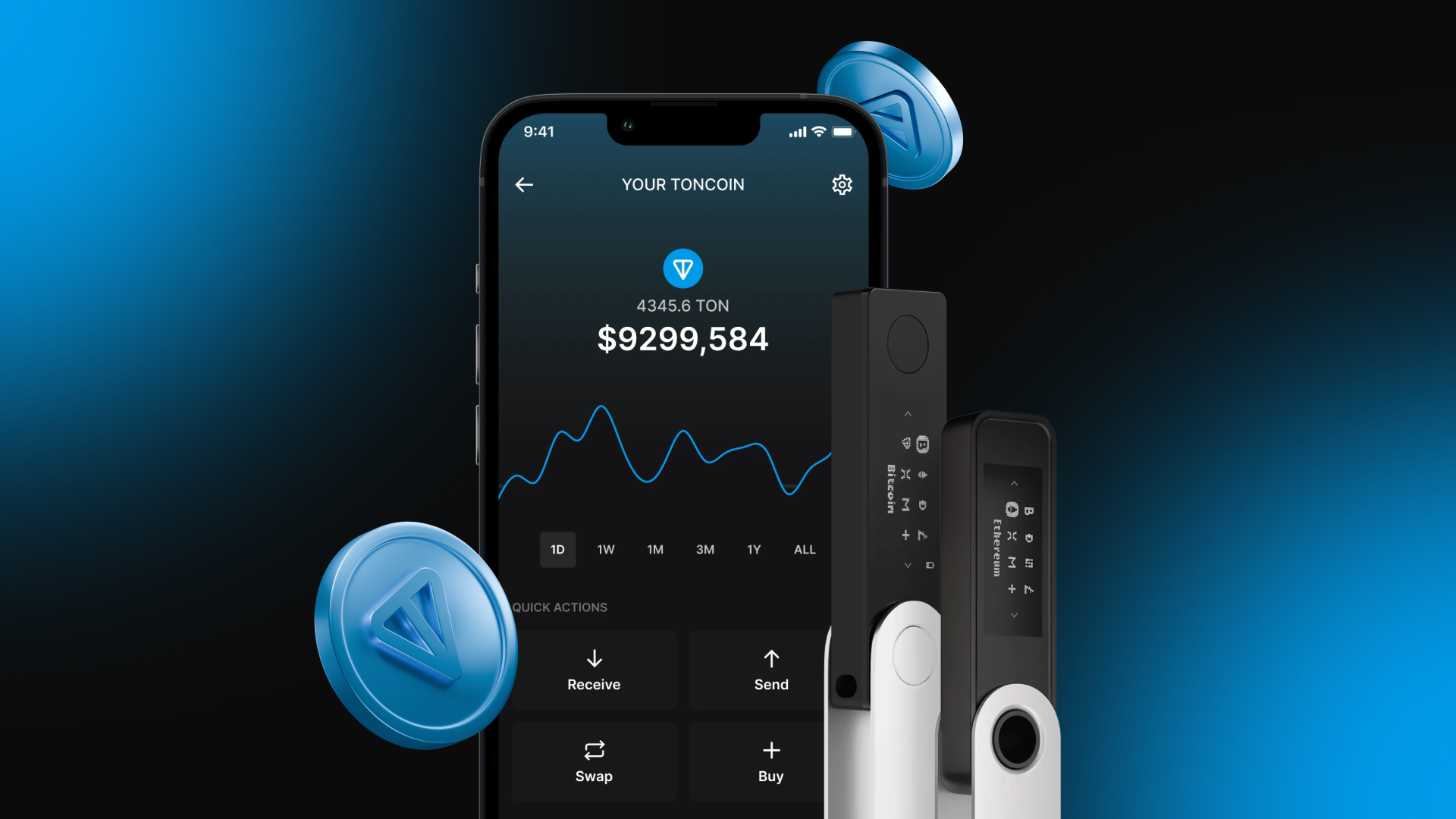
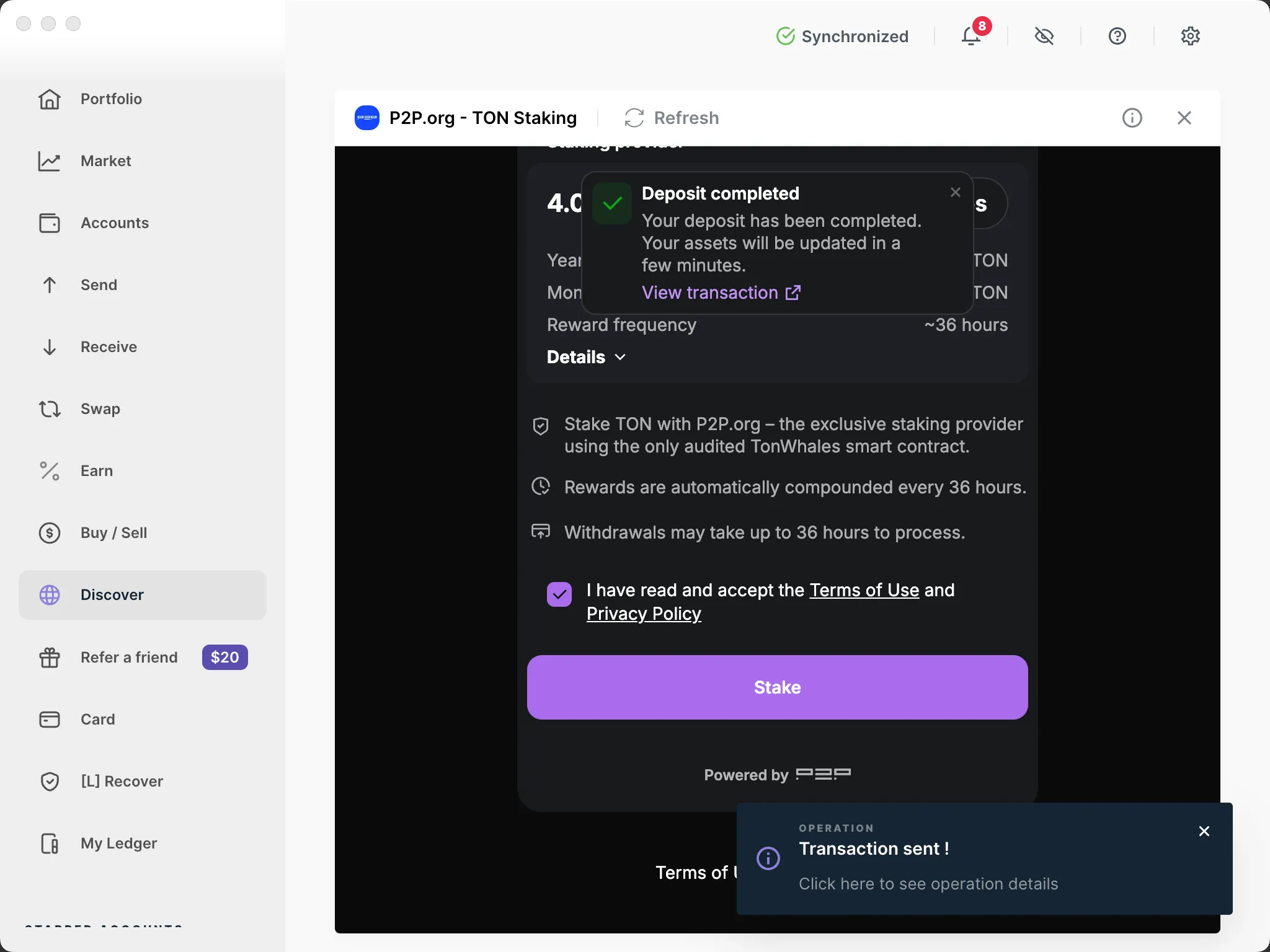
TON staking from vesting contracts is now supported via Ledger Wallet using the P2P.org dApp.
Holders with vested TON can now delegate directly without altering vesting structures.
The staking flow integrates with standard Ledger self-custody signing workflows.
Staking TON from vesting contracts is now supported through Ledger Wallet using the P2P.org dApp.
On the surface, this looks like a product enhancement. In practice, it enables additional participants to access TON’s validator infrastructure through existing vesting contracts.
Vesting contracts often represent long-term alignment — contributors, early ecosystem participants, and structured allocations tied to roadmap milestones. Until now, participation from those allocations has required additional coordination or operational workarounds.
This update streamlines the technical integration required for vesting-based delegation.
Vesting as Active Participation
In most ecosystems, vesting allocations sit idle by default.
They are designed to protect long-term alignment and prevent sudden liquidity shocks. But structurally, they also represent a meaningful portion of circulating supply that is committed to the network over time.
When vesting allocations can participate in staking, three things happen:
Long-term holders engage more directly with network security.
Contributor allocations can participate in protocol-defined staking mechanisms.
Broader participation may contribute to more distributed delegation patterns within the network.
It’s about enabling participation from capital that is already committed to the ecosystem.
How It Works
The integration enables TON holders with vesting contracts to delegate directly through Ledger Wallet while preserving standard self-custody workflows.
The process:
Connect Ledger to the P2P.org dApp.
Select the vesting contract.
Initiate staking directly from the vested allocation.
Confirm through Ledger’s signing interface.
The staking action becomes part of the same workflow users already rely on for transaction signing and asset management.
Many of these participants operate under vesting schedules.
By enabling staking directly from vesting contracts, the network broadens participation without altering distribution mechanics. Contributors can now align long-term token commitments with active validator support.
Over time, this supports:
More distributed delegation patterns
Greater engagement from aligned stakeholders
Reinforcement of validator diversity
It also reflects an ecosystem maturity shift — where staking is expected to integrate cleanly into real custody workflows rather than exist as a separate operational layer.
Wallet-Level Participation as a Standard
Ledger Wallet integration is important here not because it adds exposure, but because it anchors staking within a widely used self-custody environment.
When staking is embedded into wallet workflows:
Participation becomes routine.
Operational complexity decreases.
Reliability expectations increase.
This is where validator infrastructure becomes directly tied to user experience.
P2P.org supports TON staking through validator operations designed for continuous, production-grade performance — particularly in flows that integrate at the wallet level.
A Step Toward Broader Participation
Enabling staking from vesting contracts via Ledger Wallet expands TON’s staking accessibility to long-term, structured participants while preserving the design principles of vesting itself.
It aligns token distribution mechanics with validator participation.
And it reflects a broader direction in staking infrastructure — one where participation fits naturally into custody workflows rather than sitting outside them.
Get Started
If you hold vested TON and use Ledger Wallet, staking is now available through the P2P.org dApp.
<p>A publicly listed Japanese company is now running Ethereum validators through a DVT-based infrastructure stack. For institutional staking, that's a meaningful signal.</p><p>P2P.org has joined a four-party collaboration with BITPOINT Japan, Def consulting, and SSV Labs to support Def consulting's Ethereum treasury strategy — a framework in which ETH is held on the corporate balance sheet and participates in Ethereum network validation and receives protocol-level staking rewards. P2P.org handles validator operations; SSV Labs contributes its Distributed Validator Technology protocol; BITPOINT provides the trading and custody infrastructure that ties the structure together.</p><h2 id="the-setup"><strong>The Setup</strong></h2><p>Def consulting's approach — treating ETH as <strong>an operational treasury asset </strong>rather than a speculative holding — reflects a broader shift in how institutional players think about digital assets. Staking turns a passive balance sheet position into an active revenue line. DVT, layered on top, addresses the operational risk that has historically made institutions hesitant to run validator infrastructure at scale.</p><p>The mechanics are straightforward. Distributed Validator Technology splits validator key management and signing duties across multiple independent nodes. <strong>This design distributes validator responsibilities across multiple nodes, reducing reliance on any single operator. </strong>For a corporate treasury with fiduciary obligations, that resilience matters as much as the rewards. SSV Network's incentive program provides additional network incentives associated with SSV-enabled validator participation without changing the operational model.</p><h2 id="p2porgs-role"><strong>P2P.org's Role</strong></h2><p>P2P.org operates as a certified SSV Network operator — we've been running DVT-based validator infrastructure for institutional clients globally before this collaboration. Bringing that capability to the Japanese market, through BITPOINT's infrastructure and Def consulting's operational framework, is a concrete extension of that work.</p><p>As Konstantin Zaitcev, Co-CEO of P2P.org, noted:</p><p>"Deploying this technology and our operational expertise for corporate clients in Japan marks an important milestone for us. We believe this initiative will serve as a foundation for expanding the adoption of staking in the Japanese market."</p><p>Our mandate here is the same as it is across all institutional deployments:<strong> </strong>operate validator infrastructure with strong operational monitoring and reliability standards<strong>, and build the kind of track record that helps institutional participants evaluate staking infrastructure as part of their digital asset operations.</strong></p><h2 id="a-template-for-regulated-markets"><strong>A Template for Regulated Markets</strong></h2><p>The Japanese market has been deliberate about digital asset adoption — which is precisely why this collaboration carries weight. When a listed company formalizes ETH staking as part of its treasury strategy, backed by DVT infrastructure and a regulated exchange partner, it creates a replicable model that other corporate treasuries in the region can evaluate.</p><p>The four-party structure here — trading infrastructure, validator operations, DVT protocol, and a defined corporate ETH strategy — is a working template for how institutional staking gets built in regulated markets. It won't be the last time we see this model.</p><h2 id="start-staking-with-p2porg"><strong>Start Staking with P2P.org</strong></h2><p>If you're exploring ETH staking for your treasury or institutional portfolio, we'd be happy to walk you through how it works in practice — infrastructure, security model, reporting, and all.</p><p>Get in touch with our institutional team → <a href="https://link.p2p.org/3325c6?ref=p2p.org">https://link.p2p.org/3325c6</a></p><p>Learn more about ETH staking: <u> </u><a href="https://link.p2p.org/e3a57d?ref=p2p.org">https://link.p2p.org/e3a57d</a> </p>
 ALL
Agoric
Aptos
Auth
Avail
Avalanche
Axelar
Babylon
Bitcoin
BTC
Cardano
Celestia
Chainlink
Cosmos
Crescent
Cyberway
DAOBet
DeFi
DVT
Dymension
Economy
Education
EigenLayer
Elrond
Ethereum
Evmos
Explain Like I'm Five
Guide
HR
infrastructure
Kava
Kusama
Lido
LSP
Manta
Mantle
Marlin
Matic
Moonbeam
MultiversX
Near
News
NuCypher
Oasis
Origin
Partnership
Persistence
playbook
Pocket
Polkadot
Polygon
products
Quicksilver
Regen
Renzo
restaking
RPC Node
Sender
Serum
slashing
Solana
SSV.Network
Staking
Starknet
Sui
symbiotic
Syncro
syncro sender
Terra
Tezos
TheGraph
Threshold
Update
validator
Vara
Vega
ALL
Agoric
Aptos
Auth
Avail
Avalanche
Axelar
Babylon
Bitcoin
BTC
Cardano
Celestia
Chainlink
Cosmos
Crescent
Cyberway
DAOBet
DeFi
DVT
Dymension
Economy
Education
EigenLayer
Elrond
Ethereum
Evmos
Explain Like I'm Five
Guide
HR
infrastructure
Kava
Kusama
Lido
LSP
Manta
Mantle
Marlin
Matic
Moonbeam
MultiversX
Near
News
NuCypher
Oasis
Origin
Partnership
Persistence
playbook
Pocket
Polkadot
Polygon
products
Quicksilver
Regen
Renzo
restaking
RPC Node
Sender
Serum
slashing
Solana
SSV.Network
Staking
Starknet
Sui
symbiotic
Syncro
syncro sender
Terra
Tezos
TheGraph
Threshold
Update
validator
Vara
Vega