Introducing Syncro Sender: Solana Transaction Landing Infrastructure for Execution-Critical Teams
Today, P2P.org launches Syncro Sender, a Solana transaction sender built to optimize Solana transaction landing.
Designed for trading teams, searchers, and execution-critical applications, Syncro Sender improves how transactions reach the block leader, where milliseconds determine whether a trade is captured or missed.
Every Solana Transaction Is a Race
On Solana, every transaction competes to reach the current block leader within a ~400ms slot window.
Arrive late, and the opportunity is gone.
For arbitrage strategies, liquidations, and high-frequency execution, Solana transaction landing directly impacts P&L. The infrastructure between your system and the validator determines whether a transaction lands profitably, or not at all.
The Limitation of Standard Infrastructure
Most transactions today are submitted through public RPC endpoints.
This introduces structural limitations:
single-path routing
shared infrastructure
no prioritization
unpredictable delivery timing
For execution-critical workloads, this makes Solana transaction landing inconsistent and difficult to optimize.
Introducing Syncro Sender
Syncro Sender is a Solana transaction sender designed to optimize Solana transaction landing.
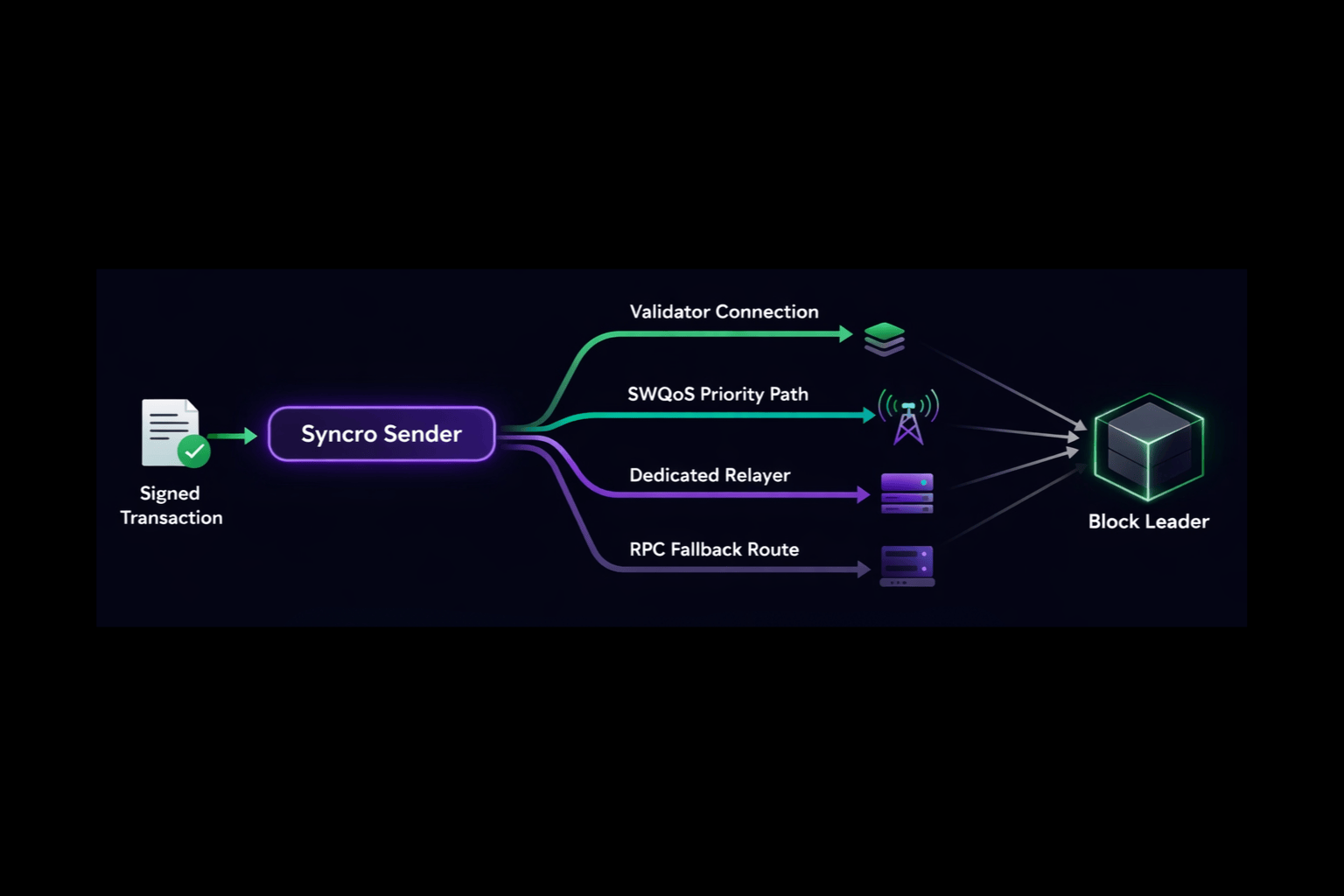
Instead of relying on a single submission path, Syncro Sender routes transactions through multiple validator-level connections simultaneously, increasing the probability of fast and reliable inclusion.
By leveraging stake-weighted QoS (SWQoS) priority routing and validator-level infrastructure, Syncro Sender gives transactions access to priority bandwidth during network congestion.
How Syncro Sender Works
Solana transaction landing via multi-path validator routing with Syncro Sender
When a transaction is submitted, Syncro Sender:
routes through validator-level connections
leverages SWQoS priority routing
distributes across multiple parallel paths
delivers to current and upcoming leaders
Whichever path reaches the leader first lands the transaction.
This architecture is purpose-built for Solana transaction landing, where speed and reliability determine execution outcomes.
Why This Matters for Trading Teams
Improving Solana transaction landing has direct economic impact:
1. Higher capture rate
More transactions land in the earliest possible slot, increasing the probability of capturing time-sensitive opportunities.
2. Lower effective cost
Reliable landing reduces wasted priority fees on failed or late transactions.
3. Simplified infrastructure
Teams can reduce retry logic, fallback endpoints, and monitoring overhead by relying on a single optimized submission layer.
Built for Fast Integration
Syncro Sender integrates directly into your existing workflow.
no changes to signing logic
no key exposure
REST supported
Add Syncro Sender as a submission endpoint and start improving Solana transaction landing within minutes.
Global Infrastructure
Endpoints are deployed across Amsterdam, Frankfurt, New York, London, Tokyo, and Singapore.
This ensures transactions are routed through the lowest-latency path to validators, improving Solana transaction landing regardless of where your systems are located.
Pricing Designed for Execution
Syncro Sender uses a per-transaction model:
pay only when a transaction lands
no subscriptions
no upfront commitment
no cost for failed or late transactions
Introductory period: 0.0001 SOL per landed transaction (first month)
Standard pricing: 0.001 SOL per landed transaction
This allows teams to benchmark Solana transaction landing performance in production with minimal risk.
Start Testing Today
For teams already using other providers, Syncro Sender is not necessarily a replacement. It’s an additional execution path.
Most trading teams run multiple senders in parallel.
Add Syncro Sender, compare Solana transaction landing performance on real flow, and evaluate results directly.
<h3 id="at-a-glance"><strong>At a Glance:</strong></h3><ul><li>Institutions assess HYPE through market structure, custody, and operational readiness</li><li>Assets are held in custody with Komainu, enabling custody-native participation</li><li>P2P.org operates validator nodes within Hyperliquid’s active validator set</li><li>A selective operator model and clear role separation signal institutional maturity</li></ul><p>Institutional participation in crypto rarely starts with incentives. It starts with systems.</p><p>When institutions evaluate a new asset or protocol, the questions are usually straightforward and unforgiving. How does the market behave under stress? Where do assets sit operationally? Who is responsible for running critical infrastructure?</p><p>HYPE is increasingly being evaluated through this lens.</p><p>Rather than optimizing for short-term participation, Hyperliquid has focused on building a system designed to operate consistently at scale.For institutions, that distinction matters. Market structure, custody integration, and operational discipline tend to determine whether engagement is even possible.</p><h2 id="why-hype-is-drawing-institutional-attention"><strong>Why HYPE Is Drawing Institutional Attention</strong></h2><p>HYPE’s relevance is closely tied to Hyperliquid’s position as a leading <strong>perpetuals-native decentralized exchange</strong>.</p><p>Perpetuals (or perps) are widely used derivatives instruments in crypto markets. They allow market participants to maintain exposure to underlying assets without fixed expiry dates and are commonly used by trading firms and liquidity providers.</p><p>For institutions, this matters for two reasons:</p><p>First, perps are a <strong>crypto-native market structure</strong> that has proven sustained demand across market cycles. Second, decentralized perps infrastructure reduces reliance on centralized intermediaries while preserving market efficiency, a combination that is attracting growing interest from professional trading firms.</p><p>Hyperliquid’s focus on performance, market structureand system design has positioned HYPE as a core asset within this category. As institutional interest in crypto-native derivatives grows, perps DEXs are becoming an important access point, with HYPE emerging as a leading example.</p><p><em>Note: This section provides market context regarding the Hyperliquid ecosystem. P2P.org does not operate the Hyperliquid exchange, facilitate derivatives trading, or provide trading services.</em></p><h2 id="what-institutions-evaluate-before-engaging"><strong>What Institutions Evaluate Before Engaging</strong></h2><p>Before capital is allocated, institutions typically look for a small set of non-negotiables, such as:</p><p><strong>Market structure that can absorb size: </strong>Institutions care about how a system behaves when volumes increase, volatility spikes, or usage becomes sustained rather than episodic. HYPE’s design choices reflect an emphasis on efficiency, transparency, and consistency under load.</p><p><strong>Custody-native workflows: </strong>Assets are expected to remain under qualified custody. Any interaction with a protocol must integrate cleanly with existing custody, governance, and risk frameworks. Workflows that require assets to move outside custody introduce friction and operational risk.</p><p><strong>Proven infrastructure operators: </strong>Validator and staking operations are not interchangeable. Institutions look for operators with a operational experience and monitoring discipline, monitoring discipline, and experience operating infrastructure at scale.</p><p>If one of these elements is missing, engagement usually stops there.</p><h2 id="custody-as-the-foundation"><strong>Custody as the Foundation</strong></h2><p>For institutions, custody is typically the foundation everything else is built on.</p><p>In the HYPE ecosystem, assets are held in custody with Komainu an institutional-grade digital asset custodian supporting regulated funds, asset managers, and financial institutions.</p><p>Komainu’s custody framework allows institutions to engage with blockchain networks while maintaining segregation of assets, governance controls, and operational oversight. This enables participation without compromising custody.</p><p>In practical terms, this means staking activity can occur without assets leaving Komainu custody.</p><p> </p><h2 id="how-infrastructure-and-custody-work-together"><strong>How Infrastructure and Custody Work Together</strong></h2><p>Custody alone is not sufficient. Institutions also require secure infrastructure that can operate reliably within these constraints.</p><p>Within Hyperliquid’s active set of [nodes or validators], P2P.org operates validator infrastructure while assets remain secured under Komainu custody. Each party plays a clearly defined role.</p><p>In practice:</p><ul><li>Assets remain under Komainu custody at all times</li><li>P2P.org operates and maintains staking infrastructure within Hyperliquid’s active set</li><li>Monitoring, performance, and operational processes are designed for institutional standards</li><li>Custody, infrastructure, and protocol responsibilities remain cleanly separated</li></ul><p>This separation of roles reduces operational risk and increases transparency.</p><figure class="kg-card kg-image-card"><img src="https://p2p.org/economy/content/images/2026/03/1080x1080-8.jpg" class="kg-image" alt="" loading="lazy" width="1080" height="1080" srcset="https://p2p.org/economy/content/images/size/w600/2026/03/1080x1080-8.jpg 600w, https://p2p.org/economy/content/images/size/w1000/2026/03/1080x1080-8.jpg 1000w, https://p2p.org/economy/content/images/2026/03/1080x1080-8.jpg 1080w" sizes="(min-width: 720px) 720px"></figure><p></p><h2 id="selectivity-signals-operational-intent"><strong>Selectivity Signals Operational Intent</strong></h2><p>Another signal institutions pay close attention to is selectivity.</p><p>Rather than allowing an unrestricted validator set, Hyperliquid maintains a curated active set of operators. Participation depends on infrastructure quality, reliability, and the ability to meet institutional standards.</p><p>P2P.org has experience operating more than $10B in secured assets across over 190 institutional clients. P2P.org’s presence in Hype‘s active validator set reflects its high standard of infrastructure discipline</p><p>On the custody side, Komainu’s support positions it among a small group of custodians enabling institutional access to HYPE today, an important factor for institutions evaluating new participation.</p><h2 id="infrastructure-as-a-prerequisite-for-institutions"><strong>Infrastructure as a Prerequisite for Institutions</strong></h2><p>Custody-native integration, a selective operator set, and production-grade operational processes are indicators that a protocol is being built for durability rather than short-term activity spikes.</p><p>HYPE’s growing institutional attention reflects these underlying choices. Rather than relying on incentives to attract participation, the ecosystem aligns with how institutions actually operate.</p><p>As institutional engagement with crypto continues to deepen, protocols that prioritize custody, operational clarity, and infrastructure quality are more likely to see sustained participation over time.</p><h2 id="learn-more"><strong>Learn More</strong></h2><p>For institutions exploring custody-native participation in the HYPE ecosystem, understanding how custody and infrastructure fit together is essential.</p><ul><li>Learn more about <strong>Komainu</strong> and its institutional custody framework: <a href="https://komainu.com/?ref=p2p.org">https://komainu.com/</a></li><li>For platforms, wallets, or infrastructure teams looking to integrate HYPE staking data, explore <strong>P2P.org’s Staking API</strong>: <a href="https://link.p2p.org/acce38?ref=p2p.org">https://link.p2p.org/acce38</a></li></ul>
 ALL
Agoric
Aptos
Auth
Avail
Avalanche
Axelar
Babylon
Bitcoin
BTC
Cardano
Celestia
Chainlink
Cosmos
Crescent
Cyberway
DAOBet
DeFi
DVT
Dymension
Economy
Education
EigenLayer
Elrond
Ethereum
Evmos
Explain Like I'm Five
Guide
HR
infrastructure
Kava
Kusama
Lido
LSP
Manta
Mantle
Marlin
Matic
Moonbeam
MultiversX
Near
News
NuCypher
Oasis
Origin
Partnership
Persistence
playbook
Pocket
Polkadot
Polygon
products
Quicksilver
Regen
Renzo
restaking
RPC Node
Serum
slashing
Solana
SSV.Network
Staking
Starknet
Sui
symbiotic
syncro sender
Terra
Tezos
TheGraph
Threshold
Update
validator
Vara
Vega
ALL
Agoric
Aptos
Auth
Avail
Avalanche
Axelar
Babylon
Bitcoin
BTC
Cardano
Celestia
Chainlink
Cosmos
Crescent
Cyberway
DAOBet
DeFi
DVT
Dymension
Economy
Education
EigenLayer
Elrond
Ethereum
Evmos
Explain Like I'm Five
Guide
HR
infrastructure
Kava
Kusama
Lido
LSP
Manta
Mantle
Marlin
Matic
Moonbeam
MultiversX
Near
News
NuCypher
Oasis
Origin
Partnership
Persistence
playbook
Pocket
Polkadot
Polygon
products
Quicksilver
Regen
Renzo
restaking
RPC Node
Serum
slashing
Solana
SSV.Network
Staking
Starknet
Sui
symbiotic
syncro sender
Terra
Tezos
TheGraph
Threshold
Update
validator
Vara
Vega