Every Solana transaction sender promises speed. Few explain where that speed actually comes from.
Solana transaction landing is about speed. But speed is not just how fast a transaction is sent. It depends on how transactions are routed through staked validator paths that give your flow priority bandwidth to the block leader, before competing with everyone else.
The difference is not small. It determines whether a transaction lands or misses entirely.
The Hidden Bottleneck Behind Solana Transaction Landing
When a transaction is submitted on Solana, it is sent toward the block leader. But how it gets there determines whether it lands.
Transactions are forwarded by RPC nodes to the current and upcoming leaders via TPU and QUIC. However, routing conditions such as bandwidth, prioritization, and connection quality define the result.
Two transactions submitted at the same time can produce very different outcomes depending on how they are routed.
This is where Solana transaction landing performance is decided.
Why Public RPC Infrastructure Limits Solana Transaction Landing
Public RPC endpoints are designed for accessibility, not execution performance. They introduce structural limitations that affect Solana transaction landing speed.
1. Limited routing paths
Public RPC nodes forward transactions to leaders, but through a constrained set of routes. If those paths are congested, transactions arrive later than competing flow.
2. Shared infrastructure
Traffic from thousands of users competes for the same resources. There is no prioritization for execution-critical transactions.
3. Unstaked bandwidth
Public RPC nodes forward transactions through connections without stake backed priority. This limits bandwidth and increases delays during periods of high demand.
For general usage, this is sufficient. For trading, arbitrage, and liquidations, this becomes a limiting factor.
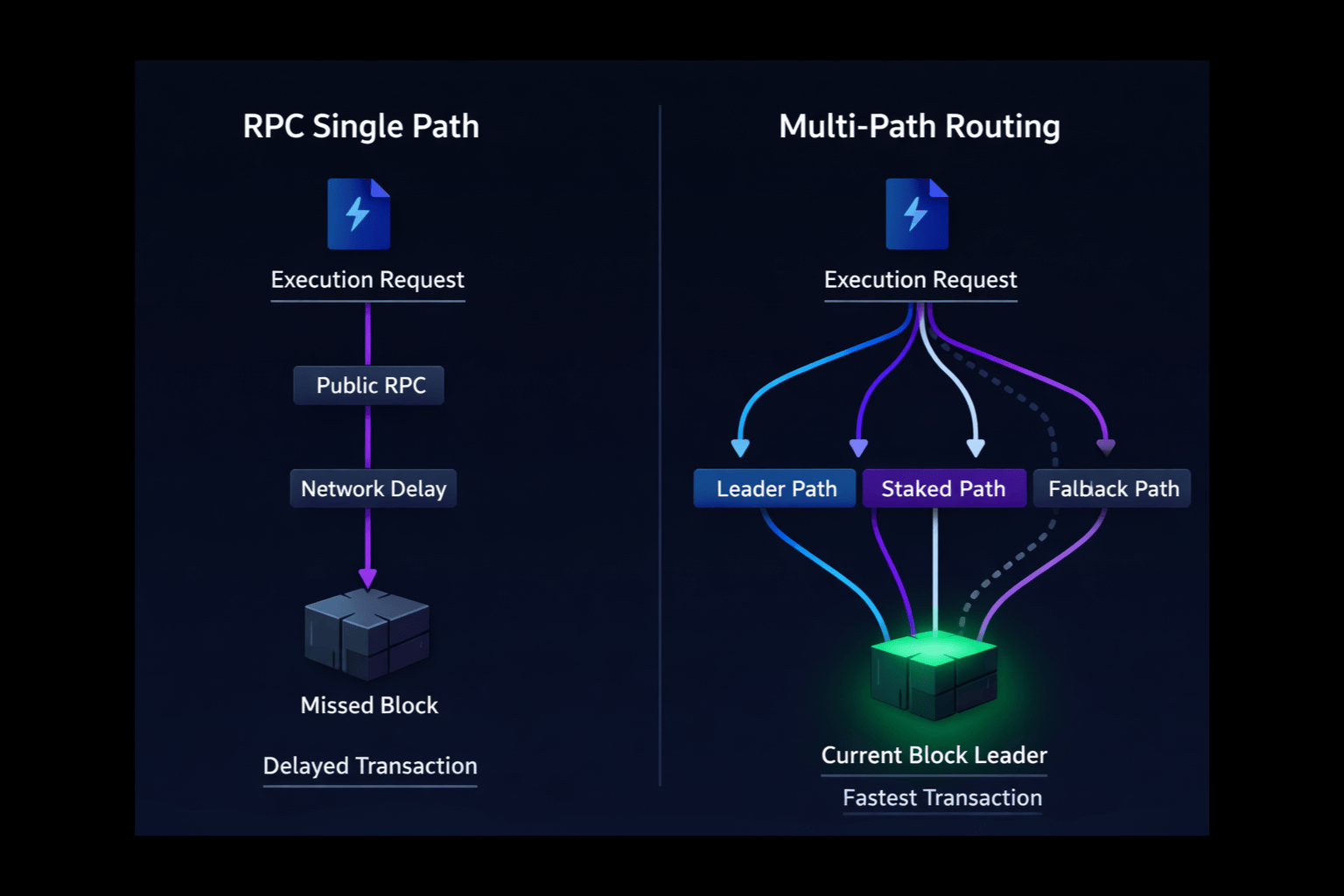
Solana transaction landing comparison between RPC single path and multi path validator routing
Solana Transaction Landing Speed Comes From Routing
The key idea is simple.
Solana transaction landing speed is determined by routing, not just submission latency. Infrastructure must:
route through high-priority paths
reduce contention with shared traffic
reach the leader through optimal connections
increase delivery probability under congestion
This is a network design problem. Not an API problem.
transactions routed through them reach validators faster
during congestion, this advantage becomes decisive
SWQoS is a critical factor in Solana transaction landing, especially for execution focused teams. Transactions submitted through unstaked public RPCs compete at a structural disadvantage.
Network Proximity and Transaction Landing
Latency still matters, but not only in geographic terms. Network proximity defines performance:
direct validator connections
optimized routing paths
fewer intermediaries
Even small differences in latency can determine whether a transaction lands in the first slot or misses the opportunity entirely. Learn more about how Solana's validator architecture affects transaction delivery.
Multi-Path Routing and Execution Reliability
Relying on a single route assumes that the path will succeed. In practice, this is not reliable.
Multi-path routing improves Solana transaction landing by sending transactions through multiple routes simultaneously:
current leader
upcoming leader
validator level paths
fallback connections
The first successful path determines the outcome. This improves consistency and landing probability, especially during congestion.
From Infrastructure to Execution Results
Improving Solana transaction landing requires a Solana sender built with the right infrastructure: one that uses Stake Weighted QoS-enabled paths, routes through validator-level connections, minimizes delays and contention, and supports multi-path delivery.
Without this, execution strategies are limited by infrastructure performance. Syncro Sender is a Solana sender built specifically for execution critical workflows, using validator-level routing and multi-path delivery to reach the block leader first.
For execution focused teams, this changes how infrastructure should be evaluated.
Instead of asking: How fast is the endpoint?
The better question is: How are transactions routed, and do they have priority access?
Apply This to Your Own Transaction Flow
If you are running execution critical workflows on Solana, speed is only part of the equation. The real question is how that speed is achieved.
Test Syncro Sender alongside your current setup and compare Solana transaction landing performance using real transaction flow. You can get started in minutes via the quick start documentation.
Takeaway
On Solana, speed defines execution.
But speed does not come from sending faster.
It comes from routing smarter.
That is what defines Solana transaction landing.
FAQ Section
What is the Solana transaction landing?
Solana transaction landing refers to whether a submitted transaction successfully reaches the block leader and is included in a block. It is the key metric that determines execution success on Solana.
Why do Solana transactions fail to land?
Solana transactions fail to land when they arrive too late to the block leader or lose priority against competing transactions. This is often caused by congestion, limited routing paths, or insufficient priority bandwidth.
What affects Solana transaction landing speed?
Solana transaction landing speed is affected by routing paths, validator connections, network congestion, and whether the transaction is sent through a Solana sender with Stake Weighted QoS-enabled infrastructure.
Does public RPC affect transaction landing on Solana?
Yes. Public RPC infrastructure can limit Solana transaction landing performance due to shared bandwidth, limited routing paths, and a lack of stake-backed priority connections.
What is Stake-Weighted QoS in Solana?
Stake-weighted Quality of Service is a mechanism that prioritizes traffic based on validator stake. Transactions routed through staked connections receive higher priority and are more likely to reach the block leader faster.
Why is routing important for Solana transaction landing?
Routing determines how quickly and reliably a transaction reaches the block leader. Even if two transactions are submitted simultaneously, the one with the better routing will be processed first.
What is multi-path routing in Solana?
Multi-path routing is the practice of sending a transaction through multiple validator routes simultaneously. This increases the probability that at least one path reaches the leader early.
How can I improve Solana transaction landing performance?
To improve Solana transaction landing, use a Solana sender that provides validator-level routing, stake-weighted QoS access, optimized network proximity, and multi-path delivery, such as Syncro Sender by P2P.org.
Subscribe to P2P-economy
Get the latest posts delivered right to your inbox
<p>The past two weeks have brought several developments across DeFi markets, staking infrastructure, and crypto financial products.</p><p>From stablecoin narratives evolving in public discourse to ETF structures integrating staking mechanics, the latest <strong>DeFi news</strong> continues to show how blockchain infrastructure is becoming increasingly embedded into broader financial systems.</p><p>This edition highlights five developments shaping how capital interacts with decentralized networks.</p><p>👉 <strong>Subscribe (at the bottom of the page) to receive DeFi Dispatch</strong> and stay updated on the latest DeFi news and market signals.</p><h2 id="quick-learning-for-busy-readers"><strong>Quick Learning for Busy Readers</strong></h2><ul><li>Stablecoins continue emerging as core infrastructure for global crypto liquidity</li><li>Staking is increasingly being discussed in the context of financial products</li><li>ETF structures are evolving to integrate blockchain-native mechanics</li><li>Tokenized assets remain one of the fastest-growing DeFi segments</li><li>Validator infrastructure continues supporting expanding network participation</li></ul><h2 id="missed-the-previous-defi-dispatch"><strong>Missed the previous DeFi Dispatch?</strong></h2><p>Catch up on the latest DeFi news and signals from the previous edition:</p><p>👉 <a href="https://p2p.org/economy/defi-dispatch-news-and-signals-march-2026-1/">https://p2p.org/economy/defi-dispatch-news-and-signals-march-2026-1/</a></p><h2 id="what%E2%80%99s-driving-defi-markets-this-week"><strong>What’s driving DeFi markets this week?</strong></h2><p><br>The latest DeFi news from the past two weeks reflects a clear trend: infrastructure and capital flows are becoming increasingly interconnected across staking, liquidity, and tokenized financial products.</p><p>From stablecoins reinforcing their role as liquidity rails to new financial products integrating staking mechanics, these developments highlight how DeFi markets continue evolving beyond isolated use cases.</p><p>Below, we break down five key developments and why they matter for participants across crypto markets.</p><h3 id="1-stablecoins-are-becoming-a-core-crypto-resource"><strong>1. Stablecoins Are Becoming a Core Crypto Resource</strong></h3><p><a href="http://p2p.org/?ref=p2p.org">P2P.org</a>’s VP of Institutions, Artemiy Parshakov, recently shared insights on the evolving role of stablecoins, highlighting how they are increasingly functioning as a foundational resource across crypto markets.</p><p>The discussion emphasizes how stablecoins are no longer just a trading tool but a key infrastructure layer enabling liquidity, settlement, and capital movement across decentralized systems.</p><p><strong>Source:</strong> Cointelegraph</p><p><strong>Why is this important?</strong></p><p>Stablecoins underpin a large portion of DeFi activity, acting as:</p><ul><li>settlement layers</li><li>liquidity bases</li><li>collateral assets</li></ul><p>As stablecoins grow, they reinforce the importance of reliable blockchain infrastructure and validator participation to support transaction execution and settlement.</p><h3 id="2-blackrock-advances-ethereum-etf-with-staking-component"><strong>2. BlackRock Advances Ethereum ETF With Staking Component</strong></h3><p>BlackRock continues advancing its Ethereum ETF structure, which may include staking participation for a portion of the fund’s holdings.</p><p>This reflects a broader trend in which traditional financial products are incorporating blockchain-native mechanics, such as staking.</p><p><strong>Source:</strong> Reuters</p><p><strong>Why is this important?</strong></p><p>This development highlights how:</p><ul><li>staking is entering regulated financial structures</li><li>blockchain infrastructure is intersecting with traditional markets</li><li>validator participation becomes indirectly linked to financial products</li></ul><p>It also raises questions around how staking will be treated within regulatory frameworks.</p><h3 id="3-ethereum-staking-participation-remains-strong"><strong>3. Ethereum Staking Participation Remains Strong</strong></h3><p>Recent on-chain data shows continued growth in Ethereum staking participation, with increasing amounts of ETH being committed to validator infrastructure.</p><p>This reflects ongoing confidence in proof-of-stake mechanics and long-term network participation.</p><p><strong>Source:</strong> Glassnode - Ethereum staking metrics</p><p><strong>Why is this important?</strong></p><p>Growing staking participation:</p><ul><li>strengthens network security</li><li>increases reliance on validator infrastructure</li><li>reflects long-term capital allocation within crypto markets</li></ul><p>Validator performance and reliability remain critical as participation scales.</p><h3 id="4-tokenized-assets-continue-expanding-across-defi"><strong>4. Tokenized Assets Continue Expanding Across DeFi</strong></h3><p>Tokenized real-world assets continue gaining traction, with more protocols exploring tokenized treasuries, credit instruments, and on-chain financial products.</p><p>This trend is attracting attention from asset managers and crypto-native funds.</p><p><strong>Source:</strong> CoinShares – Digital asset research report</p><p><strong>Why is this important?</strong></p><p>Tokenization introduces:</p><ul><li>programmable financial assets</li><li>new forms of on-chain liquidity</li><li>integration between traditional and decentralized finance</li></ul><p>As adoption grows, the reliability of underlying blockchain infrastructure becomes increasingly important.</p><h3 id="5-stablecoin-supply-growth-reinforces-defi-liquidity"><strong>5. Stablecoin Supply Growth Reinforces DeFi Liquidity</strong></h3><p>Stablecoin supply continues expanding across major blockchain ecosystems, reinforcing their role as the primary liquidity layer within DeFi.</p><p>Stablecoins remain central to trading, lending, and cross-protocol interactions.</p><p><strong>Source:</strong> CoinMetrics – Stablecoin supply data</p><h3 id="why-is-this-important">Why is this important?</h3><p>Stablecoin growth:</p><ul><li>increases liquidity across DeFi markets</li><li>enables capital movement between protocols</li><li>supports broader ecosystem activity</li></ul><p>This reinforces the importance of scalable and reliable blockchain networks.</p><h2 id="frequently-asked-questions"><strong>Frequently Asked Questions</strong></h2><h3 id="why-is-defi-news-relevant-for-staking-participants"><br><strong>Why is DeFi news relevant for staking participants?</strong></h3><p>DeFi news provides signals about how capital flows through blockchain ecosystems. These flows influence staking participation, network activity, and validator demand.</p><h3 id="are-staking-rewards-fixed"><strong>Are staking rewards fixed?</strong></h3><p>No. Rewards are determined by the underlying protocol and network conditions. They vary depending on validator participation and are not guaranteed.</p><h3 id="why-are-stablecoins-so-important-in-defi"><strong>Why are stablecoins so important in DeFi?</strong></h3><p>Stablecoins act as the primary settlement layer across DeFi. They enable liquidity, trading, and lending without requiring exposure to volatile crypto assets.</p><h3 id="how-does-tokenization-impact-defi-markets"><strong>How does tokenization impact DeFi markets?</strong></h3><p>Tokenization allows traditional assets to be represented on-chain, enabling programmable settlement and integration with DeFi protocols.</p><h2 id="key-takeaways-for-crypto-investors-funds-custodians-exchanges-and-staking-teams"><strong>Key Takeaways for Crypto Investors, Funds, Custodians, Exchanges, and Staking Teams</strong></h2><p>The latest DeFi news highlights several important trends:</p><ul><li>stablecoins continue strengthening their role as DeFi infrastructure</li><li>staking is increasingly integrated into financial products</li><li>validator infrastructure remains central to network operations</li><li>tokenized assets are expanding rapidly</li><li>DeFi markets continue evolving toward broader financial integration</li></ul><p>These developments reinforce how decentralized finance is maturing as an infrastructure layer supporting digital asset markets.</p><p>👉 <strong>Subscribe to DeFi Dispatch and Legal Layer</strong> to stay updated on the latest DeFi news, staking developments, and market signals.</p>
 ALL
Agoric
Aptos
Auth
Avail
Avalanche
Axelar
Babylon
Bitcoin
BTC
Cardano
Celestia
Chainlink
Cosmos
Crescent
Cyberway
DAOBet
DeFi
DVT
Dymension
Economy
Education
EigenLayer
Elrond
Ethereum
Evmos
Explain Like I'm Five
Guide
HR
infrastructure
Kava
Kusama
Lido
LSP
Manta
Mantle
Marlin
Matic
Moonbeam
MultiversX
Near
News
NuCypher
Oasis
Origin
Partnership
Persistence
playbook
Pocket
Polkadot
Polygon
products
Quicksilver
Regen
Renzo
restaking
RPC Node
Sender
Serum
slashing
Solana
SSV.Network
Staking
Starknet
Sui
symbiotic
Syncro
syncro sender
Terra
Tezos
TheGraph
Threshold
Update
validator
Vara
Vega
ALL
Agoric
Aptos
Auth
Avail
Avalanche
Axelar
Babylon
Bitcoin
BTC
Cardano
Celestia
Chainlink
Cosmos
Crescent
Cyberway
DAOBet
DeFi
DVT
Dymension
Economy
Education
EigenLayer
Elrond
Ethereum
Evmos
Explain Like I'm Five
Guide
HR
infrastructure
Kava
Kusama
Lido
LSP
Manta
Mantle
Marlin
Matic
Moonbeam
MultiversX
Near
News
NuCypher
Oasis
Origin
Partnership
Persistence
playbook
Pocket
Polkadot
Polygon
products
Quicksilver
Regen
Renzo
restaking
RPC Node
Sender
Serum
slashing
Solana
SSV.Network
Staking
Starknet
Sui
symbiotic
Syncro
syncro sender
Terra
Tezos
TheGraph
Threshold
Update
validator
Vara
Vega