Seven Months Into 2026: What's Actually Driving Solana's Institutional Momentum
For institutional allocators, validator diligence, and treasury & risk teams
TL;DR
• No network-wide outages in Q2, and Alpenglow's move to live testing puts sub-second finality within reach of mainnet.
• Institutional adoption is happening: MoneyGram is now a validator, Baillie Gifford issued a tokenized fund on Solana, and Open USD, a 140+ member consortium including Visa, Mastercard, and BlackRock, chose Solana for native issuance.
• The validator set thinned from about 774 to about 713 as the Foundation wound down delegation subsidies, while network gross rewards declined from about 6.6 % to about 6.1 %.
• All three P2P.org public validators beat the network skip rate every month of Q2, with rewards reported down to the individual stake account.
• The remaining blocker for institutional capital isn't the chain. It's internal - data an allocator can defend to a risk committee, investment mandates that haven't caught up, and where DeFi fits inside a compliance boundary.
A note from the P2P.org Solana team
Picture the chain you'd design if institutional money was the only client you had to satisfy:
Sub-second finality, so on-chain execution sits next to a centralized venue rather than behind it.
Tens of thousands of transactions per second at a fraction of a cent, so payments and treasury flows hold up at scale.
RWAs and tokenized funds from names your investment committee already knows.
A 140+ member bank-and-card consortium choosing it as the home for native issuance of a regulated stablecoin.
Mid-single-digit native staking rewards, a mature and separately reportable MEV layer, and unbonding in days rather than weeks, all of it verifiable on-chain down to the position.
That isn't a design exercise. It's Solana, live, today. P2P.org has been validating on it since the beginning, and this comes from that inside seat: the case for moving now is stronger than it's been at any point since.
A year ago, institutional delegators were asking whether Solana was reliable enough to process serious capital. Two quarters into 2026, that debate has gone quiet, not because the arguments changed, but because the evidence to support Solana's emergence as a keystone of the Web3 financial ecosystem has become undeniable: Alpenglow has sub-second finality in live testing, MoneyGram is now an active Solana validator, Baillie Gifford has issued a tokenized bond fund natively on the network, and Open USD, a 140+ member consortium including Visa, Mastercard, and BlackRock, chose Solana for native issuance from day one. Meanwhile, reward compression and MEV maturing into a standard, reportable part of the rewards have settled the question of whether the operational lift was worth it.
Everything above happened in Q2. Taken together, it's not a quiet quarter; it's the foundation the second half of the year gets built on. The real test now isn't whether the network works - It's who you trust to operate on it, and whether you can defend the numbers to a risk committee looking for data it can independently verify, not just take on the operator's word.
What the ecosystem is telling enterprises
Regulated products are already live on Solana - At Accelerate in May, State Street and Galaxy launched a tokenized cash fund, and Securitize, Jump, and Jupiter launched regulated tokenized-equity trading. Execution quality is now measured against centralized venues that enterprises already work with.
Regulated payment players are already testing - South Korea's Toss Bank signed a memorandum of understanding with the Solana Foundation in June to pilot stablecoin-based cross-border remittances for its 15 million customers. It's an early-stage pilot, not a live product yet, but a concrete signal of where a regulated payments player is choosing to run its first test.
Solana is already being picked as a settlement layer - Open USD picked it for native issuance from day one; when a money-movement consortium this size picks a first chain, treasury and payments flows tend to follow it.
Latency and finality no longer raise concerns - Alpenglow's move to a live test cluster puts finality on a path from about 12.8 seconds to about 100 to 150 milliseconds, orders of magnitude faster than the T+1/T+2 settlement institutions live with today, and quick enough that settlement stops constraining execution.
And the last point is, headline rewards don't tell you much anymore - The validator set is consolidating, and network rewards are compressing, so basis points and reward-type mix are what actually separate operators now, not a single APY number.
The Q2 network backdrop
Solana had no network-wide outages in Q2, worth stating plainly, since reliability was the objection a year ago. The staking ratio held steady at about 67%. At the same time, the validator set thinned from about 774 to about 713. Vote fees stayed fixed while total validator rewards compressed, and the broader drop in SOL price added further pressure, together pricing out the smallest operators, so the same stake now sits with fewer, better-resourced operators.
What happened to rewards, and why
None of this is a surprise. Solana's issuance schedule is programmed to decline over time, and Q2's numbers are simply that schedule playing out. Three numbers describe Solana rewards, and they're easy to confuse:
• The staking rate, the inflation-based reward most people quote, eased from about 5.9 % to about 5.5 % across the network.
• Total gross rewards, what a validator actually produces once block rewards (base and priority transaction fees) and MEV Jito Tips are added on top, range from about 6.6 % to about 6.1 %.
• Net of about 3.8 % inflation, real staking rewards hovered at approximately 1.7 to 1.9 %
The compression numbers also break down cleanly:
• Base (inflation): around 5.9 % to about 5.5 %. This is the biggest driver, and by design - issuance is programmed down towards a 1.5 % terminal rate, and with roughly two-thirds of supply staked, that shrinking issuance is split across more SOL.
• Block rewards: about 0.45 percent to about 0.42 percent, a smaller decline, tracking the quarter's lower fee activity.
• Jito MEV: about 0.10 % to about 0.13 %, the one component that actually grew.
So the shrinking part of rewards is the programmed, network-wide base, identical for everyone. The variable part is two things. Block rewards - base and priority transaction fees - go to the block producer today (base fees are half-burned; in-protocol sharing of priority fees with stakers, SIMD-123, is expected with Alpenglow). MEV Jito Tips are earned by the validator's work but never sits under its control: tips accumulate in smart-contract-controlled Tip Distribution Accounts (TDA) and are paid out on-chain to stakers' stake accounts (via Jito Tip Router NCN operations), net of the validator's MEV commission. So how much of this layer reaches you depends on the operator only through what it actually controls - whether it runs Jito, and the commission it sets. As the base shrinks by design, that operator-dependent layer is increasingly where returns are won or lost. Whatever gap is left comes down to the operator.
Solana's Biggest Upgrade Yet Is Coming. Here's Where We Stand
Alpenglow will rewrite Solana's consensus. Sub-second finality, new validator economics, and a faster network are landing over the coming quarters. Operators who've already invested in this infrastructure stand to benefit most from that transition.
That drop in finality time also opens the door to application categories that a 12.8-second settlement window simply couldn't support: high-frequency DeFi, real-time on-chain gaming, and payments that settle as fast as they're sent.
P2P.org's Q2 performance is evidence that our validators are already built for what Alpenglow requires. The full P2P.org Solana Staking Performance Snapshot is published here. Operator quality is the differentiator now.
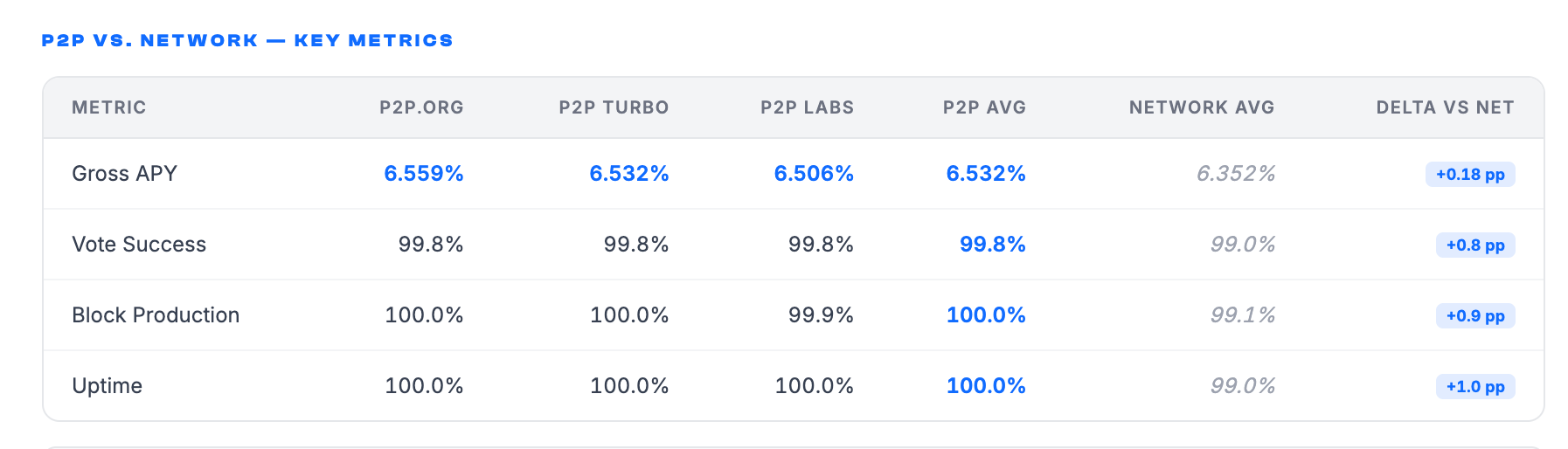
Across Q2, all three P2P.org public validators beat the network skip rate every month, and gross rewards held above the compressing network baseline, with Jito MEV settling into a stable, reportable share of rewards. The full, auditable breakdown, by validator and reward type, lives on our public Gross APY dashboard, so any figure can be checked independently rather than taken on trust.
What this means for enterprises and Validators
The binding constraint on institutional Solana today is the allocator's own internal process. On June 30, P2P.org hosted a panel with the Solana Foundation, a global market maker, a European research desk, and a regulated digital asset bank. The friction they named wasn't custody or infrastructure. It was three things:
Data you can defend - The same on-chain metric can differ by billions depending on methodology; the Foundation itself acknowledges there's no single source of truth.
Investment mandates - Many of the largest capital pools still can't hold crypto directly. What's moving is the flexible capital: crypto-native funds, family offices, HNW allocators.
The DeFi compliance line - Native staking is trusted; a liquid-staking layer complicates how frameworks think about systemic risk.
In practice, the timing depends on internal committees and policy, not on the market.The chain-level objections are closing, so what's actually slowing participation now is internal process. That gives an edge to enterprises that start the internal process now, and to the operator that makes their diligence and reporting straightforward.
Of the three blockers, data is the one that's actually urgent right now. An allocator can't sign off on a reward number it can't reconcile, and "just trust us" doesn't get past a risk committee.
This is where running your own data layer stops being a nice-to-have. We built our own on-chain data collectors instead of reselling someone else's feed, so the numbers hold up: the gross APYs methodology is public, and the dashboards break rewards down to each individual stake account going back more than three years. A client can check our performance themselves instead of taking our word for it. Mandates are the allocator's problem to solve; the data is ours, and we've done the work.
What's changed is that we're not the only ones pushing on it anymore. The Foundation has taken the problem seriously — open-sourcing its data sources and getting providers to reconcile their numbers against each other. For the first time there's a real shot at fixing this across the whole network, not one operator at a time.
What Else Happened in Q2
DoubleZero: distribution stops being a penalty
Solana's stake used to cluster in Europe, since running a validator elsewhere carried infrastructure complications with little economic upside to offset them. DoubleZero's Phase II delegation program changed that math - it incentivizes operators to move into locations like São Paulo, Singapore, Hong Kong, and Tokyo, making it economically viable for the first time to strengthen decentralization, performance, and validator economics outside the European core. P2P.org was among the first operators onboarded, moving part of its public infrastructure to São Paulo, a region where the network had a real latency gap. Latency was the reason we made the move. The incentive made the move financially worthwhile - and, for the first time, made it economically viable to stand up and test our infrastructure in regions that never penciled out before. Latency gains are still being measured, but the strategic upside is already clear: capacity in these regions is a win for decentralization - and, just as directly, for institutions that operate there and treat in-region validator infrastructure as a selection criterion in its own right (data residency, jurisdiction, latency close to home).
Epoch-based liquidity activation
An institutional treasury shouldn't have to wait for a monthly or quarterly reporting cycle to put its staking rewards to work. In Q2, P2P.org rolled out a capability that lets stakers activate staking rewards epoch by epoch, on the network's own close-to-2-day cadence, rather than on a fixed reporting period. For an institution, that means liquidity on demand rather than on a calendar, cleaner reconciliation, and far less dependence on when a reporting window happens to close.
DeFi utility for native stakers, a category we're watching
The institutions that delegate to us have grown comfortable with vanilla staking, and the natural next question is what else that stake can do. So far, most stop at the DeFi door. H1's exploits, most at the application layer, made the risk feel unbounded. And the usual on-ramp — a pooled liquid staking token — spreads the delegation across a basket of validators and wraps it in a protocol of its own, a trade many treasuries can't make. We want to give our stakers a way through that door that doesn't ask them to give up native staking to take it.
The opening is that a staker who's already delegated to us has made the hard decision — it chose an operator. The path we're building reuses that decision instead of replacing it. The same delegation — same validator, still earning — is wrapped by the SPL Single-Validator Stake Pool, a canonical first-party Solana program (three external audits, zero fees, no admin, one vote account per pool, no restaking) into a single-validator staking token whose value accrues with that one validator's rewards. That token is what the staker posts as collateral, in a single venue, to borrow against.
The smart-contract risk doesn't disappear though — what sits on the book is now a token, not a stake account the client controls directly. But it's a smaller, more legible surface than the pooled-LST route: the stake stays delegated exactly where they chose, the yield is one validator's rewards — no basket to attribute, no restaking layer in between — and the wrapper is a canonical, audited Solana program rather than a governance-heavy protocol. The one genuinely new surface is the lending venue itself: a single venue a risk team can actually clear.
And it puts the decision back where it belongs — on the operator. Once the position is native stake delegated to a named validator, choosing that validator becomes a credit decision, not a rate comparison. Clearing that bar takes the full operator stack: hardened infrastructure, the automation layered on top, and rewards data resolved to the individual stake account across years of history. That's why the DeFi utility we're watching is a category we can actually help our stakers into.
Solana Staking for Institutions: A Validator Due Diligence Checklist
Institutional allocators evaluating Solana staking tend to weigh the same handful of priorities, (and reward rate usually isn't at the top of the list):
• Track record and tenure operating validator infrastructure
• Identity, reputation, and transparency of the node operator
• SOC 2 Type II attestation
• Non-custodial architecture and clear segregation of client-controlled assets
• Reward reporting granularity - consensus rewards separated from MEV and other reward types, for tax and reconciliation purposes
• Historical skip rate and uptime relative to the network average
• Transparency and auditability of performance data, including a public, documented methodology
• Operational resilience - geographic distribution and dedicated network infrastructure
What could lie ahead…
P2P.org has been validating on Solana since its early days. The commitment to the technology was there from the start, and now that conviction is pointed at internet capital markets, since that's where they're actually forming.
Two of this year's dominant narratives warrant a more measured assessment. While spot crypto ETFs attracted significant inflows and mainstream attention, relatively little of that capital translated into direct on-chain activity. For many institutional investment committees, ETF exposure has largely satisfied digital asset allocations, reducing the immediate need to engage with blockchain infrastructure directly.
Tokenization is also frequently overstated as a source of net-new capital. In many cases, tokenized equities and other real-world assets represent existing assets in a new digital wrapper rather than entirely new investment demand. The greater long-term opportunity lies in applications that are only possible on public blockchains, including internet-scale stablecoin settlement, real-time on-chain capital markets, and autonomous, programmable payments. Solana is already at the forefront of these use cases, leading in tokenized equity trading activity and spot DEX volume, with network usage continuing to grow despite weaker market conditions.
Another milestone is the launch of Alpenglow - it isn't on mainnet yet with live testing still ongoing, but the day it ships, Solana splits into before and after. Sub-second finality closes the latency gap with centralised venues and strengthens Solana's suitability for high performance financial applications. Yet lower latency alone is unlikely to determine institutional adoption.
As blockchain infrastructure matures, the key constraints are shifting from network performance to operational readiness. Regulatory expectations around on-chain activity continue to evolve, while security has become a critical consideration as AI increases both the sophistication and scale of cyber threats. The concentration of exploits during the first half of the year, largely at the application layer, reinforced how real that risk is across the stack.
For institutional capital to scale on-chain, infrastructure must satisfy the same standards applied to traditional financial markets: transparent reporting, robust governance, resilient operations, and independently verifiable controls. The competitive advantage will increasingly lie with providers that can demonstrate operational resilience through redundancy, continuous monitoring, incident response, and auditable compliance—not simply high network performance or a promise that nothing will ever go wrong.
P2P.org has positioned itself around these institutional requirements. Its independent, non-custodial infrastructure and SOC 2 Type II attested reflect a long-term focus on operational resilience at a time when the market for independent infrastructure providers is consolidating. As institutional participation expands, trust in the operators supporting on-chain activity is likely to become as important as the performance of the underlying blockchain itself.
Key takeaways
For institutional investors, the Solana conversation is no longer centred on whether the network is technically capable. The more important questions are who can be trusted to operate critical infrastructure, how performance is measured, and whether the underlying data can withstand internal governance and regulatory scrutiny. As staking infrastructure matures, operational resilience, transparent reporting, and consistently strong validator performance are becoming the defining differentiators - a set of criteria P2P.org has long measured itself against.
So whether you're evaluating validator operations for the first time or reassessing an existing validator relationship, talk to us today about institutional-grade Solana staking.
Disclaimer: This material is provided for informational purposes only and does not constitute investment, financial, legal, or tax advice. P2P.org accepts no liability for any actions taken based on it. Latency and performance figures referenced are estimates based on internal benchmarks and may vary depending on network conditions, geography, and client infrastructure. Past performance is not indicative of future results.
Subscribe to P2P-economy
Get the latest posts delivered right to your inbox
<h2 id="series-defi-dispatch"><strong>Series: DeFi Dispatch</strong></h2><p>DeFi Dispatch is <a href="http://p2p.org/?ref=p2p.org">P2P.org</a>'s twice-monthly roundup of DeFi developments for institutional participants navigating the intersection of traditional and on-chain finance. Each edition covers the signals that matter for asset managers, custodians, hedge funds, ETF issuers, exchanges, and staking teams operating at the frontier of institutional DeFi and proof-of-stake infrastructure.</p><p>Missed the previous edition? Catch up here: <a href="https://p2p.org/economy/defi-dispatch-defi-news-july-2026-issue-1/">DeFi Dispatch: DeFi News and Signals July 2026 (Issue 1)</a></p><div class="kg-card kg-callout-card kg-callout-card-blue"><div class="kg-callout-emoji">🗞️</div><div class="kg-callout-text"><b><strong style="white-space: pre-wrap;">Subscribe to our newsletter</strong></b> at the bottom of this page to receive a monthly summary of the latest DeFi and staking developments, curated for institutional participants.</div></div><hr><h2 id="quick-learnings-for-busy-readers"><strong>Quick Learnings for Busy Readers</strong></h2><p>Short on time? Here are the key takeaways. For the full analysis, continue reading below.</p><p>The second half of July brought five developments that institutional participants in DeFi and staking infrastructure should track closely.</p><ul><li>DTCC processed its first live production trades of tokenized stocks, ETFs, and U.S. Treasuries on July 15, 2026, backed by more than 35+ firms including BlackRock, Goldman Sachs, and JPMorgan, marking the most significant institutional tokenization milestone in U.S. capital markets to date and setting the stage for a full-service launch in October 2026.</li><li>Securitize listed on the NYSE on July 2 under ticker SECZ, raising $400 million, and on July 27 its subsidiary registered with the SEC as an investment adviser, positioning the world's largest tokenization platform by AUM to serve institutions building on-chain investment strategies including tokenized vaults.</li><li>Glamsterdam Devnet 7 targeted the week of July 14 as the final devnet before public testnet activation, with core developers now working toward Q4 2026 for mainnet, and a realistic activation window between September and December 2026.</li><li>Solana's non-stablecoin RWA value crossed $3.7 billion across 313,000 holders by late July, with BlackRock's BUIDL holding over $600 million on the network and stablecoin supply crossing $16 billion, reinforcing Solana as a second institutional settlement layer alongside Ethereum.˚</li><li>DeFi TVL rebounded from a $69.4 billion low in late June to $74.32 billion by mid-July, with Aave generating $900 million in annualized fees and DeFi tokens outperforming Bitcoin during June's drawdown, signaling a divergence between protocol fundamentals and headline TVL decline.</li></ul><h2 id="whats-driving-defi-markets-in-the-second-half-of-july">What's driving DeFi markets in the second half of July?</h2><p>The second half of July 2026 marks a transition from institutional intent to institutional infrastructure. DTCC processing live tokenized securities trades is not a pilot announcement. It is the backbone of U.S. capital markets executing real settlement flows on blockchain rails for the first time in its history. Securitize's NYSE listing and SEC investment adviser registration in the same month signals that tokenization infrastructure is entering the mainstream financial system with regulated accountability. Meanwhile, Glamsterdam's final devnet narrows the upgrade timeline, Solana's RWA and stablecoin growth confirms that two proof-of-stake settlement layers are being built simultaneously, and the DeFi TVL recovery tells a more nuanced story than the headline decline: protocol fundamentals are diverging from speculative token prices in ways that matter for institutional allocators.</p><p>Below, we break down five key developments and why they matter for asset managers, custodians, hedge funds, ETF issuers, exchanges, and staking teams.</p><h2 id="story-1-dtcc-processes-first-live-tokenized-securities-trades-as-wall-streets-blockchain-pilot-goes-live">Story 1: DTCC Processes First Live Tokenized Securities Trades as Wall Street's Blockchain Pilot Goes Live</h2><p>The Depository Trust and Clearing Corporation processed its first series of live production trades involving tokenized stocks, ETFs, and U.S. Treasuries on July 15, 2026, executing the most significant institutional tokenization initiative in U.S. capital markets to date. The pilot, backed by more than 35+ firms including BlackRock, Goldman Sachs, JPMorgan, Circle, Ondo Finance, and Ripple Prime, tokenizes assets already held in DTC custody, meaning the tokens carry the same legal ownership rights, entitlements, and investor protections as their traditional equivalents. DTC currently custodies more than $114 trillion in securities, anchoring the scale of what could eventually move on-chain. A full-service launch is scheduled for October 2026.</p><p>DTCC's President and CEO Frank La Salla described the initiative as successfully bridging traditional finance and DeFi. The service is designed to enable faster settlement cycles, reduced counterparty risk, 24/7 market access, and programmable asset functionality through smart contracts. The July phase serves as a live stress test of settlement, custody, and reconciliation flows on a narrow set of instruments before the broader October rollout.</p><p>Source: <a href="https://www.coindesk.com/business/2026/07/15/dtcc-moves-tokenized-securities-into-live-trading-marking-a-milestone-for-wall-street-s-blockchain-push?ref=p2p.org">CoinDesk</a>, <a href="https://finance.yahoo.com/markets/stocks/articles/dtcc-tokenize-russell-1000-stocks-161215488.html?ref=p2p.org">Yahoo Finance</a>, July 2026.</p><h3 id="why-this-matters-for-asset-managers-custodians-hedge-funds-etf-issuers-exchanges-and-staking-teams">Why this matters for asset managers, custodians, hedge funds, ETF issuers, exchanges, and staking teams:</h3><ul><li>DTCC processing live trades of tokenized stocks, ETFs, and Treasuries means real assets, real legal ownership, and real settlement flows are moving on-chain through the institution that underpins virtually every U.S. securities trade. This is categorically different from any prior pilot announcement.</li><li>The October 2026 full-service launch establishes a hard timeline against which custodians, prime brokers, and asset managers must assess their own on-chain readiness. Institutions without tokenized settlement capabilities before October face an operational gap as trading volumes begin migrating to blockchain rails.</li><li>Blockchain settlement infrastructure supporting $114 trillion in custodied assets requires the proof-of-stake networks underneath it to meet the same reliability standards as DTCC's existing systems, setting the operational floor for on-chain infrastructure by the most systemically important post-trade institution in global finance.</li></ul><h2 id="story-2-securitize-lists-on-nyse-and-registers-as-sec-investment-adviser-becoming-publicly-accountable-tokenization-infrastructure">Story 2: Securitize Lists on NYSE and Registers as SEC Investment Adviser, Becoming Publicly Accountable Tokenization Infrastructure</h2><p>Securitize listed on the New York Stock Exchange on July 2, 2026, under ticker SECZ, following its $400 million SPAC merger with Cantor Equity Partners II. The transaction achieved a sub-30% shareholder redemption rate, rare for a late-cycle SPAC, signaling that institutional capital chose to retain exposure to tokenization infrastructure rather than exit for arbitrage. The platform manages over $4 billion in tokenized assets, administers BlackRock's BUIDL fund, and counts Apollo, KKR, Hamilton Lane, and VanEck among its institutional client roster. On July 27, Securitize Capital registered with the SEC as an investment adviser, positioning the firm to work directly with asset managers and institutional investors building on-chain investment strategies including tokenized vaults.</p><p>The 15 leading RWA tokenization protocols collectively expanded 128% in the year to June 2026, from $9.55 billion to $21.84 billion. Securitize's internal estimate puts the total addressable market for RWA tokenization at $19 trillion. The investment adviser registration moves the firm beyond its original role as a transfer agent and tokenization platform into regulated investment services, giving it the standing to advise institutional clients on on-chain capital programs directly.</p><p>Source: <a href="https://www.coindesk.com/business/2026/07/27/securitize-builds-wall-street-credentials-with-sec-adviser-license-as-tokenization-expands?ref=p2p.org">CoinDesk</a>, <a href="https://www.techtimes.com/articles/319267/20260629/securitize-heads-nyse-400m-blackrock-backed-tokenization-platform-set-july-2-debut.htm?ref=p2p.org">TechTimes</a>, July 2026.</p><h3 id="why-this-matters-for-asset-managers-custodians-hedge-funds-etf-issuers-exchanges-and-staking-teams-1">Why this matters for asset managers, custodians, hedge funds, ETF issuers, exchanges, and staking teams:</h3><ul><li>Securitize's NYSE listing provides institutional investors daily liquidity and public price discovery for tokenization infrastructure equity. The sub-30% redemption rate confirms that sophisticated institutions reviewed the regulatory environment and the business fundamentals and chose to maintain exposure.</li><li>The SEC investment adviser registration on July 27 means Securitize can now directly advise institutional clients on on-chain investment strategies including tokenized vaults, a material expansion of its role from infrastructure operator to regulated investment services provider.</li><li>As the platform administering BUIDL and serving the largest institutional asset managers in tokenized markets, Securitize's public accountability strengthens the institutional confidence layer around the entire tokenized asset ecosystem it supports.</li></ul><h2 id="story-3-glamsterdam-devnet-7-enters-final-testing-as-activation-window-narrows-to-q4-2026">Story 3: Glamsterdam Devnet 7 Enters Final Testing as Activation Window Narrows to Q4 2026</h2><p>Ethereum core developers targeted the week of July 14, 2026 for the launch of Glamsterdam Devnet 7, the final devnet before the upgrade moves to public testnets on Sepolia and Hoodi. Devnet 6, operating at approximately 80% participation, exposed client-specific issues involving Nethermind, Besu, Prysm, and others. With Prysm, Nimbus, and Lodestar already passing relevant Devnet 7 tests and Teku updating its branch, the focus has shifted from structural changes to stabilization, interoperability testing, and production-like condition testing. No mainnet date is confirmed. The realistic activation window, accounting for public testnet seasoning of two to four months based on recent Ethereum fork precedent, sits between September and December 2026. SSV Network confirmed on July 28 that core developers are working toward Q4 2026.</p><p>The upgrade introduces two headline EIPs: EIP-7732, which moves block building on-chain through Enshrined Proposer-Builder Separation, and EIP-7928, which enables parallel execution through Block-Level Access Lists. Together they target a gas limit increase from 60 million toward 200 million and throughput of approximately 10,000 transactions per second. Datawallet described Glamsterdam as Ethereum's pivot back to scaling the base layer, not just rollups, to rebuild the value that accrues to ETH.</p><p>Source: <a href="https://etherworld.co/upgrade-watch-3-glamsterdam-devnet-7-nears-final-launch/?ref=p2p.org">etherworld.co</a>, <a href="https://www.datawallet.com/crypto/ethereum-glamsterdam-upgrade-explained?ref=p2p.org">Datawallet</a>, <a href="https://coinedition.com/what-is-glamsterdam-ethereums-next-major-upgrade-explained/?ref=p2p.org">Coin Edition</a>, July 2026.</p><h3 id="why-this-matters-for-asset-managers-custodians-hedge-funds-etf-issuers-exchanges-and-staking-teams-2">Why this matters for asset managers, custodians, hedge funds, ETF issuers, exchanges, and staking teams:</h3><ul><li>The narrowing of the Glamsterdam activation window to Q4 2026 gives institutional validator operators a defined preparation timeline. Both consensus layer and execution layer clients must be updated before mainnet. Operators who have not begun tracking client release timelines should do so now.</li><li>ePBS moving block building on-chain removes the relay intermediaries that validators currently depend on for MEV, restructuring how validator rewards are distributed and how MEV risk is managed across institutional staking operations.</li><li>Glamsterdam's gas-limit increase toward 200 million will directly expand Ethereum's capacity to support institutional-scale tokenized asset settlement and DeFi protocol activity simultaneously, making it the most consequential Ethereum infrastructure upgrade for on-chain capital programs since Pectra.</li></ul><h2 id="story-4-solana-crosses-37-billion-in-rwa-value-and-16-billion-in-stablecoin-supply-as-institutional-settlement-layer-expands">Story 4: Solana Crosses $3.7 Billion in RWA Value and $16 Billion in Stablecoin Supply as Institutional Settlement Layer Expands</h2><p>Solana's non-stablecoin RWA value crossed $3.7 billion across 313,000 holders by late July 2026, with stablecoin supply on the network simultaneously crossing $16 billion. BlackRock's BUIDL fund holds over $600 million on Solana, J.P. Morgan has arranged commercial paper on the network, and Visa, Mastercard, and Franklin Templeton are operating live on the chain. The Solana Foundation rolled out STRIDE, a new security infrastructure initiative focused on strengthening the network's defences against systemic risks, alongside improved cross-network DeFi recovery tools.</p><p>Solana's $3.7 billion RWA market is structurally distinct from its Ethereum equivalent in one important way: distribution. With 313,000 holders across $3.7 billion in value, Solana's fee structure makes small-position ownership, frequent transfers, and retail-accessible distribution more viable than higher-cost environments. J.P. Morgan arranging commercial paper on Solana and BlackRock holding over $600 million in BUIDL on the network confirms that the largest traditional finance institutions are not treating Solana as an alternative to Ethereum for tokenized assets but as a complementary settlement layer with different distribution economics.</p><p>Source: <a href="https://solana.com/news/overview-of-institutional-real-world-assets-on-solana?ref=p2p.org">Solana.com</a>, <a href="https://cryptobriefing.com/solana-rwa-value-stablecoin-supply-institutional/?ref=p2p.org">CryptoBriefing</a>, July 2026.</p><h3 id="why-this-matters-for-asset-managers-custodians-hedge-funds-etf-issuers-exchanges-and-staking-teams-3">Why this matters for asset managers, custodians, hedge funds, ETF issuers, exchanges, and staking teams:</h3><ul><li>Solana crossing $3.7 billion in RWA value and $16 billion in stablecoin supply while J.P. Morgan and BlackRock operate live programs on the network confirms that institutional capital is building on two proof-of-stake settlement layers simultaneously, not selecting one over the other.</li><li>The STRIDE security initiative reflects the compliance and risk management infrastructure that regulated financial entities require before committing serious capital, addressing one of the primary operational concerns that has slowed institutional DeFi deployment on Solana relative to Ethereum.</li><li>For staking product managers and validator operators, the simultaneous growth of Solana's RWA and stablecoin markets creates a parallel demand environment for non-custodial validator infrastructure that mirrors, rather than competes with, the Ethereum demand dynamics driven by BUIDL and Ethereum ETF staking.</li></ul><h2 id="story-5-defi-tvl-rebounds-to-7432-billion-as-protocol-fundamentals-diverge-from-headline-decline">Story 5: DeFi TVL Rebounds to $74.32 Billion as Protocol Fundamentals Diverge From Headline Decline</h2><p>DeFi total value locked rebounded from a $69.4 billion low in late June to $74.32 billion by mid-July 2026, with Ethereum chain TVL posting a 3.82% seven-day gain and several major protocols attracting fresh capital inflows. Aave generated $900 million in annualized fees by mid-July, and a Bitwise report found that DeFi tokens significantly outperformed Bitcoin during June's drawdown: while BTC fell approximately 22%, the Bitwise DeFi index dropped only 4%. The report argued that the gap between DeFi protocol usage and token valuations is quietly closing, suggesting a potential re-rating as macro conditions improve in the second half of 2026.</p><p>The recovery follows a period of sustained contraction driven by the April 2026 security incidents and broader risk-off conditions. The data points emerging in mid-July tell a different story from the headline TVL decline: Aave's fee generation at $900 million annualized reflects genuine protocol usage at scale, while DeFi token resilience during a significant Bitcoin drawdown suggests that sophisticated investors are beginning to price protocol fundamentals separately from speculative market sentiment.</p><p>Source: <a href="https://blog.portals.fi/defi-tvl-july-2026-week-2/?ref=p2p.org">Portals.fi</a>, <a href="https://www.originbrief.app/en/reports/crypto-web3/2026-07-06/weekly?ref=p2p.org">originbrief.app</a>, July 2026.</p><h3 id="why-this-matters-for-asset-managers-custodians-hedge-funds-etf-issuers-exchanges-and-staking-teams-4">Why this matters for asset managers, custodians, hedge funds, ETF issuers, exchanges, and staking teams:</h3><ul><li>The divergence between DeFi protocol revenue, Aave at $900 million annualized, and headline TVL decline is precisely the kind of fundamental signal that institutional allocators applying capital efficiency metrics over raw TVL should be tracking. High fee generation from lower TVL indicates more productive capital deployment.</li><li>DeFi tokens outperforming Bitcoin by 18 percentage points during a major drawdown suggests that the investor base in DeFi protocol tokens is shifting toward participants who are pricing protocol cash flows rather than speculative momentum, a structural change in who is holding these assets.</li><li>For staking product managers evaluating DeFi vault strategies as part of a Protected Yield for Digital Assets framework, the recovery in protocol fundamentals alongside the TVL decline creates a more favorable risk-adjusted entry environment than the peak TVL conditions of 2025.</li></ul><h2 id="key-takeaways-for-asset-managers-custodians-hedge-funds-etf-issuers-exchanges-and-staking-teams">Key Takeaways for Asset Managers, Custodians, Hedge Funds, ETF Issuers, Exchanges, and Staking Teams</h2><p>The second half of July 2026 surfaces five converging signals for institutional participants in on-chain infrastructure:</p><ul><li>DTCC processed its first live tokenized securities trades on July 15. It is the single most significant institutional tokenization milestone in U.S. capital markets history. October 2026 is now the hard deadline against which custodians, asset managers, and prime brokers must assess their on-chain settlement readiness.</li></ul><p>Securitize listed on the NYSE and registered as an SEC investment adviser in the same month. Tokenization infrastructure is entering the mainstream financial system with public accountability and regulated investment services standing. It is no longer positioned merely as a technology provider.</p><p>Glamsterdam Devnet 7 has entered final testing. Core developers are converging on Q4 2026 for mainnet. ePBS restructures MEV reward distribution. The gas-limit expansion sets a new capacity floor for institutional-scale on-chain activity.</p><p>Solana crossed $3.7 billion in RWA value and $16 billion in stablecoin supply. J.P. Morgan and BlackRock are operating live programs on the network. Institutional capital is simultaneously building on two proof-of-stake settlement layers with different but complementary distribution economics.</p><p>DeFi TVL rebounded to $74.32 billion. Aave is generating $900 million in annualized fees. DeFi tokens outperformed Bitcoin during a major drawdown. Protocol fundamentals are diverging from speculative headline metrics in ways that create a more favorable risk-adjusted environment for institutional DeFi allocation.</p><div class="kg-card kg-callout-card kg-callout-card-blue"><div class="kg-callout-emoji">🗞️</div><div class="kg-callout-text"><b><strong style="white-space: pre-wrap;">Subscribe to our newsletter</strong></b> at the bottom of this page to receive a monthly summary of the latest DeFi and staking developments, curated for institutional participants. <b><strong style="white-space: pre-wrap;">Or follow us on </strong></b><a href="https://linkedin.com/company/p2p-org?ref=p2p.org" rel="noopener noreferrer"><b><strong style="white-space: pre-wrap;">LinkedIn</strong></b></a><b><strong style="white-space: pre-wrap;"> and </strong></b><a href="https://twitter.com/p2pvalidator?ref=p2p.org" rel="noopener noreferrer"><b><strong style="white-space: pre-wrap;">X</strong></b></a> to stay updated when new DeFi Dispatch editions are published.</div></div><h2 id="frequently-asked-questions-faq">Frequently Asked Questions (FAQ)</h2><h3 id="what-does-the-dtccs-live-tokenized-securities-pilot-mean-for-on-chain-infrastructure-operators">What does the DTCC's live tokenized securities pilot mean for on-chain infrastructure operators?</h3><p>The DTCC pilot brings real settlement flows onto blockchain infrastructure for the first time through the institution that underpins virtually every U.S. securities trade. For on-chain infrastructure operators, this means the reliability and uptime standards expected of the networks and validators supporting tokenized asset settlement are converging with those DTCC applies to its existing systems. The October 2026 full service launch is the operational deadline against which this readiness should be measured.</p><h3 id="why-does-solanas-rwa-and-stablecoin-growth-matter-alongside-ethereums-momentum">Why does Solana's RWA and stablecoin growth matter alongside Ethereum's momentum?</h3><p>Institutional capital is not choosing between Ethereum and Solana for tokenized asset settlement. J.P. Morgan, BlackRock, and Franklin Templeton are operating on both networks simultaneously, each for different reasons. Solana's fee structure and distribution economics make it better suited for broad holder base deployment and frequent transfer use cases. Ethereum's deeper DeFi composability and regulatory familiarity make it the primary venue for collateral management and structured products. Understanding this distinction matters for institutions building multi-chain staking and settlement programs.</p><h3 id="what-should-institutional-operators-do-to-prepare-for-glamsterdam">What should institutional operators do to prepare for Glamsterdam?</h3><p>Both consensus layer and execution layer clients must be updated before mainnet activation. The realistic window of September to December 2026 means preparation should begin now: track client release roadmaps across Prysm, Lighthouse, Teku, Nimbus, and Lodestar; assess how ePBS changes your MEV strategy and relay dependencies; and model the operational impact of the exit queue changes introduced alongside the gas-limit expansion. Institutions that have not yet mapped their validator infrastructure against Glamsterdam's EIP list should treat the Q4 activation as a hard operational deadline.</p><hr><p><strong>About P2P.org</strong></p><p>Founded in 2018, <a href="http://p2p.org/?ref=p2p.org">P2P.org</a> helps institutional capital protect Digital Asset Yield across non-custodial staking infrastructure and curated DeFi strategies. With over $10B in assets secured and operating on 40+ proof-of-stake networks, P2P.org maintains a zero slashing incident track record, is trusted by over 190 institutional clients and is SOC 2 Type II attested. To explore how P2P.org can support your institution's staking or DeFi infrastructure needs, <a href="https://p2p.org/contact?ref=p2p.org">get in touch with our team</a>.</p><hr><p><strong>Disclaimer</strong></p><p>This material is provided for informational purposes only and does not constitute investment, financial, legal, or tax advice. P2P.org accepts no liability for any actions taken based on it. Latency and performance figures referenced are estimates based on internal benchmarks and may vary depending on network conditions, geography, and client infrastructure. Past performance is not indicative of future results.</p>
<p><strong>BitGo institutional clients can stake across major networks while their assets stay inside BitGo custody. P2P.org operates the validator infrastructure underneath.</strong></p><p>TL;DR</p><ul><li>P2P.org is a staking partner for BitGo (NYSE: BTGO), the Fortune 500 custodian with a federal bank charter.</li><li>Assets stay in BitGo custody. Clients delegate to P2P.org validator operations. Each protocol sets the rewards.</li><li>Networks include Ethereum, Solana, Bitcoin, TON, Sui, and more, with additional networks to follow.</li></ul><p><strong>Who BitGo is</strong></p><p>BitGo debuted on the 2026 Fortune 500 at No. 273 with $16.2 billion in revenue in 2025, and operates BitGo Bank & Trust, the first federally chartered digital asset trust bank owned by a public company.</p><p>What matters for staking is the standard that comes with that. A federal trust bank carries capital requirements, regular audits, and fiduciary oversight. Any partner BitGo places behind client assets is held to the same standard.</p><p><strong>Staking used to mean leaving custody</strong></p><p>A regulated institution that wanted to stake usually had to move assets to a separate provider. That meant a different security model and a second set of operational processes running next to the controls compliance had already approved.</p><p>Most institutions found it hard to justify. The validator was rarely the problem. The work involved rebuilding governance around a new provider, and it was so heavy that many decided staking was not worth offering.</p><p><strong>Staking inside BitGo removes that work</strong></p><p>Assets stay in regulated qualified custody with BitGo Bank & Trust. The security model does not change. The same controls that cover custody, the approval flows, the access policies, and the audit trails also cover staking.</p><p>A BitGo client can enable P2P.org validator operations inside their current setup instead of standing up a new one. That is what moves staking from a project to a feature. The institution is not taking on new infrastructure. Instead, it is unlocking new capabilities within its existing, trusted infrastructure.</p><p><strong>Why P2P.org</strong></p><p>P2P.org has operated non-custodial validator infrastructure since 2018, across 40+ networks, for more than 130 institutional clients. When a custodian relies on outside infrastructure for client assets, it inherits that infrastructure's track record, so the diligence is unforgiving. Three critical dynamics carry the most weight:</p><p><strong>Slashing: </strong>Networks penalize validators that go offline or act incorrectly, and the penalty is taken from staked assets. A clean history is the closest thing to a verifiable track record the sector has. P2P.org has recorded zero slashing events to date.</p><p><strong>Uptime:</strong> A validator that drops offline costs rewards and, on some networks, triggers penalties. P2P.org typically runs at 99.9%+ uptime, the output of monitoring, redundancy, and on-call coverage run separately for every network.</p><p><strong>Audited controls:</strong> Institutions need claims attested, not asserted. P2P.org holds SOC 2 Type II attestation, which lets a custodian map its operations onto the compliance framework already in place rather than treating staking as an exception.</p><p>Eight years. Zero slashing events. $10B+ staked. 99.9%+ uptime. SOC 2 Type II.</p><p><strong>Why this matters beyond one integration</strong></p><p>For most regulated institutions, the limit on staking has been governance fit, not validator quality. Integrating a provider one institution at a time is slow, because each runs the same review on its own.</p><p>Putting validator operations inside a custody platform an institution already uses reaches that institution through a path it has already approved. BitGo is one of the largest of those platforms, and a partner of its standard is a reference point for the rest of the market. The same record is the base that P2P.org is extending as it moves further into institutional DeFi.</p><p><strong>Get started</strong></p><p>Already on BitGo? Access P2P.org validator operations directly within the BitGo platform.</p><p>Building a platform? Integrate P2P.org validator infrastructure into your custody or digital asset platform, the way BitGo did. Talk to<a href="https://p2p.org/?ref=p2p.org"> <u>P2P.org</u></a>.</p><p><em>Disclaimer: Staking rewards are protocol-generated, variable, and subject to network rules, validator performance, and applicable slashing or protocol risks. P2P.org does not control or set reward rates.</em></p><p>BitGo institutional clients can stake across major networks while their assets stay inside BitGo custody. P2P.org operates the validator infrastructure underneath.</p>
 ALL
Agoric
Aptos
Auth
Avail
Avalanche
Axelar
Babylon
Bitcoin
bouldertech
BTC
capital flow
Cardano
Celestia
certifications
Chainlink
compliance
Cosmos
Crescent
curator
Cyberway
DAOBet
Data stream
DeFi
defi dispatch
defi infrastrcuture
defi infrastructure
defi news
defi vault
due diligence
DVT
Dymension
Economy
Education
EigenLayer
Elrond
employee
employee advocacy
employee interviews
ETF
Ethereum
Evmos
exit queue
Explain Like I'm Five
Governance
Guide
hedge fund
how to
HR
HUB series
Hyperliquid
infrastructure
institutional lens
institutional staking
ISO 27001
ISO/IEC 27001:2022
Issuer
Kava
Kusama
landing
latin america
legal layer
legislation
Lido
liquid staking
LSP
Manta
Mantle
Marlin
Matic
MEV
MiCA
Moonbeam
MultiversX
Near
Networks
News
NuCypher
Oasis
Obol
Origin
P2P Verified
Partnership
pectra
Persistence
playbook
Pocket
Polkadot
Polygon
product
products
Quicksilver
Regen
regulation
ALL
Agoric
Aptos
Auth
Avail
Avalanche
Axelar
Babylon
Bitcoin
bouldertech
BTC
capital flow
Cardano
Celestia
certifications
Chainlink
compliance
Cosmos
Crescent
curator
Cyberway
DAOBet
Data stream
DeFi
defi dispatch
defi infrastrcuture
defi infrastructure
defi news
defi vault
due diligence
DVT
Dymension
Economy
Education
EigenLayer
Elrond
employee
employee advocacy
employee interviews
ETF
Ethereum
Evmos
exit queue
Explain Like I'm Five
Governance
Guide
hedge fund
how to
HR
HUB series
Hyperliquid
infrastructure
institutional lens
institutional staking
ISO 27001
ISO/IEC 27001:2022
Issuer
Kava
Kusama
landing
latin america
legal layer
legislation
Lido
liquid staking
LSP
Manta
Mantle
Marlin
Matic
MEV
MiCA
Moonbeam
MultiversX
Near
Networks
News
NuCypher
Oasis
Obol
Origin
P2P Verified
Partnership
pectra
Persistence
playbook
Pocket
Polkadot
Polygon
product
products
Quicksilver
Regen
regulation