Polkadot 2.0: Scalability, Interoperability, and Innovation
TLDR
In 2024, Polkadot made significant progress in scalability and interoperability, with Async Backing and the "Spammening" event proving the network's capacity to handle high transaction volumes.
The Polkadot 2.0 roadmap for 2025 introduces important updates, such as EVM compatibility, Elastic Scaling, and improved cross-chain communication with XCM v5.
With infrastructure optimizations like Omni Node and SAFROLE, Polkadot will position itself as a leader in Web3 and enterprise adoption by addressing scalability, developer tools, and cross-chain interoperability.
Looking back on 2024, for Polkadot, the year was marked by major advancements in scalability, decentralization, and interoperability. The introduction of Async Backing reduced parachain block times from 12 seconds to 6, unlocking greater transaction throughput. The "Spammening" event stress-tested the network, achieving an astounding 143,000 transactions per second (TPS), demonstrating Polkadot’s ability to handle massive surges in activity.
The successful launch of trustless bridges—including Snowbridge (Polkadot-Ethereum), the Polkadot-Kusama bridge, and Hyperbridge—extended Polkadot’s ecosystem to new external networks, extending its interoperability far beyond the ecosystem's borders.
During 2024, we saw tremendous activity in Polkadot governance, with over 1,300 referendums initiated and 215 million DOT locked through conviction voting. The ecosystem expanded rapidly, with monthly transactions increasing by over 200%, from 13.1 million in January to 39.6 million by November. On the economic side, the introduction of Coretime, which replaced Slot Auctions, made blockspace allocation more efficient and on-demand. Staking participation remained robust, with over 52.5% of DOT staked, strengthening the network's security and decentralization.
These foundational advancements have set the stage for Polkadot 2.0, improving developer experience and cross-chain interoperability.
Polkadot Staking with P2P.org
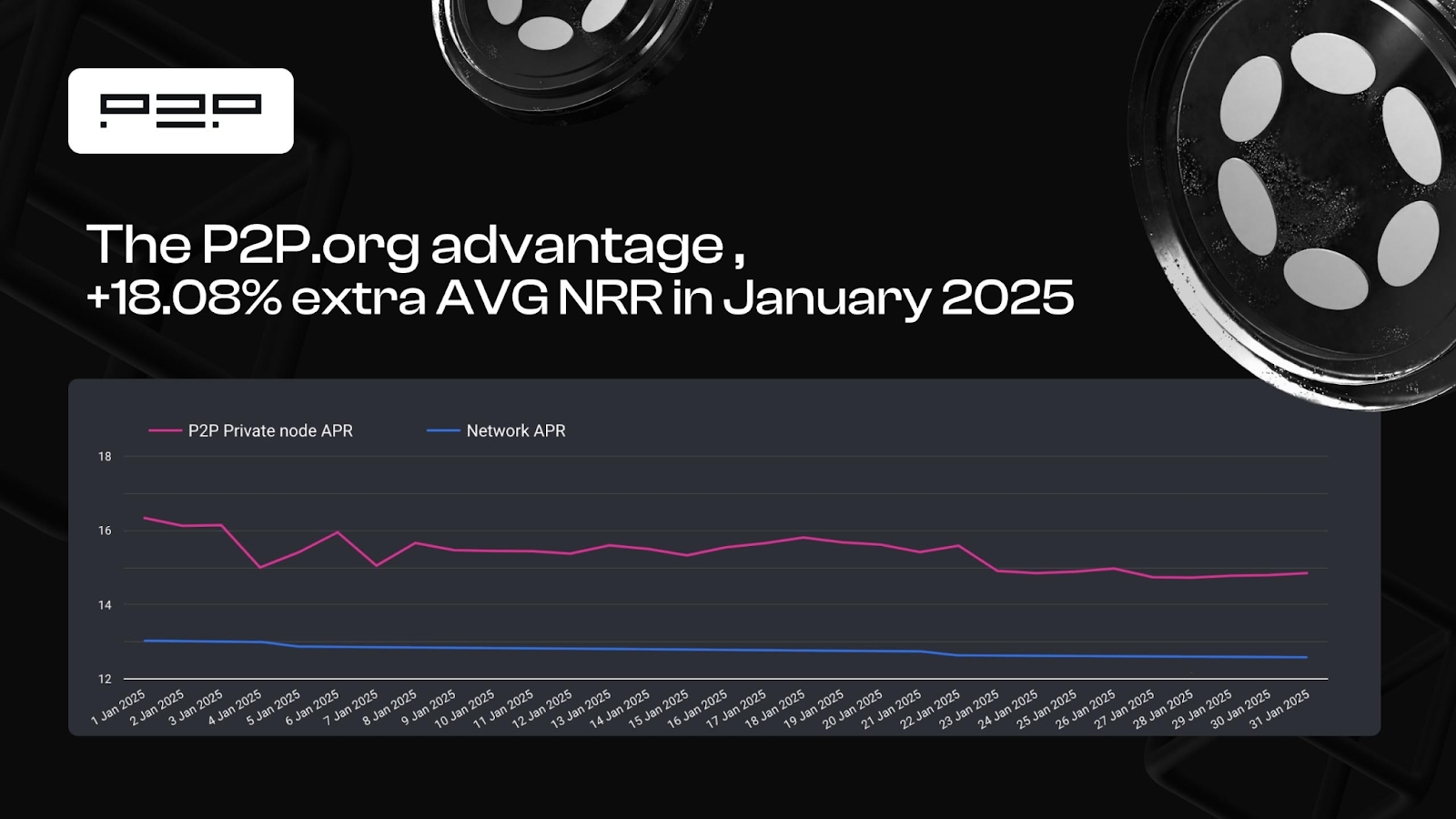
In January 2025, P2P.org delivered an impressive 18.08% higher average Network Reward Rate (NRR) than the network baseline. Our consistent outperformance, clearly visible in our private and node NRR, demonstrates our commitment to optimizing validator returns for our stakeholders.
This exceptional performance is backed by the following:
Enterprise-grade infrastructure ensures the highest uptime
24/7 technical support
Advanced validation strategies that consistently outperform network averages
As Polkadot enters a new growth phase, partnering with a proven validator becomes more crucial. P2P.org's track record of technical excellence and superior returns positions us as an ideal partner for those seeking to maximize their participation in Polkadot's ecosystem.
Our team of experts is ready to guide you through the process and help you capitalize on these industry-leading returns.
Polkadot 2.0 - 2025 Roadmap
The Polkadot roadmap for 2025 introduces several upgrades leading into Polkadot 2.0:
Smart Contract Expansion: With the integration of EVM (Ethereum Virtual Machine) compatibility and the Polkadot Virtual Machine (PVM) launch, Polkadot will support high-performance smart contracts. This update will make it easier for developers to deploy decentralized applications (dApps) across Polkadot’s multi-chain environment.
Elastic Scaling: Elastic Scaling will enable the parallel validation of transactions across multiple cores. This will allow Polkadot to easily handle increasing demand, enhancing scalability with dynamic resource allocation.
XCM v5: Enhancing Polkadot’s cross-chain communication framework, XCM v5 will further improve interoperability between parachains and external ecosystems. This update will streamline interactions between chains.
Unified Address Format: A single, unified address system will allow users to easily interact with all Polkadot rollups, simplifying wallet management and improving user experience across the entire ecosystem.
Fast Unstaking & DOT as a Fee Token: Polkadot 2.0 significantly enhances unstaking, allowing users to unstake their DOT much faster, improving liquidity. Additionally, DOT will serve as a universal gas token, allowing it to be used for transaction fees across rollups.
With this upgrade, Polkadot will solve its most pressing issues to date: scalability, developer tools, and cross-chain interoperability.
The updates in detail:
Smart Contracts: Empowering Developers
Polkadot’s smart contract functionality is set for a major overhaul in 2025. Among the most exciting developments is the expansion of smart contract environments. This expansion will make the ecosystem more accessible for a broader range of developers and enterprises by making it easier to build and scale decentralized applications.
The integration of EVM compatibility will allow Solidity-based contracts to be deployed directly onto Polkadot, enabling Ethereum developers to bring their projects to Polkadot with minimal friction. Meanwhile, the Polkadot Virtual Machine (PVM), a lightweight, RISC-V-based virtual machine, will allow for the fast, secure, and scalable execution of smart contracts, further optimizing the ecosystem for dApp developers.
The JAM SDK, a powerful toolkit for building, deploying, and scaling smart contracts on Polkadot, will also provide developers with the resources they need to build with speed.
As scalability remains one of the most crucial challenges for blockchain networks, Polkadot will introduce Elastic Scaling in 2025. This upgrade will enable parallel transaction processing across multiple cores, significantly increasing the network’s throughput.
This new approach to scaling will allow Polkadot to meet the demands of high-performance applications like decentralized finance (DeFi), gaming, and enterprise solutions without compromising security or decentralization. Polkadot can scale dynamically by optimizing resource allocation based on network demand, ensuring consistent performance even as the network grows.
XCM v5: Interoperability at its Best
Polkadot has long been a champion of interoperability, and introducing XCM v5 in 2025 will bring further advancements. The updated framework will enable seamless communication between parachains, rollups, and external ecosystems. This means that assets and data can flow securely and efficiently across multiple networks.
With enhanced security features to prevent malicious cross-chain interactions and reduced transaction costs and latency, Polkadot will be able to offer a more streamlined and secure experience for developers and users alike.
Unified Address Format: Simplifying the User Experience
Managing multiple addresses across different ecosystems can be cumbersome. The new Unified Address Format will solve this issue by allowing users to access all Polkadot rollups through a single address. This will simplify wallet management, reduce onboarding friction for new users, and improve overall usability across the ecosystem.
Fast Unstaking & DOT as a Universal Fee Token: Enhancing User Utility
Two of the most significant usability improvements coming to Polkadot in 2025 are Fast Unstaking and using DOT as a fee token.
With Fast Unstaking, users can withdraw their DOT faster than ever, enhancing liquidity and making it easier for investors to move in and out of the network. Meanwhile, DOT as a Fee Token will enable users to pay for transaction fees across all rollups, creating a universal gas token that enhances the economic utility of DOT.
Omni Node & SAFROLE: Future-Proofing Polkadot’s Infrastructure
Polkadot 2.0 also introduces Omni Node, a unified node solution that simplifies rollup deployment and enhances overall network efficiency. In addition, SAFROLE, a zkSNARK-based block production optimization, will improve security and performance, ensuring that Polkadot remains a top-tier blockchain infrastructure for years to come.
Looking Ahead: Polkadot’s Path to Mainstream Adoption
Polkadot is entering 2025 with upgrades that promise to deliver scalability, interoperability, and an improved developer experience.
With EVM compatibility and Polkadot Virtual Machine (PVM), smart contract development will be more accessible than ever. Elastic Scaling will empower Polkadot to handle high-demand applications, while XCM v5 will connect Polkadot to a broader blockchain ecosystem. Meanwhile, Fast Unstaking and DOT as a fee token will improve the network's liquidity and economic utility.
These improvements, combined with new infrastructure tools like Omni Node and SAFROLE, ensure that Polkadot will remain at the forefront of blockchain technology. They will drive adoption in enterprise solutions and Web3 applications, making Polkadot the go-to platform for developers and businesses worldwide.
About Us
P2P Validator is a world-leading non-custodial staking provider, securing over $10 billion from over 10,000 delegators/nominators across 40+ high-class networks.
Thank you, all our nominators, for your continuous backing and trust. Together, we’ll forge ahead toward a brighter, more decentralized future!
By choosing validators committed to the network's long-term health and security, token holders can contribute to a more resilient and trustworthy blockchain ecosystem.
<p>This blog was written based on Pavel Iashin's <a href="https://purple-sea-cb0.notion.site/Max-Effective-Balance-Increase-Slashing-Risks-in-Pectra-14df8e6f8ab580e4a484d7da4b56dfd1?ref=p2p.org"><u>research on MEB and slashing risks in Pectra</u></a>.</p><h2 id="tldr"><strong>TLDR</strong></h2><ul><li><em>The Pectra upgrade reduces Ethereum slashing penalties for single validators by up to 128x, making staking a safer and more attractive option for all stakers. </em></li><li><em>P2P.org offers a range of variable risk/reward staking solutions, offering strategies based on your unique risk tolerance</em></li><li><em>With advanced slashing protection and professional management, P2P.org ensures Ethereum staking is secure and optimized for the best possible returns.</em></li></ul><p>Ethereum staking will change drastically with the upcoming Pectra upgrade, which is expected to go live in April 2025. The upgrade offers a significant opportunity for stakers, introducing more flexibility in balancing risk and reward. For the first time, stakers can dramatically reduce their exposure to penalties while maintaining attractive yields. At P2P.org, we're ready to help you understand and utilize these changes with <strong>personally tailored staking solutions</strong> designed around your individual risk tolerance.</p><p>This new era of Ethereum staking combines security with improved returns – a combination that was previously impossible to achieve. Whether you're a conservative staker seeking maximum protection or a growth-oriented staker looking to optimize, the Pectra upgrade opens up new possibilities for customizing your staking strategy.</p><h3 id="eip-7251-in-a-nutshell"><strong>EIP-7251 in a nutshell</strong></h3><p><a href="https://eips.ethereum.org/EIPS/eip-7251?ref=p2p.org"><u>Ethereum Improvement Proposal #7251</u></a>, also known as the Maximum Effective Balance (MEB) Increase, will address the inefficiencies of the current Ethereum staking design. This update will enable allocating up to 2048 ETH for a single validator alongside other important improvements and changes, such as auto-compounding and validator consolidations. We have shared more information about the upcoming changes in validator economics in our <a href="https://p2p.org/economy/ethereum-pectra-upgrade-a-shift-in-staking-mechanics/"><u>recent blog post</u></a> about the upgrade.</p><figure class="kg-card kg-image-card"><img src="https://lh7-rt.googleusercontent.com/docsz/AD_4nXej2CRaaVhdnN3nzl0Ybcy86XlgGHRk-qT40cdnf-QXcmmTqeS5rzwPdGRoV1IsKMS1Nk343WCQfhHALbpMn-daV2Yr2stb8fOrxgYsU65nhsbcJKLd5yIinjgwM2M1QV_MkTlxOg?key=Z5eK-GkRd-O7PM9Klu8-_q4d" class="kg-image" alt="" loading="lazy" width="1218" height="964"></figure><p><em>Img: Increased validator balance of up to 2048 ETH</em></p><h2 id="understanding-slashing-what-you-need-to-know"><strong>Understanding Slashing: What You Need to Know</strong></h2><p>Think of slashing as Ethereum's security system – it's a protective measure that helps maintain the network's integrity by penalizing validators who break the rules, whether intentionally or due to technical issues. Under the current system, these penalties can be significant, but the Pectra update is about to change that in your favor.</p><h3 id="why-does-slashing-happen"><strong>Why Does Slashing Happen?</strong></h3><p>Slashing occurs in three specific situations, and understanding them helps explain why professional management is crucial:</p><p><strong>Double Proposals</strong> (Proposing two different blocks for the same slot)</p><ol><ul><li>Think of this as sending two different versions of the same email. This usually happens due to technical issues with the validator setup such as using the same keys in multiple setups.</li><li>Professional operators like P2P.org have sophisticated systems to prevent this.</li></ul></ol><p><strong>Double Voting</strong> (Two different votes in the same slot)</p><ol><ul><li>Similar to marking two different answers on a test. This is the most common cause of slashing.</li><li>This usually also occurs when the same keys are used in multiple setups or the validator software has database issues.</li></ul></ol><p>Instead of handling raw keys (which creates risk), we implement Threshold Signature Schemes (TSS), which split one validator key into<strong> three separate shards</strong>, requiring any two shards to create a valid signature. <br><br>This 2-of-3 approach provides:</p><ol><ul><ol><li>Enhanced security: No single point stores the complete key</li><li>Operational flexibility: Enables node maintenance without missing attestations</li><li>Failover protection: The system remains operational even if one shard is compromised.</li></ol></ul></ol><p><strong>Surround Voting</strong> (Making conflicting votes about the chain's history)</p><ol><ul><li>This is like giving contradictory testimonies about the same event.</li><li>This can happen if a validator either has a database problem, uses multiple keys, is affected by a bug, or is involved in malicious activity.</li><li>Professional management ensures proper synchronization at all times.</li></ul></ol><p><strong><em>The good news?</em></strong> When it comes to slashing incidents, the data is reassuring: 90% are caused by double voting, 10% by double proposals, and none by surround voting. These incidents are extremely rare and typically occur when validator keys are mistakenly used across multiple validators. Working with professional operators who follow strict security protocols virtually eliminates these risks. </p><p><strong>At P2P.org, we have:</strong></p><ul><li>Advanced slashing protection systems</li><li>Real-time 24/7 monitoring of validator performance</li><li>Immediate response protocols for any anomalies</li><li>Regular system audits and updates</li></ul><div class="kg-card kg-button-card kg-align-center"><a href="https://www.p2p.org/networks/ethereum?ref=p2p.org#form" class="kg-btn kg-btn-accent">Start Staking with P2P.org</a></div><h3 id="how-slashing-works"><strong>How Slashing Works</strong></h3><p>Slashing is Ethereum's security mechanism that penalizes validators who break protocol rules. When a violation occurs, three distinct penalties come into play:</p><ol><li>The <strong>Initial Penalty</strong> is applied immediately when a violation is detected. Currently, it's set at 1 ETH for every 32 ETH staked. This acts as the immediate consequence for breaking protocol rules.</li><li>The <strong>Inactivity Penalty</strong> accumulates during the withdrawal period because the validator can no longer perform their duties. For a 32 ETH validator, this is currently around 0.057 ETH (as of February 2025), though the exact amount depends on the total effective balance of all validators in the network.</li><li>The <strong>Correlation Penalty</strong> increases if other validators are slashed within an 18-day window before or after the incident. This design protects against coordinated attacks by making group slashing events exponentially more expensive than isolated incidents.</li></ol><p>When a validator commits a violation, another validator must spot it and submit proof. Once the network confirms the violation, the initial penalty is applied immediately, and the forced withdrawal period begins. During this time, the blockchain monitors for other slashing events that might trigger correlation penalties. This creates a balanced approach where technical issues face lighter penalties, while coordinated misbehavior receives harsher treatment.</p><h3 id="what-changes-with-pectra"><strong>What Changes with Pectra?</strong></h3><p>With the Pectra upgrade, we will experience a shift in how Ethereum handles slashing penalties, making staking significantly safer for participants:</p><h3 id="understanding-the-components"><strong>Understanding the Components </strong></h3><p>With the upcoming Pectra upgrade, all three components of slashing are going to change:</p><p>The <strong>Initial Penalty</strong> will be reduced from 1 ETH to 0.0078125 ETH per 32 ETH validator. This means that small technical mistakes or isolated incidents become far less costly. For a validator with 2048 ETH (the new maximum), the initial penalty would be 0.5 ETH - still significant but much smaller than under the current system.</p><p>The <strong>Inactivity Penalty</strong> remains proportional to the validator's effective balance and continues through the 36-day withdrawal period. For context, with approximately 33.3M ETH staked (as of February 2025), a 32 ETH validator would face approximately 0.057096 ETH in inactivity penalties, while a 2048 ETH validator would see about 3.654152 ETH. These numbers vary based on changes in the total amount of ETH staked and base reward parameters.</p><p>The <strong>Correlation Penalty</strong> is where Pectra introduces improvements to maintain network security while being fairer to validators. The current system's correlation penalty can be uneven due to integer division effects, but Pectra implements a new formula that ensures proportional penalties regardless of validator size. This means a single 2048 ETH validator will face the same correlation penalty as sixty-four 32 ETH validators if the same total stake is affected.</p><h3 id="real-world-impact"><strong>Real-World Impact</strong></h3><p>Current System:</p><ul><li>A slashing incident affecting 32 ETH results in approximately 1.05 ETH in total penalties</li><li>This represents about 3.28% of the staked amount</li></ul><p>After Pectra:</p><ul><li>The same incident would result in only about 0.06 ETH in penalties</li><li>This represents just 0.19% of the staked amount</li></ul><p>This reduction in penalties won’t compromise network security because the correlation penalty still provides adequate protection against large-scale attacks. If a significant portion of validators (approaching 1/3 of total stake) are slashed simultaneously, the penalties can still result in complete stake loss, effectively deterring coordinated malicious behavior.</p><p>This is a risk reduction that makes staking significantly safer for conservative investors. When combined with P2P.org's professional management and customized risk assessment, <strong>you get a sophisticated level of protection for your stake.</strong></p><figure class="kg-card kg-image-card"><img src="https://lh7-rt.googleusercontent.com/docsz/AD_4nXf5ZLIFO15ECwt9FVGVzP_8QdR2KMdp5meyM2c1MYDvrtnQuzMNo6F9KEpq0HbHLb-etLppP7r96_uF_2NcJE7gNYJH6qCDZbjNv5ctr_JCI-Ktw0N-rcExXzneLB9StmHu-q91ow?key=Z5eK-GkRd-O7PM9Klu8-_q4d" class="kg-image" alt="" loading="lazy" width="1600" height="788"></figure><p><em>Img:</em> <em>Comparison of Pre-Pectra and Post-Pectra penalties</em></p><h2 id="why-professional-management-matters"><strong>Why Professional Management Matters</strong></h2><p>The importance of professional validator management becomes clear when we examine the data on slashing incidents. According to our models, the time taken to respond to an incident significantly impacts the amount of stake affected. For a 4096 ETH cluster, <strong>a 25-minute response time results in about 0.02% of stake being affected</strong>, while a slower <strong>3-hour response increases this to around 0.1%</strong> - a fivefold increase in impact.</p><p>This difference becomes even more striking when we look at pre-Pectra penalties. The same scenarios under current rules would result in penalties of 12 ETH for quick responses versus 52 ETH for slower responses, with a significant portion coming from the initial penalty. Even though Pectra reduces the initial slashing penalty dramatically (from 1 ETH to 0.0078125 ETH for 32 ETH validators), the speed of response remains crucial.</p><p>Professional management makes a substantial difference in minimizing these risks. Automation tools can reduce response time to a single slot, significantly decreasing the potential for subsequent slashing events. This is particularly important because slashing incidents typically begin with an "alerting event" followed by potential "subsequent slashing events" that continue until the issue is resolved.</p><p>The data shows that professional management with rapid response capabilities is crucial in reducing their impact when they occur. This becomes even more important in Pectra's environment of consolidated validators, where a single incident could affect larger amounts of stake.</p><p>After all, prevention is still the best strategy. That's why P2P.org:</p><ul><li>Uses battle-tested validator software</li><li>Maintains separate databases for each validator group</li><li>Provides 24/7 technical monitoring</li><li>Offers rapid response to any potential issues</li></ul><h2 id="risk-management-with-p2porg"><strong>Risk Management with P2P.org</strong></h2><p>At P2P.org, we understand that every staker has unique needs and concerns. That's why we:</p><ul><li>Conduct detailed risk assessment consultations with each client</li><li>Design personalized staking strategies based on your specific risk tolerance</li><li>Provide ongoing risk monitoring tailored to your comfort level</li><li>Adjust strategies as your risk tolerance evolves</li></ul><div class="kg-card kg-button-card kg-align-center"><a href="https://www.p2p.org/networks/ethereum?ref=p2p.org#form" class="kg-btn kg-btn-accent">Start Staking with P2P.org</a></div><h2 id="your-next-steps"><strong>Your Next Steps</strong></h2><p>If you've been waiting for the right time to stake your ETH, the Pectra update provides the security and peace of mind you've been looking for. P2P.org's personalized approach ensures you get a staking solution that perfectly matches your risk tolerance.</p><p>Ready to start staking with peace of mind? Contact P2P.org's team to schedule your personal risk assessment consultation and learn how you can adjust your staking strategy specifically to your needs.</p>
<h2 id="tldr"><strong>TLDR</strong></h2><ul><li><em>The Ethereum Pectra upgrade in March 2025 will introduce major improvements, including larger validators (up to 2048 ETH), auto-compounding, and enhanced staking efficiency.</em></li><li><a href="P2P.org" rel="noreferrer"><strong><em>P2P.org</em></strong></a><em><strong> is fully prepared for these changes</strong>, integrating Pectra’s features into our dApp, API, and staking services to increase rewards and streamline validator management.</em></li><li><em>By transitioning with P2P.org, stakers can optimize NRR (Network Reward Rate), reduce operational complexity, and take full advantage of Ethereum’s most significant upgrade.</em></li></ul><p>Mark your calendars for <strong>March 2025</strong>— One of the largest upgrades in Ethereum’s history is about to be released. The Pectra upgrade represents a complete reimagination of staking mechanics, unlocking new opportunities for <strong>validators, intermediaries, and DeFi users.</strong></p><p>As one of the <strong>largest non-custodial staking providers</strong>, <strong>P2P.org</strong> has worked hard over the last six months to prepare for and extensively test the upcoming changes, ensuring that our user base receives the best service and exceptional performance. </p><p>We are ready to provide our users with everything that will provide significant improvements, from <strong>automatic compounding to updated validator economics. </strong>This blog post will dive deeper into the upcoming changes and how the Pectra upgrade will enhance Ethereum staking.</p><h2 id="redefining-validator-economics-the-foundation-of-pectra"><strong>Redefining Validator Economics: The Foundation of Pectra</strong></h2><p>At the core of Pectra is <a href="https://eips.ethereum.org/EIPS/eip-7251?ref=p2p.org"><strong><u>EIP-7251</u></strong></a>, a fundamental restructuring of validator economics. This proposal introduces <strong>validators with Max Effective Balances (MEB) of up to 2048 ETH</strong>, compared to today’s rigid 32 ETH limit. </p><p>While these enhanced validators maintain the standard attestation frequency of once per epoch (384 seconds), their attestations carry proportionally greater weight—up to 64 times more than a standard 32 ETH validator. This means that a 2048 ETH validator has the same voting power as 64 individual 32 ETH validators, significantly increasing its influence in finalizing blocks and improving consensus efficiency. Additionally, the probability of block proposals scales proportionally, allowing larger validators to propose blocks more frequently while maintaining Ethereum’s overall security and decentralization.</p><p>This can be illustrated in a simple real-life example:</p><p><em>Twenty independent <strong>32 ETH validators</strong> will generate the same rewards as a <strong>single 640 ETH validator</strong>.</em></p><p>Operators can drastically reduce operational costs with this upgrade, translating into higher profitability. By optimizing validator economics in this way, we’re paving the way for <strong>more competitive</strong> staking opportunities. As a result, we are positioned to <strong>offer the best NRR (Network Reward Rate) in the market</strong>.</p><h2 id="auto-compounding-unlocking-exceptional-nrr-and-staking-efficiency"><strong>Auto-Compounding: Unlocking exceptional NRR and Staking Efficiency</strong></h2><p>One of the most significant user-facing changes with Pectra is the introduction of <strong>auto-compounding for Consensus Layer rewards</strong>. This feature can be enabled by either consolidating two 0x01 validators into one 0x02 validator, updating credentials on an existing validator, or spinning up a new 0x02 one. For our <strong>dApp</strong>, we are introducing <strong>intuitive validator merging flows</strong>, allowing users to <strong>batch-merge existing validators</strong> (since Pectra’s smart contracts currently permit only two at a time). </p><p>Previously, Consensus layer rewards (which account for <strong>~75% of total staking rewards</strong>) were sent directly to withdrawal addresses. With the new <strong>0x02 validators</strong>, these rewards are automatically re-delegated into the validator, providing the opportunity to produce extra returns and enhance long-term NRR. </p><h3 id="the-benefits-of-auto-compounding"><strong>The benefits of auto-compounding:</strong></h3><p>For Validators operating at <strong>base ETH (CL+EL) NRR of 3.2%</strong>, auto-compounding gradually increases staking returns, for example:</p><ul><li>After 1 year, APR can rise to approximately<strong> 3.24%</strong></li><li>After 5 years, APR approximately increases to<strong> 3.42%</strong></li></ul><p>While these numbers may seem marginal, the <strong>cumulative effect is substantial</strong>. Over five years, an auto-compounded validator <strong>generates approximately 5.47 ETH</strong>, compared to <strong>5.12 ETH for a non-compounded validator</strong>. With ETH at current market prices, this difference <strong>translates to over $1,000 in additional rewards from the network per validator</strong>.</p><p>However, there is a <strong>critical threshold</strong>—auto-compounding only works if the validator remains <strong>below 2048 ETH</strong>. Once this limit is reached, all rewards will be distributed to the withdrawal address, effectively stopping the compounding effect.</p><p>To maintain auto-compounding for as long as possible, P2P.org will cap the maximum validator balance at 1,920 ETH, providing a runway of <strong>over two years before reaching the limit</strong>. This strategic approach ensures that users can continue to be eligible for returns and <strong>stake efficiently without interruptions</strong>. By setting this cap, we can maintain a consistent and sustainable growth model, allowing us to provide optimal returns during this timeframe. This ensures that our users not only have a reliable staking experience but also benefit from optimized returns over the long term, with <strong>no concerns about disruption in returns</strong>.</p><figure class="kg-card kg-image-card"><img src="https://lh7-rt.googleusercontent.com/docsz/AD_4nXcUcPYRWl6RRQnWRgDzm_yQuOgDYzxOvIb211j-6VZSQreSMhncEVY8yBBaWbNuY6CoIIHbmUvcDwe_FkzuSBF1nuFh-1qeMZjXg3jobpbtMlkaXj_S-Z3QiZStaSkG379XjAtC?key=tD7TinndwUWXMIxFWc2Iy7g9" class="kg-image" alt="" loading="lazy" width="1181" height="636"></figure><p></p><p><strong>Partial Withdrawals</strong></p><p>Another key feature of Pectra is the ability to perform partial withdrawals. Unlike the previous system, where users would need to fully exit their 32 ETH validator to withdraw a significant portion of their staked ETH, partial withdrawals now allow users to remove a portion of their balance while the validator remains active. </p><p>For example, if you have 64 ETH staked, you can now withdraw 20 ETH without needing to exit the validator entirely. This increased flexibility ensures that users can manage their staked ETH more efficiently, giving them more control over their assets without compromising their staking participation.</p><h2 id="the-roadmap-to-higher-nrr"><strong>The Roadmap to Higher NRR </strong></h2><p>P2P.org’s <a href="https://eth.p2p.org/auth?ref=p2p.org"><u>Ethereum staking suite</u></a> is already designed to provide <strong>flexible and high-performance staking solutions</strong> through our <strong>dApp, API, and DVT API</strong> (optimized for SSV-based distributed validators and additional reward mechanisms). After the Pectra upgrade, API and dApp native stakers will be able to access its core features, including Max Effective Balance increases, auto-compounding, and partial withdrawals - for restaking and other strategies, we need to wait on 3rd party timelines and implementations. </p><p>This means developers and institutional stakers can easily implement Pectra’s benefits into their day-to-day operations.</p><h3 id="the-transition-to-pectra-with-p2porg"><strong>The transition to Pectra with P2P.org</strong></h3><p>To ensure a smooth transition for all our staking users and newly onboarded clients, our engineering teams are working on the following:</p><ul><li><strong>Developing new user flows</strong> for merging validators under Pectra’s new staking mechanics.</li><li><strong>Enhancing monitoring tools and security protocols</strong> to adapt to the new validator structure.</li><li><strong>Implementing sophisticated compounding mechanisms</strong> to leverage Pectra’s economic model fully.</li></ul><h3 id="where-we-are-right-now"><strong>Where we are right now</strong></h3><p>Our roadmap to being the provider with the <strong>highest NRR </strong> and <strong>exceptional Execution Layer rewards</strong> includes:</p><ul><li>Initiatives to increase execution layer reward strategies for all our validator setups.</li><li>Collaborating on Mainnet releases with preconfirmation protocols like <a href="https://cyber.fund/content/bolt?ref=p2p.org"><u>Bolt</u></a>, <a href="https://docs.ethgas.com/?ref=p2p.org"><u>ETHGas</u></a>, and <a href="https://primev.xyz/?ref=p2p.org"><u>Primev</u></a> to increase rewards.</li><li>Significantly increase the returns and boosts on <a href="https://www.p2p.org/products/dvt-staking?ref=p2p.org"><u>DVT validators</u></a>.</li></ul><p>Since its inception in 2018, <a href="P2P.org" rel="noreferrer"><strong>P2P.org</strong></a><strong> has consistently prioritized performance optimization</strong>, and in 2024, we have made significant strides toward becoming the <strong>best-performing staking operator on Ethereum</strong>. Our commitment to excellence is reflected in our #1 ranking for 7-day and 30-day RAVER effectiveness among node operators with over 1% market share. Among the largest Ethereum staking providers, we lead in performance, ensuring <strong>maximum efficiency and reliability</strong> for our validators.</p><p>Looking ahead to Q2 2025, we plan to further solidify our position across the entire validator ecosystem through architectural enhancements and collaborations, particularly with SSV-based distributed validator technology (DVT). These improvements will drive greater decentralization, resilience, and efficiency, reinforcing our status as a top-tier staking operator.</p><h2 id="strategic-implications-for-ethereum-stakers-and-institutions"><strong>Strategic Implications for Ethereum Stakers and Institutions</strong></h2><p>For institutional stakeholders, Pectra represents a <strong>major strategic shift</strong> that requires preparation. <strong>Consolidating validator operations while maintaining equivalent rewards</strong> from the network presents <strong>compelling efficiency increases</strong> for large-scale stakers.</p><p>P2P.org can support you during the transition to Pectra, particularly in areas such as:</p><ul><li>Migrating existing validators to the new MEB framework</li><li>Implementing auto-compounding mechanisms for higher NRR </li></ul><p></p><p><strong><em>The transition to Pectra is your opportunity to increase staking efficiency. </em></strong></p><p><strong>P2P.org is leading this transition</strong>, ensuring our infrastructure, staking services, and validator strategies are fully optimized for Pectra. As March 2025 approaches, we will continue to <strong>guide stakers through this transformation</strong>, offering the <strong>tools, insights, and infrastructure</strong> needed to fully capture the benefits of Ethereum’s most significant upgrade of the year.</p><p>For a full breakdown of our current performance rankings, visit<a href="https://explorer.rated.network/explorer?network=mainnet&view=nodeOperator&timeWindow=7d&page=1&pageSize=15&ref=p2p.org"> <u>Rated Explorer</u></a>.</p>
 ALL
Agoric
Aptos
Auth
Avail
Avalanche
Axelar
Babylon
Bitcoin
bouldertech
BTC
capital flow
Cardano
Celestia
certifications
Chainlink
compliance
Cosmos
Crescent
curator
Cyberway
DAOBet
Data stream
DeFi
defi dispatch
defi infrastrcuture
defi infrastructure
defi news
defi vault
due diligence
DVT
Dymension
Economy
Education
EigenLayer
Elrond
employee
employee advocacy
employee interviews
ETF
Ethereum
Evmos
exit queue
Explain Like I'm Five
Governance
Guide
hedge fund
how to
HR
HUB series
Hyperliquid
infrastructure
institutional lens
institutional staking
ISO 27001
ISO/IEC 27001:2022
Issuer
Kava
Kusama
landing
latin america
legal layer
legislation
Lido
liquid staking
LSP
Manta
Mantle
Marlin
Matic
MEV
MiCA
Moonbeam
MultiversX
Near
Networks
News
NuCypher
Oasis
Obol
Origin
P2P Verified
Partnership
pectra
Persistence
playbook
Pocket
Polkadot
Polygon
product
products
Quicksilver
Regen
ALL
Agoric
Aptos
Auth
Avail
Avalanche
Axelar
Babylon
Bitcoin
bouldertech
BTC
capital flow
Cardano
Celestia
certifications
Chainlink
compliance
Cosmos
Crescent
curator
Cyberway
DAOBet
Data stream
DeFi
defi dispatch
defi infrastrcuture
defi infrastructure
defi news
defi vault
due diligence
DVT
Dymension
Economy
Education
EigenLayer
Elrond
employee
employee advocacy
employee interviews
ETF
Ethereum
Evmos
exit queue
Explain Like I'm Five
Governance
Guide
hedge fund
how to
HR
HUB series
Hyperliquid
infrastructure
institutional lens
institutional staking
ISO 27001
ISO/IEC 27001:2022
Issuer
Kava
Kusama
landing
latin america
legal layer
legislation
Lido
liquid staking
LSP
Manta
Mantle
Marlin
Matic
MEV
MiCA
Moonbeam
MultiversX
Near
Networks
News
NuCypher
Oasis
Obol
Origin
P2P Verified
Partnership
pectra
Persistence
playbook
Pocket
Polkadot
Polygon
product
products
Quicksilver
Regen