P2P.org Earns Sumsub Risk Intolerant Sentinel Recognition: What It Means for Our Partners
P2P Certified | Compliance
Introduction
Compliance claims are easy to make. In an industry where regulatory expectations are rising faster than most firms realise, the difference between a compliance page and genuine compliance practice is measured not in words but in independent validation.
At P2P.org, we have built our customer due diligence (CDD) framework as a living system, one designed for where regulation is heading rather than where it has been. That commitment recently received external recognition from Sumsub in the form of their Risk Intolerant Sentinel designation, a badge awarded to organisations that demonstrate proactive, comprehensive standards across KYC, AML monitoring, fraud prevention and identity verification.
This post explains what that recognition means, how it was earned, and what it signals to the institutions and regulated businesses that partner with P2P.org.
Key learnings for busy readers
If you are short on time, here is what this article covers:
P2P.org has been awarded the Sumsub Risk Intolerant Sentinel designation, an independent recognition awarded by a globally trusted compliance and identity verification platform operating across 220+ countries. The designation is not self-reported. It is the result of a third-party assessment of P2P.org's use of Sumsub's verification and monitoring infrastructure across our compliance operations. For institutional partners and regulated businesses, this is a concrete, externally verified signal of the compliance standards they are dealing with when they work with P2P.org. Our CDD framework was reviewed against current AMLR expectations as a deliberate investment in partnership quality, not as a reactive compliance exercise.
Independent recognition in an industry where it matters most
Recognition of compliance standards is only meaningful when it comes from outside the organisation. Anyone can write a compliance page. Third-party validation from a globally recognised authority is a different kind of signal.
Sumsub is a global compliance and identity verification platform trusted by thousands of regulated businesses across fintech, crypto, traditional financial institutions and digital asset businesses worldwide. Their infrastructure spans KYC, KYB, AML monitoring, transaction screening and fraud prevention across more than 220 countries and territories.
The Risk Intolerant initiative was created specifically to address what Sumsub describes as a gap in the industry: compliance work is largely invisible until something goes wrong. The project shifts that dynamic by publicly recognising organisations that manage risk proactively, turning otherwise unseen compliance efforts into verifiable, public proof.
The Sentinel designation is awarded following Sumsub's assessment of a company's KYC, AML, fraud prevention and compliance systems. It goes to organisations whose risk mitigation practices are comprehensive, current and effective. Importantly, it is not a self-reported badge. It requires assessment against Sumsub's global client base and the standards they apply across their entire platform.
P2P.org has received this designation based on our use of Sumsub's verification and monitoring infrastructure across our compliance operations. For our partners, it means one thing practically: your counterpart at P2P.org has been independently evaluated by a recognised global compliance authority.
"Compliance in this industry is moving faster than most firms realise. We made the decision early on to treat our CDD framework as a living system, one that needs to be built for where regulation is going, not where it has been. The AMLR review was not a defensive move. It was a deliberate investment in the quality of the partnerships we want to maintain."
The EU Anti-Money Laundering Regulation (AMLR) is reshaping expectations for regulated and high-risk sectors across financial services, crypto and digital assets. Rather than waiting to react, P2P.org reviewed and aligned our CDD processes against AMLR requirements as a deliberate, proactive step.
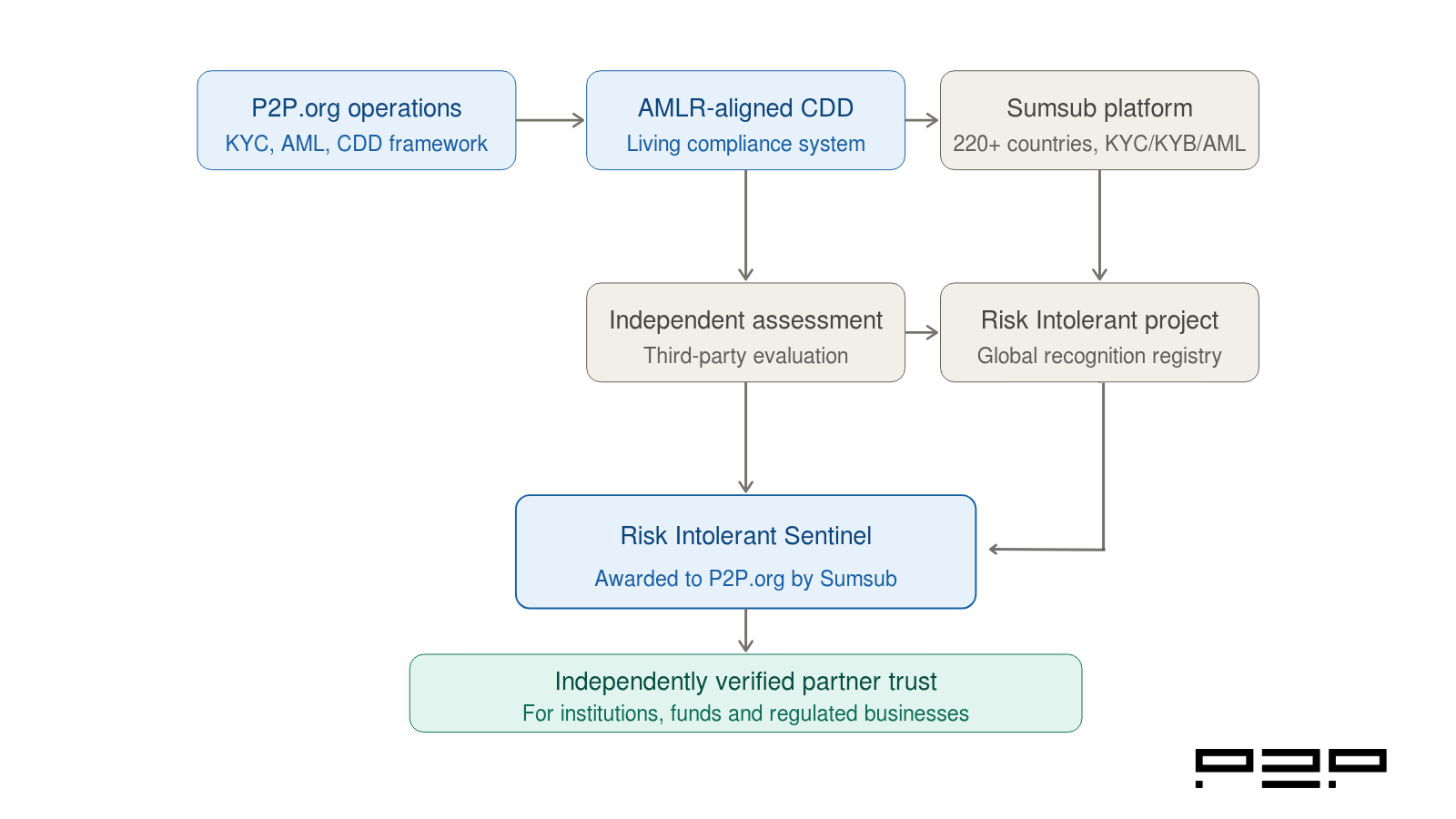
The diagram above illustrates how our internal compliance operations connect through Sumsub's platform infrastructure to the independent assessment process, culminating in the Sentinel designation that now represents verified partner trust for the institutions and funds working with us.
What the Sentinel designation means in practice
The Risk Intolerant project structures recognition across tiers based on assessment results. The Sentinel designation reflects a proactive, best-in-class approach to fraud prevention, AML screening, identity verification and customer onboarding. It is not awarded by request alone. It follows Sumsub's evaluation of how a company's systems are designed, operated and updated.
For institutions evaluating staking infrastructure providers or digital asset service partners, compliance validation from a recognised global platform provides a layer of due diligence assurance that internal claims cannot offer. When P2P.org's compliance standards are assessed by the same platform that serves thousands of regulated businesses globally, the result carries a weight that self-certification does not.
This is particularly relevant given the direction regulatory frameworks are moving. FATF's 2025 guidance and the EU's broader AML package are pushing regulated industries toward a unified, risk-based approach where continuous monitoring and adaptive controls are the expectation, not the exception. P2P.org's investment in a living CDD framework, validated independently through Sumsub, places us ahead of that curve rather than behind it.
Why independent validation matters for institutional partners
Institutions choosing infrastructure partners in the staking and digital asset space carry compliance obligations of their own. They are not just choosing a technology provider. They are choosing a counterparty whose compliance posture either supports or complicates their own regulatory standing.
A self-reported compliance page provides limited assurance. What institutions need is a signal they can actually rely on: an assessment conducted by a third party with the global reach and technical authority to evaluate compliance infrastructure objectively.
The Sumsub Risk Intolerant Sentinel designation provides exactly that. It is a third-party determination, applied consistently across a global client base, that P2P.org's approach to risk management meets the standard Sumsub sets for comprehensive, proactive compliance.
When you partner with P2P.org for staking infrastructure across our 40+ supported networks, you are working with a business that has been independently evaluated, not just one that has declared its own compliance. That distinction matters increasingly in the regulatory environment we are all operating in.
P2P.org compliance as part of a broader standard
The Sumsub recognition sits alongside P2P.org's existing compliance achievements. We achieved SOC 2 Type II certification in 2025, confirming that our security and operational frameworks meet the standards institutional clients require. Our infrastructure supports more than $10 billion in assets under management across 40+ blockchain networks, with a zero-slashing incident record and 99.9% uptime across all validator infrastructure.
Compliance and operational excellence are not separate tracks at P2P.org. They are part of the same commitment to being a partner that regulated institutions can rely on.
If you would like to explore our institutional staking products and understand how our compliance framework supports the businesses we work with, visit P2P.org Staking-as-a-Business.
For more compliance coverage and updates from the P2P Certified series, explore the P2P.org blog.
Key takeaways
P2P.org has received the Sumsub Risk Intolerant Sentinel designation following an independent third-party assessment of our compliance and verification infrastructure. The designation reflects a proactive, comprehensive approach to KYC, AML, fraud prevention and CDD, aligned with where regulation is heading under AMLR and broader global AML frameworks. For institutional partners and regulated businesses, this is a verifiable external signal of the compliance standards P2P.org operates to, not a self-declared claim. Our CDD framework is built as a living system, designed to evolve ahead of regulatory expectations rather than react to them.
Frequently Asked Questions (FAQs)
What is the Sumsub Risk Intolerant Sentinel designation?
The Risk Intolerant Sentinel is a recognition awarded by Sumsub as part of their Risk Intolerant initiative, which publicly identifies companies that demonstrate comprehensive, proactive standards in KYC, AML, fraud prevention and identity verification. It is based on a third-party assessment of a company's compliance systems, not a self-reported application.
Is this the highest designation in the Risk Intolerant programme?
The Risk Intolerant project has three tiers: Vanguard, Sentinel and Titan. The Sentinel designation is awarded to companies that demonstrate a proactive, best-in-class approach to compliance and fraud prevention, going beyond baseline requirements.
What is Sumsub, and why does its recognition matter?
Sumsub is a global compliance and identity verification platform operating in 220+ countries, trusted by thousands of regulated businesses, including traditional financial institutions, fintech companies and digital asset businesses. Their assessment reflects global compliance benchmarks, which is why their recognition carries weight beyond the digital asset sector.
What is the AMLR, and why did P2P.org review its CDD framework against it?
The EU Anti-Money Laundering Regulation (AMLR) is reshaping compliance expectations across financial services and digital assets. P2P.org reviewed and aligned our CDD framework against AMLR as a proactive investment in compliance quality and partnership standards, not as a reactive measure to regulatory pressure.
Does P2P.org hold any other compliance certifications?
Yes. P2P.org achieved SOC 2 Type II certification in 2025, confirming that our security and operational control frameworks meet institutional standards. The Sumsub Sentinel designation adds an independent layer of compliance-specific validation to that foundation.
How does this affect institutional partners working with P2P.org?
Institutional partners carry their own compliance obligations when selecting counterparties. The Sumsub Sentinel designation gives them an independently verified signal of P2P.org's compliance standards, one assessed by a globally recognised authority rather than declared internally.
Subscribe to P2P-economy
Get the latest posts delivered right to your inbox
<p>P2P.org and iLuminary have partnered to bring onchain DeFi access directly inside the iLuminary platform.</p><p>iLuminary users can now interact with onchain DeFi protocols without leaving the app — no separate wallet setup, no bridging. The experience is built into the interface they already use, powered by P2P.org's DeFi Widget running on the backend.</p><p>This is the latest integration in P2P.org's growing network of platforms embedding onchain infrastructure directly into their products. For iLuminary, it closes the distance between their users and DeFi. For P2P.org, it's another distribution point for infrastructure that was previously only accessible to institutional clients.</p><p>If you're already on iLuminary, DeFi access is live now. <a href="https://iluminary.ai/download?ref=p2p.org">→</a> <a href="https://iluminary.ai/download?ref=p2p.org">Try it here</a>.</p><p><strong>What the DeFi Widget Is</strong></p><p>The P2P.org DeFi Widget is an embeddable module that gives any platform's users direct access to onchain DeFi protocols — without leaving the host application.</p><p>It plugs into an existing product interface. Users interact with onchain protocols through a familiar UI they already trust. The complexity of the underlying infrastructure — routing, protocol connections, transaction execution — is handled entirely by P2P.org on the backend.</p><p>For the end user, it just works. For the platform, it's a single integration.</p><p><strong>The Infrastructure Behind It</strong></p><p>The widget runs on P2P.org's core infrastructure — the same stack that powers staking and DeFi operations for institutional clients managing billions in onchain assets.</p><p>$12B+ in secured assets. 40+ networks supported. Zero slashing events. SOC 2 Type II certified.</p><p>That track record matters for platforms considering an integration. When you embed the P2P.org DeFi Widget, you're not building on experimental infrastructure. You're building on a stack that institutional clients depend on daily, with the operational standards that entails.</p><p><strong>For Platforms Looking to Integrate</strong></p><p>The integration process is straightforward. The widget is embeddable — it drops into an existing product interface without requiring a full infrastructure build on your end.</p><p>What you get: onchain DeFi access for your users, powered by P2P.org's protocol infrastructure and operational layer, delivered through your own product experience.</p><p>What your users get: access to established onchain protocols, directly inside an app they already use.</p><p>If you're building a platform and want to give your users DeFi access without the infrastructure overhead, the P2P.org DeFi Widget is built for exactly that use case.</p><p>Get in touch with the P2P.org team → <a href="https://link.p2p.org/93ab18?ref=p2p.org">https://link.p2p.org/93ab18</a> <br><br>Disclaimer: P2P.org provides non-custodial infrastructure that enables access to third-party DeFi protocols and does not control, manage, or guarantee the performance of any protocol or transaction. All interactions occur directly onchain and are subject to network conditions and protocol-specific risks, for which P2P.org assumes no responsibility.</p>
 ALL
Agoric
Aptos
Auth
Avail
Avalanche
Axelar
Babylon
Bitcoin
BTC
Cardano
Celestia
certifications
Chainlink
compliance
Cosmos
Crescent
Cyberway
DAOBet
DeFi
DVT
Dymension
Economy
Education
EigenLayer
Elrond
Ethereum
Evmos
Explain Like I'm Five
Guide
how to
HR
infrastructure
Kava
Kusama
landing
Lido
LSP
Manta
Mantle
Marlin
Matic
Moonbeam
MultiversX
Near
News
NuCypher
Oasis
Origin
Partnership
Persistence
playbook
Pocket
Polkadot
Polygon
product
products
Quicksilver
Regen
regulation
Renzo
restaking
RPC Node
Sender
Serum
slashing
Solana
SSV.Network
Staking
Starknet
Sui
symbiotic
Syncro
syncro sender
Terra
Tezos
TheGraph
Threshold
Update
validator
Vara
Vega
ALL
Agoric
Aptos
Auth
Avail
Avalanche
Axelar
Babylon
Bitcoin
BTC
Cardano
Celestia
certifications
Chainlink
compliance
Cosmos
Crescent
Cyberway
DAOBet
DeFi
DVT
Dymension
Economy
Education
EigenLayer
Elrond
Ethereum
Evmos
Explain Like I'm Five
Guide
how to
HR
infrastructure
Kava
Kusama
landing
Lido
LSP
Manta
Mantle
Marlin
Matic
Moonbeam
MultiversX
Near
News
NuCypher
Oasis
Origin
Partnership
Persistence
playbook
Pocket
Polkadot
Polygon
product
products
Quicksilver
Regen
regulation
Renzo
restaking
RPC Node
Sender
Serum
slashing
Solana
SSV.Network
Staking
Starknet
Sui
symbiotic
Syncro
syncro sender
Terra
Tezos
TheGraph
Threshold
Update
validator
Vara
Vega