From Protocol to Product: How Morpho Strategies Reach Users Through P2P.org
As on-chain financial infrastructure matures, one pattern is becoming increasingly clear: strong protocols succeed when paired with effective distribution.
High-quality lending infrastructure already exists. Capital-efficient designs, modular architectures, and professional-grade primitives are now well established. What continues to evolve is how these systems are delivered through fintech applications, neobanks, custodial platforms, exchanges, and wallets in a way that fits modern financial products.
This is where distribution layers play an important role.
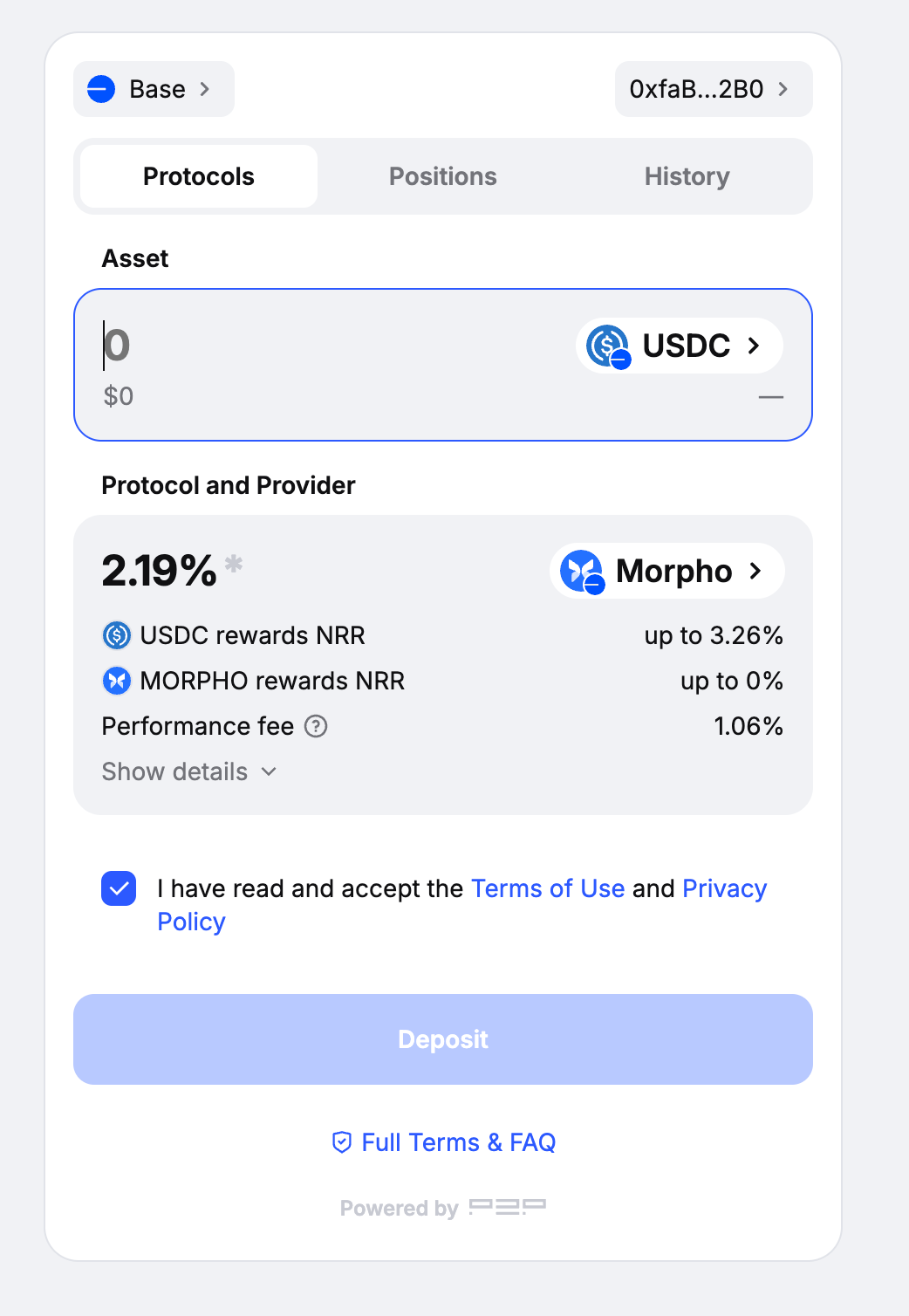
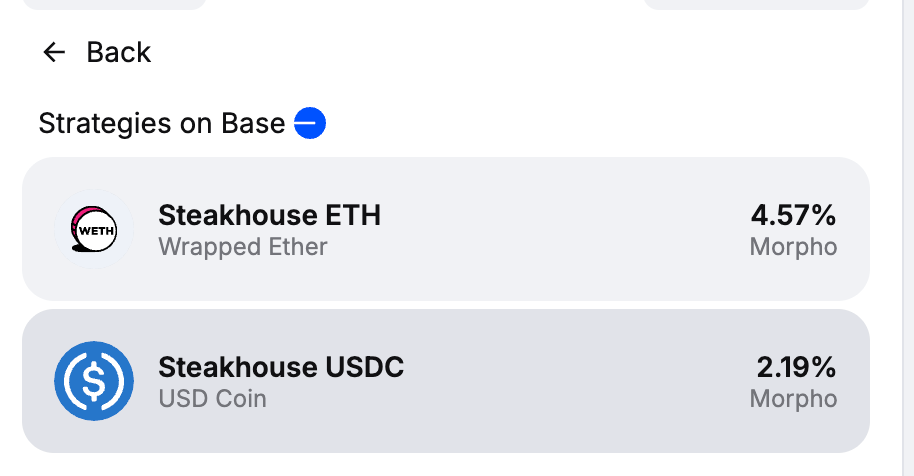
The P2P.org Stablecoin Earn Widget is one example of this model in practice. It is live on the P2P.org frontend today, where users can access Steakhouse-curated Morpho vaults directly. The same product layer is also designed to be embedded by partners, enabling broader distribution across platforms.
Morpho as a foundation for onchain credit
Morpho is designed as a core DeFi primitive. Its architecture focuses on capital efficiency and modularity, making it well-suited as the infrastructure for lending and credit strategies that need to scale.
Rather than operating as a consumer-facing product, Morpho is intentionally built to serve as infrastructure. This allows strategy managers and platforms to compose on top of it, while benefiting from its underlying design.
In the context of the Stablecoin Earn Widget, Morpho provides the universal lending network that enables these strategies to function. Its role remains consistent: power credit markets at the protocol level, while higher layers focus on strategy design and distribution.
Turning infrastructure into a product experience
The Stablecoin Earn Widget sits above the protocol layer. Its purpose is not to replace or abstract away the value of infrastructure, but to make it accessible through a controlled product interface.
Through this structure:
End users engage with a simple earn experience
Platforms integrate a single component
Protocol complexity remains at the infrastructure layer
This separation allows Morpho to remain focused on its core mission, while strategies and distribution are handled by specialized counterparts.
Access and Distribution
In addition to being embeddable by partners, the Stablecoin Earn Widget is also accessible directly through the P2P.org frontend.
This allows users to access Steakhouse-curated strategies on Morpho directly via P2P.org, while partners can integrate the same product layer into their own platforms.
This dual distribution model — direct access via P2P.org and embedded distribution via partners — highlights how protocol infrastructure, strategy curation, and product delivery can scale together.
Note: NRR values shown are illustrative examples for demonstration purposes only.
The role of curation
Between infrastructure and distribution sits curation.
The strategies available through the widget are curated by Steakhouse, which designs and maintains vaults built on Morpho. Steakhouse applies a structured approach to strategy construction, ensuring that protocol primitives are assembled into coherent, professional-grade products.
Each layer in the stack has a clear responsibility:
Morpho provides the lending mechanics
Steakhouse curates and manages strategies
P2P.org delivers the distribution layer and interface
This clarity makes it easier for platforms to offer stablecoin earn functionality without taking on roles outside their core focus.
Distribution as an enabler
Capital today increasingly sits inside wallets, fintech applications, custodial platforms, and treasury systems. Distribution layers allow protocols like Morpho to reach these environments without operating user-facing products themselves.
By embedding the Stablecoin Earn Widget, platforms can surface Morpho-based strategies within products that users already trust and use. For Morpho, this expands reach through partners. For platforms, it provides a practical way to offer earn functionality backed by established infrastructure.
Built on infrastructure designed to scale
The Stablecoin Earn Widget is supported by P2P.org infrastructure securing over $10B across more than 40 networks. This operational foundation supports the reliable delivery of strategies built on Morpho and curated by Steakhouse.
Importantly, this model does not alter how Morpho functions. It preserves the protocol’s role as infrastructure, while improving how strategies built on it are accessed and distributed.
A shared direction
This collaboration reflects a broader evolution in DeFi:
Protocols specialize in primitives
Strategy managers specialize in construction and oversight
Distribution layers specialize in product delivery
The Stablecoin Earn Widget illustrates how these roles can work together in production today, with Morpho providing the underlying credit infrastructure.
As on-chain credit continues to grow, this separation of responsibilities creates clearer paths for adoption across platforms and users.
Integrating the Stablecoin Earn Widget
For platforms exploring stablecoin earn functionality, the Stablecoin Earn Widget is designed to integrate directly into existing products.
It allows teams to offer access to curated strategies without managing protocol integrations or strategy design internally. Platforms interested in exploring integration can reach out to the P2P.org team to discuss fit and timelines.
<p>In 2025, institutional crypto allocation stopped being about exposure—and started being about structure.</p><p>The difference is subtle but fundamental.</p><p>Instead of chasing market cycles, large allocators—from crypto-native funds to DAOs and exchanges—began designing portfolios for operational liquidity, onchain rewards, and capital rotation. That shift shows up clearly in the data: stablecoin holdings in large wallets rose meaningfully, native token exposures became more intentional, and Ethereum’s role as a settlement layer only deepened.</p><p>Today, P2P.org is publishing a new report: <a href="https://link.p2p.org/ike?ref=p2p.org" rel="noreferrer"><strong>“Stablecoins vs. Native Tokens: Institutional Allocation Trends”</strong></a></p><p>It’s a data-backed look at how the portfolios of institutional actors actually changed this year—built on onchain data, analytics dashboards, and infrastructure trends we observe directly across our network.</p><h2 id="what-the-report-covers"><strong>What the Report Covers</strong></h2><p>This isn’t a market recap. It’s a breakdown of how institutions allocated real capital—and what that says about the future of staking, stablecoins, and infrastructure decisions going into 2026.</p><p>Inside the report:</p><ul><li><strong>Wallet-level allocation trends</strong> from exchanges, funds, and DAOs</li><li><strong>Stablecoin usage patterns</strong>: reserves, liquidity, and treasury behavior</li><li><strong>Ethereum’s anchoring role</strong> across staking, settlement, and reserves</li><li><strong>The rise of programmatic allocation</strong> and treasury segmentation</li><li><strong>Case studies and charts</strong> </li><li><strong>Allocation frameworks</strong> emerging across institutional teams</li><li>A forward-looking view on <strong>infrastructure-aligned portfolios</strong></li></ul><p>The research draws on multi-chain data, but the patterns are clearest on Ethereum—where stablecoin reserves and native token deployments sit side-by-side in validator-linked portfolios.</p><figure class="kg-card kg-image-card"><img src="https://p2p.org/economy/content/images/2026/02/1600--900-X.jpg" class="kg-image" alt="" loading="lazy" width="1600" height="900" srcset="https://p2p.org/economy/content/images/size/w600/2026/02/1600--900-X.jpg 600w, https://p2p.org/economy/content/images/size/w1000/2026/02/1600--900-X.jpg 1000w, https://p2p.org/economy/content/images/2026/02/1600--900-X.jpg 1600w" sizes="(min-width: 720px) 720px"></figure><h2 id="why-this-matters"><strong>Why This Matters</strong></h2><p>Stablecoins are no longer just “dry powder.” They’re tools for capital efficiency, onchain access, and risk-tiering in institutional portfolios.</p><p>ETH is no longer just an asset. It’s programmable liquidity, stakable yield, and the infrastructure of reserves.</p><p>And P2P.org’s view—as a validator and infrastructure partner across Ethereum and other proof-of-stake networks—is that allocation behaviors are now driven by operational design, not just exposure targets.</p><h2 id="download-the-full-report"><strong>Download the Full Report</strong></h2><p>This report is designed for crypto funds, asset managers, DAO treasurers, and institutional teams building real onchain portfolios.</p><p><a href="https://link.p2p.org/ike?ref=p2p.org" rel="noreferrer">[<strong>Download the Report</strong>] <em>Stablecoins vs. Native Tokens: Institutional Allocation </em></a> </p><p>Whether you're managing staking allocations, designing treasury structure, or evaluating validator partners, this research offers a data-grounded foundation for 2026 strategy.</p>
 ALL
Agoric
Aptos
Auth
Avail
Avalanche
Axelar
Babylon
Bitcoin
BTC
Cardano
Celestia
Chainlink
Cosmos
Crescent
Cyberway
DAOBet
DVT
Dymension
Economy
EigenLayer
Elrond
Ethereum
Evmos
Explain Like I'm Five
Guide
HR
Kava
Kusama
Lido
LSP
Manta
Mantle
Marlin
Matic
Moonbeam
MultiversX
Near
NuCypher
Oasis
Origin
Partnership
Persistence
Pocket
Polkadot
Polygon
Quicksilver
Regen
Renzo
restaking
RPC Node
Serum
Solana
SSV.Network
Staking
Starknet
Sui
symbiotic
Terra
Tezos
TheGraph
Threshold
Update
Vara
Vega
ALL
Agoric
Aptos
Auth
Avail
Avalanche
Axelar
Babylon
Bitcoin
BTC
Cardano
Celestia
Chainlink
Cosmos
Crescent
Cyberway
DAOBet
DVT
Dymension
Economy
EigenLayer
Elrond
Ethereum
Evmos
Explain Like I'm Five
Guide
HR
Kava
Kusama
Lido
LSP
Manta
Mantle
Marlin
Matic
Moonbeam
MultiversX
Near
NuCypher
Oasis
Origin
Partnership
Persistence
Pocket
Polkadot
Polygon
Quicksilver
Regen
Renzo
restaking
RPC Node
Serum
Solana
SSV.Network
Staking
Starknet
Sui
symbiotic
Terra
Tezos
TheGraph
Threshold
Update
Vara
Vega