How ETF Issuers Should Evaluate Validator Infrastructure: An Operational Guide
Series: Validator Playbook
The Validator Playbook is P2P.org's infrastructure education series for institutional Ethereum operators. Each article addresses a specific operational, risk, or governance decision that validator infrastructure teams, staking product managers, ETF issuers, custodians, asset managers, and risk committees face when building or evaluating proof-of-stake infrastructure.
The SEC and CFTC joint interpretive release on March 17, 2026 classified staking rewards from 16 named digital commodities, including ETH as non-securities, removing the primary legal barrier that had delayed staking-enabled ETF structures in the United States.
Staking ETFs turn validator infrastructure into the backend of a regulated product. The infrastructure provider is now a counterparty in a regulated financial product, not a commodity service.
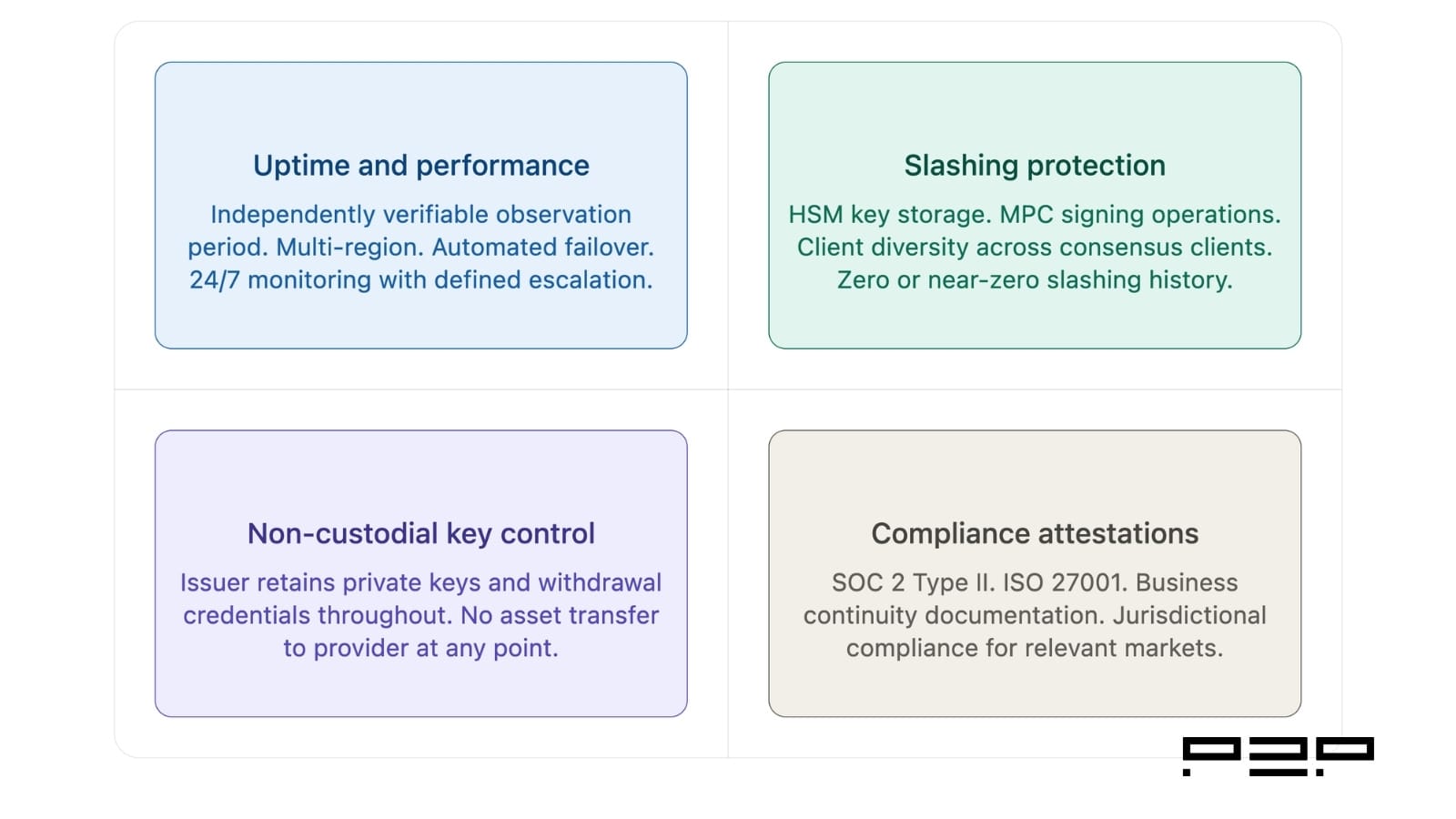
Validator selection for ETF issuers has shifted from rate optimisation to operational commitments: uptime service-level agreements, slashing-prevention architecture, key custody design, and compliance attestations.
SOC 2 Type II is now a baseline diligence requirement for ETF-grade validator infrastructure. It is not a differentiator. Providers without it can create a compliance gap in the issuer's own vendor risk program.
For ETF staking structures where fiduciary control of underlying assets must remain with the issuer, non-custodial architecture is the preferred model, keeping private keys and withdrawal credentials out of the validator provider's hands.
Correlated failure risk is a portfolio-level concern for ETF issuers, not just an infrastructure one. Provider concentration across the issuer's validator set introduces systemic exposure that commission rate comparisons will not surface.
The operational framework for selecting a validator provider maps directly onto how ETF issuers already evaluate prime brokers and custodians: counterparty risk, documented controls, and compliance standing first.
What Changed on March 17, 2026
For over a year, the primary obstacle to staking-enabled ETF structures in the United States was legal uncertainty about whether staking rewards constituted securities. That uncertainty was resolved in a single regulatory event.
The SEC and CFTC issued a joint interpretive release on March 17, 2026, that classified staking rewards from 16 named digital commodities, including ETH, as non-securities, confirming that protocol staking is not a securities transaction and that staking rewards do not create a securities-type relationship. The interpretive release explicitly covers solo, self-custodial, custodial, and liquid staking models. None of these structures triggers securities law obligations. Source: Jenner & Block LLP
The regulatory shift formalized what the market had already begun pricing in. BlackRock debuted the iShares Staked Ethereum Trust on Nasdaq on March 12, 2026, with $107 million in seed assets, staking 70 to 95% of its holdings and distributing monthly protocol-attributed participation rewards. The March 17 ruling then removed the remaining legal uncertainty that had kept other issuers on the sidelines. US spot ETH ETFs now hold approximately $12 billion in combined assets with roughly $11.6 billion in cumulative net inflows since launch. Source: CoinDesk
The ruling also expanded the addressable market for institutional staking infrastructure well beyond Ethereum. The commodity classification means compliance departments no longer have such grounds to restrict exposure based on securities risk, applying to proof-of-stake assets across the named 16 and validating existing staking products, including ETFs and exchange-based products. The addressable market for institutional staking infrastructure expanded materially on March 17. Source: Bitcoin Foundation
For ETF issuers that have not yet built a staking-enabled structure, one major legal barrier has been removed. What remains is an operational and procurement decision: which validator infrastructure supports a regulated product at the scale, compliance posture, and risk profile an ETF sponsor requires.
Why Validator Infrastructure Is Now a Regulated Product's Backend
The framing that most ETF issuers still apply to validator infrastructure is wrong. They treat it as a utility service purchased at a rate. It is not.
Staking-enabled spot ETFs do not just give institutions exposure to ETH or SOL. They create a structural, recurring source of validator demand that flows to compliant, non-custodial infrastructure underneath the product wrapper. ETF issuers and their custodians source validator infrastructure the way they source prime brokerage: on counterparty risk. Source: P2P.org Blog
That framing has direct operational implications. When a validator provider goes offline, misses attestations, or suffers a configuration error, the protocol responds with penalties. Those penalties reduce the participation rewards that the ETF distributes to shareholders. A validator infrastructure failure is not an internal IT incident. It is a fund-level performance event with a direct impact on the product the issuer has marketed to regulated investors.
For regulated financial institutions and custodians, third-party infrastructure providers sit inside the same vendor due diligence process as any cloud provider or payment processor. Before a contract clears internal security review, the provider typically needs to demonstrate recognized certifications, with SOC 2 Type II and ISO 27001 coming up most consistently because they map directly onto the control categories these institutions already audit internally across access management, incident response, availability, and data integrity. Source: Chainstack
The procurement workflow is the one ETF issuers already know. The evaluation framework is not new. What is new is that validator infrastructure now belongs inside it.
The Four Dimensions of ETF-Grade Validator Infrastructure Evaluation
The four dimensions ETF issuers should run against any validator provider before delegating staking exposure inside a regulated product structure.
1. Uptime and Attestation Performance
Validator infrastructure for an ETF product requires 24/7 operational continuity without exception. When a validator goes offline, it misses block proposals and attestations. Those missed events reduce protocol-attributed participation rewards directly.
The evaluation question is not whether a provider advertises high uptime. It is whether the provider can evidence it across an independently verifiable observation period. Commission rates are the most visible differentiator between providers and the least informative. A provider with a higher commission rate, strong uptime history, and documented slashing protection will consistently produce better outcomes for an ETF product than a provider with a lower rate on shared cloud infrastructure with no operational redundancy.
For ETF issuers, the specific questions to put to any validator provider are:
What is the documented uptime rate across the past 12 months, and is it independently verifiable?
Is infrastructure distributed across multiple geographic regions and cloud providers, or concentrated in a single data center?
What is the failover architecture, and has automated failover been tested under production conditions?
What does the monitoring stack look like, and how are anomalies escalated?
2. Slashing Protection Architecture
Slashing is the protocol-level penalty applied to validators that behave maliciously or experience specific configuration failures. For an ETF product, a slashing event is a capital loss event that the issuer must disclose and that directly reduces net asset value.
How a provider manages validator signing keys is one of the most critical security considerations most critical security consideration. Leading providers use hardware security modules for key storage and multi-party computation for key operations, ensuring that no single individual or process can unilaterally sign a transaction.
The slashing risk that ETF issuers need to understand is not just individual validator failure. It is a correlated failure. If a provider operates a large concentration of an issuer's validator set on a shared infrastructure stack, a single software bug, cloud region outage, or configuration error can affect multiple validators simultaneously. The correlation penalty on Ethereum scales with the total ETH slashed across the network in the surrounding period, meaning correlated failures produce penalties that are materially larger than the sum of individual events.
Questions for provider evaluation:
Does the provider use hardware security modules and multi-party computation for key operations?
What is the slashing incident history across the provider's full validator set?
What is the provider's approach to client diversity across consensus implementations?
How are signing keys isolated across different client accounts?
P2P.org has maintained a zero-slashing-incident track record since 2018 across 40+ proof-of-stake networks, with dedicated hardware, geographic distribution, and client diversity across consensus implementations as standard infrastructure architecture.
3. Non-Custodial Architecture and Key Control
For ETF staking structures, non-custodial architecture is not a preference. It is a structural requirement.
Non-custodial staking infrastructure is suitable for ETF staking because it gives the issuer, not the infrastructure provider, control of client assets. The institution retains control of private keys and withdrawal credentials at all times. This model reduces counterparty risk and aligns with most institutional custody mandates.
The custody question is the most consequential due diligence item for an ETF sponsor's legal team. In a custodial staking arrangement, the provider holds private keys and withdrawal credentials. In the event of provider insolvency, regulatory enforcement, or operational failure, the assets may be inaccessible or treated as part of the provider's estate. That custody risk is not acceptable inside a regulated ETF structure.
Issuers should confirm explicitly:
Does the provider take custody of private keys or withdrawal credentials at any point?
Who holds withdrawal address control throughout the staking lifecycle?
What is the technical mechanism through which the issuer retains key custody while the provider operates validation?
How does the provider's custodian integration work, and which custodians have native integrations?
4. Compliance Attestations and Vendor Risk Program Fit
SOC 2 Type II provides audited evidence that security controls actually work, measured continuously over a three to twelve-month observation period rather than a single point-in-time assessment. Together with ISO 27001, these certifications answer the due diligence requirements of institutional clients who need institutional-grade security assurances before routing assets through validator infrastructure.
For ETF issuers operating under fiduciary obligations, a validator provider without SOC 2 Type II attestation creates a gap in the issuer's own vendor risk program. The compliance team cannot map an unattested provider's controls onto the institution's internal security framework. The deal stalls or the provider is excluded from consideration.
The compliance evaluation should include:
Current SOC 2 Type II report: scope, observation period, and any exceptions noted
ISO 27001 certification status and Statement of Applicability
Jurisdictional compliance posture for the markets the ETF will serve
Business continuity and disaster recovery documentation
Incident notification and reporting commitments under contract
The institutional digital asset space moves fast.
Our subscribers get structured analysis across staking, DeFi vaults, and regulation through DeFi Dispatch, Institutional Lens, DeFi Infrastructure for Institutions, and Legal Layer.
No noise. Just the signals that matter.
Subscribe to the newsletter at the bottom of this page.
The ETF Validator Infrastructure Evaluation Checklist
The checklist below is structured for the procurement motion ETF issuers already run for other regulated infrastructure counterparties. It is organized by evaluation category, not by provider marketing claims.
Operational performance
[ ] Documented uptime rate across a minimum 12-month independently verifiable observation period
[ ] Multi-region, multi-cloud or bare-metal infrastructure with no single geographic concentration
[ ] Automated failover with documented recovery time objective
[ ] 24/7 monitoring with defined escalation protocols and incident notification timelines
Slashing protection
[ ] Zero or documented-near-zero slashing history across the full validator set, not just client-specific validators
[ ] Hardware security module used for key storage with multi-party computation for key operations
[ ] Client diversity across consensus implementations (minimum two consensus clients in production)
[ ] Documented approach to isolating signing keys across client accounts
Custody and key control
[ ] Explicit contractual confirmation that the provider does not take custody of private keys or withdrawal credentials
[ ] Withdrawal address control retained by the issuer or designated custodian throughout
[ ] Native integrations with the issuer's existing custodian(s)
[ ] Clear technical documentation of the key custody architecture
Compliance attestations
[ ] Current SOC 2 Type II report: read the report’s scope and exceptions rather than filing it without review
[ ] ISO 27001 certification with current Statement of Applicability
[ ] Jurisdictional compliance documentation for relevant markets
[ ] Business continuity and disaster recovery plans reviewed and tested
[ ] API or custodian integration confirmed for reward attribution and reconciliation
What Correlated Failure Risk Means for ETF Products
One risk category that most ETF issuers underweight is provider concentration. A large staking position delegated entirely to a single validator provider on a shared infrastructure stack introduces correlated failure exposure that individual uptime statistics do not capture.
As institutions deploy into staking, the infrastructure requirements extend beyond standard validator operations to include actively validated service participation, slashing risk management across multiple protocols, and more complex reporting requirements. Source: Bitcoin Foundation
For an ETF product, correlated failure has three forms that the issuer's risk committee needs to evaluate:
1. Infrastructure concentration
If the provider runs all of an issuer's validators on the same cloud region or software stack, a single outage affects the full position simultaneously.
2. Network-level concentration
If the issuer's provider controls a large share of total staked ETH on the network, a provider-wide failure triggers network-level events including delayed finality and emergency protocol responses that affect every participant.
3. Client concentration
If the provider runs a single consensus client implementation across its full validator set, a client-specific bug affects all validators simultaneously. Client diversity across implementations is the mitigation, not a preference.
Risk committees evaluating validator providers should request explicit documentation of the provider's infrastructure architecture, client diversity posture, and concentration limits per client account.
Key Takeaway
The March 2026 regulatory shift transformed staking-enabled ETFs from a compliance question into an operational one. For custodians, asset managers, ETF and ETP issuers, treasury teams, staking product managers, and risk committees, the validator infrastructure decision is now a counterparty risk decision that belongs inside the same procurement framework applied to prime brokers and custodians.
The evaluation framework is built on four dimensions: uptime and attestation performance evidenced over a verifiable observation period; slashing protection architecture grounded in hardware security modules and client diversity; non-custodial key control that keeps withdrawal credentials with the issuer throughout; and compliance attestations, including SOC 2 Type II, that fit into the institution's vendor risk program. Rate optimization is the last consideration, not the first.
Institutions that build validator infrastructure evaluation on operational commitments rather than headline rates are better positioned to protect the regulated product their investors hold.
To explore how P2P.org supports ETF issuers and institutional staking programs with non-custodial validator infrastructure, visit p2p.org/networks.
Frequently Asked Questions (FAQ)
What did the March 2026 SEC and CFTC ruling change for ETF issuers evaluating staking infrastructure?
The joint interpretive release issued on March 17, 2026, classified staking rewards from 16 named digital commodities, including ETH as non-securities. The ruling explicitly confirmed that protocol staking is not a securities transaction and that staking rewards do not create a securities-type relationship between validators and token holders. For ETF issuers, this removed the primary legal basis on which institutional compliance departments had restricted staking-enabled product structures. Compliance officers who had blocked staking ETF development on securities grounds can no longer cite that uncertainty. The ruling validated existing staking ETF products and cleared the approval path for new ones across the 16 named assets. The operational and procurement question is all that remains.
Why does non-custodial architecture matter specifically for ETF staking products?
In a custodial staking arrangement, the validator provider holds private keys and withdrawal credentials on behalf of the client. In the event of provider insolvency, regulatory enforcement action, or operational failure, the staked assets may be inaccessible or treated as part of the provider's estate. For an ETF product operating under fiduciary obligations, that counterparty exposure is not acceptable. Non-custodial architecture means the issuer or its designated custodian retains control of private keys and withdrawal credentials throughout the staking lifecycle. The validator provider operates the consensus infrastructure but cannot access or move the underlying assets. This model aligns with most institutional custody mandates and is the structure that regulated ETF products require.
What compliance attestations should ETF issuers require from a validator provider?
SOC 2 Type II is the baseline. It provides independently audited evidence that a provider's security and operational controls function as designed, measured over a continuous observation period rather than a single point-in-time assessment. Issuers should read the report for scope and any noted exceptions rather than filing it as received. ISO 27001 certification adds a governance layer, covering the policies and risk management processes that define how the provider protects its information assets. Issuers operating across European markets should also assess provider compliance posture against DORA and MiCA requirements. Providers that cannot produce current attestations create a gap in the issuer's own vendor risk program that the compliance team will flag during internal review.
How should ETF issuers think about provider concentration risk?
Delegating a large staking position entirely to a single validator provider on a shared infrastructure stack introduces correlated failure exposure that individual uptime statistics do not surface. If a provider's infrastructure fails across a cloud region, all validators in that region fail simultaneously. If a provider uses a single consensus client across its full validator set, a client-specific bug affects all validators at once. At the network level, a provider controlling a large share of total staked ETH introduces systemic exposure that affects all participants in a network-level event. Risk committees should request explicit documentation of a provider's infrastructure architecture, client diversity posture across consensus implementations, and concentration limits per client account. These are not secondary considerations. They belong in the same risk model as individual validator uptime.
What is the difference between how ETF issuers should evaluate validator infrastructure versus how other institutional stakers do?
The evaluation framework is similar in structure but different in stakes. Any institutional staker should assess uptime history, slashing protection, key custody architecture, and compliance attestations. For ETF issuers specifically, the consequences of infrastructure underperformance are fund-level events: reduced participation rewards that flow directly to shareholder distributions, potential NAV impacts that require disclosure, and vendor risk program requirements that apply to all regulated counterparties. The validator provider sits inside the ETF's operational stack in the same category as a prime broker or custodian. The procurement standards that apply to those relationships apply here. Rate optimization is relevant but secondary. Operational commitments, compliance standing, and counterparty risk documentation are the primary evaluation criteria.
How does Ethereum validator infrastructure differ from Solana validator infrastructure for ETF staking products?
The two networks have structurally different validator economics and operational profiles that shape how an issuer provisions infrastructure for each. Ethereum validators operate in fixed stake units with an activation and exit queue, while Solana validators stake across variable delegation amounts with different unbonding mechanics. Protocol-attributed participation reward rates also differ: Solana runs at approximately 6% to 7% gross versus Ethereum's approximately 3.1% to 3.3% at current network conditions. For multi-asset staking ETF products, these differences are structural inputs to infrastructure provisioning and reward distribution design, not comparable rates on a single scale. Issuers building multi-network staking products need provider infrastructure and reporting capability that handles both networks independently, with validator-level reward attribution for each.
Founded in 2018, P2P.org helps institutional capital protect digital asset yield across non-custodial staking infrastructure and curated DeFi strategies. With over $10B in assets secured and operating on 40+ proof-of-stake networks, P2P.org maintains a zero-slashing-incident track record, is trusted by over 190 institutional clients and is SOC 2 Type II attested. To explore how P2P.org can support your institution's staking or DeFi infrastructure needs, get in touch with our team.
Disclaimer
This material is provided for informational purposes only and does not constitute investment, financial, legal, or tax advice. P2P.org accepts no liability for any actions taken based on it. Latency and performance figures referenced are estimates based on internal benchmarks and may vary depending on network conditions, geography, and client infrastructure. Past performance is not indicative of future results.
Subscribe to P2P-economy
Get the latest posts delivered right to your inbox
<h2 id="series-defi-infrastructure-for-institutions">Series: DeFi Infrastructure for Institutions</h2><p><a href="http://p2p.org/?ref=p2p.org">P2P.org</a>'s content series for regulated institutions evaluating onchain capital allocation. Each article addresses a specific infrastructure, governance, or compliance dimension that determines whether a DeFi allocation can clear institutional approval and operate within mandate.</p><p>This is the third and closing article of the third trilogy of the series, completing the institutional profile sequence. <a href="https://p2p.org/economy/defi-vault-allocation-for-custodians-infrastructure-requirements-and-risk-considerations/">The first article</a> examined the infrastructure requirements for custodians. <a href="https://p2p.org/economy/how-hedge-funds-are-approaching-on-chain-yield-strategies-in-2026/">The second article</a> examined how hedge funds are approaching onchain yield strategies. This article examines stablecoin onchain yield strategies for treasury functions at financial institutions and asset managers.</p><p>The previous trilogy examined how conflict-of-interest frameworks across MiFID II, AIFMD II, and IOSCO's DeFi recommendations are converging on the curator model: <a href="https://p2p.org/economy/conflict-of-interest-defi-vault-regulation-institutional/">How Conflict-of-Interest Regulatory Frameworks Are Catching Up to the Curator Model</a></p><p><em>Previously in this series: </em><a href="https://p2p.org/economy/how-hedge-funds-are-approaching-on-chain-yield-strategies-in-2026/"><em>How Hedge Funds Are Approaching Onchain Yield Strategies in 2026</em></a></p><hr><h2 id="learnings-for-busy-readers">Learnings for Busy Readers</h2><p>Short on time? Here are the key takeaways. For the full analysis and supporting data, continue reading below.</p><ul><li>The stablecoin market has crossed $315 billion in total supply as of mid-2026. Annual stablecoin transaction volumes exceed $45 trillion, surpassing traditional payment networks. Treasury functions at financial institutions and asset managers are holding material stablecoin balances that generate no return, while the onchain yield infrastructure to put those balances to work at 5 to 8% APY is available, auditable, and increasingly regulated.</li><li>The GENIUS Act prohibits payment stablecoin issuers from paying yield directly to holders, creating a structural separation that shapes how all stablecoin yield products work in 2026. Yield generation must happen at the asset deployment layer, not the stablecoin issuer layer. Treasury teams need to understand this distinction before evaluating any stablecoin yield product: the stablecoin is the vehicle, not the return.</li><li>Stablecoin yield in 2026 is a tiered stack, not a single rate. The four primary tiers for institutional treasury mandates are tokenized money market funds at the capital-preservation end, curated DeFi lending vaults in the middle, real-world asset vaults for lower crypto-correlated yield, and yield-bearing stablecoin wrappers for passive deployment. Each tier has a distinct risk profile and governance requirement.</li><li>The governance infrastructure requirement for treasury teams interacting with DeFi vault protocols is the same as for custodians and hedge funds: pre-execution mandate validation, exportable compliance logs, and contractual role separation between the curator and the infrastructure layer.</li><li>The regulatory environment is supportive but evolving. The GENIUS Act provides US regulatory clarity. MiCA governs EU stablecoin operations. Both frameworks create compliance obligations for treasury teams that go beyond simply choosing a yield-bearing product.</li></ul><h2 id="introduction">Introduction</h2><p>Treasury functions at financial institutions, exchanges, asset managers, and neobanks are holding stablecoin balances that have grown materially over the past two years. The stablecoin market has crossed $315 billion in total supply as of mid-2026, with annual transaction volumes exceeding $45 trillion, surpassing traditional payment networks. Public companies, DAOs, fintechs, and crypto-native operating businesses collectively hold over $35 billion in onchain stablecoin reserves as of Q1 2026. Source: <a href="https://www.sygnum.com/blog/2025/05/30/institutional-defi-in-2025-the-disconnect-between-infrastructure-and-allocation/?ref=p2p.org">Sygnum Bank</a></p><p>For most of these treasury teams, those balances are idle. Stablecoins held in custody generate no return. The operational rationale for holding stablecoin balances, settling transactions faster, moving capital across chains without correspondent banking friction, and managing operational floats across multiple jurisdictions is strong. But holding is not the same as deploying. And the gap between a stablecoin balance earning nothing and the same balance deployed into a curated DeFi lending vault earning 5 to 8% APY is now wide enough to attract treasury committee attention across the institutional spectrum.</p><p>According to a June 2025 EY-Parthenon survey, 13% of financial institutions and corporates globally are already using stablecoins, with 54% of non-users expecting to adopt them within 6 to 12 months. The regulatory environment has moved to support that transition. The GENIUS Act, signed into law on July 18, 2025, established the first comprehensive federal framework for payment stablecoins in the US. MiCA governs stablecoin operations across all 27 EU member states. The compliance environment is now defined enough to navigate. Source: <a href="https://www.sygnum.com/blog/2025/05/30/institutional-defi-in-2025-the-disconnect-between-infrastructure-and-allocation/?ref=p2p.org">Sygnum Bank</a></p><p>But regulatory clarity on stablecoins does not automatically produce operational clarity on stablecoin yield. The infrastructure requirements for holding stablecoins and deploying them into onchain yield strategies within a treasury mandate are related but not equivalent. This article examines what those requirements look like in practice, what the stablecoin yield stack looks like for institutional treasury mandates in 2026, and what the governance infrastructure requirement is for treasury teams interacting with DeFi vault protocols.</p><h2 id="the-genius-act-and-the-yield-separation-problem">The GENIUS Act and the Yield Separation Problem</h2><p>Before examining stablecoin yield strategies, treasury teams need to understand a structural feature of the regulatory environment that shapes how those strategies work.</p><p>The GENIUS Act, passed in July 2025, prohibits payment stablecoin issuers from paying interest or yield to stablecoin holders. This prohibition is significant. It means that USDC, USDT, and other payment stablecoins issued under the GENIUS Act framework cannot themselves generate yield for holders. The stablecoin is a transfer and settlement instrument. Yield generation must happen separately, at the asset deployment layer. Source: <a href="https://defiprime.com/defi-vaults-guide?ref=p2p.org">DeFi Prime</a></p><p>This creates a structural separation that treasury teams need to internalize before evaluating any stablecoin yield product. The stablecoin is the vehicle. The yield-generating instrument is a separate product that the treasury team deploys stablecoins into: a tokenized money market fund, a DeFi lending vault, a yield-bearing stablecoin wrapper issued by a separate entity, or a real-world asset vault. Each of these products has its own risk profile, its own regulatory classification, and its own governance requirement. The yield does not come from the stablecoin. It comes from what the stablecoin is deployed into.</p><p>Under the GENIUS Act and similar regulations, stablecoins must be backed one-to-one by high-quality reserves including US dollars, insured bank deposits, and short-term US Treasuries, with monthly public disclosures and management certifications. These reserve requirements apply to the issuer, not to the treasury team deploying the stablecoin. But they matter for treasury evaluation: the quality of the reserve backing determines the stability of the stablecoin itself, which is the entry point for any yield strategy built on top of it.</p><h2 id="the-stablecoin-yield-stack-for-institutional-treasury">The Stablecoin Yield Stack for Institutional Treasury</h2><p>Stablecoin yield in 2026 is no longer a single number. The onchain dollar market has stratified along the same yield curve treasurers already know offchain: cash management at the short end, savings rates in the middle, basis trades and structured strategies at the long end. For institutional treasury mandates, four tiers within that stack are relevant, each mapped to a specific mandate type and risk tolerance. Source: <a href="https://arxiv.org/html/2512.11976v1?ref=p2p.org">arXiv</a></p><figure class="kg-card kg-image-card kg-card-hascaption"><img src="https://p2p.org/economy/content/images/2026/07/stablecoin-yield-stack-institutional-treasury.jpg.png" class="kg-image" alt="A horizontal four-tier risk spectrum diagram showing the stablecoin yield stack for institutional treasury mandates. From left to right: tokenized money market funds at the capital preservation end with T-bill rate minus fee yield, curated DeFi lending vaults at 4 to 9% APY with smart contract and curator risk, real-world asset vaults with offchain-backed yield and lower crypto correlation, and yield-bearing stablecoin wrappers at the right with passive deployment and wrapper smart contract risk." loading="lazy" width="1600" height="849" srcset="https://p2p.org/economy/content/images/size/w600/2026/07/stablecoin-yield-stack-institutional-treasury.jpg.png 600w, https://p2p.org/economy/content/images/size/w1000/2026/07/stablecoin-yield-stack-institutional-treasury.jpg.png 1000w, https://p2p.org/economy/content/images/2026/07/stablecoin-yield-stack-institutional-treasury.jpg.png 1600w" sizes="(min-width: 720px) 720px"><figcaption><span style="white-space: pre-wrap;">The stablecoin yield stack for institutional treasury mandates, from lowest to highest risk across four strategy tiers.</span></figcaption></figure><p></p><h3 id="tier-1-tokenized-money-market-funds">Tier 1: Tokenized money market funds</h3><p>The lowest-risk entry point for institutional treasury stablecoin yield. Funds like BlackRock's BUIDL with $2.4 billion AUM as of March 2026, Ondo's USDY, Franklin Templeton's BENJI, and Superstate's USTB hold real US Treasury bills and pass the yield through onchain. The yield is the T-bill rate minus a 15 to 50 basis point management fee. These products are appropriate for treasury mandates with capital preservation as the primary objective, where the governance question is essentially the same as for a traditional money market fund: issuer quality, reserve transparency, and redemption mechanics. The onchain layer adds transparency, 24/7 accessibility, and composability. The risk profile is comparable to a regulated money market fund. Source: <a href="https://www.zircuit.com/en/blog/vault-infrastructure-the-institutional-upgrade-traditional-asset-management-has-been-waiting-for?ref=p2p.org">Zircuit</a></p><h3 id="tier-2-curated-defi-lending-vaults">Tier 2: Curated DeFi lending vaults</h3><p><strong>.</strong> The primary yield generation tier for institutional treasury teams willing to accept smart contract risk in exchange for materially higher returns. Deposits held in onchain lending markets have grown by over 60% year-on-year. Across leading collateralised lending platforms, 30-day lending yields on USDC ranged from 4% to 9% as of June 2025. Curated vaults on Morpho, Aave, and Euler allocate depositor stablecoins across lending markets according to the curator's strategy, generating yield from borrower interest. The governance requirement for this tier is material: pre-execution mandate validation, exportable compliance logs, and contractual role separation between the curator and the infrastructure layer. Without this governance infrastructure, the treasury team cannot demonstrate mandate alignment to its board, auditors, or regulators.</p><h3 id="tier-3-real-world-asset-vaults">Tier 3: Real-world asset vaults</h3><p>For treasury mandates requiring yield with lower correlation to crypto market conditions, RWA vaults offer returns derived from offchain economic activity, including government debt, private credit, and money market instruments. The value of tokenized real-world assets surpassed $7 billion, with tokenized T-bill products adopted and integrated into the DeFi ecosystem. These products sit between Tier 1 and Tier 2 in risk profile: they carry smart contract risk from the onchain layer and credit or duration risk from the underlying assets, but they are less exposed to crypto-native market volatility. The governance requirement includes verifying that the offchain asset backing is accurately and continuously represented onchain, which adds a due diligence dimension beyond standard vault evaluation.</p><h3 id="tier-4-yield-bearing-stablecoin-wrappers">Tier 4: Yield-bearing stablecoin wrappers</h3><p>The most passive deployment option for treasury teams that want yield without active position management. Yield-bearing wrappers like sUSDS, sDAI, and USDY are plain ERC-20 tokens that can be used as collateral elsewhere, allowing treasury teams to stack passive yield underneath whatever deployment they do next, instead of parking capital in an isolated account where the yield stops the moment capital needs to move. The risk profile is the underlying yield source plus wrapper smart contract risk. For treasury mandates with high liquidity requirements, the composability of yield-bearing wrappers makes them a useful base layer. Source: <a href="https://www.thetokendispatch.com/p/defis-risk-layer?ref=p2p.org">Thetokendispatch</a></p><h2 id="the-governance-infrastructure-requirement-for-treasury-teams">The Governance Infrastructure Requirement for Treasury Teams</h2><p>The governance infrastructure requirement for treasury functions interacting with DeFi vault protocols is structurally the same as for custodians and hedge funds, with one additional dimension specific to treasury operations: board and audit committee reporting.</p><h3 id="1-pre-execution-mandate-validation">1. Pre-execution mandate validation</h3><p>A treasury function operating under a documented investment policy statement needs to demonstrate at every execution point that its stablecoin deployments are within mandate parameters. Concentration limits across protocols, approved counterparty lists, maximum smart contract risk exposure, and liquidity requirements are all parameters that must be validated before any vault interaction executes. The curator managing the vault has no visibility into any individual treasury team's mandate. The validation layer is the treasury team's responsibility, not the vault's.</p><h3 id="2-exportable-compliance-logs">2. Exportable compliance logs</h3><p>Treasury functions at regulated financial institutions face audit requirements from internal audit, external auditors, and regulatory examiners. Each of these functions needs to be able to verify that stablecoin deployments were within mandate parameters at every historical point. A vault dashboard is not an audit trail. The compliance log must be sequential, timestamped, and exportable in a format that satisfies the institution's audit infrastructure.</p><h3 id="3-conflict-of-interest-documentation">3. Conflict of interest documentation</h3><p>As the second trilogy of this series established, the curator model creates a structural conflict of interest that MiFID II, AIFMD II, and MiCA all require to be identified, documented, and managed. Treasury functions at regulated institutions face the same requirement through their compliance frameworks. The independent validation layer is the primary control. Its existence and operation need to be documented in the institution's risk and governance framework.</p><h3 id="4-board-and-audit-committee-reporting">4. Board and audit committee reporting</h3><p>Beyond the regulatory compliance requirements that custodians and hedge funds share, treasury functions face specific governance obligations to their board and audit committees. Stablecoin yield positions need to be reported at fair value, with appropriate disclosure of the smart contract, curator concentration, and liquidity risks specific to each strategy tier. Board members and audit committee chairs evaluating stablecoin yield exposure for the first time will ask questions that require the same structural answers as LP due diligence: what is the mandate alignment mechanism, what does the audit trail look like, and what happens in a stress scenario?</p><hr><blockquote><strong>The institutional digital asset space moves fast.</strong><br><br>Our subscribers get structured analysis across staking, DeFi vaults, and regulation through <em>DeFi Dispatch</em>, <em>Institutional Lens</em>, <em>DeFi Infrastructure for Institutions</em>, and <em>Legal Layer</em>.<br><br>No noise. Just the signals that matter.<br><br><strong>Subscribe to the newsletter at the bottom of this page.</strong></blockquote><hr><h2 id="the-regulatory-environment-for-institutional-stablecoin-treasury">The Regulatory Environment for Institutional Stablecoin Treasury</h2><p>Treasury functions at financial institutions operating across multiple jurisdictions face a regulatory environment that has clarified materially in 2025 and 2026 but remains complex in its cross-border dimensions.</p><p>In the US, the GENIUS Act established the first comprehensive federal framework for payment stablecoins. On April 8, 2026, FinCEN and OFAC issued a joint Notice of Proposed Rulemaking to implement AML and sanctions compliance provisions of the GENIUS Act for permitted payment stablecoin issuers, treating them as financial institutions under the Bank Secrecy Act and requiring AML/CFT programs and sanctions compliance. For treasury teams at US financial institutions, this means their stablecoin operations are subject to the same BSA and OFAC compliance framework as their traditional financial activities. The compliance infrastructure for stablecoin treasury management is not separate from the institution's existing AML and sanctions framework. It is an extension of it. Source: <a href="https://www.rapidinnovation.io/post/top-defi-protocols-to-look-for-in-2024?ref=p2p.org">Rapid Innovation</a></p><p>In the EU, MiCA governs stablecoin operations through its e-money token and asset-referenced token frameworks, with full authorisation required for all issuers operating in the EU. The MiCA framework requires reserve backing, redemption at par, and compliance with the same conflict of interest, audit trail, and client asset safeguarding requirements that MiCA imposes on CASPs more broadly.</p><p>For multinational institutions, navigating this patchwork requires careful attention to jurisdictional requirements and the selection of stablecoin issuers with appropriate licences in target markets. The practical implication for treasury teams is that stablecoin selection is not just a yield and risk question. It is a regulatory compliance question that needs to be evaluated on a jurisdiction-by-jurisdiction basis before any deployment. Source: <a href="https://www.calibraint.com/blog/defi-regulatory-compliance-sec-cftc-2025?ref=p2p.org">Calibraint</a></p><h2 id="what-this-means-for-treasury-functions-evaluating-onchain-yield">What This Means for Treasury Functions Evaluating Onchain Yield</h2><p>The treasury functions at financial institutions that are building durable stablecoin yield programs in 2026 are not the ones evaluating headline APY rates across DeFi protocols. They are the ones that have mapped the yield stack against their mandate parameters, built or sourced the governance infrastructure to validate every deployment, and structured their onchain positions within a framework that their boards, auditors, and regulators can examine.</p><p>Yield-bearing stablecoins have grown from $9.5 billion at the start of 2025 to more than $20 billion, with average yields around 5%, slightly above traditional money market rates. The yield opportunity is documented, growing, and in many cases accessible within conservative treasury mandates through Tier 1 and Tier 2 strategies. The question for treasury teams is not whether stablecoin yield is available. The question is whether the governance infrastructure governing the deployment can demonstrate mandate alignment at every execution point to every stakeholder that needs to see it. Source: <a href="https://www.sygnum.com/blog/2025/05/30/institutional-defi-in-2025-the-disconnect-between-infrastructure-and-allocation/?ref=p2p.org">Sygnum Bank</a></p><p><a href="https://p2p.org/?ref=p2p.org#form">Talk to our team</a> if you are evaluating how <a href="http://p2p.org/?ref=p2p.org">P2P.org</a>'s protection layer integrates with treasury infrastructure for institutional stablecoin yield strategies.</p><h2 id="key-takeaway">Key Takeaway</h2><p>Stablecoin yield for institutional treasury mandates is no longer a frontier question. The protocols exist, the regulatory frameworks are defined, and the yield spreads over traditional money market rates are wide enough to attract treasury committee attention across the institutional spectrum. What remains is the governance question.</p><p>The GENIUS Act's yield separation structure means treasury teams must evaluate stablecoin yield at the asset deployment layer, not the issuer layer. The stablecoin yield stack in 2026 spans four tiers from tokenized money market funds to yield-bearing wrappers, each with a distinct risk profile and mandate fit. And the governance infrastructure that makes deployment within mandate demonstrable, pre-execution validation, exportable compliance logs, and board-level reporting, is the same infrastructure that the first trilogy of this series identified as the missing layer in DeFi vault architecture.</p><p>The treasury functions that build or source that governance infrastructure now will capture the yield spread that idle stablecoin balances are currently leaving on the table. The ones who defer it will find the question increasingly difficult to answer when their boards ask why their stablecoin balances are generating nothing.</p><p><em>The DeFi Infrastructure for Institutions series continues. The next sequence examines how the protection layer operates in practice for specific products and integration use cases.</em></p><h2 id="frequently-asked-questions-faq">Frequently Asked Questions (FAQ)</h2><h3 id="why-cant-payment-stablecoins-like-usdc-pay-yield-directly-to-holders">Why can't payment stablecoins like USDC pay yield directly to holders?</h3><p>The GENIUS Act, signed into law on July 18, 2025, explicitly prohibits permitted payment stablecoin issuers from paying interest or yield to stablecoin holders. This prohibition reflects a policy decision to treat payment stablecoins as settlement instruments rather than investment products, avoiding the regulatory classification questions that yield-paying tokens would raise under securities and banking law. Yield generation must therefore happen at the asset deployment layer: treasury teams deploy stablecoins into yield-generating instruments such as tokenized money market funds, DeFi lending vaults, or RWA vaults, and earn yield from those instruments rather than from the stablecoin itself.</p><h3 id="what-is-the-difference-between-a-tokenized-money-market-fund-and-a-curated-defi-lending-vault-for-treasury-purposes">What is the difference between a tokenized money market fund and a curated DeFi lending vault for treasury purposes?</h3><p>A tokenized money market fund wraps short-duration government debt into an onchain token and passes the yield through to holders. The yield source is sovereign debt or government money market instruments, and the risk profile is comparable to a traditional money market fund with the addition of smart contract risk from the token wrapper. A curated DeFi lending vault deploys depositor stablecoins into DeFi lending markets and generates yield from borrower interest. The yield is higher, but the risk profile is materially different: smart contract risk from the vault and the underlying protocols, curator incentive misalignment, and liquidity risk from the underlying lending markets. For treasury mandates with capital preservation as the primary objective, Tier 1 is the appropriate starting point. For mandates with room for managed risk in exchange for yield above money market rates, Tier 2 becomes relevant.</p><h3 id="what-reserve-requirements-apply-to-stablecoins-under-the-genius-act">What reserve requirements apply to stablecoins under the GENIUS Act?</h3><p>The GENIUS Act requires permitted payment stablecoin issuers to maintain one-to-one backing with high-quality liquid assets, including US dollars, insured bank deposits, and short-term US Treasuries with a maximum 93-day maturity. Reserves cannot be rehypothecated or commingled with the issuer's own funds. Monthly public disclosures of reserve composition and outstanding stablecoins are required, along with monthly management certifications and annual audited financial statements for large issuers. These requirements apply to the issuer, not to the treasury team deploying the stablecoin, but they are material to stablecoin selection for treasury operations because reserve quality determines the stability of the instrument at the base of any yield strategy.</p><h3 id="how-does-the-governance-infrastructure-requirement-for-treasury-differ-from-that-for-hedge-funds">How does the governance infrastructure requirement for treasury differ from that for hedge funds?</h3><p>The core infrastructure requirements are similar: pre-execution mandate validation, exportable compliance logs, and contractual role separation between the curator and the infrastructure layer. The primary additional requirement for treasury functions at regulated financial institutions is board and audit committee reporting: stablecoin yield positions need to be reported at fair value, with appropriate disclosure of smart contract, curator concentration, and liquidity risks specific to each strategy tier. Board members and audit committee chairs evaluating stablecoin yield exposure for the first time will ask the same structural questions as regulatory examiners. The governance infrastructure needs to produce answers that satisfy both audiences.</p><h3 id="what-does-multi-jurisdictional-regulatory-compliance-mean-for-treasury-teams-deploying-stablecoins-across-borders">What does multi-jurisdictional regulatory compliance mean for treasury teams deploying stablecoins across borders?</h3><p>Treasury functions at financial institutions operating across multiple jurisdictions face different regulatory requirements for stablecoin operations in each market. In the US, stablecoin operations are subject to the GENIUS Act framework and BSA/OFAC compliance obligations through FinCEN and OFAC's April 2026 joint Notice of Proposed Rulemaking. In the EU, MiCA governs stablecoin operations through its e-money token framework, requiring issuer authorisation, reserve backing, and compliance with MiCA's conflict of interest and client asset safeguarding requirements. Other jurisdictions, including Hong Kong, Singapore, and the UAE have their own frameworks. The practical implication is that stablecoin selection needs to account for the regulatory status of the issuer in each jurisdiction where the treasury operates, not just in the home jurisdiction.</p><hr><p><strong>About </strong><a href="http://p2p.org/?ref=p2p.org"><strong>P2P.org</strong></a></p><p><a href="http://p2p.org/?ref=p2p.org">P2P.org</a> builds the protection layer that sits between regulated institutions and DeFi execution environments, independently of the curators who manage allocation strategies. If you are evaluating the infrastructure requirements for a DeFi allocation program, <a href="https://p2p.org/?ref=p2p.org#form">reach out to our team of experts</a>.</p><hr><p><strong>Disclaimer</strong></p><p>This article is provided for informational purposes only and does not constitute legal, regulatory, compliance, or investment advice. Regulatory obligations may vary depending on jurisdiction and specific business activities. Readers should consult their own legal and compliance advisors regarding applicable requirements.</p>
<hr><h2 id="series-defi-dispatch">Series: DeFi Dispatch</h2><p>DeFi Dispatch is <a href="http://p2p.org/?ref=p2p.org">P2P.org</a>'s twice-monthly roundup of DeFi developments for institutional participants navigating the intersection of traditional and on-chain finance. Each edition covers the signals that matter for asset managers, custodians, hedge funds, ETF issuers, exchanges, and staking teams operating at the frontier of institutional DeFi and proof-of-stake infrastructure.</p><p><em>👉 <strong>Subscribe to our newsletter</strong> at the bottom of this page to receive a monthly summary of the latest DeFi and staking developments, curated for institutional participants.</em></p><p>Missed the previous edition? Catch up here: <a href="https://p2p.org/economy/defi-dispatch-defi-news-june-2026-issue-2/">DeFi Dispatch: DeFi News and Signals June 2026 (Issue 2)</a></p><hr><h2 id="quick-learnings-for-busy-readers">Quick Learnings for Busy Readers</h2><p>Short on time? Here are the key takeaways. For the full analysis, continue reading below.</p><p>The start of July brought five developments that institutional participants in DeFi and staking infrastructure should track closely.</p><ul><li><strong>Robinhood launched the public mainnet of Robinhood Chain</strong> on July 1, an Ethereum Layer 2 built on Arbitrum's technology with Stock Tokens available in 120 countries, Uniswap and Chainlink integrated from day one, and a DeFi ecosystem operational at launch, marking the first time a major brokerage has shipped its own blockchain infrastructure at production scale.</li><li><strong>BlackRock's BUIDL tokenized Treasury fund crossed $2.87 billion in total multi-chain assets under management</strong>, with Avalanche now hosting the second-largest allocation after Ethereum, reinforcing proof-of-stake networks as the settlement layer for institutional-grade tokenized assets.</li><li><strong>Ethereum ETFs recorded $84 million in net inflows in the week ending July 11</strong>, breaking an eight-week outflow streak, with ETH recovering 20% from its 2026 low to cross $1,800, as staking-integrated products continued capturing the majority of inflows relative to non-staking alternatives.</li><li><strong>More than one-third of all ETH is now staked</strong>, a threshold the network has never crossed, driven by institutional adoption and staking ETF demand, with the Glamsterdam upgrade targeting parallel execution and gas-limit increases toward 200 million expected in Q3 2026.</li><li><strong>Ethereum spot ETF inflows have continued accumulating</strong> even as ETH's price declined more than 16% over three months, with staking-integrated products maintaining their structural advantage over non-staking alternatives and Standard Chartered maintaining a $40,000 ETH target for 2030 based on its role in stablecoins and tokenization.</li></ul><h2 id="introduction-whats-driving-defi-markets-in-the-first-half-of-july">Introduction: What's driving DeFi markets in the first half of July?</h2><p>The start of July 2026 is defined by a convergence of distribution and infrastructure. The launch of the Robinhood Chain on July 1 is not a crypto-native event. It is a brokerage with 23 million users turning its own settlement rails into a public blockchain, with tokenized equities, DeFi composability, and AI-native trading operational from day one. At the same time, BUIDL crossing $2.87 billion across multiple chains, one-third of all ETH now staked, and Ethereum ETF inflows reversing after eight consecutive weeks of outflows all point in the same direction: institutional capital is consolidating around Ethereum as the primary on-chain settlement infrastructure, even as short-term price performance remains challenged. For institutions focused on protecting Digital Asset Yield rather than chasing price momentum, the structural signals this month are more significant than the near-term price narrative.</p><p>Below, we break down five key developments and why they matter for asset managers, custodians, hedge funds, ETF issuers, exchanges, and staking teams.</p><h2 id="story-1-robinhood-chain-launches-public-mainnet-on-july-1-with-tokenized-stocks-in-120-countries">Story 1: Robinhood Chain Launches Public Mainnet on July 1 With Tokenized Stocks in 120 Countries</h2><p>On July 1, 2026, Robinhood officially launched the public mainnet of Robinhood Chain at its "The World is Flat" event in London. Built using the Arbitrum platform to institutional standards and natively connected to Robinhood's on-chain users, the Layer 2 blockchain launched with Uniswap, deploying a dedicated AMM as the primary public liquidity protocol, and deep integrations from Alchemy, BitGo, and Chainlink. Stock Tokens are available on the Robinhood Wallet in more than 120 countries. The chain features fast block times and out-of-the-box DeFi primitives, including lending and borrowing.</p><p>Robinhood Chain runs 100-millisecond block times, settles to Ethereum for security, and ships with Uniswap and Chainlink integrated from day one. The public testnet recorded 4 million transactions in its first week before the July 1 mainnet debut. The chain is permissionless and AI-native, designed for real-world assets, and supports ERC-4337 account abstraction out of the box, enabling gas sponsorship, batched transactions, and social recovery.</p><h3 id="why-this-matters-for-asset-managers-custodians-hedge-funds-etf-issuers-exchanges-and-staking-teams">Why this matters for asset managers, custodians, hedge funds, ETF issuers, exchanges, and staking teams:</h3><ul><li>A brokerage with 23 million users has launched its own permissionless Ethereum Layer 2. Tokenized equities are composable as DeFi collateral from day one. This is the clearest signal yet that the distribution gap between traditional finance and on-chain infrastructure is closing at the product layer, not only the regulatory layer.</li><li>Robinhood Chain settles to Ethereum for security. That means Ethereum's validator infrastructure now underpins the settlement layer for Stock Tokens traded across 120 countries. This adds a new category of institutional-grade real-world asset settlement to the demand base for Ethereum validator operations.</li><li>The chain's AI-native design and Agentic Trading integration signal that the next institutional DeFi infrastructure cycle will be built around automated execution. This raises the operational standards expected of the validator and protocol infrastructure that automated agents depend on.</li></ul><p>Sources: <a href="https://robinhood.com/us/en/newsroom/robinhood-accelerates-global-expansion-robinhood-chain-mainnet-stock-tokens-agentic-trading/?ref=p2p.org">Robinhood Newsroom</a>, <a href="https://cryptobriefing.com/robinhood-chain-launches-real-world-assets-layer-2/?ref=p2p.org">CryptoBriefing</a>, July 2026.</p><h2 id="story-2-blackrocks-buidl-crosses-287-billion-as-avalanche-becomes-second-largest-allocation">Story 2: BlackRock's BUIDL Crosses $2.87 Billion as Avalanche Becomes Second-Largest Allocation</h2><p>BUIDL's total value reached approximately $2.87 billion as tokenized Treasury demand continued growing across blockchains. RWA.xyz's BUIDL dashboard places the fund's total asset value at approximately $2.87 billion across supported networks, with Avalanche now holding close to one-third of the full fund, placing it behind Ethereum as BUIDL's second-largest network allocation. BUIDL remains concentrated among a limited number of approved investors, with RWA.xyz listing 113 holders even as the fund approaches $2.87 billion in value, reflecting its focus on qualified purchasers rather than broad retail access.</p><p>The BUIDL expansion across Avalanche is architecturally significant beyond the headline figure. Each new network allocation requires the proof-of-stake infrastructure supporting that network to meet the same reliability and performance standards that BlackRock applies to its Ethereum-based operations. Avalanche's addition as the second-largest BUIDL network means its validator ecosystem is now part of the settlement infrastructure for the world's largest tokenized Treasury fund, not simply a DeFi-native chain competing for liquidity.</p><h3 id="why-this-matters-for-asset-managers-custodians-hedge-funds-etf-issuers-exchanges-and-staking-teams-1">Why this matters for asset managers, custodians, hedge funds, ETF issuers, exchanges, and staking teams:</h3><ul><li>BUIDL crossing $2.87 billion across multiple proof-of-stake networks confirms that the multi-chain tokenized Treasury model is operational at an institutional scale, with each network hosting BUIDL assets requiring validator infrastructure that meets BlackRock's institutional operational standards.</li><li>The concentration of 113 holders managing $2.87 billion underscores that tokenized Treasury products at this stage remain institutional-only infrastructure, with per-holder averages reflecting capital deployment at the scale of asset managers, family offices, and treasury teams.</li><li>As BUIDL's Avalanche position illustrates, institutional capital is distributing across multiple proof-of-stake networks simultaneously rather than concentrating on a single chain, creating parallel demand for non-custodial validator infrastructure quality across every network where it operates.</li></ul><p>Sources: <a href="https://crypto.news/blackrocks-buidl-hits-900m-on-avalanche-as-rwa-race-grows/?ref=p2p.org">crypto.news</a>, <a href="https://rwa.xyz/?ref=p2p.org">RWA.xyz</a>, July 2026.</p><h2 id="story-3-ethereum-etfs-break-eight-week-outflow-streak-as-eth-recovers-20-from-2026-low">Story 3: Ethereum ETFs Break Eight-Week Outflow Streak as ETH Recovers 20% From 2026 Low</h2><p>ETH was trading near $1,767 as of July 6, far below the bullish expectations that surrounded the first U.S. spot Ethereum ETFs in 2024. ETF demand had been uneven and major banks had already cooled their Ether forecasts. Citi cut its 12-month Ether target from $3,175 to $2,240, citing negative ETF flows, weaker investor demand, limited regulatory momentum, and broader risk-off conditions. Ethereum staking currently generates roughly 2.6% to 3.0% annually, depending on the data source and measurement method.</p><p>That backdrop shifted materially in the second week of July. Ethereum's price surged past $1,800 on July 12, 2026, marking a 20% recovery from its 2026 low, fueled by spot ETF inflows and a bullish technical reversal pattern. The move was supported by more than $84 million in net inflows to U.S. spot Ethereum ETFs in the week ending July 11, ending an eight-week outflow streak that had been the longest sustained redemption period for any crypto ETF on record.</p><h3 id="why-this-matters-for-asset-managers-custodians-hedge-funds-etf-issuers-exchanges-and-staking-teams-2">Why this matters for asset managers, custodians, hedge funds, ETF issuers, exchanges, and staking teams:</h3><ul><li>The eight-week outflow streak ending on the back of $84 million in weekly inflows confirms that institutional demand for Ethereum ETF exposure is durable rather than event-driven, with staking-integrated products continuing to capture the majority of inflows relative to non-staking alternatives.</li><li>Citi's downward revision of its ETH price target alongside its maintained institutional coverage reflects the bifurcation in how sophisticated allocators are approaching Ethereum: short-term price caution coexisting with long-term structural conviction around proof-of-stake network participation and settlement infrastructure.</li><li>For ETF issuers with staking amendments still pending SEC approval, the reversal of the outflow streak reinforces the urgency of completing integration before the competitive gap between staking and non-staking products becomes permanent and reflected in AUM divergence.</li></ul><p>Sources: <a href="https://coinmarketcap.com/cmc-ai/ethereum/latest-updates/?ref=p2p.org">CoinMarketCap</a>, <a href="https://bitcoinfoundation.org/news/crypto-etfs-news/ethereum-etf-update-could-staking-etfs-become-eths-biggest-catalyst/?ref=p2p.org">Bitcoin Foundation</a>, July 2026.</p><h2 id="story-4-more-than-one-third-of-all-eth-is-now-staked-as-glamsterdam-targets-q3-2026">Story 4: More Than One-Third of All ETH Is Now Staked as Glamsterdam Targets Q3 2026</h2><p>Approximately 37 million ETH, representing more than one-third of the circulating supply, is now committed to staking, a threshold the Ethereum network has never crossed. The Glamsterdam upgrade targets mainnet activation in Q3 2026 and introduces two headline EIPs: EIP-7732, which moves block building on-chain through Enshrined Proposer-Builder Separation, and EIP-7928, which enables parallel execution through Block-Level Access Lists. Together, they target a gas limit increase from 60 million toward 200 million and a throughput of approximately 10,000 transactions per second.</p><p>Glamsterdam is Ethereum's pivot back to scaling the base layer, not just rollups, to rebuild the value that accrues to ETH. The upgrade hit final devnet testing in June 2026, with public testnet activation on Sepolia and Hoodi expected to follow before mainnet confirmation. It arrives as ETF issuers begin distributing protocol staking rewards to shareholders and regulators clarify how institutions participate in proof-of-stake yield, making the timing structurally significant for the institutional staking product landscape.</p><h3 id="why-this-matters-for-asset-managers-custodians-hedge-funds-etf-issuers-exchanges-and-staking-teams-3">Why this matters for asset managers, custodians, hedge funds, ETF issuers, exchanges, and staking teams:</h3><ul><li>One-third of all ETH being staked means that the liquid supply available for immediate market transactions has contracted materially, creating a structural supply dynamic that amplifies price sensitivity to marginal ETF inflow changes in a way that has no equivalent in Bitcoin's supply structure.</li><li>Glamsterdam's gas-limit increase toward 200 million and parallel execution implementation will directly expand Ethereum's capacity to support institutional-scale tokenized asset settlement and DeFi protocol activity simultaneously, making it the most consequential Ethereum upgrade for institutional infrastructure since Pectra.</li><li>For institutions evaluating proof-of-stake network participation as part of a Protected Yield for Digital Assets strategy, the combination of a record staking ratio and an approaching capacity upgrade strengthens the case for Ethereum as a durable non-custodial infrastructure layer.</li></ul><p>Sources: <a href="https://ethereum.org/roadmap/glamsterdam/?ref=p2p.org">ethereum.org</a>, <a href="https://www.datawallet.com/crypto/ethereum-glamsterdam-upgrade-explained?ref=p2p.org">Datawallet</a>, <a href="https://phemex.com/blogs/ethereums-glamsterdam-upgrade-explained?ref=p2p.org">Phemex</a>, July 2026.</p><h2 id="story-5-ethereum-etf-inflows-defy-price-weakness-as-institutional-positioning-decouples-from-spot-performance">Story 5: Ethereum ETF Inflows Defy Price Weakness as Institutional Positioning Decouples From Spot Performance</h2><p>The iShares Ethereum Trust ETF, ETHA, drew fresh inflows of $36.64 million on July 2, 2026, despite a soft spot market, representing roughly 0.83% of the fund's $4.40 billion in assets under management. ETH-USD was trading at $1,730, down about 16.94% over the prior three months. The contrast between negative spot performance and positive ETF flows suggests that market participants may be positioning for a medium-term rebound or favoring regulated vehicles over direct crypto holdings.</p><p>On-chain analytics firm Glassnode reported that exchange ETH balances fell to a multi-year low of approximately 8.3% of total supply in May 2026, suggesting that a significant portion of previously tradeable supply has moved into long-term custody or staking contracts. These dynamics create a structural supply squeeze that amplifies price sensitivity to marginal inflow changes. BlackRock's ETHA has captured approximately 47% of total cumulative net inflows as of May 23, 2026, with the nine-product ETH ETF field showing the same competitive concentration dynamic that characterized the Bitcoin ETF market.</p><h3 id="why-this-matters-for-asset-managers-custodians-hedge-funds-etf-issuers-exchanges-and-staking-teams-4">Why this matters for asset managers, custodians, hedge funds, ETF issuers, exchanges, and staking teams:</h3><ul><li>ETF inflows remaining positive through a 16.94% price drawdown confirms that institutional capital is treating Ethereum as a portfolio allocation with a duration horizon, not a tactical trade — a categorically different and more durable demand driver than the retail-driven cycles that preceded ETF approval.</li><li>Exchange ETH balances falling to a multi-year low of 8.3% of total supply, combined with growing staking commitments through ETF products, means that the liquid float available for institutional execution is structurally smaller than at any point in Ethereum's history, amplifying the price impact of sustained institutional inflows when they materialize.</li><li>BlackRock's 47% share of cumulative ETH ETF inflows mirrors its Bitcoin ETF dominance, establishing a pattern where the leading institutional distribution platform captures disproportionate share as the market matures, with direct implications for which non-custodial validator relationships receive the majority of ETF-driven staking demand.</li></ul><p>Sources: <a href="https://www.tipranks.com/news/cryptocurrencies/ethereum-etf-inflows-defy-slumping-token-price-as-institutional-cash-keeps-coming?ref=p2p.org">TipRanks</a>, <a href="https://yellow.com/research/ethereum-etf-inflows-btc-underperformance-gap-2026?ref=p2p.org">Yellow.com</a>, July 2026.</p><h2 id="frequently-asked-questions-faq">Frequently Asked Questions (FAQ)</h2><h3 id="what-does-robinhood-chains-launch-mean-for-ethereum-validator-infrastructure">What does Robinhood Chain's launch mean for Ethereum validator infrastructure?</h3><p>Robinhood Chain settles to Ethereum for security, meaning any transactions that are processed on the chain are ultimately recorded on Ethereum's base layer. As Stock Tokens across 120 countries and DeFi activity on Robinhood Chain grow, the settlement demand on Ethereum's non-custodial validator infrastructure scales proportionally. A brokerage-scale distribution channel pointing at Ethereum settlement is a qualitatively different demand driver from DeFi-native usage, because it brings retail and institutional equity trading volume onto the same settlement rails that proof-of-stake validators secure.</p><h3 id="why-does-more-than-one-third-of-eth-being-staked-matter-for-institutional-allocators">Why does more than one-third of ETH being staked matter for institutional allocators?</h3><p>The staking ratio matters because it directly affects the liquid supply of ETH available for immediate transactions and creates a structural supply constraint that amplifies price sensitivity to inflow changes. For institutional allocators focused on protecting Digital Asset Yield, it also signals that the network's security model is maturing: a higher staking ratio means more capital committed to network security, which strengthens the case for Ethereum as a durable settlement layer for institutional-grade financial products.</p><h3 id="what-does-the-decoupling-of-etf-inflows-from-eth-price-performance-mean-for-staking-programs">What does the decoupling of ETF inflows from ETH price performance mean for staking programs?</h3><p>Sustained ETF inflows during a 16.94% price drawdown indicate that institutional capital is treating Ethereum as a portfolio allocation with a duration horizon, not a tactical trade. For non-custodial staking programs operating within institutional mandates, this is a more favorable demand environment than price-correlated inflows, because capital committed through ETF-driven staking is less likely to exit during short-term price weakness, creating more stable validator set conditions and more predictable protocol reward participation for infrastructure operators.</p><h2 id="key-takeaways-for-asset-managers-custodians-hedge-funds-etf-issuers-exchanges-and-staking-teams">Key Takeaways for Asset Managers, Custodians, Hedge Funds, ETF Issuers, Exchanges, and Staking Teams</h2><p>The start of July 2026 surfaces five converging signals for institutional participants in on-chain infrastructure:</p><ul><li>Robinhood Chain launching with tokenized equities in 120 countries and full DeFi composability from day one marks the first time a major brokerage has deployed its own blockchain infrastructure at production scale, adding a new category of institutional real-world asset settlement demand to Ethereum's non-custodial validator ecosystem.</li><li>BUIDL crossing $2.87 billion with Avalanche as its second-largest network allocation confirms that the multi-chain tokenized Treasury model is operational at an institutional scale, with validator infrastructure quality across multiple proof-of-stake networks now a direct consideration for the world's largest asset manager.</li><li>Ethereum ETFs breaking an eight-week outflow streak with $84 million in weekly inflows, alongside a 20% price recovery from 2026 lows, signals that institutional conviction in Ethereum's settlement infrastructure role is reasserting itself after a period of tactical caution.</li><li>More than one-third of all ETH now being staked, combined with Glamsterdam's approaching parallel execution and gas-limit expansion toward 200 million, frames Q3 2026 as the period in which Ethereum's capacity to support institutional-scale tokenized asset settlement is tested at a new scale.</li><li>BlackRock's 47% share of cumulative ETH ETF inflows, alongside exchange balances falling to an 8.3% multi-year low, confirms that institutional capital concentration in Ethereum is deepening through regulated product wrappers rather than direct holdings, with non-custodial validator relationships attached to those products becoming a structurally important part of institutional digital asset infrastructure.</li></ul><hr><p>👉 <strong>Subscribe to our newsletter </strong>at the bottom of this page to receive a monthly summary of the latest DeFi and staking developments, curated for institutional participants. Or follow us on <a href="https://linkedin.com/company/p2p-org?ref=p2p.org">LinkedIn</a> and <a href="https://twitter.com/p2pvalidator?ref=p2p.org">X</a> to stay updated when new DeFi Dispatch editions are published.</p><hr><p><strong>About P2P.org</strong></p><p>Founded in 2018, P2P.org helps institutional capital protect Digital Asset Yield across non-custodial staking infrastructure and curated DeFi strategies. With over $10B in assets secured and operating on 40+ proof-of-stake networks, P2P.org maintains a zero-slashing-incident track record, is trusted by over 190 institutional clients and is SOC 2 Type II attested. To explore how P2P.org can support your institution's staking or DeFi infrastructure needs, <a href="https://p2p.org/contact?ref=p2p.org" rel="noreferrer">get in touch with our team</a>.</p><hr><p><strong>Disclaimer</strong></p><p>This material is provided for informational purposes only and does not constitute investment, financial, legal, or tax advice. P2P.org accepts no liability for any actions taken based on it. Latency and performance figures referenced are estimates based on internal benchmarks and may vary depending on network conditions, geography, and client infrastructure. Past performance is not indicative of future results.</p>
 ALL
Agoric
Aptos
Auth
Avail
Avalanche
Axelar
Babylon
Bitcoin
bouldertech
BTC
capital flow
Cardano
Celestia
certifications
Chainlink
compliance
Cosmos
Crescent
curator
Cyberway
DAOBet
Data stream
DeFi
defi dispatch
defi infrastrcuture
defi infrastructure
defi news
defi vault
due diligence
DVT
Dymension
Economy
Education
EigenLayer
Elrond
employee
employee advocacy
employee interviews
ETF
Ethereum
Evmos
exit queue
Explain Like I'm Five
Governance
Guide
hedge fund
how to
HR
HUB series
Hyperliquid
infrastructure
institutional lens
institutional staking
ISO 27001
ISO/IEC 27001:2022
Issuer
Kava
Kusama
landing
latin america
legal layer
legislation
Lido
liquid staking
LSP
Manta
Mantle
Marlin
Matic
MEV
MiCA
Moonbeam
MultiversX
Near
Networks
News
NuCypher
Oasis
Obol
Origin
P2P Verified
Partnership
pectra
Persistence
playbook
Pocket
Polkadot
Polygon
product
products
Quicksilver
Regen
ALL
Agoric
Aptos
Auth
Avail
Avalanche
Axelar
Babylon
Bitcoin
bouldertech
BTC
capital flow
Cardano
Celestia
certifications
Chainlink
compliance
Cosmos
Crescent
curator
Cyberway
DAOBet
Data stream
DeFi
defi dispatch
defi infrastrcuture
defi infrastructure
defi news
defi vault
due diligence
DVT
Dymension
Economy
Education
EigenLayer
Elrond
employee
employee advocacy
employee interviews
ETF
Ethereum
Evmos
exit queue
Explain Like I'm Five
Governance
Guide
hedge fund
how to
HR
HUB series
Hyperliquid
infrastructure
institutional lens
institutional staking
ISO 27001
ISO/IEC 27001:2022
Issuer
Kava
Kusama
landing
latin america
legal layer
legislation
Lido
liquid staking
LSP
Manta
Mantle
Marlin
Matic
MEV
MiCA
Moonbeam
MultiversX
Near
Networks
News
NuCypher
Oasis
Obol
Origin
P2P Verified
Partnership
pectra
Persistence
playbook
Pocket
Polkadot
Polygon
product
products
Quicksilver
Regen