Staking-as-a-Business: A Complete Guide for Custodians, Exchanges, Wallets, and Banks
Series: Hub | Institutional Staking
The Institutional Staking Hub is P2P.org's definitive reference for institutions building proof-of-stake programs. From foundational concepts to infrastructure selection and risk architecture, each article addresses a specific operational or technical dimension that determines how a staking program performs in practice.
What staking as a business means and who it is built for
The revenue model behind staking as a business program
The four institutional segments building staking revenue streams in 2026
What the infrastructure layer requires for a compliant staking business
How the non-custodial model protects client assets and operator compliance
What the integration options look like for different business types
A due diligence checklist for evaluating a staking as a business partner
The core argument: Staking as a business is not a feature. It is a revenue stream built on top of proof-of-stake infrastructure that an institution does not need to build or operate itself. The decision to launch it is a product and compliance decision, not an engineering one. Getting the infrastructure partner right is what determines whether that revenue stream is sustainable and compliant.
Introduction
Staking-as-a-business has crossed from crypto-native into mainstream institutional strategy. The global staking platform market was valued at $3.8 billion in 2025 and is projected to reach $22.6 billion by 2034, growing at a CAGR of 21.9%, driven by accelerating adoption of proof-of-stake networks, surging institutional participation, and the expansion of DeFi ecosystems. Source: Market Intelo
The institutional staking services market specifically was valued at $7.2 billion in 2025 and is projected to reach $38.6 billion by 2034, growing at a CAGR of 20.5%. Source: Dataintelo
The competitive dynamic is now clear. Neobanks and exchanges already earn revenue from staking. Traditional banks are still negotiating permission to join. The firms that move first are establishing client relationships, product differentiation, and institutional infrastructure that will be difficult for later entrants to match. Source: Mobile Money Latam
For custodians, exchanges, wallets, and banks evaluating whether and how to launch staking as a revenue stream, the question is no longer whether the market exists. It is whether the infrastructure, compliance framework, and integration model are in place to capture it.
What Staking-as-a-Business Is
Staking as a business is the commercial model in which an institution offers staking services to its clients or deploys its own assets into proof-of-stake protocols to generate protocol-defined rewards, using third-party infrastructure rather than self-operated validators.
It is distinct from institutional staking as a portfolio strategy. An institution running a staking program for its own treasury is participating in staking. An institution offering staking to its clients as a product, or embedding staking into its existing services to generate fee revenue, is running staking as a business.
The distinction matters because the operational requirements differ. A treasury staking program requires custody architecture, reward reporting, and risk management. A staking business requires all of that, plus a client-facing integration layer, per-client reward attribution, commercial agreements with an infrastructure provider, and a compliance framework that covers the staking services offered to third parties, not just the institution's own assets.
The model that makes staking as a business operationally viable for most institutions is non-custodial staking-as-a-service. The institution partners with a specialist validator infrastructure provider. The provider operates the validators, manages the technical layer, and delivers per-client reward attribution. The institution's clients retain custody of their assets throughout. The institution earns revenue from the commission structure it sets on top of the protocol-generated rewards its clients receive.
The Revenue Model Behind Staking-as-a-Business
The revenue mechanics of staking as a business are straightforward. The proof-of-stake protocol distributes rewards to validators and delegators for securing the network. Validator operators typically charge a commission on those rewards. An institution running staking as a business sets its own commission rate on top of the base protocol reward, keeps that margin as revenue, and passes the remainder to its clients.
The commission structure is configurable. An institution can set different commission rates for different client segments, different networks, or different product tiers. The infrastructure provider operates the validators and handles reward distribution. The institution controls the commercial layer.
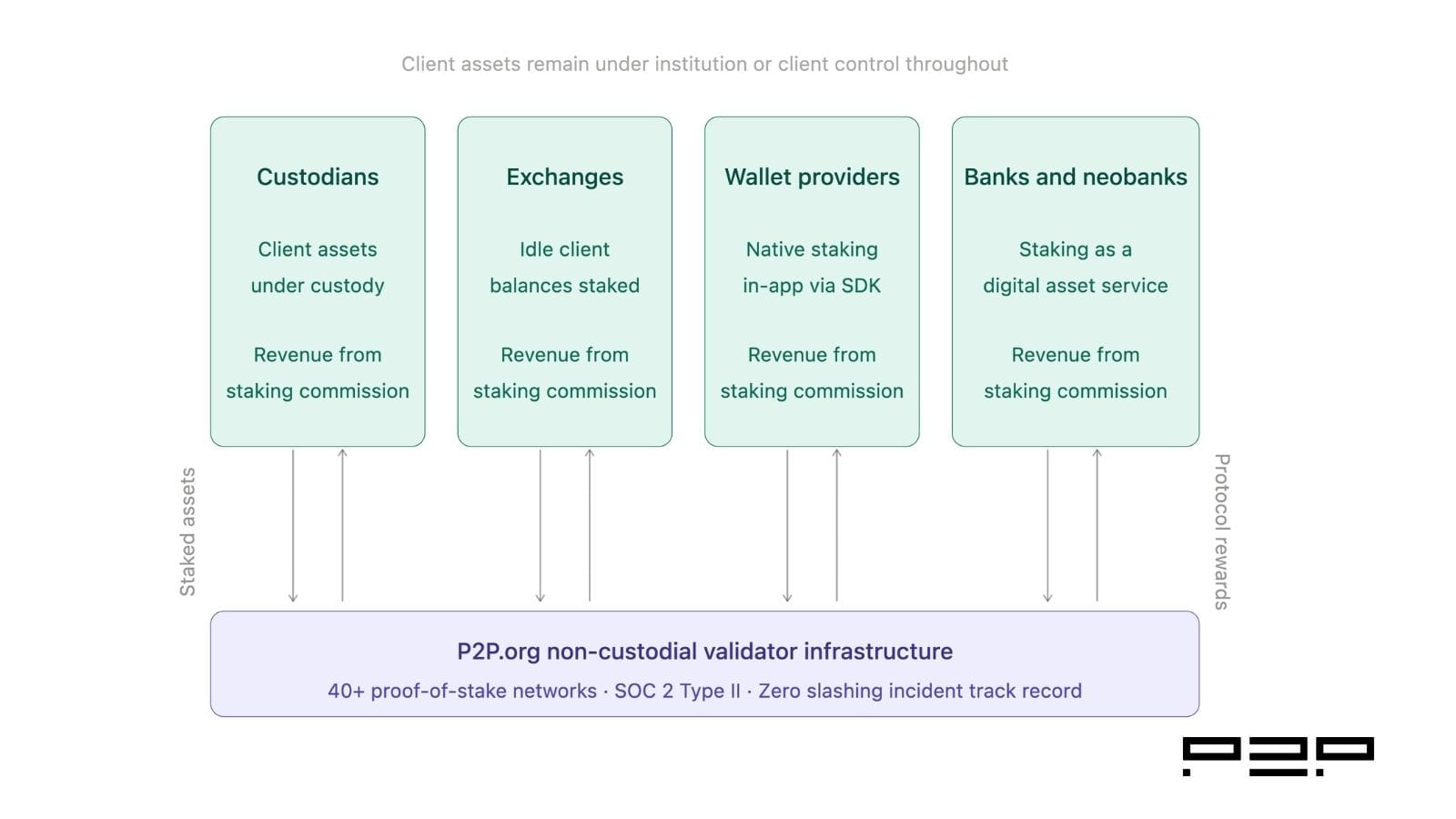
For custodians, this means staking revenue sits alongside custody fees as a recurring revenue stream on existing client assets, with no additional capital deployment required. For exchanges, staking revenue diversifies the fee income model away from pure trading volume dependency. For wallet providers, staking transforms a free utility into a revenue-generating product. For banks and neobanks, staking is a new digital asset service that deepens client relationships and increases assets under management.
Institutional participation in staking reached a watershed moment in early 2026, with over $58 billion in capital flowing through liquid staking protocols and an additional $19 billion in restaking, signaling that staking has evolved from a crypto-native activity into a mainstream institutional revenue category. Source: AMINA Group
Network conditions determine protocol-generated rewards and are variable. P2P.org does not control or set reward rates.
The Four Institutional Segments Building Staking Businesses in 2026
Staking as a business looks different for each institutional segment. The infrastructure requirements, compliance frameworks, and integration models vary by business type.
The four institutional segments running staking as a business. Custodians, exchanges, wallet providers, and banks each sit above a shared non-custodial validator infrastructure layer, with client assets flowing down and protocol-generated rewards flowing back up.
Custodians
For custodians, staking as a business is a natural extension of the core custody offering. Client assets are already held under custody. Adding staking means connecting those assets to validator infrastructure and enabling clients to earn protocol-generated rewards without moving their assets out of custody. The non-custodial architecture is essential: client assets remain in the custodian's custody throughout, and the validator provider operates infrastructure without ever holding the assets.
Custodians offering staking must address per-client reward attribution for reporting and audit purposes, slashing risk disclosures in client agreements, segregation of staked assets from firm capital as required under MiCA and applicable regulations, and integration with existing back-office reporting systems.
Exchanges
For exchanges, staking as a business converts idle digital asset balances into a productive service. Clients holding assets on the exchange can earn protocol-generated rewards without withdrawing to external wallets. The exchange earns commission revenue on those rewards.
The compliance consideration for exchanges is the distinction between custodial and non-custodial staking. In custodial arrangements, assets are held by the exchange and staked on the client's behalf. In non-custodial arrangements, the protocol architecture ensures assets remain attributable to the client throughout. The March 2026 SEC and CFTC joint interpretation confirmed that non-custodial, non-discretionary staking services do not constitute securities transactions, removing the primary US regulatory barrier to exchange staking programs. Source: Gibson Dunn
Wallet providers
For wallet providers, staking as a business transforms a free product into a revenue-generating one. Staking integration through an SDK or API allows wallet users to stake directly from the wallet interface. The wallet provider sets its commission rate and earns revenue on every staking delegation made through its platform.
The integration model matters for wallet providers. SDK-based integrations embed staking natively into the wallet interface with minimal engineering lift. API-based integrations offer more flexibility for custom product designs. In both cases, the validator infrastructure and key management are handled by the provider, not the wallet team.
Banks and neobanks
For banks and neobanks, staking as a business is a new digital asset revenue stream that sits alongside custody, trading, and lending services. The regulatory entry point varies by jurisdiction. In Europe, MiCA provides a framework for licensed digital asset service providers to offer staking. In the United States, the March 2026 SEC and CFTC interpretation clarified the securities law treatment of staking services, and the OCC simultaneously confirmed that national banks may offer crypto custody and ancillary services including staking.
Traditional banks are still negotiating permission to join the staking business in many jurisdictions, while neobanks and crypto-native fintechs are already earning revenue from it. The institutions that establish compliant staking infrastructure now will be better positioned when broader regulatory access is confirmed.
What the Infrastructure Layer Requires
Launching staking as a business requires more than a commercial agreement with a validator provider. The infrastructure layer must meet specific requirements across five dimensions.
Non-custodial architecture
Client assets must remain under the institution's or client's control throughout. The validator provider operates infrastructure but never holds assets. Withdrawal authority stays with the institution or client. This is the foundational requirement for institutional compliance frameworks and the architecture that satisfies both MiCA asset segregation requirements and US regulatory guidance on non-custodial staking.
Multi-network coverage
Clients hold digital assets across multiple proof-of-stake networks. A staking business that only covers Ethereum leaves revenue on the table from Solana, Polkadot, Cosmos, and other networks where clients have holdings. Infrastructure coverage across 40 or more proof-of-stake networks is the standard requirement for institutional staking business programs in 2026.
Per-client reward attribution
At the institutional level, reward reporting must be attributed per client, per network, per epoch. Aggregate reporting is not sufficient for clients with their own accounting, tax reporting, and audit obligations. The infrastructure provider must deliver granular reward data in formats compatible with the institution's back-office systems and its clients' reporting requirements.
Integration flexibility
Different business types require different integration models. Custodians typically integrate through API. Wallet providers integrate through SDK. Exchanges may use either model depending on their technical architecture. The infrastructure provider must support both integration paths with documented APIs, sandbox environments, and technical support for the integration process.
Compliance and certification
The institution's compliance team and its clients will require independent validation of the infrastructure provider's operational controls. SOC 2 Type II certification is the floor requirement for institutional vendor onboarding. ISO 27001 certification is relevant for data governance obligations, particularly under MiCA. Incident disclosure history, slashing track record, and governance participation policies round out the compliance picture.
The Non-Custodial Model and Why It Matters for Compliance
The architecture distinction between custodial and non-custodial staking is not just a technical detail. It is the compliance decision that determines the regulatory treatment of the staking business an institution operates.
In a custodial staking arrangement, the institution or its provider holds client assets. That custody relationship triggers additional regulatory obligations in most institutional compliance frameworks, including capital adequacy requirements, segregation obligations, and in some jurisdictions, licensing requirements that apply to custodians of client assets.
In a non-custodial staking arrangement, client assets remain under the client's control throughout. The delegation happens at the protocol level. Withdrawal authority stays with the client. The validator provider operates infrastructure only. This architecture avoids the custody implications that would trigger the additional regulatory obligations associated with holding client assets.
For institutions launching staking as a business, the non-custodial model is the architecture that most compliance frameworks require. It is also the architecture that the March 2026 SEC and CFTC interpretation specifically addressed as not constituting a securities transaction, when operated on a non-discretionary basis.
P2P.org operates non-custodial validator infrastructure across more than 40 proof-of-stake networks. Our Staking-as-a-Business product is designed for custodians, exchanges, wallet providers, and banks that want to launch staking revenue streams without building or operating validator infrastructure themselves. Client assets remain under the institution's or client's control throughout.
Explore P2P.org's Staking-as-a-Business infrastructure at P2P.org.
Due Diligence Checklist: Evaluating a Staking-as-a-Business Partner
For custodians, exchanges, wallet providers, neobanks, and banks evaluating an infrastructure partner for a staking business program, these are the foundational questions to answer before committing to a partnership.
Architecture and custody
[ ] Is the infrastructure provider's model non-custodial throughout the staking lifecycle? [ ] Does client withdrawal authority remain with the institution or client at all times? [ ] Is the non-custodial architecture independently documented and auditable?
Network coverage
[ ] How many proof-of-stake networks does the provider support? [ ] Does coverage include the networks where your clients hold the most assets? [ ] What is the process for adding new network support as your client base evolves?
Per-client reporting
[ ] Can the provider deliver per-client reward attribution at the epoch level? [ ] Are reports available in formats compatible with your back-office and your clients' accounting systems? [ ] Is there a documented audit trail for every delegation, reward distribution, and operational event?
Integration
[ ] Does the provider support API integration, SDK integration, or both? [ ] What is the documented onboarding timeline and technical support process? [ ] Is a sandbox environment available for testing before production deployment?
Compliance and certification
[ ] Does the provider hold SOC 2 Type II certification covering security and availability? [ ] Is ISO 27001 certification in place for information security management? [ ] What is the provider's slashing track record across all networks they operate on? [ ] Can the provider supply the compliance documentation your legal and audit teams require for vendor onboarding?
Commercial terms
[ ] Is the commission structure configurable per client segment, network, and product tier? [ ] What are the SLA commitments for validator uptime and incident response? [ ] Is there a documented indemnification framework for slashing events?
Key Takeaway
Staking as a business is a revenue stream built on proof-of-stake infrastructure that custodians, exchanges, wallet providers, and banks can launch without building or operating validators themselves. The non-custodial model keeps client assets under client control, satisfies institutional compliance frameworks, and aligns with the regulatory treatment confirmed by US and European regulatory guidance in 2025 and 2026.
The market is growing fast, and the competitive dynamic is already visible. Neobanks and exchanges are earning staking revenue. Traditional banks are building toward it. The institutions that establish compliant staking infrastructure and launch client-facing staking products now will be best positioned as staking becomes a standard component of the institutional digital asset service stack.
Network conditions determine protocol-generated rewards and are variable. P2P.org does not control or set reward rates. Slashing risks are protocol-defined and client-borne. Operational safeguards are implemented to reduce exposure but do not eliminate protocol-level risk.
Frequently Asked Questions (FAQs)
What is staking-as-a-business?
Staking as a business is the commercial model in which a custodian, exchange, wallet provider, or bank offers staking services to its clients or deploys its own assets into proof-of-stake protocols to generate protocol-defined rewards, using third-party validator infrastructure rather than self-operated validators. It differs from an institutional treasury staking program in that it is a client-facing product or revenue stream, not just a strategy for the institution's own assets. The institution sets a commission rate on protocol-generated rewards, earns that margin as revenue, and passes the remainder to clients.
Who runs staking-as-a-business?
Staking as a business is run by custodians, exchanges, wallet providers, neobanks, and banks. Custodians add staking as a revenue stream on assets already held under custody. Exchanges offer staking to convert idle client balances into productive positions. Wallet providers embed staking into their interface to transform a free product into a revenue-generating one. Banks and neobanks offer staking as a digital asset service alongside custody, trading, and lending. Each segment has distinct integration requirements, compliance frameworks, and commercial models.
What is the difference between custodial and non-custodial staking-as-a-business?
In a custodial staking business, the institution holds client assets and stakes them on the client's behalf. This triggers additional regulatory obligations in most institutional compliance frameworks, including capital adequacy requirements and segregation obligations. In a non-custodial staking business, client assets remain under the client's control throughout. Delegation happens at the protocol level, and withdrawal authority stays with the client. The validator provider operates infrastructure only. The non-custodial model is the architecture most institutional compliance frameworks require and the one that aligns with current US and European regulatory guidance on staking services.
What infrastructure does a staking business require?
A staking business requires non-custodial validator infrastructure covering the proof-of-stake networks where clients hold assets, per-client reward attribution at the epoch level for reporting and audit purposes, API or SDK integration options for embedding staking into existing products, and independent certification of the infrastructure provider's operational controls, including SOC 2 Type II. The institution sets the commercial layer, including commission rates and client terms. The validator provider operates the technical layer, including node operations, key management, monitoring, and reward distribution.
How do custodians launch staking-as-a-business?
Custodians launch staking as a business by partnering with a non-custodial validator infrastructure provider, integrating the provider's API into their custody platform, configuring per-client commission rates, and enabling clients to stake directly from their existing custody accounts. The non-custodial architecture ensures client assets remain in custody throughout. The validator provider handles node operations, key management, and reward distribution. The custodian handles client onboarding, reporting, and compliance documentation for its own regulatory obligations.
What are the regulatory requirements for staking-as-a-business?
In the United States, the March 2026 SEC and CFTC joint interpretation confirmed that non-custodial, non-discretionary staking services do not constitute securities transactions. The OCC simultaneously confirmed that national banks may offer crypto custody and ancillary staking services. In Europe, MiCA provides a framework for licensed digital asset service providers to offer staking, with requirements for asset segregation and capital adequacy. The regulatory treatment of staking services varies by jurisdiction and business model. Each institution's legal and compliance advisors must assess the applicable requirements for their specific operating markets and client base.
What commission structure is standard in staking-as-a-business programs?
Commission structures in staking-as-a-business programs are configurable and vary by institution, client segment, network, and product tier. The institution sets its own commission rate on top of the base protocol reward. The infrastructure provider takes its operational fee from that commission structure. Rates vary by network and market conditions. Institutions typically offer different commission tiers for different client segments, from retail to institutional, and different rates across different proof-of-stake networks based on reward levels and competitive dynamics.
About P2P.org
Founded in 2018, P2P.org helps institutional capital protect Digital Asset Yield across non-custodial staking infrastructure and curated DeFi strategies. With over $10B in assets secured and operating on 35+ proof-of-stake networks, P2P.org maintains a zero-slashing-incident track record, is trusted by over 190 institutional clients and is SOC 2 Type II attested and ISO/IEC 27001:2022 certified. To explore how P2P.org can support your institution's staking or DeFi infrastructure needs, get in touch with our team.
Disclaimer
This material is provided for informational purposes only and does not constitute investment, financial, legal, or tax advice. P2P.org accepts no liability for any actions taken based on it. Latency and performance figures referenced are estimates based on internal benchmarks and may vary depending on network conditions, geography, and client infrastructure. Past performance is not indicative of future results.
Subscribe to P2P-economy
Get the latest posts delivered right to your inbox
<p>Each month, we publish a full breakdown of how our Solana validators performed against the rest of the field: gross rewards, MEV capture, and reliability, all sourced from our own on-chain data collectors and reproducible from raw epoch data. Here's how we performed in August, covering epochs 1010 to 1025. </p><p><strong>The headline</strong></p><p>Almost every Solana validator earns close to the same base reward. Issuance, the protocol-set portion of staking rewards, is identical for any correctly run validator. What actually separates operators is what they capture on top of that base: MEV and reliability.</p><p>In August, P2P.org's Total Gross APY came in at 6.16%, just ahead of the next-best validator we track at 6.11%. The gap is small because most of that return is the same base reward every validator earns. </p><figure class="kg-card kg-image-card"><img src="https://p2p.org/economy/content/images/2026/09/1600x900--47-.png" class="kg-image" alt="Bar chart comparing P2P.org's 6.16% Total Gross APY against the next-best peer validator's 6.11% for August 2026." loading="lazy" width="1600" height="900" srcset="https://p2p.org/economy/content/images/size/w600/2026/09/1600x900--47-.png 600w, https://p2p.org/economy/content/images/size/w1000/2026/09/1600x900--47-.png 1000w, https://p2p.org/economy/content/images/2026/09/1600x900--47-.png 1600w" sizes="(min-width: 720px) 720px"></figure><p><strong>Where the edge comes from</strong></p><p>MEV capture: P2P.org's Jito tips rate ran at 0.39%, against a 0.26% simple network average. That's the one part of the reward validators actually compete on: tip volume carries a real element of market luck, but capturing it consistently comes down to validator-client configuration, MEV-strategy setup, and being present for every assigned slot.</p><figure class="kg-card kg-image-card"><img src="https://p2p.org/economy/content/images/2026/09/1600x900--44--2.png" class="kg-image" alt="Bar chart comparing P2P.org's 0.39% Jito tips APY against a 0.26% simple network average for August 2026." loading="lazy" width="1600" height="900" srcset="https://p2p.org/economy/content/images/size/w600/2026/09/1600x900--44--2.png 600w, https://p2p.org/economy/content/images/size/w1000/2026/09/1600x900--44--2.png 1000w, https://p2p.org/economy/content/images/2026/09/1600x900--44--2.png 1600w" sizes="(min-width: 720px) 720px"></figure><p>Reliability: Across vote success, block production, and uptime, P2P.org ran ahead of the network average for validators with 100k+ SOL staked, on every metric, in August:</p><figure class="kg-card kg-image-card"><img src="https://p2p.org/economy/content/images/2026/09/1600x900--45-.png" class="kg-image" alt="Table comparing P2P.org against network average across three reliability metrics for August 2026: vote success at 99.8% versus 99.0%, block production at 100.0% versus 99.5%, and uptime at 100.0% versus 99.4%." loading="lazy" width="1600" height="900" srcset="https://p2p.org/economy/content/images/size/w600/2026/09/1600x900--45-.png 600w, https://p2p.org/economy/content/images/size/w1000/2026/09/1600x900--45-.png 1000w, https://p2p.org/economy/content/images/2026/09/1600x900--45-.png 1600w" sizes="(min-width: 720px) 720px"></figure><p><strong>Why this matters going forward</strong></p><p>Solana's SGP-0002 vote, passed in August, doubles the pace at which the issuance (base reward) component declines over the next three years. As that shared portion shrinks, MEV and reliability make up more of what a validator actually earns, and more of what separates one from another.</p><p>The full breakdown, including the reward-composition chart, the full peer comparison, and our methodology, is available here: </p><h3 id="read-the-august-2026-solana-staking-snapshot"><a href="https://2e4kdb.share-eu1.hsforms.com/2vrb-vR6VRtCUQrjQA6mhjg?ref=p2p.org"><strong>Read the August 2026 Solana Staking Snapshot</strong></a><br></h3><p>If you're staking on Solana, or considering it, reach out to your account manager or visit p2p.org to get started.<br></p><div class="kg-card kg-toggle-card" data-kg-toggle-state="close">
<div class="kg-toggle-heading">
<h4 class="kg-toggle-heading-text"><span style="white-space: pre-wrap;">FAQ</span></h4>
<button class="kg-toggle-card-icon" aria-label="Expand toggle to read content">
<svg id="Regular" xmlns="http://www.w3.org/2000/svg" viewBox="0 0 24 24">
<path class="cls-1" d="M23.25,7.311,12.53,18.03a.749.749,0,0,1-1.06,0L.75,7.311"></path>
</svg>
</button>
</div>
<div class="kg-toggle-content"><p dir="ltr"><b><strong style="white-space: pre-wrap;">What is Total Gross APY?</strong></b><span style="white-space: pre-wrap;"> It's the combined annualized rate from all three Solana validator reward types: staking (issuance), Jito tips, and block rewards, before any commission is deducted.</span></p><p dir="ltr"><b><strong style="white-space: pre-wrap;">Why does P2P.org report a different APY than sites like Staking Rewards?</strong></b><span style="white-space: pre-wrap;"> A few reasons: whether compounding is included (APY vs. APR), whether commission is deducted (gross vs. net), which reward types are counted, and how the averaging window is defined. None of these methodologies is wrong; they're just measuring different things. We publish our full methodology alongside the raw data on our dashboard.</span></p><p dir="ltr"><b><strong style="white-space: pre-wrap;">Is this the APY I'd actually earn if I staked with P2P.org?</strong></b><span style="white-space: pre-wrap;"> This report shows gross rewards, before commission. Your actual net rewards depend on P2P.org's fee and your specific delegation. Contact your account manager for the exact numbers.</span></p><p dir="ltr"><b><strong style="white-space: pre-wrap;">How often is this published? </strong></b><span style="white-space: pre-wrap;">Monthly, covering the prior month's epochs.</span></p><p dir="ltr"><b><strong style="white-space: pre-wrap;">Can I check these numbers myself?</strong></b><span style="white-space: pre-wrap;"> Yes. All the raw epoch-level data behind this report is exportable from our public dashboard at </span><a href="http://reports.p2p.org/superset/dashboard/p/WMGBkJ8LvPz/?ref=p2p.org"><span style="white-space: pre-wrap;">reports.p2p.org</span></a><span style="white-space: pre-wrap;">, along with the calculation methodology.</span></p></div>
</div><p><strong>Disclaimer</strong></p><p><em>This material is provided for informational purposes only and does not constitute investment, financial, legal, or tax advice. </em><a href="http://p2p.org/?ref=p2p.org"><em>P2P.org</em></a><em> accepts no liability for any actions taken based on it. Latency and performance figures referenced are estimates based on internal benchmarks and may vary depending on network conditions, geography, and client infrastructure. Past performance is not indicative of future results.</em></p>
 ALL
Agoric
Aptos
Auth
Avail
Avalanche
Axelar
Babylon
Bitcoin
bouldertech
BTC
capital flow
Cardano
Celestia
certifications
Chainlink
compliance
Cosmos
Crescent
curator
Cyberway
DAOBet
Data stream
DeFi
defi dispatch
defi infrastrcuture
defi infrastructure
defi news
defi vault
due diligence
DVT
Dymension
Economy
Education
EigenLayer
Elrond
employee
employee advocacy
employee interviews
ETF
Ethereum
Evmos
exit queue
Explain Like I'm Five
Governance
Guide
hedge fund
how to
HR
HUB series
Hyperliquid
infrastructure
institutional lens
institutional staking
ISO 27001
ISO/IEC 27001:2022
Issuer
Kava
Kusama
landing
latin america
legal layer
legislation
Lido
liquid staking
LSP
Manta
Mantle
Marlin
Matic
MEV
MiCA
Moonbeam
MultiversX
Near
Networks
News
NuCypher
Oasis
Obol
Origin
P2P Verified
Partnership
pectra
Persistence
playbook
Pocket
Polkadot
Polygon
product
products
Quicksilver
Regen
regulation
ALL
Agoric
Aptos
Auth
Avail
Avalanche
Axelar
Babylon
Bitcoin
bouldertech
BTC
capital flow
Cardano
Celestia
certifications
Chainlink
compliance
Cosmos
Crescent
curator
Cyberway
DAOBet
Data stream
DeFi
defi dispatch
defi infrastrcuture
defi infrastructure
defi news
defi vault
due diligence
DVT
Dymension
Economy
Education
EigenLayer
Elrond
employee
employee advocacy
employee interviews
ETF
Ethereum
Evmos
exit queue
Explain Like I'm Five
Governance
Guide
hedge fund
how to
HR
HUB series
Hyperliquid
infrastructure
institutional lens
institutional staking
ISO 27001
ISO/IEC 27001:2022
Issuer
Kava
Kusama
landing
latin america
legal layer
legislation
Lido
liquid staking
LSP
Manta
Mantle
Marlin
Matic
MEV
MiCA
Moonbeam
MultiversX
Near
Networks
News
NuCypher
Oasis
Obol
Origin
P2P Verified
Partnership
pectra
Persistence
playbook
Pocket
Polkadot
Polygon
product
products
Quicksilver
Regen
regulation