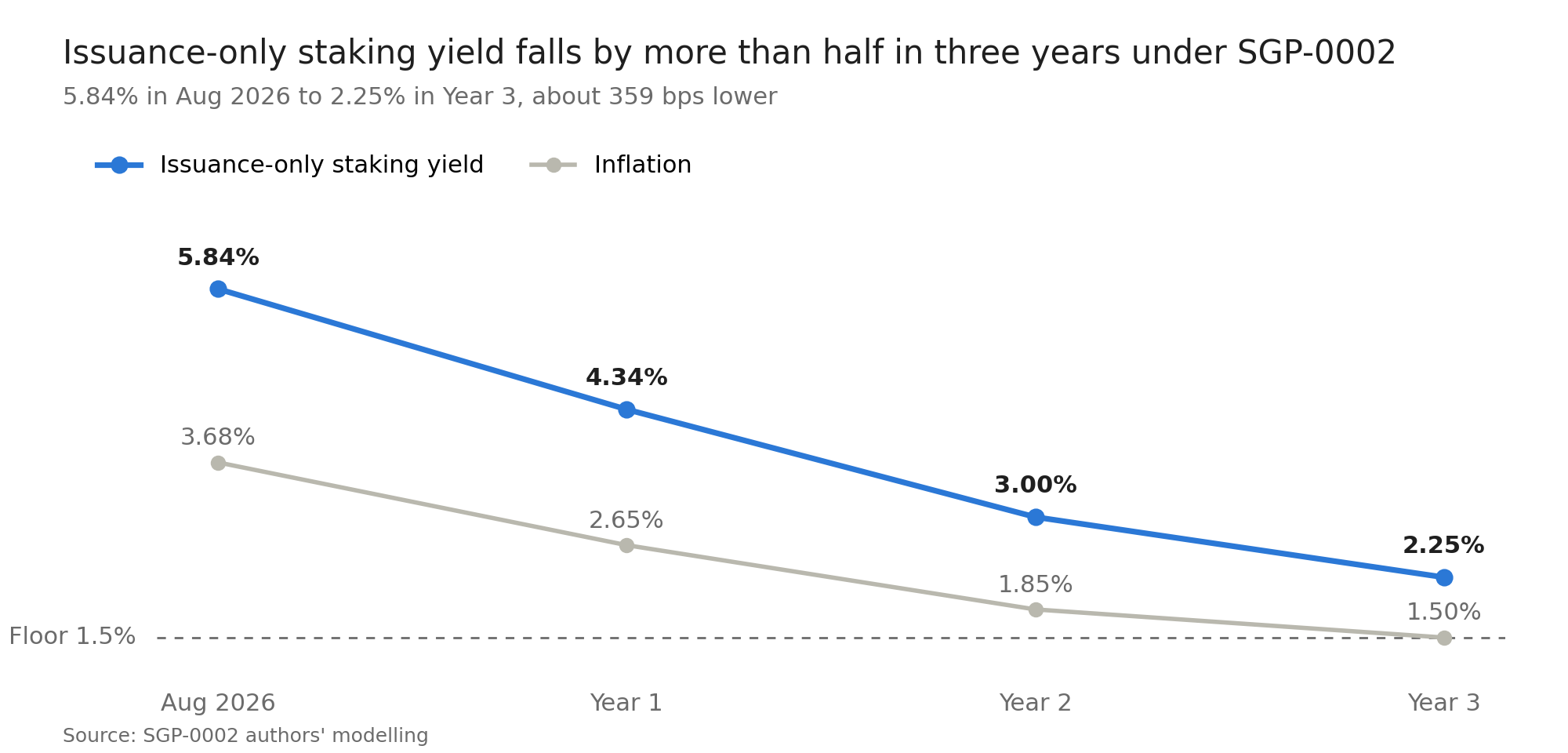
After Q3's governance vote, issuance-only staking yield on Solana is set to fall by about 150 bps next year.
More of what a delegator earns will depend on the operator, and since 8 September, that has become harder to check.
Institutional demand grew alongside these changes. Staked SOL reached a record 441M, SOL spot ETPs took in $492M of net inflows, four times Q2, and Charles Schwab and Morgan Stanley's E*Trade opened SOL trading to their clients (Blockworks). Every staked ETP or treasury position sits behind an operator someone had to choose. The largest treasury holder, Forward Industries, stakes nearly all of its roughly 7.8M SOL through its own validator.
This report covers the quarter from the operator side, with data from our three public validators.
TL;DR
SGP-0002, Solana's first binding governance vote, passed with 67.001% For. Once implemented, issuance-only staking yield is modelled to drop from about 5.84% to about 4.34% in year one.
Network priority fees rose 37% in July and 32% in August, then fell 20% in September. How much of that reaches delegators depends on the operator.
On 8 September, Solana stopped recording the commission rate applied to each reward. We caught it on the first affected payout because our tests check that field.
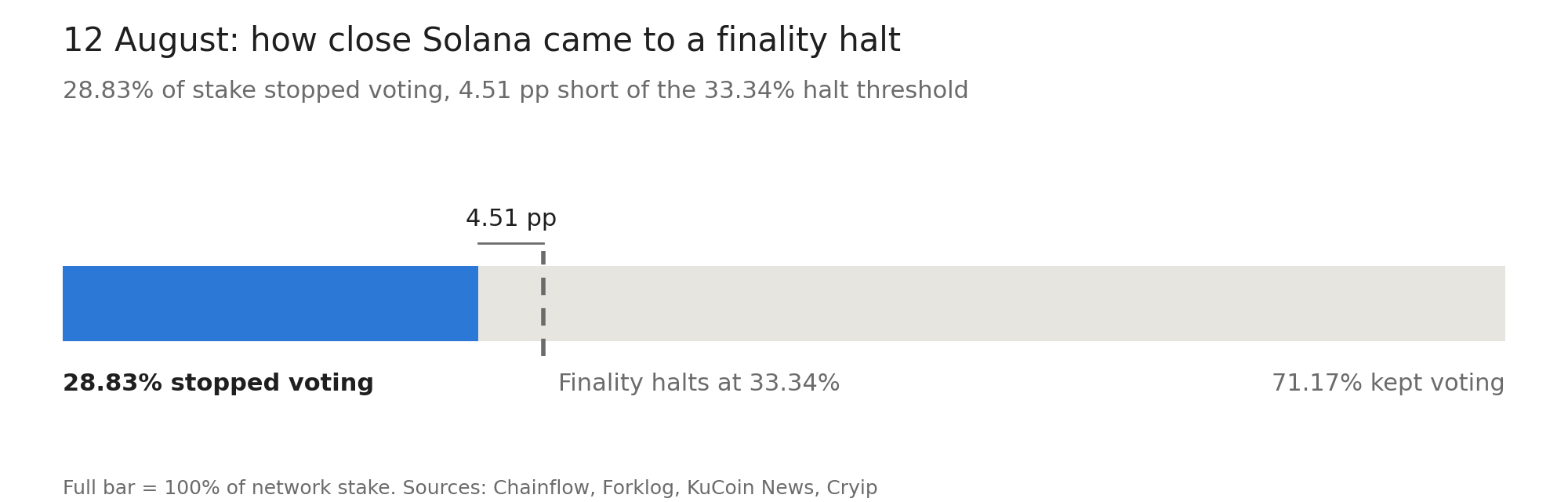
On 12 August, a TeraSwitch routing failure took 28.83% of stake offline for about 33 minutes, 4.51 pp short of a finality halt. Our three public validators kept 100% uptime that month.
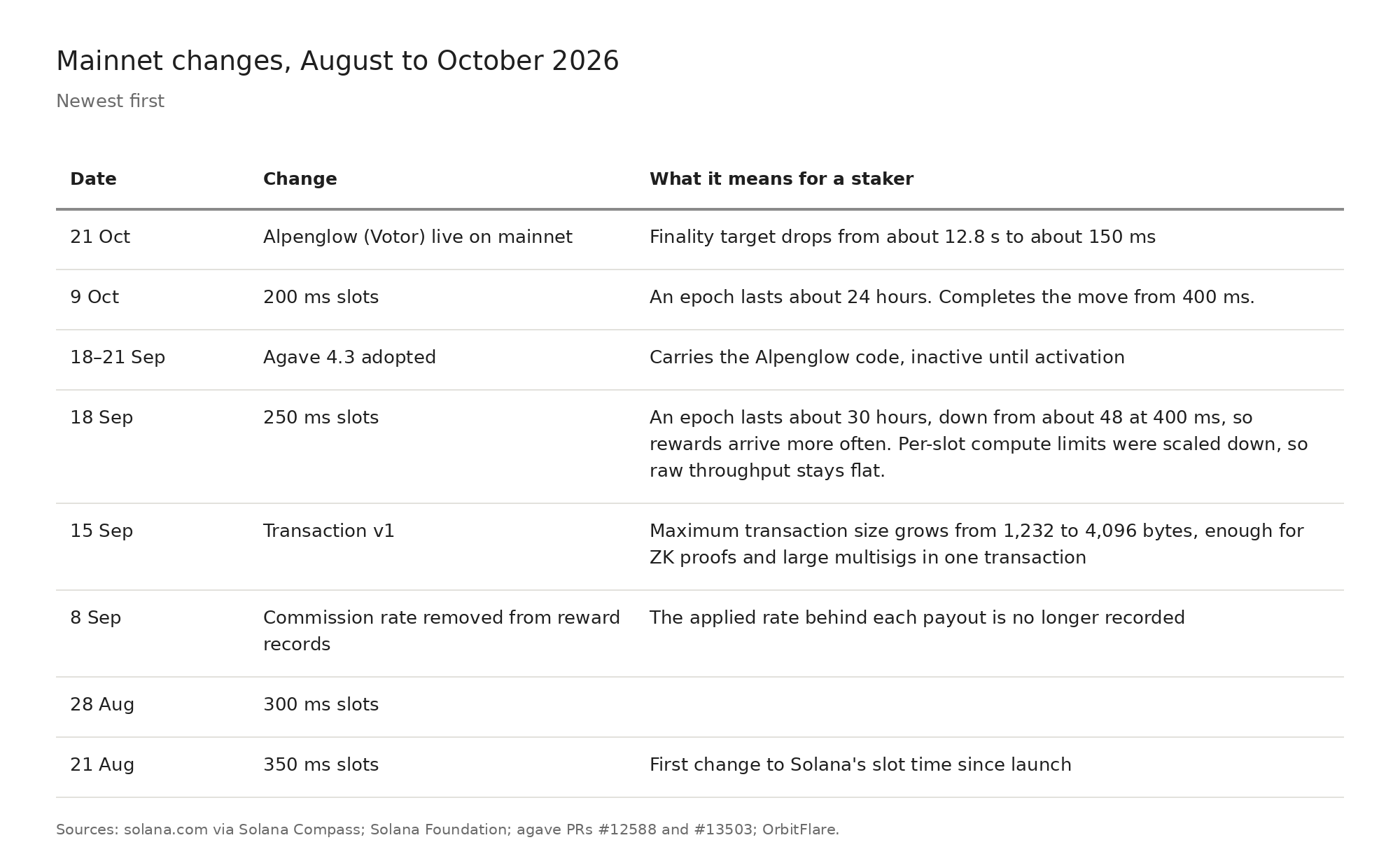
Mainnet went from 400 ms to 200 ms slots between 19 August and 9 October. Alpenglow - TowerBFT was replaced on 21 October.
1. The first binding vote
Solana's first binding governance vote doubled the disinflation rate.
Once the new schedule is implemented, it removes about 150 bps of issuance-only staking yield in year one.
SGP-0002 (Double Disinflation) closed on 28 August with 67.001% For against a 66.67% threshold, on 60.7% turnout. Seventy minutes before close, it was losing by about 58M SOL, until Kraken reversed its vote and delegator overrides carried it over the threshold. SGP-0001 (Solana Constitution) also passed. SGP-0003 (Resource and Inclusion Fee) failed.
What changes once the schedule is implemented and activated:
The annual disinflation rate moves from 15% to 30%. The 1.5% floor stays, and Solana reaches it around 2029 instead of around 2032.
About 18.9M SOL of issuance disappears over six years.
The voting process changed too. Validators now vote with the weight of the stake delegated to them, and delegators can override their validator's vote on each proposal. That makes an operator's voting record part of due diligence.
We published our SGP-0002 voter guide before the vote and gave clients step-by-step instructions in case they’d want to override our vote.2. Blockspace revenue
The part of staking yield that comes from blockspace depends on the operator. In Q3, it grew.
Network priority fees rose 37% month-on-month in July and 32% in August, then eased 20% in September: about 540K SOL for the quarter. Blocks also grew: on 29 July the per-block compute limit rose from 60M to 100M units, a 66% increase, leaving more room for fee-paying transactions in every leader slot.The average block-reward APR across validators with more than 50K SOL rose from 0.39% in June to 0.60% in August.
Priority fees now make up about two-thirds of the network's fee revenue, yet issuance still accounted for about 98% of what stakers earned in Q3 (Blockworks). As issuance falls, closing that gap becomes the main question for delegators. Blockworks calls in-protocol fee sharing the single largest pending improvement to staker value accrual.
A market formed around that value:
Validator clients are adding specialized schedulers and transaction-inclusion networks that pool order flow across landing services.
Blockspace is being sold through two-sided marketplaces: shred streams, stake-weighted QoS, and private transaction routing.
Managed landing and optimization services are on offer, some claiming reward uplifts above the network average.
In September, Corvus Labs traced private order-flow payments to named validators. Separate public allegations accused a group of validators of slot lagging: delaying blocks to capture more fees.
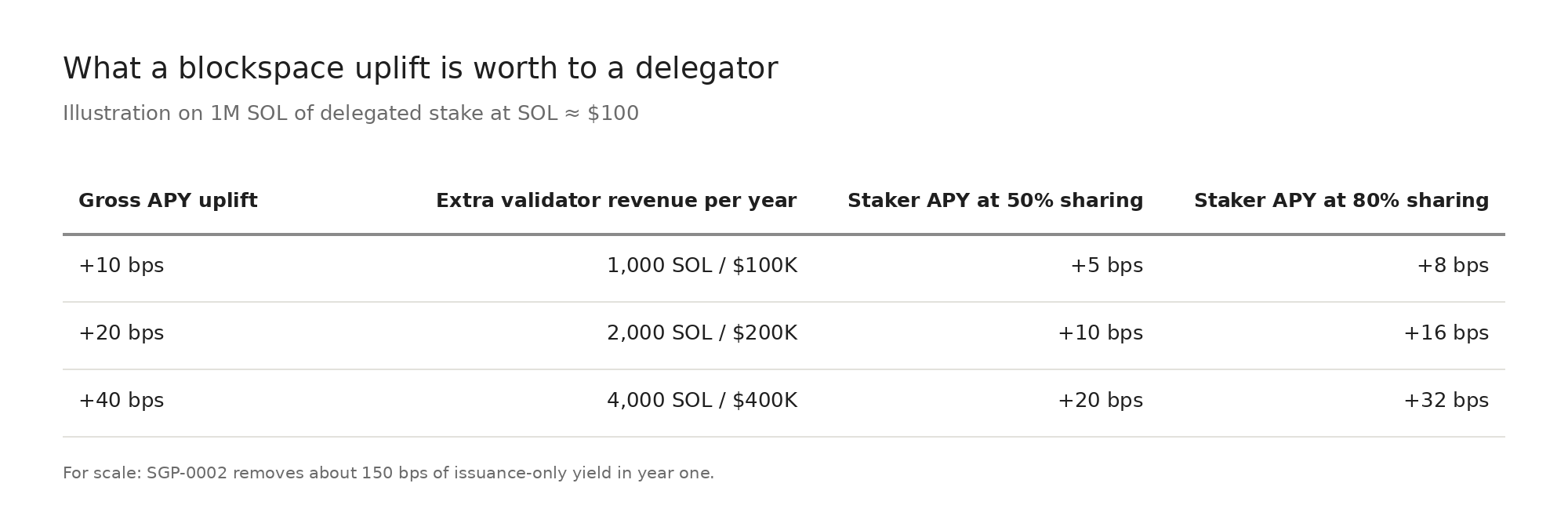
For scale, SGP-0002 removes about 150 bps of issuance-only yield in year one. Blockspace revenue can make up some of that, which is why it became one of the most discussed topics on Solana this quarter.
The debate also raised questions the market has yet to settle: which blockspace practices are acceptable, how that revenue is disclosed, and how much of it reaches delegators. For a delegator, these are now fair questions to put to any operator.
On the last one, protocol support is on the way: the validator client already contains logic to pay block rewards to stakers through a separate block-reward commission that each validator opts into.
On the toxic end of the spectrum, our position is unchanged: P2P.org opposes sandwich attacks, front-running, any other form of toxic MEV.3. The missing commission record
From 8 September, Solana stopped recording the commission rate applied to each epoch's rewards. Commission is charged as before and reward amounts still reconcile. Only the record of which rate produced each payout is gone.
The change came with a client update that prepares for custom commission collectors, and it affects both voting and staking reward records. It shipped without an announcement, and third-party migration guides kept showing the old format. We caught it on the first affected epoch, and raised it with both Solana Foundation and Anza.
What it means for reporting:
The network shows only the rate a validator charges now: Recovering the rate behind a past payout means replaying each validator's commission history and rebuilding where stake was delegated at the time.
History before 8 September is intact: After that, anyone who didn't record the state themselves has to reconstruct it, and the gap grows every epoch.
A reward figure in a client report has to trace back to the on-chain record it came from: Gross rewards and the commission taken from them used to sit in that same record.
Once validators set custom collectors, a voting reward record will no longer show which validator earned it: Amounts pooled across vote accounts that share a collector can't be split back.
Most staking reports have a version of this problem already. They are built on snapshots of stake accounts, taken daily or per epoch, and splits, authority changes, and stray transfers between snapshots leave gaps. Balances can be approximated but rarely tied to the transaction that changed them.
We have been rebuilding our data layer around transactions. It already reconstructs any stake account at any point in time from on-chain events and matches our snapshot data at 99.9% across millions of accounts. The same method rebuilds the delegation map at any past epoch, which is what recovering a historical commission rate requires.
4. Outage and upgrades
In Q3, mainnet came within 4.51 pp of a finality halt and changed its slot time three times. P2P.org validators kept voting through both.
12 August: the TeraSwitch outage
A routing failure at TeraSwitch's Miami site spread to its sites in Europe and Asia in the early hours of 12 August. TeraSwitch carried about 27% of network stake, and about 94% of it dropped at once. With other delinquent validators, 28.83% of stake stopped voting at the peak. Finality halts when delinquent stake reaches 33.34%.
The network kept producing blocks, more slowly. Slots led by offline validators produced no block, and transactions took noticeably longer to land. Routing was restored in about 33 minutes. Roughly 90 validators went delinquent and together missed about 333 SOL in rewards. 597 of 699 staked validators kept voting, and that spread across independent providers is what kept Solana running.
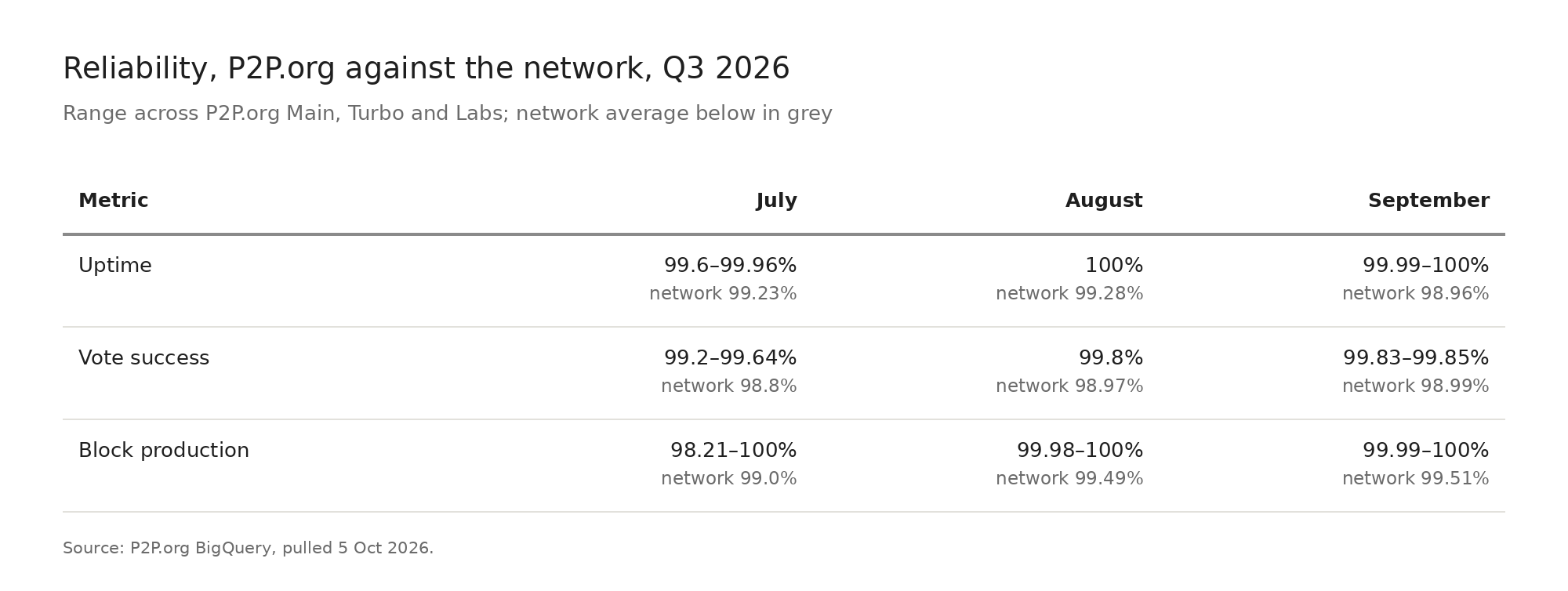
P2P.org Main, Turbo and Labs recorded 100% uptime and 99.8% vote success in August.
The validator set keeps thinning: 699 staked validators on 12 August against about 713 in Q2, and 633 validators above 50K SOL in September against 671 in June.
Alpenglow
Alpenglow's first phase, Votor, replaces TowerBFT on mainnet on 21 October at the start of epoch 1064 (Solana Foundation). It went live on testnet and devnet in late September. On testnet, the Solana Foundation reported more than 25,000 TPS and about 150 ms finality. P2P.org testnet validators went through the switch without incident.
What changes for a delegator:
The finality target drops from about 12.8 seconds to about 150 ms.
The network stays safe with up to 20% of stake acting maliciously and another 20% offline at the same time. TowerBFT's limit was under 33% in total.
Validator votes leave the block. They made up 54–59% of daily mainnet transactions in late September, so headline transaction counts will drop by that share with no change in real activity. Track non-vote transactions instead.
Firedancer and Frankendancer aren't supported during the migration, so operators running them move to Agave-based clients until Firedancer adds the new consensus.
Rotor, the second phase, changes how block data is distributed. It has no announced date.
5. Q3 performance
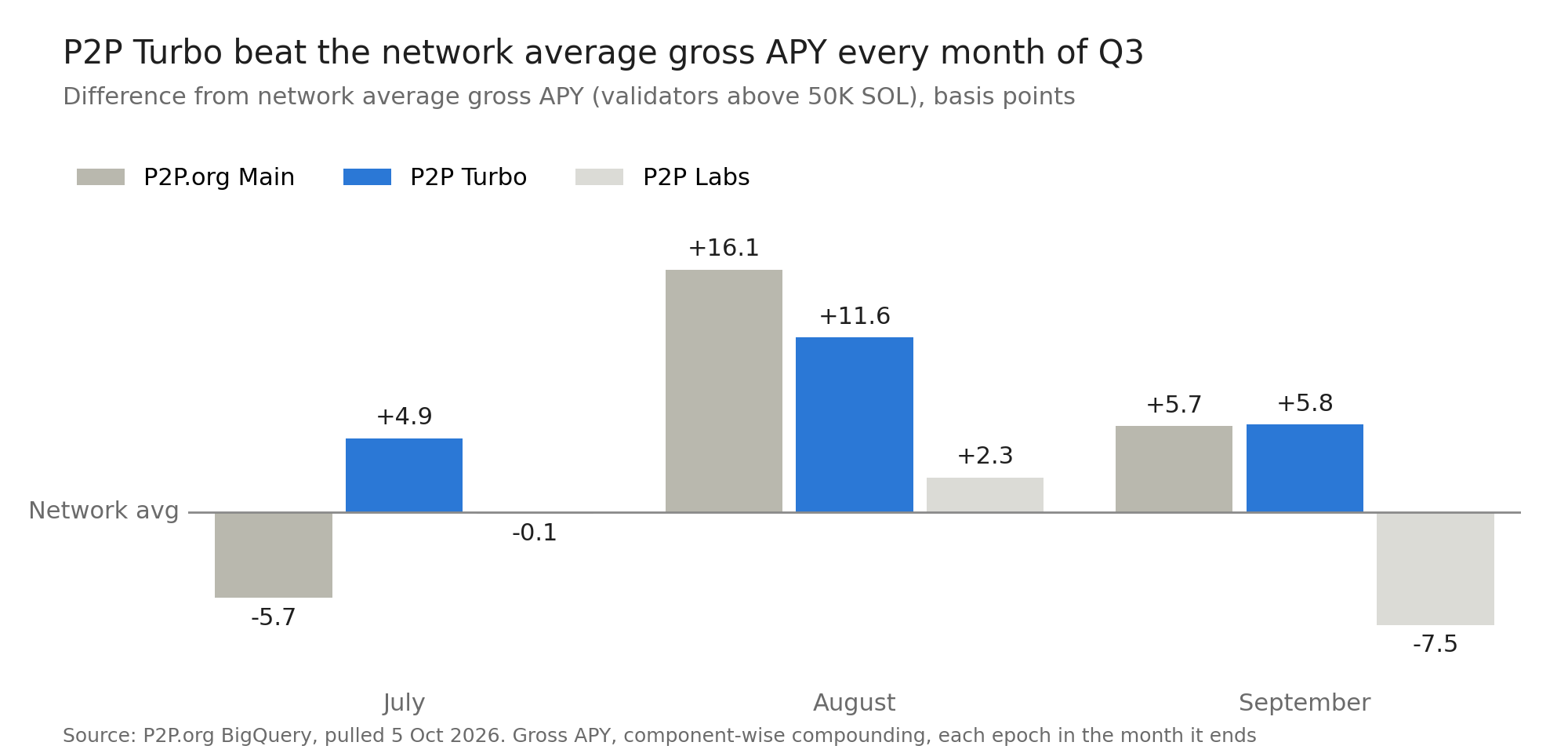
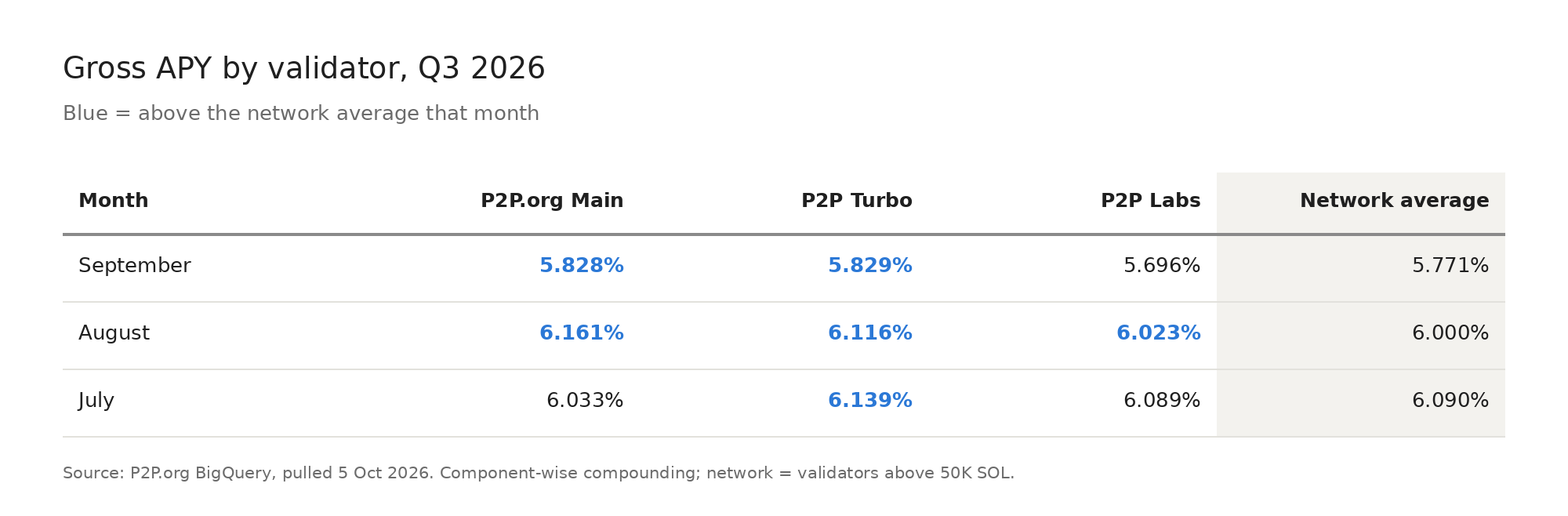
Network gross APY fell from 6.090% to 5.771% through the quarter as issuance followed its schedule. P2P Turbo stayed above the network average every month, and P2P.org Main was above it in August and September. Uptime and vote success beat the network average on every validator in every month.
Our MEV APR stayed above the network average every month: 0.19–0.39% against 0.12–0.15%. Our block-reward APR trailed the rising network average.
Block production beat the network average on every validator from August.
Method: gross APY with component-wise compounding, as published on our public dashboard. Network average covers validators with more than 50K SOL. Each epoch is attributed to the month it ends in. Full breakdown by validator and reward type: http://reports.p2p.org/superset/dashboard/p/NqGBo8lqQLw/
6. What to watch in Q4
Alpenglow on Mainnet: measured finality against the 150 ms target, stability in the first weeks, and when Firedancer adds support.
200 ms slots: how skip rates hold up at the new pace.
SGP-0002: implementation as a new issuance schedule, and its activation date.
Block-reward sharing: activation, and which validators opt in.
Commission data: a supported source for historical applied rates, or a reporting standard the industry agrees on.
For Solana reward reporting that reconciles to on-chain records: P2P.org
Disclaimer. This material is provided for informational purposes only and does not constitute investment, financial, legal, or tax advice. P2P.org accepts no liability for any actions taken based on it. Performance figures are based on P2P.org data and methodology and may differ from other sources. Past performance is not indicative of future results.
<p><strong>At a Glance</strong></p><ul><li>AMINA Bank AG and P2P.org have signed an MoU to co-develop institutional-grade products for professional and institutional investors</li><li>P2P.org is now integrated into AMINA's staking offering, strengthening its multi-network staking capabilities for professional and institutional clients</li><li>The collaboration addresses a structural gap: regulated institutions, such as wealth managers, banks, pension funds, and asset managers, remain limited to foundational staking while crypto-native participants access the full spectrum of capital efficiency strategies</li><li>AMINA Bank AG is a FINMA-regulated Swiss bank with regulated entities in Switzerland, Abu Dhabi, Austria/EU, and Hong Kong</li></ul><p>Institutional staking has matured rapidly. Tens of billions now flow through liquid staking protocols alone. But most of that infrastructure was built for self-custodial, crypto-native participants. Professional and institutional investors operate under a different set of constraints - segregation of client assets, KYC/AML obligations, custodial requirements, and fiduciary standards and existing tooling was built around different assumptions.</p><p>The result is a two-speed market. Crypto-native participants can access the full spectrum of staking-adjacent strategies and capital efficiency tools. Professional and institutional investors remain largely limited to foundational staking-locking assets for modest staking rewards, with capital sitting idle and more sophisticated strategies out of reach within their regulatory framework. </p><figure class="kg-card kg-image-card"><img src="https://p2p.org/economy/content/images/2026/10/Screenshot-2026-10-29-at-14.19.34.png" class="kg-image" alt="" loading="lazy" width="1124" height="660" srcset="https://p2p.org/economy/content/images/size/w600/2026/10/Screenshot-2026-10-29-at-14.19.34.png 600w, https://p2p.org/economy/content/images/size/w1000/2026/10/Screenshot-2026-10-29-at-14.19.34.png 1000w, https://p2p.org/economy/content/images/2026/10/Screenshot-2026-10-29-at-14.19.34.png 1124w" sizes="(min-width: 720px) 720px"></figure><p>The gap is not only about yield. Professional and institutional investors that allocate to digital assets increasingly expect the same range of tools available to other asset classes, but delivered within frameworks that meet their regulatory and fiduciary obligations. For most, that infrastructure doesn’t exist yet. </p><p><strong>The Collaboration</strong></p><p>AMINA Bank AG and P2P.org have signed a Memorandum of Understanding to co-develop next-generation institutional-grade digital asset products. </p><p>P2P.org is now integrated into AMINA's staking offering, joining the bank's existing roster of institutional staking providers. The integration strengthens AMINA's multi-network staking capabilities for institutional clients, who can now access staking across a broader range of networks through their existing relationship with the bank. Clients can access staking across a broader range of networks through their existing relationship with AMINA with no validator management, custody migration, or new operational setup required.</p><figure class="kg-card kg-image-card"><img src="https://p2p.org/economy/content/images/2026/10/Screenshot-2026-10-29-at-14.20.01.png" class="kg-image" alt="" loading="lazy" width="1150" height="856" srcset="https://p2p.org/economy/content/images/size/w600/2026/10/Screenshot-2026-10-29-at-14.20.01.png 600w, https://p2p.org/economy/content/images/size/w1000/2026/10/Screenshot-2026-10-29-at-14.20.01.png 1000w, https://p2p.org/economy/content/images/2026/10/Screenshot-2026-10-29-at-14.20.01.png 1150w" sizes="(min-width: 720px) 720px"></figure><p>P2P.org has been operating staking infrastructure since 2018, securing over $10B in client assets across 40+ networks with a zero-slashing track record and SOC 2 Type II certification. The architecture is non-custodial throughout - P2P.org operates the staking validator infrastructure independently without holding or controlling client assets at any point. Client assets staked via P2P.org remain under AMINA’s custody at all times. Protocol-level staking rewards are variable and determined entirely by the relevant network.</p><p>Beyond the immediate integration, both parties intend to explore and co-design products that address the capital efficiency constraints facing professional and institutional investors - making advanced strategies accessible within a compliant, custodial framework.</p><p><strong>The Forward-Looking Direction</strong></p><p>Both parties intend to explore and co-design products that make advanced digital asset strategies accessible within a compliant, custodial framework. The goal is to make advanced strategies accessible within a regulated, custodial environment, bringing the full spectrum of what the asset class offers within reach for eligible clients that need to operate inside those frameworks.</p><p>The integration is live. The co-development work is what comes next.</p><p><strong>Get in Touch</strong></p><p>If you are evaluating staking infrastructure for your institution or exploring how to build compliant digital asset products for your clients, our institutional team is available to walk through the infrastructure, security model, and integration approach.</p><p>Learn more about staking at <a href="http://p2p.org/?ref=p2p.org">P2P.org</a>.</p><p><strong><em>Disclaimer</em></strong></p><p><em>This material is provided for informational purposes only and does not constitute investment, financial, legal, or tax advice. </em><a href="http://p2p.org/?ref=p2p.org"><em>P2P.org</em></a><em> accepts no liability for any actions taken based on it. Latency and performance figures referenced are estimates based on internal benchmarks and may vary depending on network conditions, geography, and client infrastructure. Past performance is not indicative of future results.</em></p><p></p>
 ALL
Agoric
Aptos
Auth
Avail
Avalanche
Axelar
Babylon
Bitcoin
bouldertech
BTC
capital flow
Cardano
Celestia
certifications
Chainlink
compliance
Cosmos
Crescent
curator
Cyberway
DAOBet
Data stream
DeFi
defi dispatch
defi infrastrcuture
defi infrastructure
defi news
defi vault
due diligence
DVT
Dymension
Economy
Education
EigenLayer
Elrond
employee
employee advocacy
employee interviews
ETF
Ethereum
Evmos
exit queue
Explain Like I'm Five
Governance
Guide
hedge fund
how to
HR
HUB series
Hyperliquid
infrastructure
institutional lens
institutional staking
ISO 27001
ISO/IEC 27001:2022
Issuer
Kava
Kusama
landing
latin america
legal layer
legislation
Lido
liquid staking
LSP
Manta
Mantle
Marlin
Matic
MEV
MiCA
Moonbeam
MultiversX
Near
Networks
News
NuCypher
Oasis
Obol
Origin
P2P Verified
Partnership
pectra
Persistence
playbook
Pocket
Polkadot
Polygon
product
products
Quicksilver
Regen