P2P.org's 2025 Wrapped: The Year We Led Institutional Staking
At a Glance:
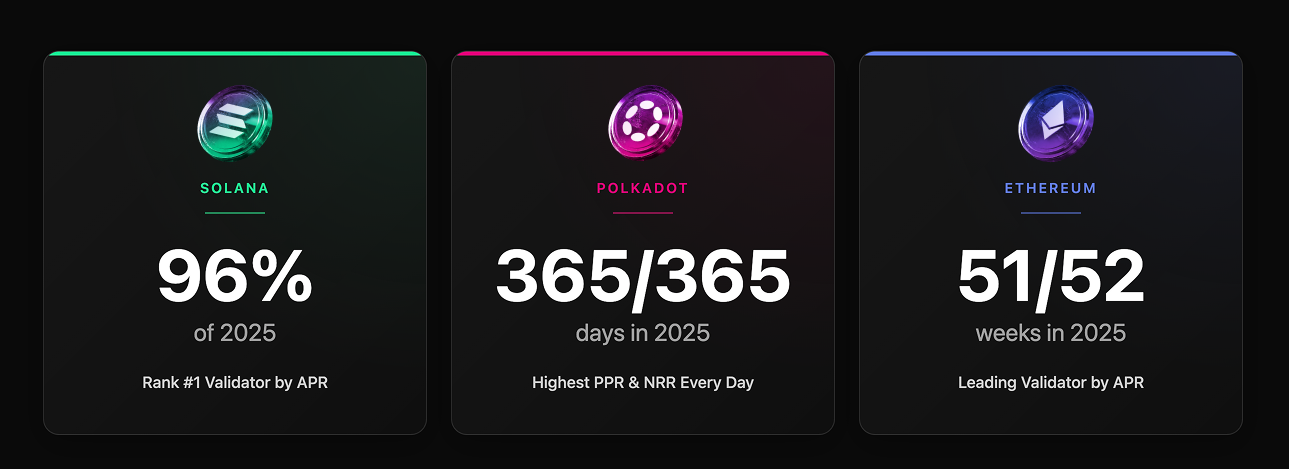
P2P.org held #1 validator position by APR on Solana for 96%+ of the year, achieved the highest PPR and NRR on Polkadot every single day, and led Ethereum staking by APR for 51 out of 52 weeks
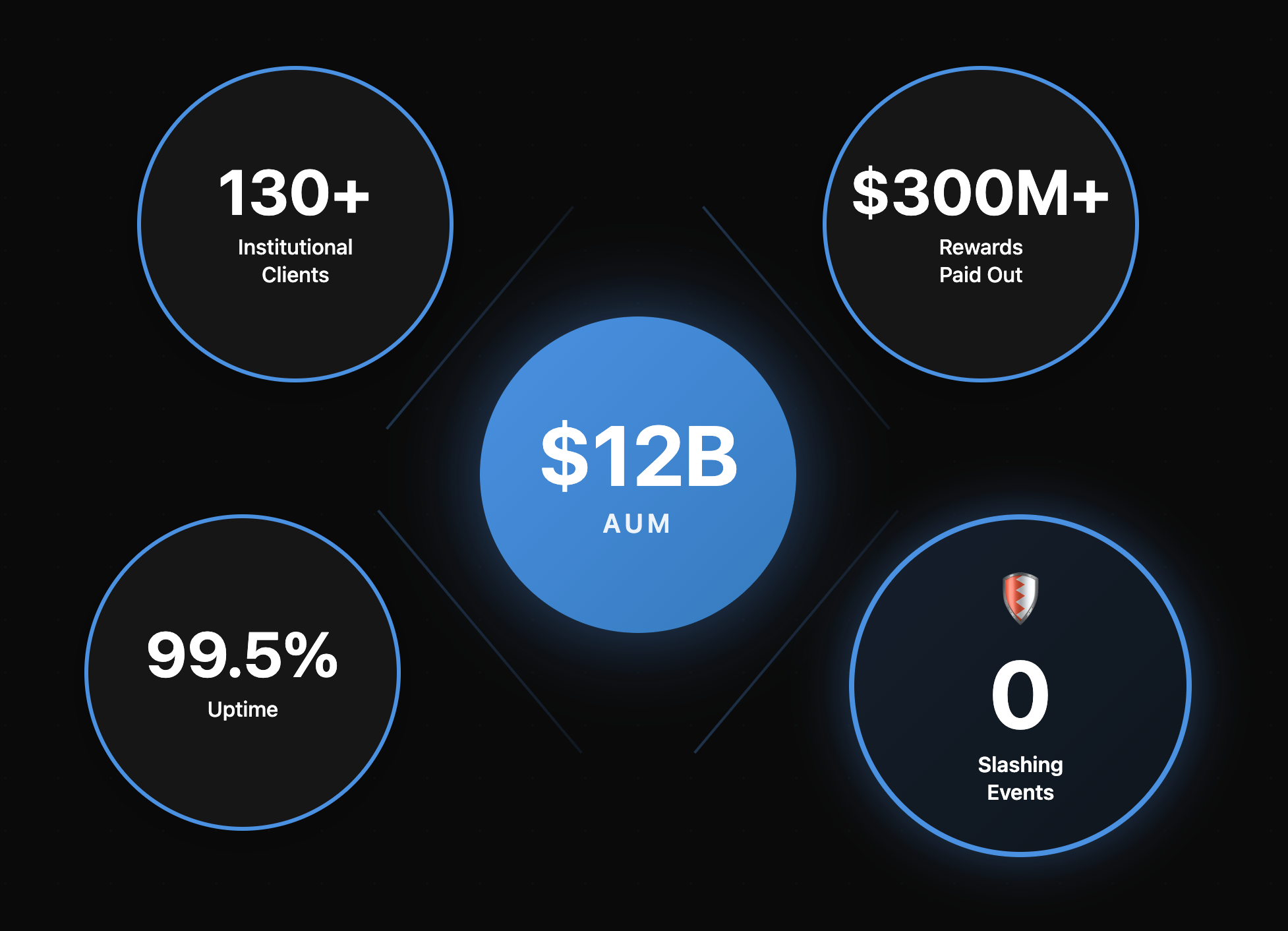
Secured over $12 billion in AUM for 130+ institutional clients with zero slashing events, 99.9%+ uptime, and $300M+ in rewards paid out
First to market with Pectra support, ETH reward auto-compounding on Ledger, and staking of vested assets on TON (with Ton Whales) — plus genesis validator on Symbiotic, Babylon, Aztec, and Monad
Launched Unified API (20 networks), ETH Pooled Staking, achieved SOC 2 Type II certification, and expanded to 40+ networks with 23 new protocol integrations
2025: A Year of Market Leadership
Day after day, week after week, month after month, we delivered performance that set the standard for institutional staking.
The Performance That Speaks for Itself
On Solana: We held the #1 validator position by APR for over 96% of the year. That's relentless operational excellence.
On Polkadot: We achieved the highest PPR and NRR every single day, of every single week, in 2025. Read that again: every day.
On Ethereum: We were the leading validator by APR for 51 out of 52 weeks. The math is simple — when institutions need performance, they choose P2P.org.
The Trust Numbers
$12+ billion in assets under management
130+ institutional clients trusting us with their staking operations
$300M+ in rewards paid out to our clients
Above 99.5% uptime across all networks
Zero slashing events (because rock solid security is our baseline)
First to Market. Every Time.
In 2025, we led the industry with speed and precision:
First staking provider to release Pectra support
First to enable auto-compounding of ETH rewards on Ledger
First to offer staking of vested assets on TON (in collaboration with Ton Whales)
Genesis validators on Symbiotic, Babylon, Aztec, Monad, and more
When the biggest protocols in Web3 launched in 2025, they launched with P2P.org as their infrastructure partner.
The Infrastructure That Scales
Launched Unified API supporting 20 networks from a single integration point. Institutional clients get one integration, 20+ networks.
Launched ETH Pooled Staking with same-day Pectra support, making institutional Ethereum staking accessible at any scale.
Achieved SOC 2 Type II certification, proving our security and compliance frameworks meet the standards institutions require.
Became #1 in TVL with EtherFi and led Symbiotic Networks' mainnet launch as their top operator.
Integrated with Ledger Live as the first option in their Earn section — when the world's leading hardware wallet chooses a default staking provider, they chose us.
40+ Networks. One Standard of Excellence.
We welcomed 23 new protocols in 2025, expanding our coverage to over 40 networks. Quantity never compromised quality:
Every network receives the same institutional-grade infrastructure
Every protocol benefits from the same operational rigor
Every client gets the same zero-slashing guarantee
Whether you're staking ETH, SOL, DOT, or launching on an emerging L1, you get the same P2P.org standard: uncompromising.
Why This Success Sets the Stage for 2026
2025 was the year institutional staking went from "interesting" to "essential." The infrastructure is mature. The regulatory clarity is emerging. The opportunity is now.
The data is conclusive — when institutions choose staking infrastructure, they choose performance, security, and reliability that P2P.org delivered every single day in 2025.
The 2026 Question Is Simple:
Do you want to stake with the provider that talks about institutional-grade infrastructure?
Or do you want to stake with the provider that proved it 365 days in a row?
Thank You
To our 130+ institutional clients: Your trust drives everything we do. Every validator spun up, every integration built, every protocol supported — it's all in service of delivering the bottom-line business impact your stakeholders demand.
To our ecosystem partners: You made 2025's biggest launches possible. We're honored to build the infrastructure that powers your protocols.
To our team: Zero slashing events don't happen by accident. 99.5% uptime isn't luck. You made 2025 possible.
Ready to Win 2026?
2025 taught us that the gap between good staking infrastructure and institutional staking infrastructure is measured in:
Reliable uptime that never wavers
Performance that doesn’t compromise
Security that you can depend on
We've spent years building that infrastructure. We spent 2025 proving it works at scale.
<h2 id="at-a-glance"><strong>At a Glance:</strong></h2><ul><li><strong>P2P.org, BITPOINT JAPAN, and Def consulting</strong> announce tripartite collaboration to enhance Ethereum treasury management for Japanese corporations</li><li><strong>Def consulting</strong> will deploy diversified asset management approach for its Ethereum holdings using P2P.org's institutional staking infrastructure and BITPOINT's corporate services</li><li><strong>Partnership creates replicable model</strong> for Japanese enterprises to incorporate digital assets into corporate financial strategy with institutional-grade standards</li><li><strong>P2P.org brings</strong> $12B+ in secured assets, zero slashing record, 99.9% uptime, and SOC 2 compliance to Japanese market</li><li><strong>BITPOINT plans to expand</strong> Ethereum asset management support for corporate clients using this collaboration as foundation</li></ul><p><strong>Tripartite collaboration establishes new model for institutional digital asset operations in Japanese market</strong></p><p>We're excited to announce a landmark partnership with BITPOINT JAPAN and Def consulting that's setting a new standard for how Japanese corporations manage Ethereum treasury operations.</p><h2 id="solving-the-corporate-ethereum-challenge"><strong>Solving the Corporate Ethereum Challenge</strong></h2><p>While Japanese companies are increasingly holding digital assets on their balance sheets, many lack institutional-grade frameworks for managing these assets strategically. This collaboration changes that equation.</p><p><strong>The partnership combines:</strong></p><ul><li><strong>BITPOINT's</strong> domestic crypto-asset exchange expertise</li><li><strong>Def consulting's</strong> Ethereum-focused treasury strategy</li><li><strong>P2P.org's</strong> institutional staking infrastructure</li></ul><p>Together, we're building a practical framework for Ethereum treasury operations that other institutions can adopt—demonstrating how digital assets integrate into corporate financial strategy with transparency and operational discipline.</p><h2 id="a-strategic-approach-to-ethereum-treasury-management"><strong>A Strategic Approach to Ethereum Treasury Management</strong></h2><p>Def consulting, a comprehensive IT solutions consulting firm, has been building a digital asset treasury business since 2025 that incorporates Ethereum and other digital assets into their balance sheet to support sustainable corporate value.</p><p>Under this partnership, Def consulting will deploy a more diversified and strategic asset management approach for its Ethereum holdings, supported by BITPOINT's corporate services and P2P.org's battle-tested staking infrastructure.</p><p>"Accelerating our Ethereum treasury strategy together with such strong partners—BITPOINT, a leading player in the domestic market, and P2P.org, which has world-class technical capabilities—holds significant meaning for our company," said <strong>Yuta Shimomura, Representative Director and President at Def consulting</strong>. "This three-party structure will further advance the strategic utilization of our Ethereum assets and maximize the return of value to all our stakeholders."</p><h2 id="global-standards-local-execution"><strong>Global Standards, Local Execution</strong></h2><p>This collaboration reflects our commitment to building institutional-grade digital asset infrastructure in Japan with the same reliability, security, and transparency we provide to our 130+ institutional clients worldwide.</p><p>"We are honored to collaborate with Def consulting, an innovative Ethereum treasury player in the Japanese market, and BITPOINT, one of Japan's leading crypto-asset exchanges," said <strong>Alex Esin, Co-CEO at P2P.org</strong>. "P2P.org is proud to support Ethereum staking and treasury operations in Japan and contribute to the development of the market."</p><p><strong>Ken Nakata, Representative Director and President at BITPOINT JAPAN</strong>, added: "I am delighted that this tripartite collaboration has been realized. Working with P2P.org, which has world-class technical expertise, allows our Ethereum asset management support services to reach a new dimension. Through this partnership, we aim to demonstrate the potential of digital assets within corporate financial strategies to a much broader audience."</p><h2 id="the-p2porg-difference"><strong>The P2P.org Difference</strong></h2><p>Our institutional staking infrastructure brings to this partnership:</p><ul><li><strong>$12+ billion</strong> in assets under management across 40+ blockchain networks</li><li><strong>Zero slashing incidents</strong> across seven years of operation</li><li><strong>99.9% uptime</strong> delivering consistent institutional-grade reliability</li><li><strong>SOC 2 compliance</strong> meeting enterprise security and operational standards</li></ul><h2 id="looking-ahead"><strong>Looking Ahead</strong></h2><p>BITPOINT plans to use this collaboration as a model to expand Ethereum asset management support for corporate clients. By combining BITPOINT's services with P2P.org's infrastructure, the companies intend to offer Japanese enterprises methods for using crypto assets that align with global standards and support more advanced digital asset integration in corporate finance.</p><p>This is just the beginning. As more institutions in Japan recognize the strategic value of Ethereum treasury operations, we're here to provide the infrastructure, expertise, and reliability they need to execute with confidence.</p><p><strong>Corporate customers interested in Ethereum asset management and staking support can contact BITPOINT's corporate services team via</strong><a href="https://www.bitpoint.co.jp/?ref=p2p.org"><strong> <u>bitpoint.co.jp</u></strong></a><strong>.</strong></p><p><strong>More information about Def consulting:</strong><a href="https://def-consulting.co.jp/?ref=p2p.org"><strong> <u>def-consulting.co.jp</u></strong></a></p><div class="kg-card kg-button-card kg-align-center"><a href="https://link.p2p.org/bdteam?ref=p2p.org" class="kg-btn kg-btn-accent">Learn about P2P.org's institutional staking services</a></div>
<h2 id="at-a-glance"><strong>At a Glance:</strong></h2><ul><li><strong>Programmatic Incentives v2</strong> launched, shifting focus from short-term capital movement to duration, consistency, and operator reliability</li><li><strong>EigenAI and EigenCompute</strong> went live on mainnet alpha — the first production applications secured by restaking</li><li><strong>Operator responsibilities</strong> expanded beyond uptime to include predictable infrastructure and conservative risk management</li><li><strong>P2P.org launched</strong> a dedicated 5% EIGEN operator aligned with the updated incentive structure</li><li><strong>EigenLayer transitioned</strong> from theoretical security model to functioning economic system with clear participant roles</li></ul><p>Over the course of 2025, EigenLayer moved into a more defined phase of its development. </p><p>The network introduced clearer incentive structures, brought its first production services online, and gave operators and restakers a more concrete role in how the system functions.</p><p>Taken together, these changes marked an important step forward: restaking began to operate less as a theoretical model and more as an economic system with real participants, responsibilities, and outcomes.</p><h2 id="a-more-structured-incentive-model"><strong>A More Structured Incentive Model</strong></h2><p>One of the most meaningful developments this year was the rollout of Programmatic Incentives v2.</p><p>The update refined how issuance is distributed and clarified what long-term participation on EigenLayer is meant to look like.</p><p>Instead of optimizing primarily for short-term capital movement, the new structure places more emphasis on duration, consistency, and operator reliability.</p><p>For restakers and operators, this created a clearer set of expectations. Incentives became easier to reason about, and participation started to feel more deliberate rather than reactive.</p><h2 id="eigenai-and-eigencompute-brought-restaking-into-production"><strong>EigenAI and EigenCompute Brought Restaking Into Production</strong></h2><p>In parallel, EigenLayer saw the launch of EigenAI and EigenCompute on mainnet alpha.</p><p>These services represented the first concrete examples of applications relying on restaking for security. EigenAI introduced verifiable inference, while EigenCompute provided a framework for verifiable off-chain execution. Together, they demonstrated how restaked capital and operator infrastructure could support live workloads rather than remaining an abstract security layer.</p><p>This shift was important not because of scale, but because it made the role of restaking observable in practice.</p><h2 id="operators-as-part-of-the-economic-core"><strong>Operators as Part of the Economic Core</strong></h2><p>As EigenLayer’s structure became clearer, so did the role of operators.</p><p>In 2025, operating on EigenLayer increasingly meant more than maintaining uptime. </p><p>Operators became responsible for supporting AVSs with predictable infrastructure, managing risk conservatively, and aligning their setups with the protocol’s evolving incentive model.</p><p>For P2P.org, the year was focused on staying aligned with that direction. As Programmatic Incentives v2 came online and EigenLayer expanded its AVS set, P2P adjusted its operator parameters to reflect the new framework, including the launch of a dedicated 5% EIGEN operator designed specifically around the updated incentive structure.</p><p>The goal throughout the year was consistency: operating in a way that fits EigenLayer’s long-term design rather than optimizing for short-term changes.</p><h2 id="a-clearer-picture-going-into-2026"><strong>A Clearer Picture Going Into 2026</strong></h2><p>By the end of 2025, EigenLayer had established a more coherent system across incentives, infrastructure, and applications.</p><ul><li>Restakers had clearer signals.</li><li>Operators had more defined responsibilities.</li><li>AVSs began operating on top of a security layer that was designed to support them over time.</li></ul><p>That coherence is what defines this year in retrospect. </p><p>EigenLayer has grown, and become easier to understand, participate in, and build on.</p><p>As the network moves into 2026, that clarity sets a stronger foundation for what comes next.</p><p>Reminder: <a href="http://p2p.org/?ref=p2p.org"><u>P2P.org</u></a> has a dedicated 5% EIGEN Operator live, available to the end of 2025.</p><div class="kg-card kg-button-card kg-align-center"><a href="link.p2p.org/c4365d" class="kg-btn kg-btn-accent">Delegate now</a></div>
 ALL
Agoric
Aptos
Auth
Avail
Avalanche
Axelar
Babylon
Bitcoin
BTC
Cardano
Celestia
Chainlink
Cosmos
Crescent
Cyberway
DAOBet
DeFi
DVT
Dymension
Economy
EigenLayer
Elrond
Ethereum
Evmos
Explain Like I'm Five
Guide
HR
Kava
Kusama
Lido
LSP
Manta
Mantle
Marlin
Matic
Moonbeam
MultiversX
Near
News
NuCypher
Oasis
Origin
Partnership
Persistence
Pocket
Polkadot
Polygon
Quicksilver
Regen
Renzo
restaking
RPC Node
Serum
Solana
SSV.Network
Staking
Starknet
Sui
symbiotic
Terra
Tezos
TheGraph
Threshold
Update
Vara
Vega
ALL
Agoric
Aptos
Auth
Avail
Avalanche
Axelar
Babylon
Bitcoin
BTC
Cardano
Celestia
Chainlink
Cosmos
Crescent
Cyberway
DAOBet
DeFi
DVT
Dymension
Economy
EigenLayer
Elrond
Ethereum
Evmos
Explain Like I'm Five
Guide
HR
Kava
Kusama
Lido
LSP
Manta
Mantle
Marlin
Matic
Moonbeam
MultiversX
Near
News
NuCypher
Oasis
Origin
Partnership
Persistence
Pocket
Polkadot
Polygon
Quicksilver
Regen
Renzo
restaking
RPC Node
Serum
Solana
SSV.Network
Staking
Starknet
Sui
symbiotic
Terra
Tezos
TheGraph
Threshold
Update
Vara
Vega