KR1 Launches Branded Ethereum Validators on Lido stVaults, Operated by P2P.org
Boards, auditors and shareholders at listed companies that stake ETH tend to ask the same things: who runs the validators, where protocol rewards go, how the position can be unwound and how it is kept separate from other stakers. In a shared pool, some of those answers depend on the pool's rules and on thousands of other depositors.
KR1 plc, the digital asset company listed on the Main Market of the London Stock Exchange, has launched its own branded Ethereum validators. They run in a dedicatedLido stVault, operated by P2P.org on Lido V3 infrastructure. KR1 is starting with 10 validators and targeting up to 6,000 ETH staked in the near term, subject to Ethereum's validator entry queue.
Treasury teams at other listed companies face the same questions about control, attribution, and liquidity. So do asset managers building ETH exposure and custodians and exchanges designing staking products for their clients, which makes the details of KR1's setup worth a close look.
Learnings for Busy Readers
KR1 is staking ETH through its own validators in a dedicated Lido stVault operated by P2P.org, starting with 10 validators and targeting up to 6,000 ETH.
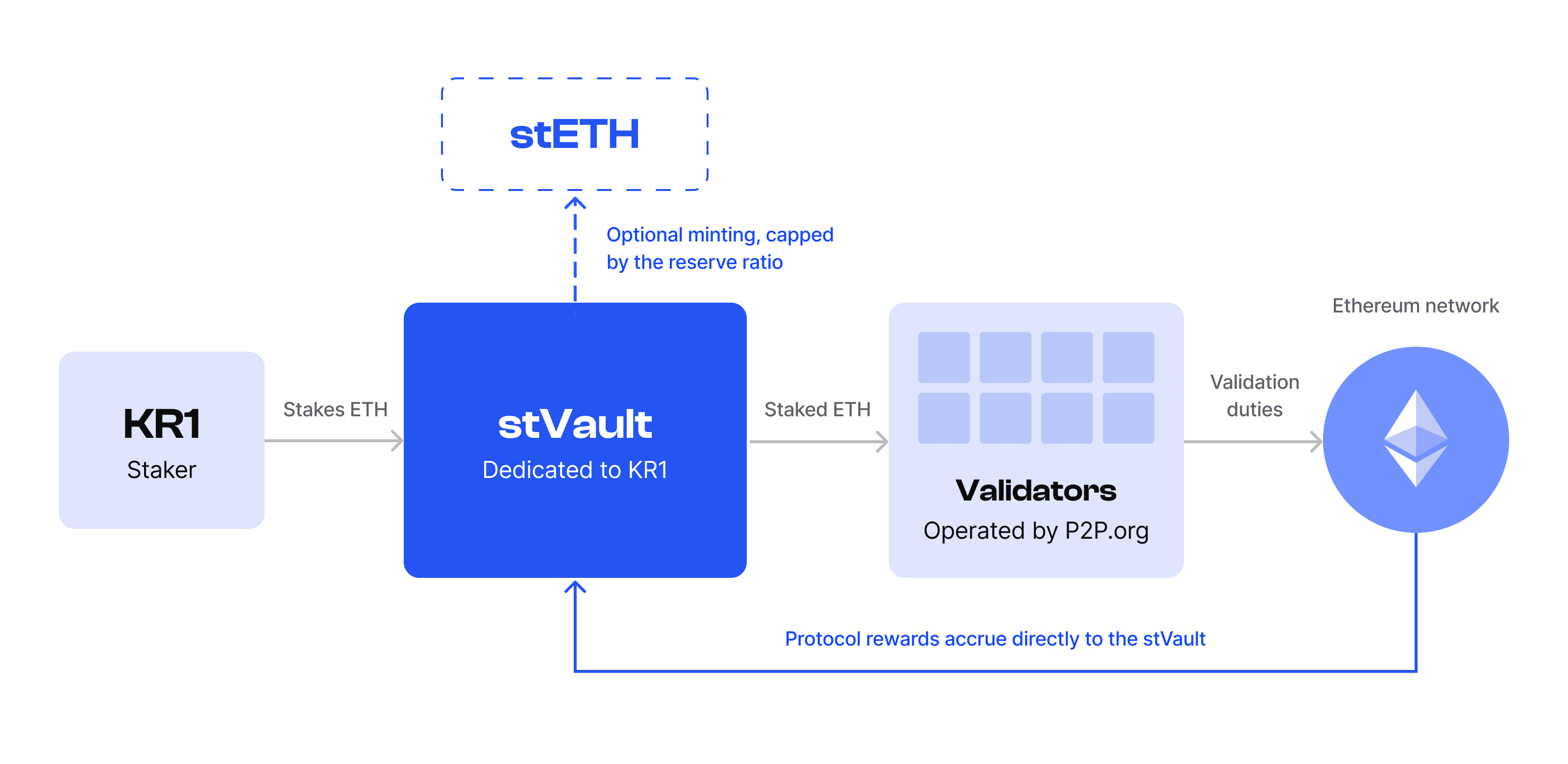
The stVault is dedicated to KR1's stake, with its own validator set and optional stETH minting.
Protocol rewards generated by the validators accrue to the stVault, with P2P.org operating the validator infrastructure.
stETH minting is optional and capped by a reserve ratio governed by the Lido DAO.
Slashing exposure is tied to the vault's chosen operator.
What KR1 Is Launching on Lido stVaults
Each of KR1's validators is attached on-chain to the stVault dedicated to KR1, so the stake is attributable to KR1 and performance reporting maps directly to its own validator set. KR1 describes the launch as part of its strategy of giving public market investors direct access to on-chain infrastructure.
The vault is dedicated to KR1's stake, so its validators, their performance and the protocol rewards they generate are kept separate from other stakers. P2P.org runs the validators, and Lido's V3 contracts provide the vault framework and access to stETH liquidity.
KR1 will add validators in phases after the first 10. The pace depends largely on Ethereum's entry queue, which lengthens and shortens with network-wide demand to stake.
“Today’s launch is a key milestone for the Company, delivering on the validator plans we set out last year: a dedicated Lido stVault, run by P2P.org, with KR1 in control of deposits, withdrawals, fees and stETH minting. This gives public-market investors a clearly attributed route into the infrastructure income at the centre of KR1’s operating strategy, while reinforcing our position as the only dedicated infrastructure operator on the London Stock Exchange Main Market.”
-George McDonaugh and Keld van Schreven, Managing Directors and Co-Founders, KR1 plc
How Lido stVaults Work for a Dedicated Validator Set
Lido V3 introduced stVaults as a non-custodial staking layer that operates alongside Lido's core pool. Each stVault is a dedicated smart contract with its own validators and its own node operator, kept separate from other stakers. Lido'sV3 technical paper sets out the full design.
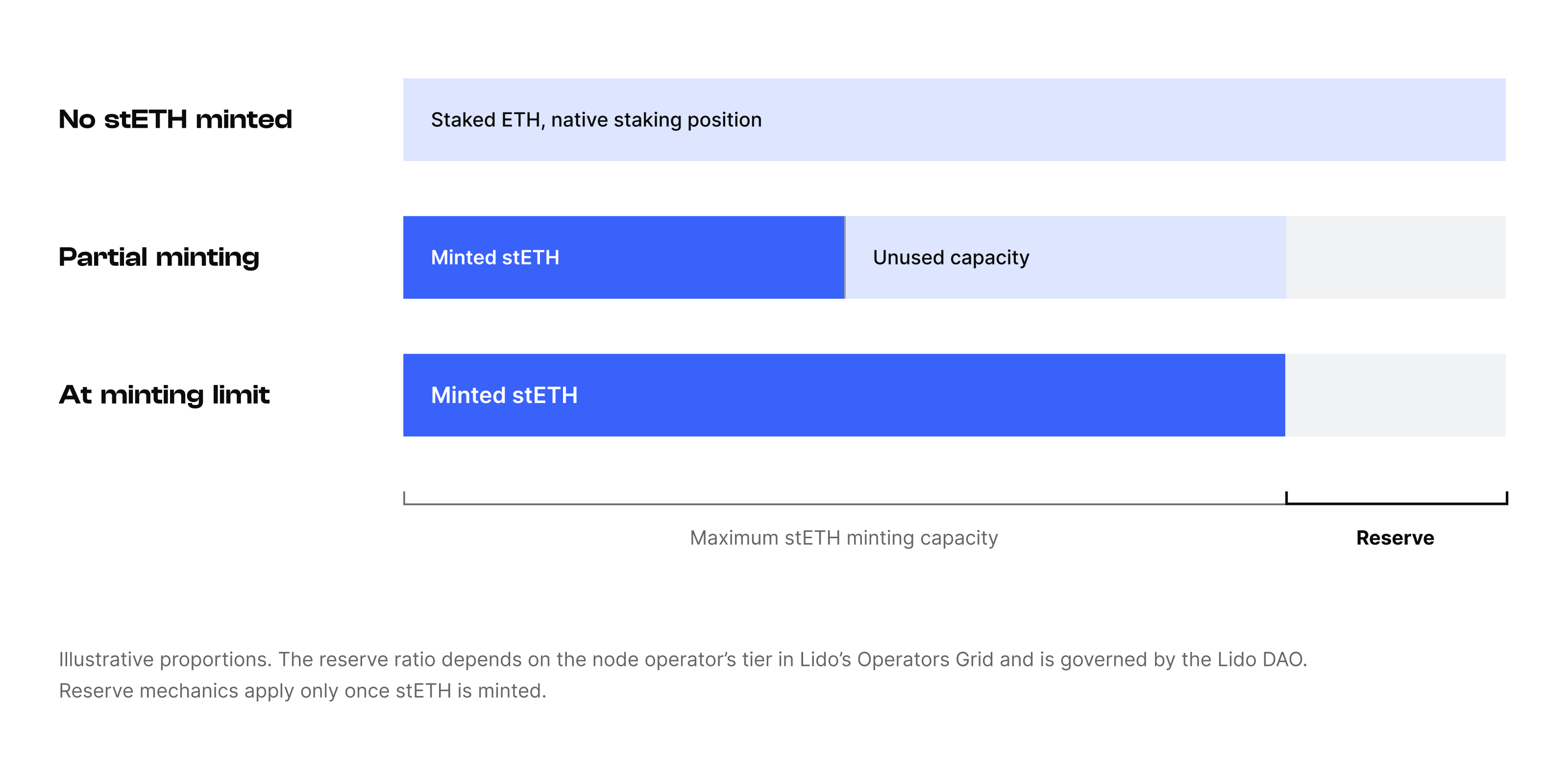
stVaults also support minting stETH against ETH staked in the vault. That stETH can then be used for liquidity, collateral, or DeFi activity while the validators keep running. Minting is optional and capped by a reserve ratio, which keeps every stETH minted through an stVault overcollateralized by the ETH behind it. The reserve ratio depends on the node operator's tier within Lido's Operators Grid, and changes to it are set by the Lido DAO.
When no stETH is minted, the reserve ratio mechanics stay inactive and the vault functions as a dedicated staking setup with its own contract and its own operator. Once minting begins, a protocol contract called VaultHub enforces minting limits and vault health across every stVault. This design is intended to contain the risk of any single vault and keep it away from the wider stETH supply.
The same validators can support a native staking position now and stETH liquidity later, with the same operator throughout.
Kean Gilbert, Head of Institutional Relations at the Lido Ecosystem Foundation, sees the launch as part of a broader change in how institutions approach staking:
"Institutions are showing growing interest in staking on their own terms: with control over their staking setup, without compromising on compliance, and with access to liquidity and more flexible yield strategies. That is what stVaults are designed for. KR1, the first publicly listed company to launch its own branded validators on Lido stVaults, is a clear example of that shift."
What P2P.org Runs Inside KR1's stVault
P2P.org is the node operator for KR1's vault. The role covers validator setup, infrastructure and client management, uptime monitoring, and per-validator performance reporting that KR1 can use for its own records.
Protocol rewards generated by the validators accrue to the stVault.
P2P.org has operated validators since 2018 and maintains a zero-slashing-incident record, with operations that are SOC 2 Type II attested and ISO/IEC 27001:2022 certified. That record reflects past performance, and slashing risk remains present for every Ethereum validator regardless of operator.
Amir Kahoori, Senior Product Manager for Ethereum at P2P.org, framed the launch around operator accountability:
"As more listed companies bring digital assets onto their balance sheets, the infrastructure behind that stake matters as much as the asset itself. The uptime, the slashing record, and the per-validator reporting all come from the operator, and for KR1's dedicated set that's us. stVaults unlock optional liquidity on top of the validators, without commingling funds in a pool. It's a different level of accountability to running a shared pool, and we think that's where institutional staking is going."
Evaluating a Node Operator for an stVault
Operator choice affects validator performance, the reserve ratio available to the vault, and the quality of reporting the owner receives. Before committing ETH to an stVault, institutions may wish to consider the following:
[ ] Slashing and penalty history across Ethereum and other networks, with a clear incident disclosure policy
[ ] Independent security attestations such as SOC 2 Type II and ISO/IEC 27001
[ ] The operator's tier in Lido's Operators Grid and the reserve ratio that tier implies
[ ] Per-validator reporting on rewards, penalties, and uptime at the frequency your finance team needs
[ ] Key management practices, including separation between validator signing keys and withdrawal authority
[ ] Client diversity and infrastructure redundancy across regions and providers
[ ] Procedures and response times for owner-initiated exits and withdrawals
[ ] Fee terms and how the node operator fee is settled from the vault
[ ] Support for vault role structures that match your internal approval policies
Key Takeaway
KR1's launch gives treasury teams at listed companies, along with the asset managers and custodians who work with them, a live example of a dedicated Lido stVault that combines validator attribution, a dedicated validator set and optional stETH liquidity. Institutions considering a similar setup should take operator selection and a minting policy to their board or investment committee before making a first deposit.
Institutions exploring a dedicated Ethereum validator setup on Lido stVaults can speak with P2P.org's team about operator configuration, reporting, and onboarding.
What is a Lido stVault?A Lido stVault is a non-custodial smart contract, introduced with Lido V3, that lets its owner stake ETH through a node operator of its choosing while keeping the position isolated from other stakers. The owner can optionally mint stETH against the staked ETH, subject to a reserve ratio that keeps minted stETH overcollateralized. If the owner never mints, the vault operates as a dedicated staking setup.
Who operates KR1's validators?P2P.org operates the validators in KR1's stVault, covering setup, infrastructure, monitoring and per-validator reporting. Lido's V3 contracts provide the vault framework and enforce protocol-level rules such as minting limits.
Where do protocol rewards go?Protocol rewards generated by KR1's validators accrue to the stVault. The node operator fee is agreed between KR1 and P2P.org, and Lido protocol fees apply separately.
Is stETH minting required?
No. An stVault can operate as a dedicated staking setup without minting stETH, in which case the reserve ratio mechanics do not apply. When stETH is minted, the amount is capped by the reserve ratio, and the vault must keep enough ETH in reserve to cover it.
About KR1
KR1 plc owns and operates productive digital assets across the networks powering the convergence of AI and crypto. As the only dedicated onchain infrastructure company listed on the Main Market of the London Stock Exchange, KR1 draws on a decade of domain expertise to take a high-conviction, thesis-driven approach to its holdings, targeting a dual return profile: infrastructure income and capital appreciation.
About Lido stVaults
Lido is a liquid staking protocol on Ethereum.stVaults is its modular staking infrastructure that allows institutions and builders to create custom staking products with optional stETH minting for on-demand liquidity and DeFi integrations, while retaining full control over validator operations and setup.
Disclaimer
This material is provided for informational purposes only and does not constitute investment, financial, legal, or tax advice.P2P.org accepts no liability for any actions taken based on it. Past performance is not indicative of future results. P2P.org is not affiliated with or endorsed by any of the third-party institutions named herein.
Subscribe to P2P-economy
Get the latest posts delivered right to your inbox
<h1 id="defi-dispatch-defi-news-and-signals-october-2026-issue-1">DeFi Dispatch: DeFi News and Signals October 2026 (Issue 1)</h1><h2 id="series-defi-dispatch"><br>Series: DeFi Dispatch</h2><p>DeFi Dispatch is P2P.org's twice-monthly roundup of DeFi developments for institutional participants navigating the intersection of traditional and on-chain finance. Each edition covers the signals that matter for asset managers, custodians, hedge funds, ETF issuers, exchanges, and staking teams operating at the frontier of institutional DeFi and proof-of-stake infrastructure.</p><p>Missed the previous edition? Catch up here: <a href="https://p2p.org/economy/defi-dispatch-defi-news-september-2026-issue-2/">DeFi Dispatch: DeFi News and Signals September 2026 (Issue 2)</a></p><div class="kg-card kg-callout-card kg-callout-card-blue"><div class="kg-callout-emoji">🗞️</div><div class="kg-callout-text"><b><strong style="white-space: pre-wrap;">Subscribe to the P2P.org newsletter</strong></b> at the bottom of this page to receive a monthly summary of the latest DeFi and staking developments, curated for institutional participants.</div></div><hr><h2 id="quick-learnings-for-busy-readers">Quick Learnings for Busy Readers</h2><p>Short on time? Here are the key takeaways. For the full analysis, continue reading below.</p><p>The first half of October brought five developments that institutional participants in DeFi and staking infrastructure should track closely.</p><ul><li>ARK Invest tokenized its $1.3 billion ARK Venture Fund on Ethereum via Securitize on September 24, marking ARK’s first blockchain-based fund and one of the largest institutional venture capital products ever brought on-chain, with holdings in OpenAI, Anthropic, SpaceX, Stripe, and Databricks accessible to eligible investors through tokenized fund interests.</li><li>Glamsterdam activated successfully on the Sepolia testnet on October 6 at 13:53:36 UTC, finalizing seven epochs past the fork at epoch 353,031. The Ethereum Foundation has set no activation date for Hoodi testnet or mainnet, leaving the Q4 2026 window open but unconfirmed.</li><li>DeFi lending TVL climbed 55% since its July 2026 low, reaching approximately $56 billion by mid-October, reversing the Q2 contraction driven by the KelpDAO exploit. Aave recovered to $18.21 billion in October and protocols including Aave and Spark overhauled their collateral and cross-chain risk review frameworks in response.</li><li>Ethereum ETF flows turned sharply negative in October, with approximately $715 million in cumulative outflows through October 13, before recording $24.84 million in net inflows on October 13 as ETH bounced off the $2,400 support level. ETH is trading near $2,500 as of October 15, with $2,700 to $2,800 identified as the institutional accumulation trigger.</li><li>Interactive Brokers launched Ethereum staking for eligible LLC clients on October 13, enabling ETH staking directly through its Client Portal Staking Dashboard via zerohash’s Staking-as-a-Service infrastructure. The launch makes Interactive Brokers the latest major brokerage to embed staking into its institutional client offering.</li></ul><h2 id="what%E2%80%99s-driving-defi-markets-in-the-first-half-of-october">What’s driving DeFi markets in the first half of October?</h2><p>The first half of October 2026 presents a market of sharp contrasts. Institutional product infrastructure is accelerating: ARK Invest’s $1.3 billion tokenized venture fund on Ethereum is one of the most significant RWA milestones of the year, Glamsterdam’s clean Sepolia activation clears the path toward mainnet, and Interactive Brokers embedding Ethereum staking directly into its brokerage platform confirms the custody-to-yield distribution pattern is extending to the largest retail-facing institutional brokerages. But ETF flows tell a different short-term story, with approximately $715 million leaving Ethereum ETFs in the first two weeks of October before a single positive session on October 13 provided the first signal of stabilization. The DeFi lending TVL recovery to $56 billion, driven by institutional capital returning to battle-tested protocols with overhauled risk frameworks, is the structural story that matters more than the near-term ETF volatility.</p><p>Below, we break down five key developments and why they matter for asset managers, custodians, hedge funds, ETF issuers, exchanges, and staking teams.</p><h2 id="story-1-ark-invest-tokenizes-its-13-billion-venture-fund-on-ethereum-via-securitize">Story 1: ARK Invest Tokenizes Its $1.3 Billion Venture Fund on Ethereum via Securitize</h2><p>ARK Invest and Securitize announced on September 24, 2026 that the ARK Venture Fund, known by its ticker ARKVX, has been tokenized and made available to eligible investors on Ethereum. The fund manages approximately $1.3 billion in net assets as of August 31, 2026, and invests in private and public technology companies including OpenAI, Anthropic, SpaceX, Stripe, and Databricks. The tokenization does not alter the fund’s underlying investment strategy. Investors receive tokenized fund interests representing their share in the existing fund structure rather than direct tokenized shares of underlying portfolio companies. Securitize provides issuance, investor onboarding, and on-chain infrastructure. A September 21 SEC amended order permitted the fund to offer shares with ownership recorded through distributed-ledger technology and enabled trading through regulated alternative trading systems.</p><p>ARKVX is an interval fund with quarterly buybacks and a 2.9% annual fee after waivers. The $500 minimum investment, originally designed to broaden access to venture capital, is maintained in the tokenized version. The relationship between ARK Invest and Securitize was strengthened after ARK participated in a Securitize funding round in October 2025. The fund gained approximately 32% through late September 2026.</p><h3 id="why-this-matters-for-asset-managers-custodians-hedge-funds-etf-issuers-exchanges-and-staking-teams">Why this matters for asset managers, custodians, hedge funds, ETF issuers, exchanges, and staking teams:</h3><ul><li>ARKVX bringing $1.3 billion in venture capital exposure on-chain through Securitize on Ethereum establishes a template for how actively managed funds with illiquid underlying assets can be tokenized without changing their investment strategy, custody model, or regulatory status.</li><li>The SEC’s September 21 amended order enabling tokenized share classes to trade on regulated alternative trading systems is the regulatory enabler that makes this structure viable for other asset managers evaluating tokenization, signaling that the SEC is accommodating on-chain fund structures through administrative action.</li><li>For Ethereum validator infrastructure, ARKVX joining BUIDL, BSTBL, JLTXX, and other tokenized institutional products in the Securitize and Ethereum ecosystem adds another demand driver for settlement reliability. The networks and validators supporting tokenized fund operations are absorbing an institutional compliance requirement rather than a speculative one.</li></ul><p>Source: <a href="https://cryptodaily.co.uk/2026/09/ark-invest-tokenizes-arkvx-venture-fund-ethereum-securitize?ref=p2p.org">CryptoDaily</a>, <a href="https://www.altcoinbuzz.io/ark-invest-tokenizes-1-3b-venture-fund-through-securitize?ref=p2p.org">AltcoinBuzz</a>, <a href="https://en.coin-turk.com/ark-invest-tokenizes-1-3-billion-venture-fund-with-spacex-openai-holdings/?ref=p2p.org">CoinTurk</a>, September 2026.</p><h2 id="story-2-glamsterdam-activates-on-sepolia-on-october-6-finalizing-successfully-within-an-hour">Story 2: Glamsterdam Activates on Sepolia on October 6, Finalizing Successfully Within an Hour</h2><p>The Ethereum upgrade known as Glamsterdam activated on the Sepolia testnet at epoch 353,024 on October 6, 2026 at 13:53:36 UTC, exactly as scheduled in the Ethereum Foundation’s September 17 announcement. A reading of the Sepolia beacon chain an hour later showed the head at slot 11,297,074, some 306 slots beyond the fork slot of 11,296,768, with the last finalized epoch at 353,031, seven epochs past the fork, and epoch 353,032 justified. The fork version moved from 0x90000075 to 0x90000076 at epoch 353,024 without incident. The Ethereum Foundation has set no activation date for Hoodi testnet or mainnet.</p><p>Glamsterdam bundles three headline changes: ePBS via EIP-7732, which moves block building on-chain through enshrined proposer-builder separation; Block-Level Access Lists via EIP-7928, which enables parallel execution; and revised gas pricing via EIP-8037, which adds a state gas dimension to reflect the cost of creating new accounts, contracts, or storage entries. The Sepolia activation also tested the 200 million gas limit target for the first time on a live public network. Developers described Glamsterdam as probably the largest fork since the Merge in terms of scope.</p><h3 id="why-this-matters-for-asset-managers-custodians-hedge-funds-etf-issuers-exchanges-and-staking-teams-1">Why this matters for asset managers, custodians, hedge funds, ETF issuers, exchanges, and staking teams:</h3><ul><li>Glamsterdam finalizing cleanly seven epochs past the fork on Sepolia is the most significant technical validation the upgrade has received. It confirms that the changes that caused Devnet-9 to fail have been resolved and that the upgrade is ready for Hoodi and then mainnet.</li><li>The 200 million gas limit tested on Sepolia expands Ethereum’s transaction throughput by more than three times relative to the current 60 million limit. For institutions building tokenized asset settlement infrastructure on Ethereum, this capacity expansion directly affects the scale of on-chain operations the network can support per block.</li><li>Institutional validator operators must update both consensus and execution layer clients before mainnet activation. Operators relying on Prysm should note that its Sepolia release defaults to the 60 million gas limit after activation and requires manual configuration to support the 200 million target.</li></ul><p>Source: <a href="https://financefeeds.com/ethereum-upgrade-glamsterdam-sepolia-no-date/?ref=p2p.org">FinanceFeeds</a>, <a href="https://forklog.com/en/ethereum-team-activates-glamsterdam-on-sepolia-testnet/?ref=p2p.org">ForkLog</a>, <a href="https://blog.ethereum.org/en/2026/09/17/glamsterdam-testnet-announcement?ref=p2p.org">Ethereum Foundation blog</a>, October 2026.</p><h2 id="story-3-defi-lending-tvl-climbs-55-to-56-billion-since-july-as-protocols-overhaul-risk-frameworks">Story 3: DeFi Lending TVL Climbs 55% to $56 Billion Since July as Protocols Overhaul Risk Frameworks</h2><p>Total value locked in crypto lending protocols climbed 55% since their July 2026 low, reaching approximately $56 billion as of mid-October, according to data cited by Gokhshtein Media and FRNT Financial. The recovery reverses a sharp Q2 contraction: lending markets dropped 16.78% during Q2, with $11.33 billion exiting the sector according to Galaxy data. The overall DeFi TVL recovery since the July low has been 41%, with the metric reaching $96.18 billion as of early October per FRNT Financial citing DeFiLlama. Aave’s TVL recovered to $18.21 billion in October, still 31% below its pre-KelpDAO exploit level but representing a third consecutive month of gains.</p><p>The recovery has come alongside a structural overhaul of how lending protocols evaluate collateral risk. Aave now conducts quarterly asset reviews covering governance design, operational security, collateral quality, liquidity management, and ecosystem dependencies. Spark’s CEO Sam MacPherson outlined a multi-layer security review process specifically addressing cross-chain risks that standard smart contract audits do not capture. The overhaul reflects the lesson of the April 2026 KelpDAO exploit: risks nested in bridges, oracle networks, and token wrappers cascade into lending platforms even when the core protocol is secure.</p><h3 id="why-this-matters-for-asset-managers-custodians-hedge-funds-etf-issuers-exchanges-and-staking-teams-2">Why this matters for asset managers, custodians, hedge funds, ETF issuers, exchanges, and staking teams:</h3><ul><li>DeFi lending TVL recovering 55% since July while protocols simultaneously tighten risk frameworks signals a maturation of the sector: capital is returning to infrastructure that has demonstrably improved its collateral and cross-chain risk management in response to the April 2026 security incidents.</li><li>Aave’s institutionalized quarterly asset review, covering ecosystem dependencies beyond the core protocol, is the governance standard that institutional allocators have been asking for. Its formalization provides a framework that compliance teams can reference when assessing DeFi lending exposure at an institutional scale.</li><li>For staking product managers evaluating DeFi vault strategies, the 55% lending TVL recovery alongside enhanced protocol risk frameworks creates a more favorable risk-adjusted entry environment than the Q2 2026 peak TVL conditions. Capital efficiency metrics now favor battle-tested protocols with documented risk overhauls.</li></ul><p>Source: <a href="https://gokhshtein.com/news/2026-10-14-defi-lending-tvl-hits-56b-as-protocols-grapple-with-cross?ref=p2p.org">Gokhshtein Media</a>, <a href="https://frnt.substack.com/p/reviewing-defi-metrics-c4b">FRNT Financial</a>, <a href="https://cryptonews.net/news/defi/33567416/?ref=p2p.org">Cryptonews.net</a>, October 2026.</p><h2 id="story-4-ethereum-etf-flows-turn-sharply-negative-in-october-before-first-positive-session-on-october-13">Story 4: Ethereum ETF Flows Turn Sharply Negative in October Before First Positive Session on October 13</h2><p>U.S. spot Ethereum ETFs recorded approximately $715 million in cumulative net outflows from October 1 through October 13, with the month’s first ten trading sessions all negative before $24.84 million in net inflows returned on October 13. ETH fell as low as $2,316 on October 15 before recovering toward $2,500, testing the rising trendline from the June 2026 lows. Bitcoin ETFs recorded four positive sessions in the same period, including $175.62 million in inflows on October 13, showing that the outflow pressure was specific to Ethereum rather than a broad risk-off exit from digital assets.</p><p>Cumulative net inflows for U.S. spot Ethereum ETFs stood at $13.20 billion as of mid-October, down from $13.84 billion at the October 1 opening. The October 13 positive session of $24.84 million was led by Grayscale’s mini Ethereum ETF at $16.73 million and Fidelity’s FETH at $8.11 million. BlackRock’s ETHA remained the dominant fund by assets at approximately $8.61 billion. ETH ETFs recorded a further $19.7 million outflow on October 14, confirming that October 13 was a single positive session rather than a confirmed trend reversal.</p><h3 id="why-this-matters-for-asset-managers-custodians-hedge-funds-etf-issuers-exchanges-and-staking-teams-3">Why this matters for asset managers, custodians, hedge funds, ETF issuers, exchanges, and staking teams:</h3><ul><li>Ten consecutive days of Ethereum ETF outflows totaling $715 million, following October’s failure to sustain price above $2,800, confirms that institutional demand has entered a consolidation phase. Bitcoin recording positive sessions while Ethereum recorded outflows signals a tactical rotation within institutional digital asset allocations rather than an exit from the space.</li><li>The October 13 positive session followed by a return to outflows on October 14 means the outflow cycle has not yet confirmed its end. Risk committees managing Ethereum staking programs should monitor whether $2,700 to $2,800 resistance acts as the institutional reaccumulation trigger that analysts and ETF flow data both identify.</li><li>For staking-integrated Ethereum ETF products, the outflow cycle directly affects assets under management and the volume of ETH being staked through ETF mechanisms, creating a direct read-through from ETF flow data to validator demand in the near term.</li></ul><p>Source: <a href="https://coingape.com/markets/ethereum-price-prediction-ahead-of-october-15-eth-upgrade-talks-can-eth-reclaim-2700/?ref=p2p.org">CoinGape</a>, <a href="https://kucoin.com/news/flash/crypto-etfs-post-200m-inflows-as-bitcoin-and-ethereum-funds-turn-positive?ref=p2p.org">KuCoin</a>, <a href="https://bravenewcoin.com/insights/ethereum-eth-price-prediction-eth-holds-near-2500-as-etf-flows-turn-positive-and-long-positions-reach-four-year-high?ref=p2p.org">BraveNewCoin</a>, October 2026.</p><h2 id="story-5-interactive-brokers-launches-ethereum-staking-through-zerohash-on-october-13">Story 5: Interactive Brokers Launches Ethereum Staking Through zerohash on October 13</h2><p>Interactive Brokers launched Ethereum staking for eligible Interactive Brokers LLC clients on October 13, 2026, adding the service through the Staking Dashboard in its Client Portal. The announcement makes Interactive Brokers the latest major brokerage to embed staking into its institutional client offering, following BNY’s partnership with Galaxy and Deutsche Bank’s custody commitment announced in September. Clients can submit staking and unstaking requests and monitor pending activity through the same portal they use to manage their Interactive Brokers accounts, with rewards credited as additional staked cryptocurrency that may compound while they remain staked. ETH is the only cryptocurrency supported for staking at launch. zerohash provides the underlying infrastructure, including blockchain infrastructure, validator operations, rewards accounting, and compliance, through an API integration.</p><p>The launch follows zerohash’s Staking-as-a-Service announcement on June 25, 2026, in which zerohash named Interactive Brokers, Public, and BitMart as initial launch partners for the institutional product. Solana staking was planned for a later date. Financial terms for the integration were not disclosed. Interactive Brokers supports trading in 20 digital assets, making staking currently available for one of those assets. Crypto commissions start at 0.12% to 0.18% of trade value, subject to a $1.75 minimum per order, with no separate staking charges announced at launch.</p><h3 id="why-this-matters-for-asset-managers-custodians-hedge-funds-etf-issuers-exchanges-and-staking-teams-4">Why this matters for asset managers, custodians, hedge funds, ETF issuers, exchanges, and staking teams:</h3><ul><li>Interactive Brokers embedding Ethereum staking directly into its Client Portal confirms that the custody-to-yield distribution pattern established by BNY and Deutsche Bank is now extending to large retail-facing institutional brokerages, not only wholesale custodians and investment banks.</li><li>zerohash providing the validator operations and rewards accounting as a managed service represents the Staking-as-a-Service model reaching mainstream brokerage distribution: Interactive Brokers handles the client relationship and compliance framework while zerohash handles the proof-of-stake infrastructure layer.</li><li>With Solana staking planned as a later addition to the zerohash partnership, the Interactive Brokers launch establishes a multi-asset institutional staking distribution channel that will expand across proof-of-stake networks as the product matures, creating incremental demand for non-custodial validator infrastructure across each network added.</li></ul><p>Source: <a href="https://cryptodaily.co.uk/2026/10/interactive-brokers-ethereum-staking-zerohash?ref=p2p.org">CryptoDaily</a>, <a href="https://www.theblock.co/news/ecosystems/2026-10-13-interactive-brokers-ethereum-staking-zerohash-418457?ref=p2p.org">The Block</a>, October 2026.</p><h2 id="key-takeaways-for-asset-managers-custodians-hedge-funds-etf-issuers-exchanges-and-staking-teams"><strong>Key Takeaways for Asset Managers, Custodians, Hedge Funds, ETF Issuers, Exchanges, and Staking Teams</strong></h2><p>The first half of October 2026 surfaces five converging signals for institutional participants in on-chain infrastructure:</p><ul><li>ARK Invest tokenizing its $1.3 billion venture fund on Ethereum via Securitize establishes one of the most significant RWA milestones of 2026, with a September 21 SEC amended order enabling the structure and providing a regulatory template for other fund managers evaluating on-chain distribution.</li><li>Glamsterdam’s clean Sepolia activation on October 6 resolves the technical uncertainty from Devnet-9’s failure and confirms the upgrade is ready for Hoodi and mainnet. The 200 million gas limit tested on Sepolia sets a new capacity standard for institutional Ethereum settlement infrastructure. No Hoodi or mainnet date has been confirmed.</li><li>DeFi lending TVL recovering 55% since July to $56 billion, alongside institutionalized quarterly collateral reviews at Aave and Spark, creates the most defensible risk-adjusted case for DeFi vault allocation since before the April 2026 exploit cycle.</li><li>Ethereum ETF outflows of approximately $715 million through October 13, followed by a single positive session on October 13 and a return to outflows on October 14, confirm a consolidation phase rather than a structural reversal. The $2,700 to $2,800 range remains the institutional accumulation trigger.</li><li>Interactive Brokers launching Ethereum staking through zerohash on October 13 confirms that the custody-to-yield distribution pattern is extending from wholesale custodians to large retail-facing institutional brokerages, with Solana staking planned as the next asset to be added to the zerohash partnership.</li></ul><div class="kg-card kg-callout-card kg-callout-card-blue"><div class="kg-callout-emoji">🗞️</div><div class="kg-callout-text"><b><strong style="white-space: pre-wrap;">Subscribe to our newsletter</strong></b> at the bottom of this page to receive a monthly summary of the latest DeFi and staking developments, curated for institutional participants. <b><strong style="white-space: pre-wrap;">Or follow us on </strong></b><a href="https://linkedin.com/company/p2p-org?ref=p2p.org" rel="noopener noreferrer"><b><strong style="white-space: pre-wrap;">LinkedIn</strong></b></a><b><strong style="white-space: pre-wrap;"> and </strong></b><a href="https://twitter.com/p2pvalidator?ref=p2p.org" rel="noopener noreferrer"><b><strong style="white-space: pre-wrap;">X</strong></b></a><b><strong style="white-space: pre-wrap;"> to stay updated</strong></b> when new DeFi Dispatch editions are published.</div></div><h2 id="frequently-asked-questions-faqs">Frequently Asked Questions (FAQs)<br></h2><h3 id="what-does-the-ark-invest-arkvx-tokenization-mean-for-institutional-fund-managers-evaluating-on-chain-structures">What does the ARK Invest ARKVX tokenization mean for institutional fund managers evaluating on-chain structures?</h3><p>ARKVX establishes that a $1.3 billion actively managed fund with illiquid venture capital holdings can be tokenized without changing its investment strategy, SEC registration, custody model, or fee structure. The enabling mechanism is the SEC’s September 21 amended order permitting tokenized share classes to trade on regulated alternative trading systems. For fund managers evaluating tokenization, ARKVX provides a live public reference point that has received regulatory accommodation and institutional validation from Securitize, which manages over $5 billion in tokenized real-world assets. The primary constraint is investor eligibility: the tokenized version remains limited to qualified investors.</p><h3 id="what-does-glamsterdam%E2%80%99s-clean-sepolia-activation-mean-for-institutions-still-preparing-validator-infrastructure">What does Glamsterdam’s clean Sepolia activation mean for institutions still preparing validator infrastructure?</h3><p>The clean finalization at epoch 353,031 resolves the uncertainty that Devnet-9’s failure created. The upgrade is ready for Hoodi and then mainnet. The Ethereum Foundation has set no activation date for Hoodi or mainnet. Both consensus and execution layer clients must be updated before mainnet activation. Prysm operators specifically should note that the Sepolia release defaults to the 60 million gas limit after activation and requires manual configuration for the 200 million target. Institutions should treat preparation as active and ongoing rather than contingent on date confirmation.</p><h3 id="what-does-the-defi-lending-tvl-recovery-to-56-billion-mean-for-institutional-defi-vault-strategies">What does the DeFi lending TVL recovery to $56 billion mean for institutional DeFi vault strategies?</h3><p>The 55% recovery from the July low reflects genuine capital return to lending protocols rather than price inflation of existing deposits. The more important signal for institutional allocators is the simultaneous overhaul of risk frameworks at Aave and Spark, which now include quarterly collateral reviews covering cross-chain dependencies. These governance improvements directly address the systemic collateral concentration risk that made institutional DeFi vault sizing difficult to defend after the April 2026 KelpDAO exploit. The combination of recovering TVL and documented risk framework improvements creates a more defensible institutional DeFi allocation case than at any point in 2026.</p><hr><p><strong>About P2P.org</strong></p><p>Founded in 2018, P2P.org helps institutional capital protect Digital Asset Yield across non-custodial staking infrastructure and curated DeFi strategies. With over $10B in assets secured and operating on 35+ proof-of-stake networks, P2P.org maintains a zero slashing incident track record, is trusted by over 190 institutional clients and is SOC 2 Type II attested and ISO/IEC 27001:2022 certified. To explore how P2P.org can support your institution’s staking or DeFi infrastructure needs, <a href="https://p2p.org/contact?ref=p2p.org">get in touch with our team</a>.</p><hr><p><strong>Disclaimer</strong></p><p>This material is provided for informational purposes only and does not constitute investment, financial, legal, or tax advice. <a href="http://p2p.org/?ref=p2p.org">P2P.org</a> accepts no liability for any actions taken based on it. Latency and performance figures referenced are estimates based on internal benchmarks and may vary depending on network conditions, geography, and client infrastructure. Past performance is not indicative of future results.</p>
<h2 id="series-defi-dispatch"><strong>Series: DeFi Dispatch</strong></h2><p>DeFi Dispatch is P2P.org's twice-monthly roundup of DeFi developments for institutional participants navigating the intersection of traditional and on-chain finance. Each edition covers the signals that matter for asset managers, custodians, hedge funds, ETF issuers, exchanges, and staking teams operating at the frontier of institutional DeFi and proof-of-stake infrastructure.</p><p>Missed the previous edition? Catch up here: <a href="https://p2p.org/economy/defi-dispatch-defi-news-september-2026-issue-1/">DeFi Dispatch: DeFi News and Signals September 2026 (Issue 1)</a></p><hr><h2 id="quick-learnings-for-busy-readers"><strong>Quick Learnings for Busy Readers</strong></h2><p>Short on time? Here are the key takeaways. For the full analysis, continue reading below.</p><p>The second half of September brought five developments that institutional participants in DeFi and staking infrastructure should track closely.</p><ul><li>Deutsche Bank announced on September 16 that it plans to launch regulated digital asset custody for European institutional and corporate clients later in 2026, covering Bitcoin, Ether, USDC, EURC, and EURAU, pending BaFin clearance. With $2.217 trillion in AUM, its entry marks the first time a major European bank has formally committed to managing wallets and private keys for institutional crypto clients at this scale.</li><li>Glamsterdam's Sepolia public testnet fork is targeted for October 6, 2026 at 13:53 UTC, following Devnet-11's successful launch on September 14 with 84,000 validators. The October 6 date replaced an earlier September 28 proposal after the September 3 ACDC call. Mainnet remains targeted for Q4 2026 with no confirmed date.</li><li>Solana ETFs recorded their strongest week since launch, drawing $188.21 million in net inflows between September 21 and September 25, with all seven funds positive and Bitwise's BSOL capturing $128.46 million or 68% of total inflows.</li><li>Ethereum closed Q3 2026 near $2,709, with DeFi TVL stabilising near $53 billion and on-chain stablecoin supply at about $147 billion. Regulatory guidance confirmed during the period that native staking does not constitute a securities offering, removing a key institutional overhang.</li><li>Vitalik Buterin published "The Cryptographic World Computer" on September 27, describing Ethereum's evolution toward a hybrid system combining blockchain consensus with zero-knowledge proofs, post-quantum cryptography, and native privacy features, with Hegotá in 2027 framed as likely Ethereum's last normal fork.</li></ul><div class="kg-card kg-callout-card kg-callout-card-blue"><div class="kg-callout-emoji">🗞️</div><div class="kg-callout-text"><b><strong style="white-space: pre-wrap;">Subscribe to the P2P.org newsletter</strong></b> at the bottom of this page to receive a monthly summary of the latest DeFi and staking developments, curated for institutional participants. <b><strong style="white-space: pre-wrap;">Or follow us on </strong></b><a href="https://linkedin.com/company/p2p-org?ref=p2p.org" rel="noopener noreferrer"><b><strong style="white-space: pre-wrap;">LinkedIn</strong></b></a><b><strong style="white-space: pre-wrap;"> and </strong></b><a href="https://twitter.com/p2pvalidator?ref=p2p.org" rel="noopener noreferrer"><b><strong style="white-space: pre-wrap;">X</strong></b></a><b><strong style="white-space: pre-wrap;"> to stay updated</strong></b> when new DeFi Dispatch editions are published.</div></div><h2 id="whats-driving-defi-markets-in-the-second-half-of-september"><strong>What's driving DeFi markets in the second half of September?</strong></h2><p>The second half of September 2026 is defined by three simultaneous confirmations. Deutsche Bank entering institutional crypto custody confirms that European banking infrastructure is embedding digital assets at the custody layer, not just monitoring them from a distance. Glamsterdam clearing its most significant devnet hurdle and approaching Sepolia activation confirms that Ethereum's most consequential upgrade since Pectra is moving from testing to deployment. And Solana ETFs posting their strongest week since launch confirms that institutional capital is returning to proof-of-stake network participation at record pace, with the second half of 2026 establishing a new baseline for what institutional staking demand looks like across both major networks.</p><p>Below, we break down five key developments and why they matter for asset managers, custodians, hedge funds, ETF issuers, exchanges, and staking teams.</p><h2 id="story-1-deutsche-bank-commits-to-institutional-crypto-custody-for-european-clients-pending-bafin-clearance"><strong>Story 1: Deutsche Bank Commits to Institutional Crypto Custody for European Clients, Pending BaFin Clearance</strong></h2><p>Deutsche Bank announced on September 16, 2026 that it plans to launch a regulated digital asset custody service for institutional and corporate clients in Europe later in 2026, subject to completion of its regulatory process including BaFin clearance. The initial asset range covers Bitcoin, Ether, USDC, EURC, and EURAU, with tokenized financial instruments planned further down the road. The bank will manage clients' wallets and private keys directly, using hardware-based key protection, multi-person approvals, and separate warm and cold storage environments. Deutsche Bank reported $2.217 trillion in AUM as of June 30, 2026. The custody project builds on a 2023 partnership with Swiss infrastructure provider Taurus and involvement from Bitpanda Technology Solutions.</p><p>The announcement is explicit that custody, not trading, is Deutsche Bank's chosen entry point into digital assets. The decision mirrors the path taken by Standard Chartered and BBVA, which already offer institutional crypto custody, and Commerzbank, which received its BaFin crypto-custody license in 2023. MiCA in Europe and the replacement of SAB 121 with SAB 122 in the U.S. are cited as the regulatory tailwinds that removed key accounting barriers and made the formal commitment viable.</p><h3 id="why-this-matters-for-asset-managers-custodians-hedge-funds-etf-issuers-exchanges-and-staking-teams"><strong>Why this matters for asset managers, custodians, hedge funds, ETF issuers, exchanges, and staking teams:</strong></h3><ul><li>Deutsche Bank entering regulated custody for Ether at $2.217 trillion in AUM means institutional digital asset custody is no longer a specialist offering. It is becoming a baseline service expectation from major banks for their European corporate and institutional clients.</li><li>The custody model, where Deutsche Bank manages wallets and private keys rather than delegating to a specialist custodian, means Ether held in custody can eventually be integrated into the bank's staking infrastructure. The roadmap to tokenized financial instruments held in the same custody stack signals where this goes next.</li><li>For non-custodial staking infrastructure providers, Deutsche Bank's entry confirms the pattern established by BNY: the custody layer is becoming the primary institutional staking distribution channel. Providers without banking custody partnerships face a growing structural disadvantage in the institutional client acquisition market.</li></ul><p>Source: <a href="https://www.theblock.co/news/business/2026-09-16-deutsche-bank-plans-bitcoin-ether-custody-for-institutional-clients-in-europe-415251?ref=p2p.org">The Block</a>, <a href="https://coinpaprika.com/news/deutsche-bank-steps-crypto-custody/?ref=p2p.org">CoinPaprika</a>, <a href="https://crypto.news/deutsche-bank-to-launch-btc-eth-crypto-custody/?ref=p2p.org">Crypto.news</a>, September 2026.</p><h2 id="story-2-glamsterdam-targets-october-6-for-sepolia-fork-as-devnet-11-clears-final-hurdle"><strong>Story 2: Glamsterdam Targets October 6 for Sepolia Fork as Devnet-11 Clears Final Hurdle</strong></h2><p>Ethereum developers confirmed October 6, 2026 at 13:53 UTC as the target for Glamsterdam's Sepolia public testnet fork, at epoch 353,024, following the successful launch of Devnet-11 on September 14 with 84,000 validators. The October 6 date was agreed at the September 3 ACDC call and replaced an earlier August 20 proposal that had placed the fork on September 28. Devnet-11 achieved the stable finalization that Devnet-9 had failed to reach, clearing the path for Sepolia activation. The fork bundles EIPs across consensus and execution layers including ePBS via EIP-7732, Block-Level Access Lists via EIP-7928, and the state gas dimension via EIP-8037. EIP-7805, Fork-Choice Inclusion Lists, was moved to the following Hegotá upgrade to avoid interaction complexity with ePBS.</p><p>The Sepolia activation remains conditional. Ethereum Foundation engineer Parithosh Jayanthi cautioned that if issues arise during the October 6 activation, the following developer calls would weigh skipping the date altogether. Hoodi testnet is the next step after Sepolia before mainnet confirmation. Ethereum's official roadmap lists mainnet as targeted for Q4 2026 with no confirmed date. The realistic activation window based on the sequence remaining is November to December 2026.</p><h3 id="why-this-matters-for-asset-managers-custodians-hedge-funds-etf-issuers-exchanges-and-staking-teams-1"><strong>Why this matters for asset managers, custodians, hedge funds, ETF issuers, exchanges, and staking teams:</strong></h3><ul><li>The October 6 Sepolia date is conditional but represents the first confirmed public testnet target. Institutional validator operators should treat this as the preparation deadline: both consensus and execution layer clients must be updated and tested before Sepolia activates.</li><li>The 200 million gas limit being tested on Sepolia for the first time on a public network is the capacity expansion that determines whether Ethereum can support institutional-scale tokenized asset settlement at the next order of magnitude. Sepolia's performance will be the first real data point on how Glamsterdam handles adversarial conditions.</li><li>ePBS moving block building on-chain restructures MEV reward distribution and removes relay intermediaries from the validator workflow. Institutions operating Ethereum validators should update their MEV strategy and relay dependency assessments to reflect the new architecture before mainnet.</li></ul><p>Source: <a href="https://www.tokenpost.com/news/technology/24612?ref=p2p.org">TokenPost</a>, <a href="https://en.cryptonomist.ch/2026/09/27/ethereum-glamsterdam-upgrade/?ref=p2p.org">Cryptonomist</a>, <a href="https://ethereum.org/roadmap/glamsterdam/?ref=p2p.org">ethereum.org</a>, September 2026.</p><h2 id="story-3-solana-etfs-post-record-188-million-weekly-inflows-as-institutional-demand-returns"><strong>Story 3: Solana ETFs Post Record $188 Million Weekly Inflows as Institutional Demand Returns</strong></h2><p>U.S. spot Solana ETFs recorded $188.21 million in net inflows between September 21 and September 25, 2026, the strongest weekly figure since the products launched. All seven funds recorded positive inflows for the week. Bitwise's BSOL captured $128.46 million, representing 68% of total weekly inflows, extending its lead as the dominant institutional Solana staking ETF vehicle. Grayscale followed with $28.06 million for the week. The record came as SOL prices rallied strongly in the final week of September, with institutional confidence in Solana's proof-of-stake infrastructure rebuilding after the mid-September consolidation period.</p><p>The record inflow week arrived following a period of significant divergence: Solana ETF inflows fell 96% from $153.87 million in the week ending August 28 to $6.18 million in the week ending September 4, before recovering through mid-September and breaking to a new record in the final week of the month. The recovery pattern confirms that institutional demand for Solana staking ETF exposure is not correlated with short-term price momentum.</p><h3 id="why-this-matters-for-asset-managers-custodians-hedge-funds-etf-issuers-exchanges-and-staking-teams-2"><strong>Why this matters for asset managers, custodians, hedge funds, ETF issuers, exchanges, and staking teams:</strong></h3><ul><li>$188.21 million in a single week across all seven funds with universal positive flows reflects broad institutional reallocation into Solana staking exposure, not rotation from one product to another.</li><li>The 96% inflow collapse in early September followed by a record-breaking recovery confirms that institutional capital is allocating to Solana ETFs on a duration basis rather than momentum. The recovery happened despite Solana not reaching August highs, reinforcing the infrastructure conviction thesis.</li><li>Bitwise's 68% share of the record week extends the competitive concentration dynamic in the Solana staking ETF market, with direct implications for which validator relationships receive the majority of Solana ETF-driven staking demand.</li></ul><p>Source: <a href="https://dailyhodl.com/2026/09/28/solana-etfs-smash-record-with-188100000-in-weekly-inflows/?ref=p2p.org">The Daily Hodl</a>, <a href="https://u.today/solana-sees-biggest-etf-week-since-launch?ref=p2p.org">U.Today</a>, <a href="https://www.digitaltoday.co.kr/en/view/107947/solana-spot-etfs-post-record-weekly-net-inflows-as-institutional-money-pours-in?ref=p2p.org">Digital Today</a>, September 2026.</p><h2 id="story-4-ethereum-closes-q3-2026-near-2709-as-staking-regulatory-clarity-removes-institutional-overhang">Story 4: Ethereum Closes Q3 2026 Near $2,709 as Staking Regulatory Clarity Removes Institutional Overhang</h2><p>Ethereum wrapped Q3 2026 near $2,709, down roughly 30% from its August 2025 peak near $4,950 but firmly above every major moving average. DeFi TVL on Ethereum stabilized near $53 billion according to available market data. Stablecoin supply on-chain reached approximately $147 billion. ETF inflows remained positive through late September, sustaining the institutional bid that has characterized Q3 2026. Regulatory guidance confirmed during the period that native staking does not constitute a securities offering, removing a meaningful institutional overhang and helping sustain the bid into the end of the quarter.</p><p>Solana's slot time was cut to 250 milliseconds on September 18, increasing block production speed by nearly 17% and enabling faster confirmations. Transaction V1 launched on September 9, increasing maximum transaction size by 3.3 times to support complex operations including zero-knowledge proofs. These network-level improvements arrive as both Ethereum and Solana compete to serve as the primary settlement layer for institutional tokenized asset programs.</p><h3 id="why-this-matters-for-asset-managers-custodians-hedge-funds-etf-issuers-exchanges-and-staking-teams-3">Why this matters for asset managers, custodians, hedge funds, ETF issuers, exchanges, and staking teams:</h3><ul><li>Regulatory confirmation that native staking does not constitute a securities offering is the operative guidance that unlocks institutional staking program development without the legal uncertainty that has constrained product timelines. Combined with the CLARITY Act's failure, it confirms that agency guidance is the framework for the foreseeable future, making this confirmation materially more significant than it would have been if statute had passed.</li><li>Stablecoin supply of approximately $147 billion on-chain against $53 billion in DeFi TVL continues the structural pattern established earlier in 2026: on-chain liquidity is accumulating faster than it is being deployed into DeFi protocols. The demand overhang for institutional-grade yield infrastructure remains the dominant structural feature of the market.</li><li>Solana's 250-millisecond slot time and increased transaction capacity reflect the infrastructure investment required to serve institutional settlement demand at scale. The simultaneous improvement of both Ethereum and Solana's underlying infrastructure through Q3 confirms that both networks are actively competing for the institutional tokenized asset settlement market.</li></ul><p>Source: <a href="https://blockchain.news/news/20260927-price-prediction-eth-bulls-stalling-at-the-gate-2816?ref=p2p.org">Blockchain.news</a>, <a href="https://coinmarketcap.com/cmc-ai/solana/latest-updates/?ref=p2p.org">CoinMarketCap Solana AI</a>, September 2026.</p><h2 id="story-5-vitalik-buterin-publishes-the-cryptographic-world-computer-mapping-ethereums-path-to-2030">Story 5: Vitalik Buterin Publishes "The Cryptographic World Computer," Mapping Ethereum's Path to 2030</h2><p>Ethereum co-founder Vitalik Buterin published an essay on September 27 titled "The Cryptographic World Computer," describing Ethereum's evolution from a traditional blockchain toward a hybrid system that fuses blockchain consensus with zero-knowledge proofs, off-chain computation, post-quantum cryptography, and native privacy features. Buterin described Hegotá, planned for 2027, as likely Ethereum's last normal fork before recursive STARKs, automated formal verification, and quantum-safe cryptography take over the roadmap entirely. By 2030, he envisions a network that processes transactions through cryptographic proofs rather than redundant computation, with privacy baked into the protocol at the transaction, account, and balance level.</p><p>Buterin's essay arrives as Glamsterdam approaches Sepolia activation. The combination of near-instant finality, expanded base-layer throughput, and post-quantum cryptography maps onto the requirements that DTCC, JPMorgan, and BlackRock have implicitly established for blockchain-based settlement infrastructure through their tokenization programs. Ethereum's security roadmap targets quantum resistance across its execution, consensus, and data layers by December 2029. Buterin framed Ethereum not as a platform competing with traditional finance but as the infrastructure layer that traditional finance is building on.</p><h3 id="why-this-matters-for-asset-managers-custodians-hedge-funds-etf-issuers-exchanges-and-staking-teams-4">Why this matters for asset managers, custodians, hedge funds, ETF issuers, exchanges, and staking teams:</h3><ul><li>A publicly documented long-range roadmap through 2030 gives institutional infrastructure teams a planning horizon that did not previously exist. Institutions building staking programs, tokenized asset settlement infrastructure, and DeFi vault strategies can now model Ethereum's capacity and capability trajectory against their own five-year product roadmaps.</li><li>Post-quantum cryptography targeting December 2029 means that institutional key management and custody infrastructure built today will require architectural updates before the end of the decade. Institutions should begin factoring post-quantum readiness into their digital asset infrastructure planning now rather than treating it as a future consideration.</li><li>Buterin framing Hegotá as likely Ethereum's last normal fork confirms that the upgrade cycle is accelerating toward cryptographic infrastructure that will require meaningfully different operational expertise from validator operators. Institutions building staking programs should factor the post-Glamsterdam technical trajectory into their multi-year infrastructure investment decisions.</li></ul><p>Source: <a href="https://cryptobriefing.com/ethereum-cryptographic-world-computer-buterin/?ref=p2p.org">CryptoBriefing</a>, <a href="https://www.theblock.co/news/ecosystems/2026-09-27-its-really-not-just-a-blockchain-anymore-vitalik-buterin-maps-ethereums-path-to-2030-416953?ref=p2p.org">The Block</a>, <a href="https://www.cryptotimes.io/2026/09/28/vitalik-buterin-says-ethereum-is-becoming-a-cryptographic-world-computer/?ref=p2p.org">CryptoTimes</a>, September 2026.</p><h2 id="key-takeaways-for-asset-managers-custodians-hedge-funds-etf-issuers-exchanges-and-staking-teams">Key Takeaways for Asset Managers, Custodians, Hedge Funds, ETF Issuers, Exchanges, and Staking Teams</h2><p>The second half of September 2026 surfaces five converging signals for institutional participants in on-chain infrastructure:</p><ul><li>Deutsche Bank committing to regulated Ether custody for European institutional clients at $2.217 trillion in AUM confirms that major European banks are embedding digital assets at the custody infrastructure layer, with staking yield as the logical next product in the custody-to-yield pipeline.</li><li>Glamsterdam targeting October 6 for Sepolia activation after Devnet-11's successful launch narrows the mainnet preparation window to November to December 2026. ePBS restructures MEV reward distribution and the 200 million gas limit target sets a new capacity floor for institutional-scale Ethereum activity.</li><li>Solana ETFs posting their strongest week since launch at $188.21 million, with all seven funds positive and Bitwise capturing 68%, confirms that institutional capital is returning to Solana proof-of-stake exposure at record pace on a duration basis rather than a momentum basis.</li><li>Ethereum closing Q3 2026 with stablecoin supply on-chain near $147 billion, regulatory confirmation that native staking is not a securities offering, and sustained positive ETF inflows confirms that the structural institutional bid for Ethereum is intact despite price remaining below 2025 highs.</li><li>Vitalik Buterin's "The Cryptographic World Computer" essay frames Hegotá as Ethereum's last normal fork and post-quantum cryptography as a 2029 target, giving institutional infrastructure teams a decade-long planning horizon for digital asset operations for the first time.</li></ul><div class="kg-card kg-callout-card kg-callout-card-blue"><div class="kg-callout-emoji">🗞️</div><div class="kg-callout-text"><b><strong style="white-space: pre-wrap;">Subscribe to the P2P.org newsletter</strong></b> at the bottom of this page to receive a monthly summary of the latest DeFi and staking developments, curated for institutional participants. <b><strong style="white-space: pre-wrap;">Or follow us on </strong></b><a href="https://linkedin.com/company/p2p-org?ref=p2p.org" rel="noopener noreferrer"><b><strong style="white-space: pre-wrap;">LinkedIn</strong></b></a><b><strong style="white-space: pre-wrap;"> and </strong></b><a href="https://twitter.com/p2pvalidator?ref=p2p.org" rel="noopener noreferrer"><b><strong style="white-space: pre-wrap;">X</strong></b></a><b><strong style="white-space: pre-wrap;"> to stay updated</strong></b> when new DeFi Dispatch editions are published.</div></div><h2 id="frequently-asked-questions-faqs">Frequently Asked Questions (FAQs)</h2><h3 id="what-does-deutsche-banks-crypto-custody-announcement-mean-for-institutional-staking-demand"><strong>What does Deutsche Bank's crypto custody announcement mean for institutional staking demand?</strong></h3><p>Deutsche Bank managing wallets and private keys for Ether held in custody creates the prerequisite infrastructure for staking integration. Once custody is live and BaFin clearance is secured, the path to staking yield for Deutsche Bank's institutional clients runs through the same infrastructure. The bank's roadmap to tokenized financial instruments held in the same custody stack signals that Ether staking is a logical next product rather than a separate initiative. For institutional staking infrastructure providers, the question is whether Deutsche Bank will build its own validator relationships or route staking through an existing provider as BNY did through Galaxy.</p><h3 id="what-does-glamsterdams-sepolia-target-date-mean-operationally-for-institutional-validators">What does Glamsterdam's Sepolia target date mean operationally for institutional validators?</h3><p>October 6 is a conditional target, not a confirmed activation. If Devnet-11 holds stable through its testing period, October 6 becomes credible. If issues arise, the date moves again. What is operationally certain is that Sepolia activation is weeks away rather than months. Both consensus and execution layer clients must be updated before the fork activates. EIP-8037's state gas dimension and ePBS's restructuring of MEV reward distribution are the two changes with the most direct operational implications for institutional validator configurations. Institutions should treat preparation as active and ongoing, not contingent on date confirmation.</p><h3 id="what-does-the-solana-etf-record-week-tell-institutions-about-proof-of-stake-demand-dynamics">What does the Solana ETF record week tell institutions about proof-of-stake demand dynamics?</h3><p>The $188.21 million record week arriving after a 96% inflow collapse in early September confirms that institutional Solana ETF demand is duration-based rather than momentum-driven. Capital returned at record pace without Solana reaching August price highs, indicating that allocators are positioning on infrastructure conviction rather than price performance. For institutions evaluating Solana staking programs, this demand pattern is structurally more durable than retail-driven inflow cycles and suggests the institutional Solana thesis is hardening rather than moderating through Q3 2026.</p><hr><p><strong>About P2P.org</strong></p><p>Founded in 2018, P2P.org helps institutional capital protect Digital Asset Yield across non-custodial staking infrastructure and curated DeFi strategies. With over $10B in assets secured and operating on 35+ proof-of-stake networks, P2P.org maintains a zero-slashing incident track record, is trusted by over 190 institutional clients and is SOC 2 Type II attested and ISO/IEC 27001:2022 certified. To explore how P2P.org can support your institution's staking or DeFi infrastructure needs, <a href="https://p2p.org/contact?ref=p2p.org">get in touch with our team</a>.</p><hr><p><strong>Disclaimer</strong></p><p>This material is provided for informational purposes only and does not constitute investment, financial, legal, or tax advice. <a href="http://p2p.org/?ref=p2p.org">P2P.org</a> accepts no liability for any actions taken based on it. Latency and performance figures referenced are estimates based on internal benchmarks and may vary depending on network conditions, geography, and client infrastructure. Past performance is not indicative of future results.</p>
 ALL
Agoric
Aptos
Auth
Avail
Avalanche
Axelar
Babylon
Bitcoin
bouldertech
BTC
capital flow
Cardano
Celestia
certifications
Chainlink
compliance
Cosmos
Crescent
curator
Cyberway
DAOBet
Data stream
DeFi
defi dispatch
defi infrastrcuture
defi infrastructure
defi news
defi vault
due diligence
DVT
Dymension
Economy
Education
EigenLayer
Elrond
employee
employee advocacy
employee interviews
ETF
Ethereum
Evmos
exit queue
Explain Like I'm Five
Governance
Guide
hedge fund
how to
HR
HUB series
Hyperliquid
infrastructure
institutional lens
institutional staking
ISO 27001
ISO/IEC 27001:2022
Issuer
Kava
Kusama
landing
latin america
legal layer
legislation
Lido
liquid staking
LSP
Manta
Mantle
Marlin
Matic
MEV
MiCA
Moonbeam
MultiversX
Near
Networks
News
NuCypher
Oasis
Obol
Origin
P2P Verified
Partnership
pectra
Persistence
playbook
Pocket
Polkadot
Polygon
product
products
Quicksilver
Regen
regulation
ALL
Agoric
Aptos
Auth
Avail
Avalanche
Axelar
Babylon
Bitcoin
bouldertech
BTC
capital flow
Cardano
Celestia
certifications
Chainlink
compliance
Cosmos
Crescent
curator
Cyberway
DAOBet
Data stream
DeFi
defi dispatch
defi infrastrcuture
defi infrastructure
defi news
defi vault
due diligence
DVT
Dymension
Economy
Education
EigenLayer
Elrond
employee
employee advocacy
employee interviews
ETF
Ethereum
Evmos
exit queue
Explain Like I'm Five
Governance
Guide
hedge fund
how to
HR
HUB series
Hyperliquid
infrastructure
institutional lens
institutional staking
ISO 27001
ISO/IEC 27001:2022
Issuer
Kava
Kusama
landing
latin america
legal layer
legislation
Lido
liquid staking
LSP
Manta
Mantle
Marlin
Matic
MEV
MiCA
Moonbeam
MultiversX
Near
Networks
News
NuCypher
Oasis
Obol
Origin
P2P Verified
Partnership
pectra
Persistence
playbook
Pocket
Polkadot
Polygon
product
products
Quicksilver
Regen
regulation