The rise of privacy-preserving networks like Zcash and Monero in late 2025 signals something important: enterprises are entering the arena, and adoption is accelerating. But to bring privacy to users and organisations in a scalable way, the ecosystem needs infrastructure that is both decentralized and private by design.
That’s where Aztec comes in — a privacy-first, decentralized Ethereum Layer 2 built for real-world use cases. Aztec enables private transactions natively, allowing individuals and organisations to transact without exposing balances or activity publicly.
As the network launches its token and prepares for public participation, users can now stake AZTEC with P2P.org to help secure the protocol.
Staking With P2P.org
Once the public sale has concluded, you’ll be able to stake your newly acquired AZTEC tokens.
To begin:
Visit https://stake.aztec.network.
Connect the wallet you used in the sale.
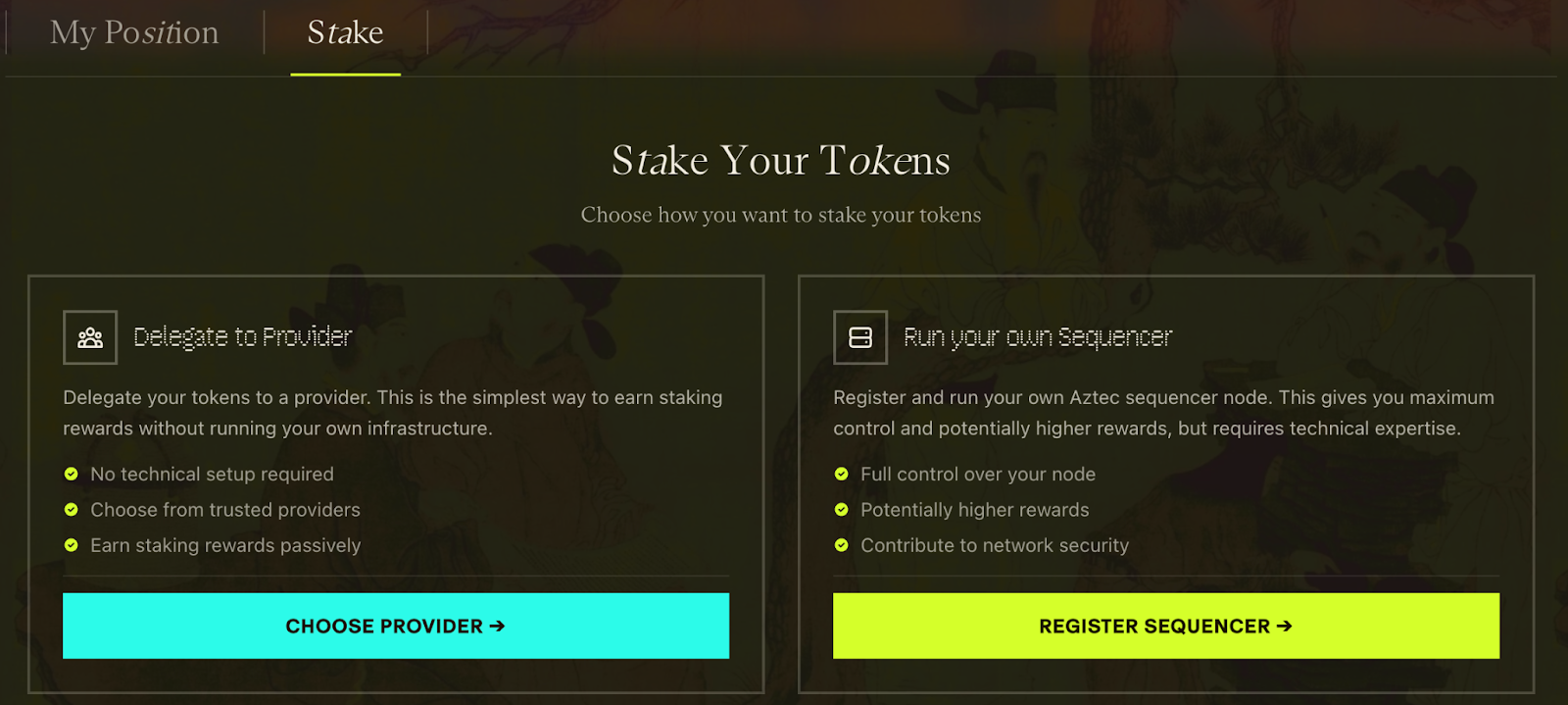
Scroll down to choose your preferred staking path:
Solo staking increases decentralization, and Aztec benefits from a broad validator set.
But if you don’t want to manage hardware, uptime, or operational risk, P2P.org provides the geographic and data-center redundancy required for secure private networks.
Click Choose Provider → Select P2P.org from the list → Proceed to stake.
Managing Your Stake
Staking on Aztec takes inspiration from Ethereum’s model.
Sequencer Batches (200k AZTEC units)
When delegating, your stake is organized into fixed 200,000 AZTEC batches — analogous to 32 ETH validator units on Ethereum.
Example:
If you delegate 500,000 AZTEC:
Two batches (sequencers) of 200k are created
The remaining 100k stays inactive until enough is added to form another 200k batch
This is expected behavior — and important for understanding rewards and activation.
Understanding Slashing on Aztec
Aztec includes a slashing mechanism to penalize misbehaving sequencers. Unlike some networks, slashing only affects the specific sequencer that misbehaved, not your entire delegated balance.
Continuing the earlier example:
You stake 500k AZTEC, creating two sequencers.
If one of these sequencers is slashed repeatedly, it may eventually become inactive.
Key point: You cannot simply “refill” or top up that slashed sequencer. Instead, you must fully unstake that batch and restake it with 200k AZTEC as a fresh sequencer.
This design encourages healthy validator performance and strong operational setups.
Monitoring & Operational Safety
To support delegators, both P2P.org and the broader Aztec community will deploy monitoring tools shortly after mainnet launch. These will help users track:
Sequencer status
Performance
Possible slashing events
Activation of new batches
Our infrastructure is distributed geographically across top-tier data centers, ensuring strong reliability for a privacy-sensitive chain like Aztec.
Final Notes
Staking AZTEC helps secure one of the first fully private, decentralized L2 networks. Whether you choose to solo stake or delegate, you are contributing to a critical new layer of Ethereum infrastructure.
For users who want security, resilience, and zero-maintenance staking, P2P.org is ready to support your participation from day one.
If Aztec is part of your strategy, we’ll help you run it at institutional standards.
<p>While most validators are still figuring out what BAM means, P2P.org is already running it in production.</p><p>We were one of the first validators to run Jito's Block Assembly Marketplace testnet back in August — months before the ecosystem realized execution quality would redefine Solana validation. We've been testing, optimizing, and proving BAM under real-world institutional conditions while others were still reading the docs.</p><p>Now we're live on mainnet. Our delegators get execution quality that most of the Solana ecosystem won't have access to for months.</p><p>Validator performance used to mean uptime and low commission. That era is over. Execution quality (how your transactions are ordered, your MEV exposure, the predictability of outcomes) now separates institutional-grade infrastructure from everyone else.</p><h2 id="the-problem-execution-opacity-on-solana"><strong>The Problem: Execution Opacity on Solana</strong></h2><p>Trading high-value positions on Solana comes with hidden costs. Front-running, bot exploitation, unpredictable transaction ordering — all of these drain value from institutional operations. Your transaction either executes cleanly or it doesn't, and when things go wrong, there's limited visibility into why, how much it cost you, or who profited.</p><p>Transaction ordering felt random. For institutions moving serious capital, that randomness is unacceptable.</p><h2 id="what-bam-delivers"><strong>What BAM Delivers</strong></h2><p>BAM transforms how transactions are assembled before they reach validators. Think institutional-grade order routing, applied to blockchain validation.</p><p><strong>Delegators and clients gain:</strong></p><ul><li><strong>Transparent execution</strong>: Clear visibility into how and why transactions are ordered</li><li><strong>Reduced toxic MEV exposure</strong>: Less vulnerability to front-running and predatory bot activity</li><li><strong>Predictable outcomes</strong>: Consistent block production with lower variance</li><li><strong>Safer high-value trading</strong>: Protection where it matters most — on your largest transactions</li></ul><p>For institutional treasuries, liquidity providers, and DeFi protocols, this upgrade changes how you evaluate validator infrastructure. Execution quality becomes measurable, comparable, and optimizable.</p><h2 id="why-p2porg-was-already-there"><strong>Why P2P.org Was Already There</strong></h2><p>We secure over $10 billion in digital assets across 40+ networks for 130+ institutional clients. Over $1 billion of that is SOL — making us one of the largest institutional validators on Solana. Zero slashing. 99.9% uptime. And a track record of adopting breakthrough infrastructure before the rest of the market knows it matters.</p><p>When we became a first-wave BAM validator in August, we built institutional-grade operational playbooks around it. While other validators were watching from the sidelines, we were gathering production data, identifying edge cases, and proving that BAM delivers under the conditions that matter to serious capital allocators.</p><p>Solana is becoming an institutional-grade settlement layer. Institutions demand measurable execution quality above validator philosophy. BAM makes that quality quantifiable, and P2P.org spent months ensuring we could deliver it at scale.</p><h3 id="our-approach"><strong>Our Approach</strong></h3><p>We validated performance under institutional trading conditions. We stress-tested stability across network scenarios. We documented everything and shared insights with the Solana ecosystem. By the time most validators start their BAM evaluation, we'll already be optimizing version 2.0.</p><p>That's the difference between infrastructure leadership and infrastructure followers.</p><h2 id="the-solana-block-space-economy"><strong>The Solana Block Space Economy</strong></h2><p>BAM represents the future of how professional-grade Solana validation operates. P2P.org's early adoption places us at the centre of Solana's evolving block space economy — a position we've earned through consistent infrastructure leadership.</p><p>Your validator choice now has an additional dimension: Does your validator support the infrastructure that protects your execution quality?</p><p>For liquidity providers, trading desks, DeFi protocols, and institutional treasuries, the answer matters.</p><h2 id="breakpoint-will-catch-up-to-what-were-already-running"><strong>Breakpoint Will Catch Up to What We're Already Running</strong></h2><p>Solana Breakpoint will feature panels about MEV optimization and next-generation validator infrastructure. Speakers will discuss the theoretical benefits of BAM and what the future might look like.</p><p>We're past theory. We're running that future in production.</p><p>P2P.org operates at the bleeding edge of Solana's block space economy. We build the infrastructure that defines trends rather than chase them. When the ecosystem catches up to BAM adoption over the next 6-12 months, we'll already be iterating on what comes next.</p><p>For Solana natives building serious DeFi protocols, for institutions allocating real capital, and for delegators who understand that APY is only part of the equation — BAM-powered validation represents the infrastructure standard everyone else will be scrambling to match.</p><p><strong>Want to discuss how P2P.org's BAM infrastructure impacts your Solana operations?</strong></p><p>Connect with our institutional team or delegate to P2P.org. Experience what next-generation Solana validation looks like while the rest of the market is still reading the announcement blog posts.</p><div class="kg-card kg-button-card kg-align-center"><a href="https://link.p2p.org/bdteam?ref=p2p.org" class="kg-btn kg-btn-accent">Contact our team</a></div>
<h2 id="at-a-glance"><strong>At a Glance:</strong></h2><ul><li>PeerDAS (Peer Data Availability Sampling) launches with Fusaka in on December 3, 2025.</li><li>Dramatically reduces bandwidth requirements for Ethereum validators.</li><li>Enables cheaper, more scalable Layer 2 operations.</li><li><a href="https://p2p.org/?ref=p2p.org" rel="noopener noreferrer nofollow">P2P.org</a>'s infrastructure positioned to maximize PeerDAS benefits for institutional clients.</li></ul><p>PeerDAS is the core of the Fusaka upgrade. It’s the piece that actually shifts Ethereum’s capacity and changes the economics of data availability for rollups. While the concept is technical, the impact is practical: more room for L2s, more responsibility for node operators, and a more scalable Ethereum base layer.</p><p>Today we’re focusing specifically on PeerDAS: what it changes and what it means for the teams building on top of Ethereum — including P2P.org’s validator and node infrastructure.</p><h2 id="why-peerdas-exists"><strong>Why PeerDAS Exists</strong></h2><p>Rollups publish compressed transaction data to Ethereum in the form of “blobs.”Since Dencun, this has been the cheapest and most scalable way to anchor L2 activity on-chain.</p><p>The bottleneck is how Ethereum verifies that data is available.Today, every node must download every blob in full. With blob throughput capped at 6 blobs per slot, the system simply cannot scale alongside growing L2 usage.</p><p>PeerDAS replaces this model with something lighter, safer, and more scalable.</p><figure class="kg-card kg-image-card"><img src="https://p2p.org/economy/content/images/2025/12/data-src-image-64ebfdd7-a14b-462c-8b0f-288a12d8b873.png" class="kg-image" alt="" loading="lazy" width="1600" height="580" srcset="https://p2p.org/economy/content/images/size/w600/2025/12/data-src-image-64ebfdd7-a14b-462c-8b0f-288a12d8b873.png 600w, https://p2p.org/economy/content/images/size/w1000/2025/12/data-src-image-64ebfdd7-a14b-462c-8b0f-288a12d8b873.png 1000w, https://p2p.org/economy/content/images/2025/12/data-src-image-64ebfdd7-a14b-462c-8b0f-288a12d8b873.png 1600w" sizes="(min-width: 720px) 720px"></figure><p>Source: <a href="https://dune.com/hildobby/blobs?ref=p2p.org"><u>https://dune.com/hildobby/blobs</u></a> </p><h2 id="how-peerdas-actually-works"><strong>How PeerDAS Actually Works</strong></h2><p>Instead of treating blob data as a single chunk that every node must download, PeerDAS breaks each blob into many independent pieces (“columns”). Each node downloads only a fraction of the blob. Other nodes download the remaining pieces.</p><p>Because these pieces are mathematically linked, sampling a subset with enough diversity gives the same confidence as downloading the whole blob.</p><p>This is a shift from full replication to distributed verification.</p><figure class="kg-card kg-image-card"><img src="https://p2p.org/economy/content/images/2025/12/data-src-image-518d4f69-f653-4847-96b4-e31e83629c9d.png" class="kg-image" alt="" loading="lazy" width="1600" height="900" srcset="https://p2p.org/economy/content/images/size/w600/2025/12/data-src-image-518d4f69-f653-4847-96b4-e31e83629c9d.png 600w, https://p2p.org/economy/content/images/size/w1000/2025/12/data-src-image-518d4f69-f653-4847-96b4-e31e83629c9d.png 1000w, https://p2p.org/economy/content/images/2025/12/data-src-image-518d4f69-f653-4847-96b4-e31e83629c9d.png 1600w" sizes="(min-width: 720px) 720px"></figure><h2 id="what-this-enables-for-rollups"><strong>What This Enables for Rollups</strong></h2><p>PeerDAS doesn’t just reduce bandwidth; it expands Ethereum’s capacity.</p><h3 id="1-up-to-8x-more-blob-throughput"><strong>1. Up to 8x more blob throughput</strong></h3><p>The network can safely increase blob limits from 6 → up to 48 blobs per slot over time. More data availability means rollups can post more frequently, at lower and more stable costs.</p><h3 id="2-lower-fees-and-fewer-congestion-shocks"><strong>2. Lower fees and fewer congestion shocks</strong></h3><p>Rollups no longer compete for a narrow DA window, reducing situations where blob fees suddenly spike.</p><h3 id="3-room-for-more-complex-l2-applications"><strong>3. Room for more complex L2 applications</strong></h3><p>Higher bandwidth supports applications that generate more data — social networks, gaming activity, high-frequency trading, and more sophisticated L2 designs.</p><p>Rollups get the most direct benefit from PeerDAS. Their operating environment becomes cheaper and less volatile.</p><h2 id="what-peerdas-means-for-validators"><strong>What PeerDAS Means for Validators</strong></h2><p>This is where the upgrade becomes more nuanced.</p><p>PeerDAS reduces per-node download requirements, but it increases node responsibilities:</p><h3 id="1-stricter-bandwidth-and-peering-expectations"><strong>1. Stricter bandwidth and peering expectations</strong></h3><p>Nodes must reliably fetch, store, and serve their assigned columns. Poor performance impacts peer scoring and can reduce overall network connectivity.</p><h3 id="2-higher-operational-load-under-increased-throughput"><strong>2. Higher operational load under increased throughput</strong></h3><p>More blobs overall still means more data moving through the network. Even with sampling, operators will see more traffic than before.</p><h3 id="3-supernode-dynamics"><strong>3. Supernode dynamics</strong></h3><p>Operators running very large key counts (>3,872 validators per node) are effectively pushed into “supernode” territory, which requires storing and serving all blob data.Some operators will choose this voluntarily for reliability and resilience.</p><h2 id="p2porgs-peerdas-readiness"><strong>P2P.org's PeerDAS Readiness</strong></h2><p>Higher DA throughput and larger validator loads mean the infrastructure layer becomes even more important.</p><p>Our technical team has thoroughly tested PeerDAS functionality across Ethereum testnets, validating that our infrastructure handles the sampling mechanisms reliably while maintaining validator performance.</p><p>What PeerDAS changes for us:</p><ul><li>More bandwidth headroom is required per node</li><li>Healthier peer selection and scoring becomes essential</li><li>Validators must maintain consistent performance under increased blob load</li><li>Monitoring and alerting around DA sampling failures becomes part of normal operations</li></ul><p>When Fusaka activates in December 2025, P2P.org's validators will immediately leverage PeerDAS capabilities. Institutional clients will experience seamless transitions to the new data availability model with zero service interruption.</p><p>This preparation reflects P2P.org's broader approach: we don't wait for network upgrades to catch up. We test thoroughly, optimize proactively, and ensure our clients capture every advantage new protocol features offer.</p><h2 id="the-bottom-line"><strong>The Bottom Line</strong></h2><p>For institutional validators, PeerDAS means better operational efficiency without compromising security. For the Ethereum ecosystem, it means Layer 2 solutions can scale to serve millions of users affordably.</p><p>For P2P.org, it reinforces a simple reality: as Ethereum scales, so do the expectations placed on those who secure it.</p><p>And for P2P.org clients, it means their infrastructure partner is positioned to deliver these benefits from day one of the upgrade.</p><p><strong>Questions about how PeerDAS will impact your operations? </strong></p><div class="kg-card kg-button-card kg-align-center"><a href="https://link.p2p.org/bdteam?ref=p2p.org" class="kg-btn kg-btn-accent">Contact our institutional team</a></div>
 ALL
Agoric
Aptos
Auth
Avail
Avalanche
Axelar
Babylon
Bitcoin
BTC
Cardano
Celestia
Chainlink
Cosmos
Crescent
Cyberway
DAOBet
DeFi
DVT
Dymension
Economy
EigenLayer
Elrond
Ethereum
Evmos
Explain Like I'm Five
Guide
HR
Kava
Kusama
Lido
LSP
Manta
Mantle
Marlin
Matic
Moonbeam
MultiversX
Near
News
NuCypher
Oasis
Origin
Partnership
Persistence
Pocket
Polkadot
Polygon
Quicksilver
Regen
Renzo
restaking
RPC Node
Serum
Solana
SSV.Network
Staking
Starknet
Sui
symbiotic
Terra
Tezos
TheGraph
Threshold
Update
Vara
Vega
ALL
Agoric
Aptos
Auth
Avail
Avalanche
Axelar
Babylon
Bitcoin
BTC
Cardano
Celestia
Chainlink
Cosmos
Crescent
Cyberway
DAOBet
DeFi
DVT
Dymension
Economy
EigenLayer
Elrond
Ethereum
Evmos
Explain Like I'm Five
Guide
HR
Kava
Kusama
Lido
LSP
Manta
Mantle
Marlin
Matic
Moonbeam
MultiversX
Near
News
NuCypher
Oasis
Origin
Partnership
Persistence
Pocket
Polkadot
Polygon
Quicksilver
Regen
Renzo
restaking
RPC Node
Serum
Solana
SSV.Network
Staking
Starknet
Sui
symbiotic
Terra
Tezos
TheGraph
Threshold
Update
Vara
Vega