The biggest Consensus change on Solana: Alpenglow is live
TL;DR. On October 21st, Solana switched its consensus engine to Alpenglow. For stakers, nothing changes: stake accounts, delegation, rewards and reports work as before. What changes sits underneath: transactions become final in about 150 milliseconds, the network handles failures and heavy load better, and validators pay for consensus with a flat fee that costs less than half of what voting cost before. Every P2P.org validator went through the switch smoothly.
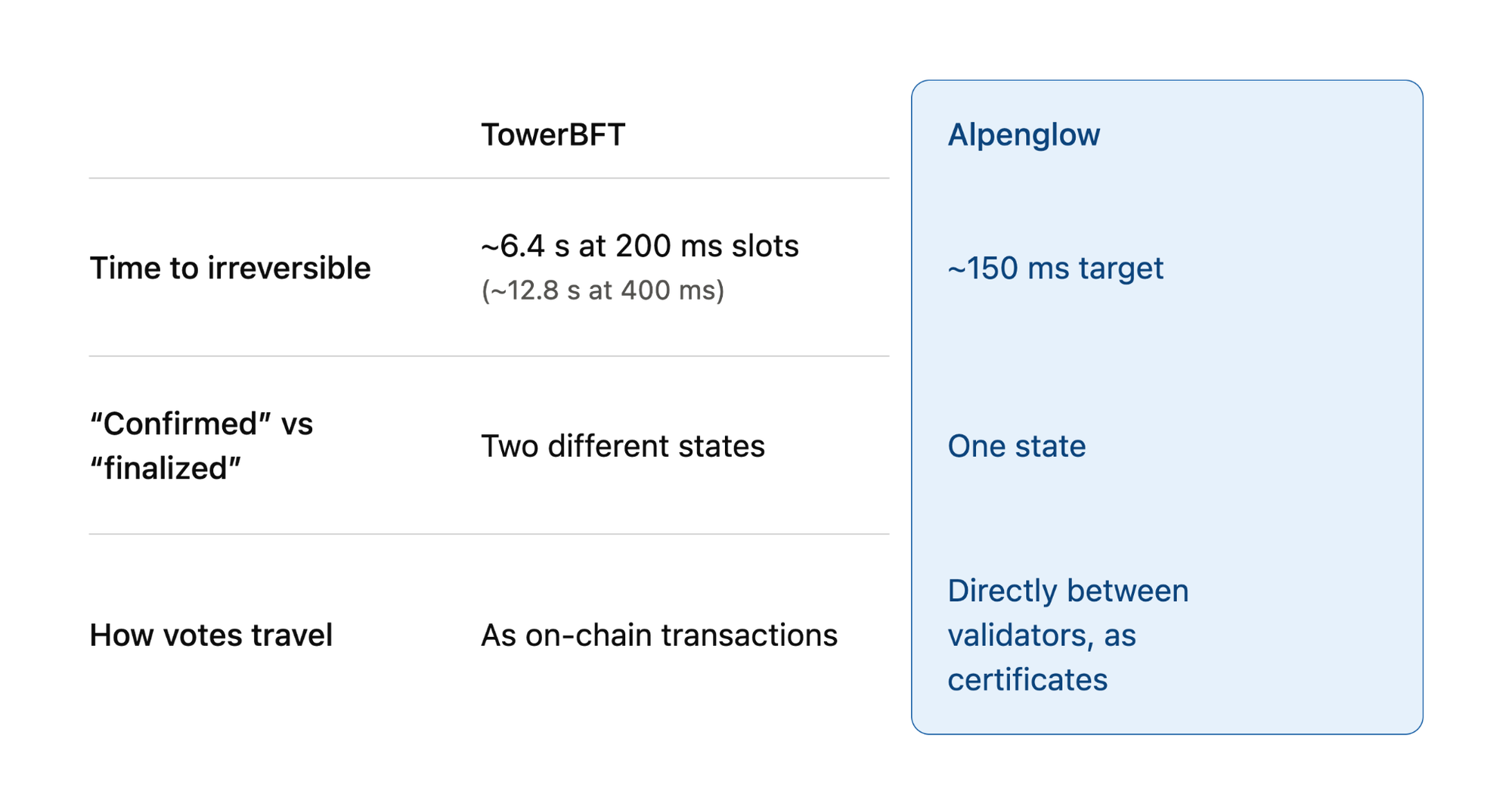
For most of Solana’s history, a transaction executed in under half a second and took several more seconds to become final: about 12.8 seconds at the original 400ms slots, around 6 seconds after this fall’s slot-time cuts. Most users never noticed the wait. Risk teams built their processes around it: exchanges held incoming transfers in a confirmation buffer, custodians wrote the gap into settlement policy, and funds treated a “confirmed” transaction as very likely final, without a guarantee that it was.
On October 21, Solana switched to Alpenglow, the largest change to its core protocol since mainnet launched in 2020. Finality now targets around 150 milliseconds, votes have moved off the chain, and a flat 0.8 SOL fee per epoch replaces per-vote costs.
For stakers, nothing changed in how a staking position earns rewards. What changed is how the network performs, how much stress it can absorb, and the economics of running a validator. This post covers all three, starting with how we prepared.
How we prepared at P2P.org
We moved every validator we ran to the Alpenglow-ready client before activation - as soon as the testnet cluster went live.
Our SRE team is watching each node through the switch, and our analytics team is tracking finality, vote participation, and reward attribution.
We will share what we see as the data comes in.
What stays the same for stakers
Alpenglow changes consensus and leaves everything a staker touches in place:
Your stake: Stake accounts, their addresses and their delegations stay exactly where they were. No action was needed before or after the switch.
Staking and unstaking: Delegation, deactivation and withdrawals follow the same rules as before.
Rewards: Alpenglow keeps the existing reward mechanics. Inflation rewards are still paid by the network every epoch, and they remain variable.
Transactions and fees: Execution, programs and transaction fees are untouched.
Reporting: At P2P.org, rewards stay attributed per validator, and reports keep their schedule.
One change stakers may notice predates Alpenglow. Solana cut slot times from 400 to 200 milliseconds in four steps between August and October (SIMD-0525), so an epoch now lasts about a day. Rewards arrive daily, and unstaked SOL becomes withdrawable within roughly a day. Reward distribution and reporting snapshots now happen twice as often, so any reconciliation built around two-day epochs deserves a check.
What changes: network performance
Under TowerBFT, validators voted by sending transactions, and a block became final once 32 slots of votes had stacked up on top of it. That stacking is where the seconds of waiting came from.
Under Votor, validators send votes directly to each other and aggregate them into compact certificates. When at least 80% of stake votes for a block, it is final after one round. When participation lands between 60% and 80%, a second round at 60% finalizes it. Both paths run at once, and the faster one decides.
For exchanges, custodians and funds, this collapses the window between “included” and “irreversible” to a fraction of a second. Deposits can be credited as soon as they are final, and settlement on Solana becomes close to instant for redemptions and end-of-day books.
Two caveats for policy: The 150ms figure is a target from testing and will move with the stake distribution, so base settings on observed mainnet data. And integrations need no change on day one: statuses stay the same, and the separate “confirmed” level is retired in a later release. We recommend keeping current confirmation settings for the first weeks, in line with the Solana Foundation’s guidance.
What changes: readiness for load
Alpenglow makes Solana sturdier in three ways.
More room for real activity: Vote transactions made up the majority of everything Solana processed. With votes off the chain, that block space goes back to user transactions, which gives the network more headroom during demand spikes. Network-wide transaction counts drop sharply for the same reason, while real activity stays where it was, so re-baseline any dashboard that counted votes.
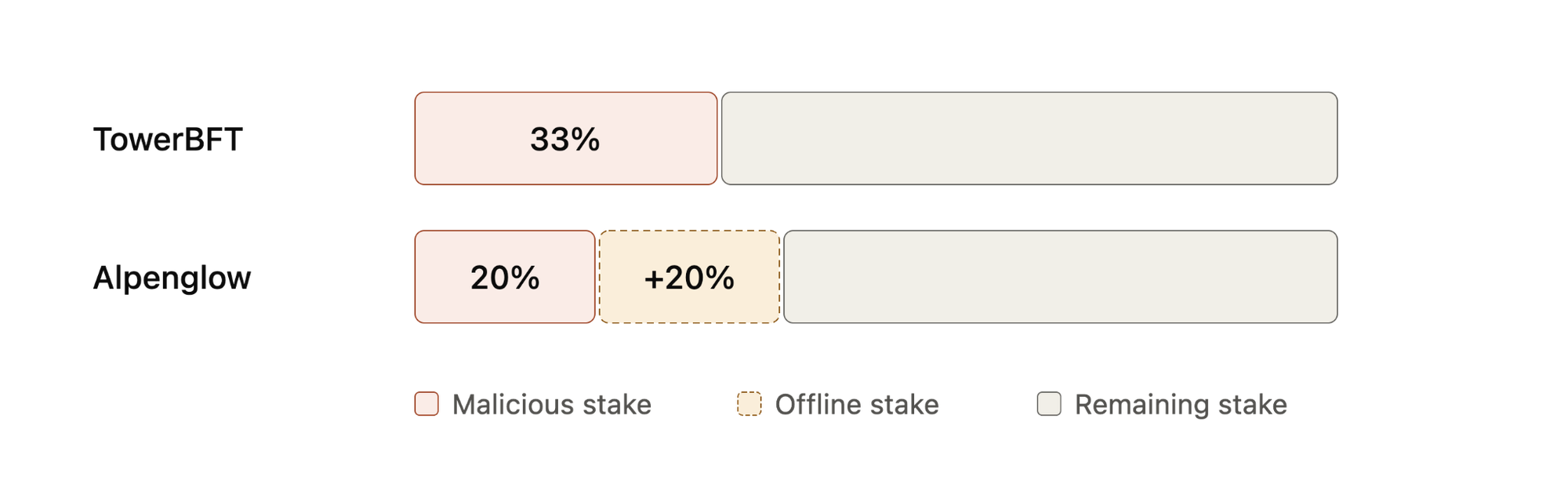
Better tolerance for the failures Solana has actually had: Past outages came from software bugs, congestion and validators going down at once. Alpenglow is built differently: it stays safe with up to 20% of stake acting maliciously and keeps finalizing blocks with a further 20% offline.
The trade lowers the bar for a coordinated attack, which would still require control of a fifth of all staked SOL, in exchange for much stronger resilience to crashes. We think that is the right trade for a network carrying financial flows. Teams that model adversarial scenarios should move their threshold from one third of stake to one fifth.
Predictable timing, higher bar for operators: Each slot now has a fixed deadline, and a block that misses it is skipped, so the leader loses that slot’s rewards. With 200ms slots, a leader’s four-slot window lasts about 800 milliseconds, and slow hardware or poor network placement shows up quickly. When you compare operators, skip rate, latency, monitoring and incident response now have a more direct effect on the rewards your stake earns.
The switch itself showed how this works under pressure. The migration ran on its own in five steps, and user transactions paused for only about two slots, roughly 400 milliseconds, while the network handed over to the new protocol.
What changes: validator economics
The biggest shift is on the validator’s side of the ledger. Under TowerBFT, every vote was a transaction with a fee, paid from the validator’s identity account.
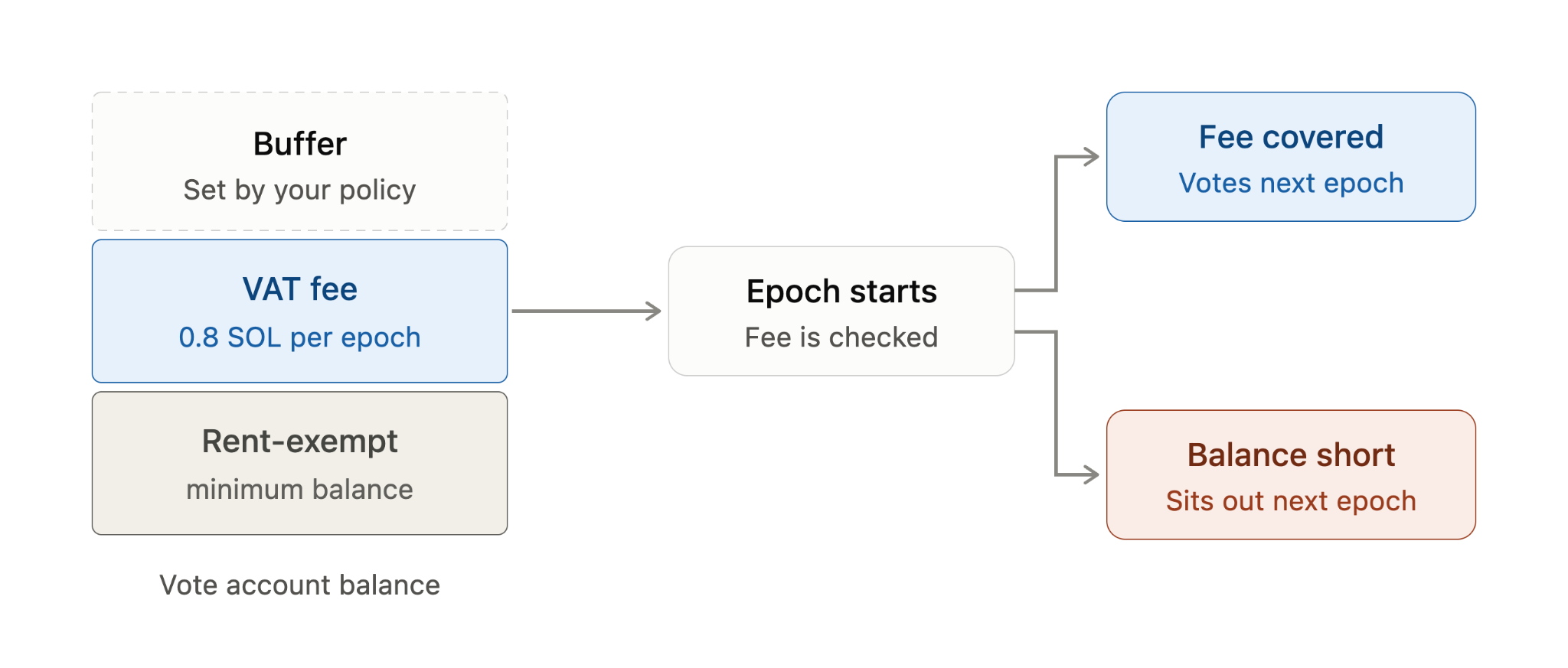
Alpenglow replaces that stream with the Validator Admission Ticket (VAT): a flat fee charged from the vote account once per epoch and burned. At today’s 200ms slots it is 0.8 SOL per epoch of about 24 hours, paid one epoch ahead.
Voting got cheaper: Because vote fees were charged per slot, this autumn’s slot-time cuts pushed them up with every step. Alpenglow brings the cost back down.
Rising vote costs over the last two months came from faster slots, and the admission ticket reverses them. The saving has one offset: half of every vote fee used to go to the leader of the block that included it, so validators producing many blocks also lose that income. The net effect depends on each validator’s share of block production
The vote account becomes an operating balance: If it cannot cover the fee, plus its rent-exempt minimum, at the start of an epoch, the validator does not vote or produce blocks in the next one and earns no rewards for it. Funding that used to sit on identity accounts now has to live on vote accounts, with monitoring and alerts around it.
For white-label validators this raises a practical question: who holds the vote account’s withdraw authority. If the client holds it, the client controls withdrawals and carries the risk of drawing the balance below the fee. If the operator manages it, the operator keeps a buffer and withdraws rewards above it. Both models work, as long as the balance rules are written into the process.
What we are watching in the first weeks
Real finality on mainnet: The 150ms target was measured in testing. We are tracking how finality behaves under live load and stake distribution before recommending any change to confirmation settings.
Reward data across the ecosystem: Some operators may collect rewards from many validators into a single account to simplify operations. That removes the per-validator view funds and white-label clients use for reconciliation, and rebuilding it requires certificate data that current RPC methods do not expose cleanly. Vote credits now derive from those certificates, so a validator’s inflation rewards also depend partly on how the rest of the network performs.
Metrics and tooling: Figures computed from vote transactions, such as vote success rate, stop working at activation until Anza ships new RPC methods. Explorers, indexers and analytics providers will update on their own timelines.
Client diversity: The migration ran on Agave-based clients only. Firedancer supports Alpenglow in later releases.
What comes next
Votor is the first phase. Agave 4.4 brings fast leader handover, which lets the next leader start building before the previous window is fully decided. Rotor, the second half of Alpenglow’s design, will replace Turbine’s multi-hop block propagation with a single relay layer in a later, still unscheduled release.
FAQ: Alpenglow and Solana staking for institutions
What is Solana Alpenglow?
Alpenglow is Solana’s new consensus protocol, activated on mainnet at epoch 1064 on October 21, 2026. Its first phase, Votor, replaces TowerBFT. Validators send votes directly to each other, combine them into certificates, and finalize a block after one or two voting rounds, with a target of roughly 150 ms. Transaction execution, the SVM, and fees are unchanged. A second phase, Rotor, will change how block data is propagated in a later release.
I stake with your validators. Do I need to do anything?
No. Your stake stays where it is, and delegation, unstaking, and withdrawals work as before. We handle the switch on our side.
Will my protocol rewards change?
The reward mechanics remain the same.
Will my reports change?
No. Reports keep the same schedule and format.
What does the Validator Admission Ticket cost?
A flat 0.8 SOL per epoch, charged from the vote account, burned, and paid one epoch ahead. With 200 ms slots, an epoch lasts about a day. If the vote account cannot cover the fee when an epoch starts, the validator does not vote or produce blocks in the following epoch and earns no protocol rewards for it.
I run a white-label validator. What changes for me?
How consensus is paid for, what balance has to stay on the vote account, and who is responsible for keeping it there. The right setup depends on how your validator is configured today. Talk to our team, and we will walk you through it.
Evaluating Solana staking or a white-label validator? Talk to our team.
This material is provided for informational purposes only and does not constitute investment, financial, legal, or tax advice. P2P.org accepts no liability for any actions taken based on it. Latency and performance figures referenced are estimates based on internal benchmarks and may vary depending on network conditions, geography, and client infrastructure. Past performance is not indicative of future results.
Subscribe to P2P-economy
Get the latest posts delivered right to your inbox
<p>Kryptos gives users a single view of their digital assets across wallets and exchanges. Today, that view also lets users put eligible assets to work.</p><p>Through a new integration with P2P.org, users can now stake eligible assets directly from Kryptos, without switching platforms or creating another account.</p><h2 id="learnings-for-busy-readers"><strong>Learnings for Busy Readers</strong></h2><ul><li>Staking is now live inside Kryptos, powered by P2P.org infrastructure</li><li>Users retain control of their assets throughout; P2P.org never takes custody</li><li>Staking is available directly alongside eligible assets in the portfolio view</li><li>Each network determines reward rates and can change as network conditions change</li><li>5 networks are supported at launch: Solana, Aptos, Monad, Sui, Hyperliquid</li></ul><h2 id="bringing-staking-to-where-assets-are-already-tracked"><strong>Bringing staking to where assets are already tracked</strong></h2><p>Kryptos users already have a complete picture of their holdings across wallets and exchanges. Until now, putting those assets to work through staking often meant moving to a separate platform and starting the process again.</p><p>That changes with this integration. When an asset in a connected wallet is eligible for staking, the option is available directly alongside it in Kryptos.</p><p>No separate platform. No additional workflow. Just staking where users already manage their portfolios.</p><h2 id="delegation-runs-through-p2porg-custody-stays-with-the-user"><strong>Delegation runs through P2P.org; custody stays with the user</strong></h2><p>Kryptos remains the interface users interact with. P2P.org provides the infrastructure behind the staking experience, with delegation going directly to validators and assets remaining under the user's control.</p><p>Neither Kryptos nor P2P.org takes custody of the staked assets.</p><p>The underlying network determines rewards and can change over time based on network conditions. Neither platform sets or guarantees the reward rate.</p><figure class="kg-card kg-image-card"><img src="https://p2p.org/economy/content/images/2026/10/article-pic-1--1-.png" class="kg-image" alt="" loading="lazy" width="2000" height="759" srcset="https://p2p.org/economy/content/images/size/w600/2026/10/article-pic-1--1-.png 600w, https://p2p.org/economy/content/images/size/w1000/2026/10/article-pic-1--1-.png 1000w, https://p2p.org/economy/content/images/size/w1600/2026/10/article-pic-1--1-.png 1600w, https://p2p.org/economy/content/images/size/w2400/2026/10/article-pic-1--1-.png 2400w" sizes="(min-width: 720px) 720px"></figure><h2 id="two-platforms-built-around-a-connected-view-of-digital-assets"><strong>Two platforms built around a connected view of digital assets</strong></h2><p>Kryptos brings wallets, exchanges, and on-chain assets into one portfolio view. P2P.org provides the infrastructure that enables those assets to participate in network rewards without introducing a custodial layer.</p><p>Bringing the two together means users can move from tracking an eligible asset to staking it within the same portfolio experience.</p><h2 id="whats-live-at-launch"><strong>What's live at launch</strong></h2><p>Five networks are supported from day one: Solana, Aptos, Monad, Sui, Hyperliquid.</p><p>The initial rollout covers a broad range of established and emerging networks, with additional assets and networks planned over time.</p><h2 id="key-takeaway"><strong>Key Takeaway</strong></h2><p>Staking is now available directly within the Kryptos portfolio experience, powered by P2P.org's non-custodial infrastructure. Users can stake eligible assets without leaving the platform they already use to track their holdings.</p><h2 id="about-kryptos"><strong>About Kryptos</strong></h2><p>Kryptos is a financial infrastructure company for digital assets. Its platform connects 5,500+ exchanges, wallets, blockchains and DeFi protocols and normalises the data into a standardised format. Individuals use it for portfolio tracking and tax reporting in 35+ countries, businesses use it as a financial OS, and other companies build on the same data through the Kryptos Connect API. Founded in 2022 and based in Sweden. Investors include YZi Labs, Gate.io, and Blockchain Founders Fund.</p><h2 id="disclaimer"><strong>Disclaimer</strong></h2><p>This material is provided for informational purposes only and does not constitute investment, financial, legal, or tax advice. P2P.org accepts no liability for any actions taken based on it. Past performance is not indicative of future results.</p><div class="kg-card kg-toggle-card" data-kg-toggle-state="close">
<div class="kg-toggle-heading">
<h4 class="kg-toggle-heading-text"><span style="white-space: pre-wrap;">FAQs</span></h4>
<button class="kg-toggle-card-icon" aria-label="Expand toggle to read content">
<svg id="Regular" xmlns="http://www.w3.org/2000/svg" viewBox="0 0 24 24">
<path class="cls-1" d="M23.25,7.311,12.53,18.03a.749.749,0,0,1-1.06,0L.75,7.311"></path>
</svg>
</button>
</div>
<div class="kg-toggle-content"><p dir="ltr"><b><strong style="white-space: pre-wrap;">Which assets can I stake at launch?</strong></b><span style="white-space: pre-wrap;"> Solana, Aptos, Monad, Sui, Hyperliquid. </span></p><p dir="ltr"><b><strong style="white-space: pre-wrap;">Who holds my assets while they're staked? </strong></b><span style="white-space: pre-wrap;">The user retains control throughout. P2P.org's staking infrastructure is non-custodial and does not take possession of staked assets.</span></p><p dir="ltr"><b><strong style="white-space: pre-wrap;">Will staking rewards show up automatically in my Kryptos portfolio view?</strong></b><span style="white-space: pre-wrap;">Yes. Staking rewards are reflected automatically in the portfolio view as they accrue.</span></p></div>
</div>
 ALL
Agoric
Aptos
Auth
Avail
Avalanche
Axelar
Babylon
Bitcoin
bouldertech
BTC
capital flow
Cardano
Celestia
certifications
Chainlink
compliance
Cosmos
Crescent
curator
Cyberway
DAOBet
Data stream
DeFi
defi dispatch
defi infrastrcuture
defi infrastructure
defi news
defi vault
due diligence
DVT
Dymension
Economy
Education
EigenLayer
Elrond
employee
employee advocacy
employee interviews
ETF
Ethereum
Evmos
exit queue
Explain Like I'm Five
Governance
Guide
hedge fund
how to
HR
HUB series
Hyperliquid
infrastructure
institutional lens
institutional staking
ISO 27001
ISO/IEC 27001:2022
Issuer
Kava
Kusama
landing
latin america
legal layer
legislation
Lido
liquid staking
LSP
Manta
Mantle
Marlin
Matic
MEV
MiCA
Moonbeam
MultiversX
Near
Networks
News
NuCypher
Oasis
Obol
Origin
P2P Verified
Partnership
pectra
Persistence
playbook
Pocket
Polkadot
Polygon
product
products
Quicksilver
Regen